This year, we reinforce that commitment with an updated listing of data and also a brief rundown on some new equipment and a few — not all — of the changes you can expect.
The categories created last year, “Air/Water,” “Airless” and “Fan” remain unchanged. The size classifications, which are based upon rate of water flow (snow production), also remain largely the same. Parameters for reporting data are suggested to the suppliers and are: 75% RH, 34-35 degree water temp., 25-30 pcf density and 45 degree air. These numbers closely correlate with most of the manufacturers’ testing programs, although some show lower humidities and may predict wetter or drier snow.
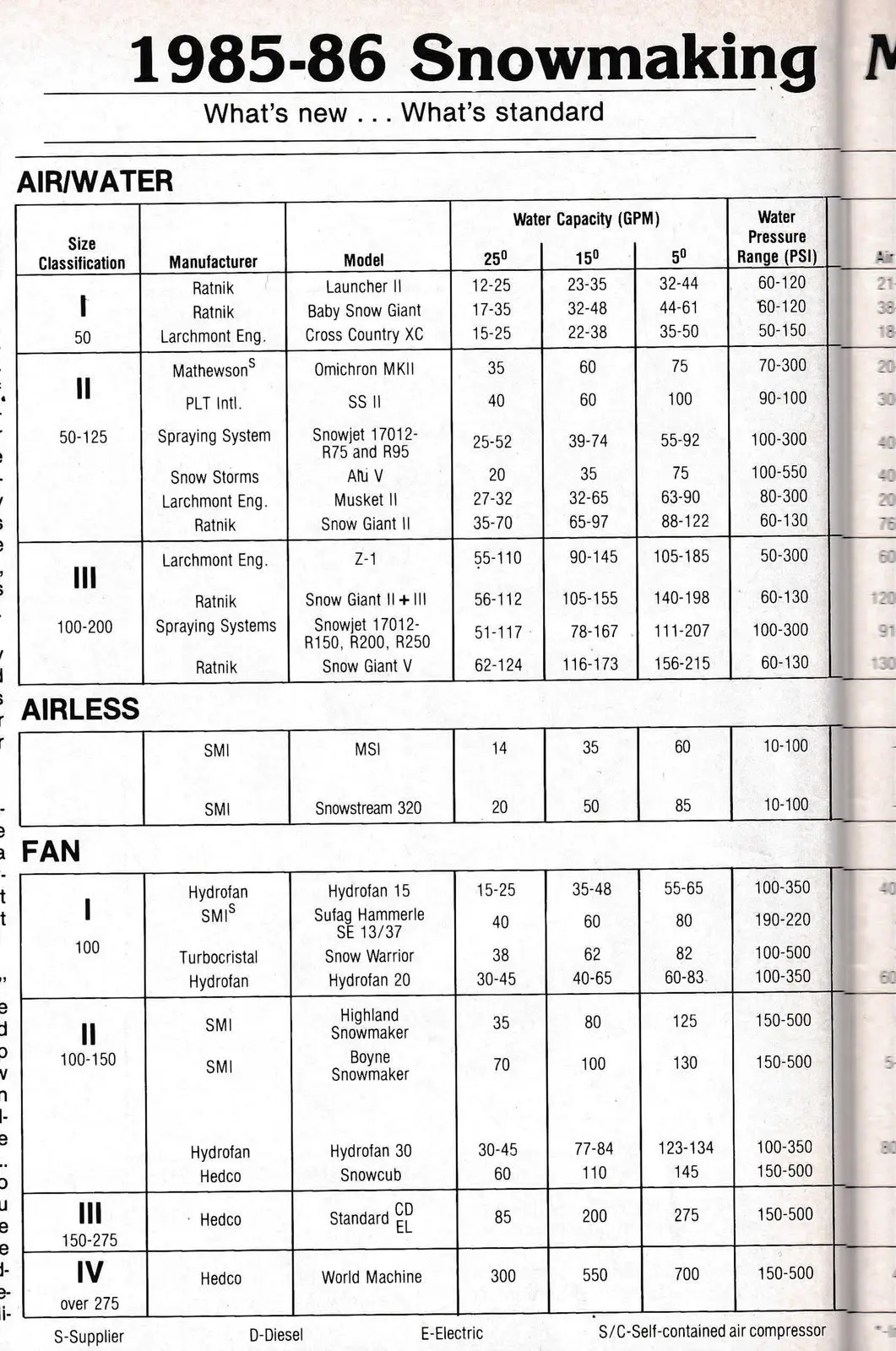
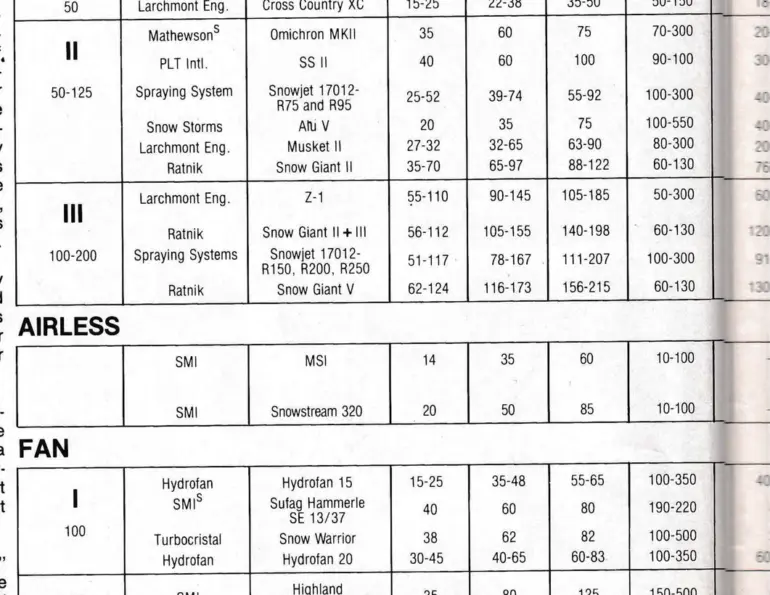
Air/Water
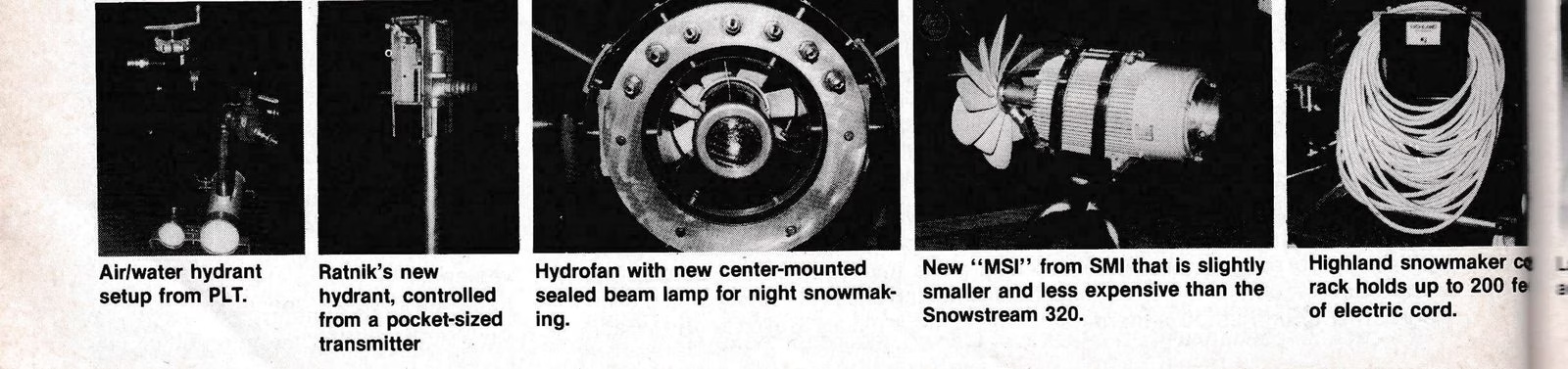
The Alu V by Snow Storms, may soon have a new big brother called “Avalanche.” Ratnik industries has developed a radio controlled water hydrant and new larger sled for their Snow Giant series of guns.
Airless
SMI, currently the only manufacturer of a totally airless unit (the SS320) has introduced the MSI, a slightly smaller version of the Snow-Stream. At about 75% of the output of the larger unit, it will price out at four thousand dollars less.
Fan Type
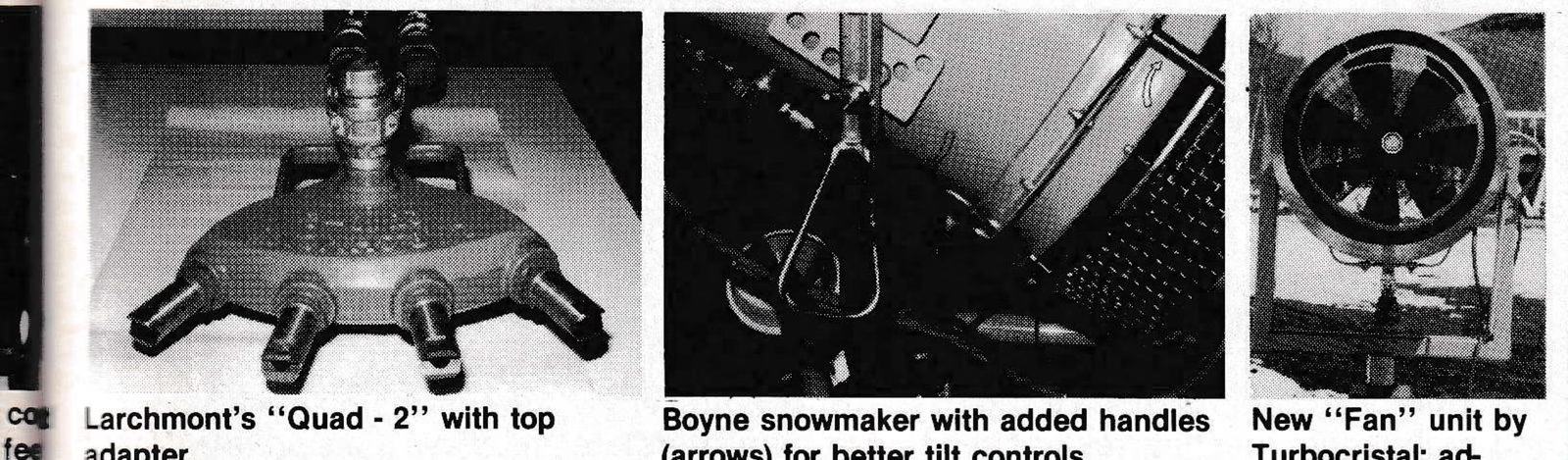
Since the departure of “FanJet” there has been a gap created that the two other fan suppliers, Hedco and SMI, are very willing to fill in. To keep the situation interesting, a totally new fan unit is being introduced this season from Eastern Canada. The unit is already patented and being called the “Snow Warrior” from Turbocristal, Inc. At first glance it appears very similar to other units on the market, until you stick your head down its’ throat. There you will see what appears to be a single nozzle, dead center of the fan. It is adjustable, with the aperture size changeable, depending upon weather conditions.
Hedco has borrowed expertise from their parent company, Dewey Electronics, while refining their junior sized Hedco, the Snowcub. Sophisticated electronics now assist the new larger engine to optimize performance.
SMI has reworked the tilt handle on their Boyne Snowmaker and added a short “grab bar” to the shroud. Both additions should assist during “gloves-on operation.” Also, a carrier has been added to the Highland.
The Hydrofan people have just refined an ingenious idea. They have installed a reliable light source in the center of their fan to assist snowmakers in nighttime manuevers. The fan rotates; it doesn’t.
Table Headings
Much of the information is listed in ranges. This is an attempt to indicate the many variables in snowmaking that affect performance such as wind, humidity, suspended particulates in the water, compressed air moisture, etc.
Size Classification — Shown as Roman numerals, these categories are determined from the maximum rated output of each unit.

Water Capacity — Three temperatures are listed (25, 15, 5 degrees F) to cover the average range of operating temperatures at 75 percent relative humidity. Where two numbers are shown, assume the lowest flow is at higher humidities and higher flows are for drier air.
Pressure Range — These are the recommended high and low pressures at which the unit will be productive. Usually the higher pressure will produce better results.
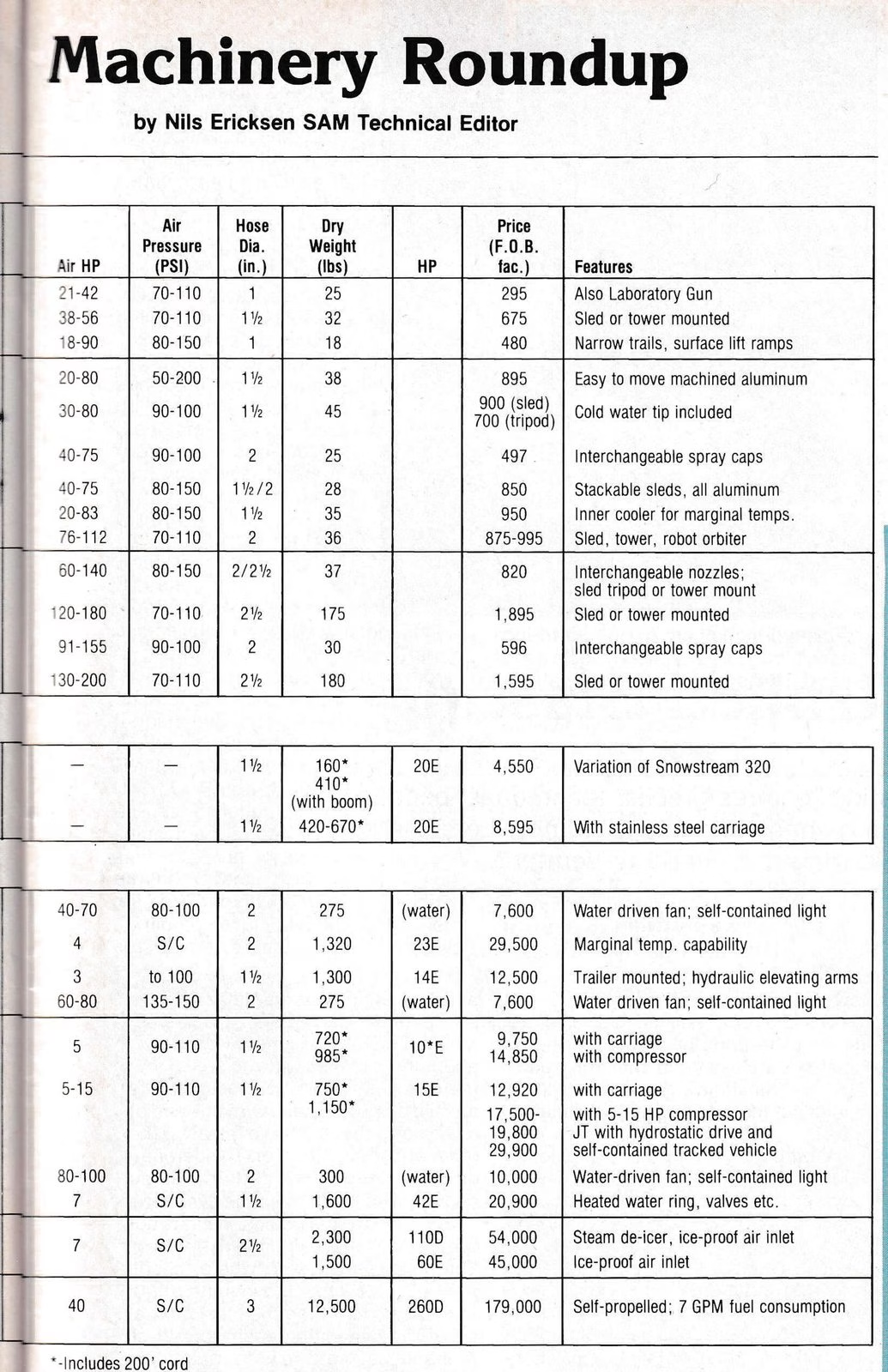
Air Horsepower — For the sake of standardization and simplicity, the data was based on 5 cfm per horsepower. An average of 4.4 to 4.5 is more realistic for some compressors.
Air Pressure — As with water, this is the recommended operating range (not to be exceeded without an ok).
Hose Diameter — For the air/water machines, the minimum size for either air or water. On the fan equipment, 1-1.5 inches should handle most of the air requirements with water hose as shown.
Dry Weight — This is without fluids and mounted on a tripod, sled or vehicle supplied as standard equipment.
Horsepower — Electric (E) or diesel (D) are indicated. On the Hedco and Hammerle units the figures include self-contained air compressors. Ask for KW to determine the total electrical load.
Price — Many variables here. Prices shown are guide for warehouse or plant f.o.b.