


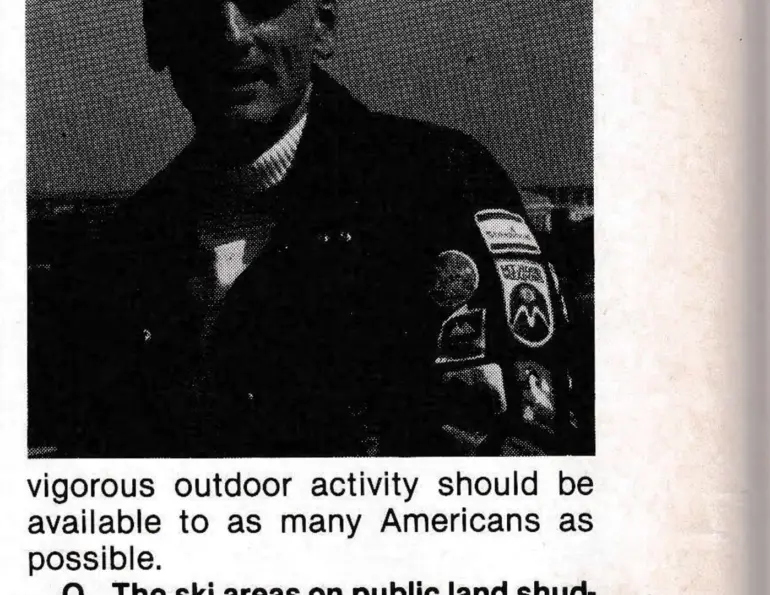
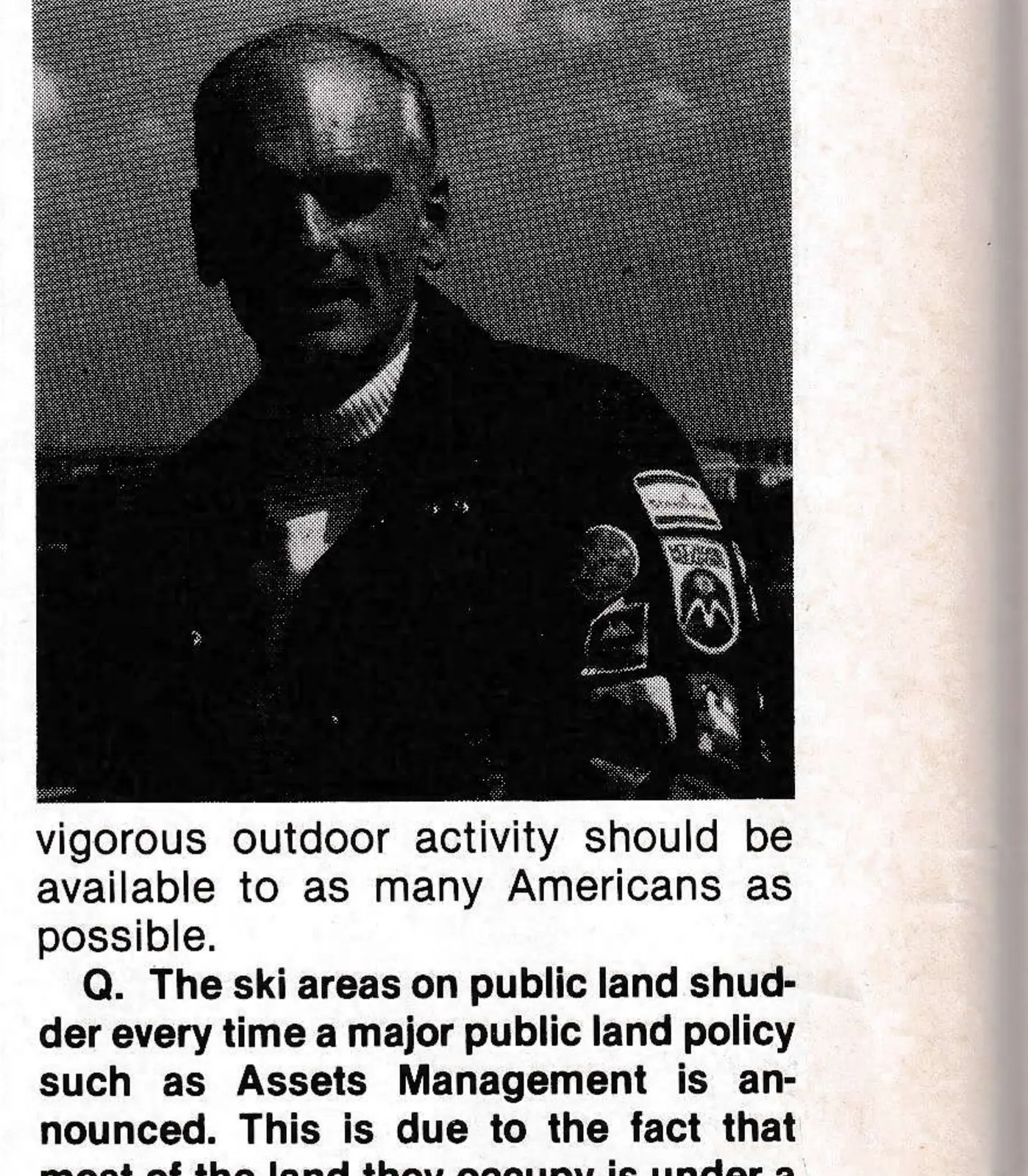
Q. We understand that you are a skier — and an expert and enthusiastic one at that. Tell us, please, how you got involved in the sport.
A. About 15 years ago, in 1970, I was looking for an outdoor activity that our family could enjoy in the winter in Oregon and I had been complaining about the rain. My brother said to me, “Take up skiing and then when it starts raining in the fall in Portland you’ll say ‘oh, great, it’s snowing on the mountain.’” And I said, “That will never happen.” Only it did. It was in the first year. As a matter of fact, the following October my whole family and I were in precisely that frame of mind. So we got involved as a means of having an outdoor activity that we could enjoy as a family.
Q. Ski areas on government land provide a significant amount of skier visits. Do you feel that the industry is doing an adequate job on federal lands of providing skiing opportunities to the public? Are there things we should be doing better?
A. While my experience with skiing on federal land is limited to that of a user rather than a manager — almost all ski areas on federal land are in National Forests, managed by the Forest Service in the Department of Agriculture — I think the ski industry is doing a good job of providing skiing opportunities to the public. But I am sure there is room for improvement. Those who use federal lands, which are really the people’s lands, have an obligation to provide a quality service. I hope they will use all the ingenuity at their command to make skiing opportunities available for young people and others who may have limited funds for recreation purposes. I firmly believe that outdoor recreation, such as skiing, is just what the root word indicates, “re-creation.” The opportunity to restore your spirit and your body in vigorous outdoor activity should be available to as many Americans as possible.
Q. The ski areas on public land shudder every time a major public land policy such as Assets Management is announced. This is due to the fact that most of the land they occupy is under a one-year permit. Has the industry contacted you about this problem, and what are your thoughts?
A. I can certainly see that anyone with a land use permit which must be renewed every year would get a little nervous when changes are proposed in federal land management policies. Since Interior does not have this kind of recreational lease arrangement, I have not become directly involved, so I would defer on this issue to my good friend Agriculture Secretary John Block. I would just like to suggest that when a proposal such as Asset Management is made public, that you make sure that you are dealing with what the proposal really says, that you really understand what it proposes to do. We have not heard much about Asset Management lately, but when it was being discussed, most of the things I heard about it had absolutely no relationship to the actual plans involved.
Q. Since your confirmation as Secretary of Interior, you have developed goals for your agency to accomplish during the second term of President Reagan. Can you tell us some of your goals and if you feel that they will impact on skiing?

A. When President Reagan offered me the job of being Secretary of the Interior, he gave me five charges:
- Preserve the Nation’s national park, wilderness and wildlife resources;
- Enhance America’s ability to meet its energy and mineral needs with domestic resources;
- Increase the supply of quality water resources;
- Improve the federal government’s relationship with State and local governments; and,
- Develop the economic and social resources of American Indians, Native Americans and the people of the U.S. Territories.
I am not sure what degree of success I will have in achieving these goals, but I am sure of one thing. I won’t attain a single one of them without the help and the support of the Congress, the States, cities and the American people from every part of the Nation and in all walks of life. I am not seeking complete agreement on every issue I face, but rather a consensus upon which progress can be made. That is why I am anxious to meet with as many people and as many organizations as possible. I want to get them thinking about the staggering resource problems and the great opportunities we face to begin working toward solutions.
Q. We have been hearing a little bit about ORRRC-II (or PCAO), and we wonder about the extent to which this commission’s work will impact on our industry, and how?
A. We anticipate a White House announcement on the Presidential Commission on Americans Outdoors very soon, perhaps before this interview is published. The Commission should provide a new focus on the Nation’s outdoor recreational estate and what must be done to make sure Americans in the 21st century have equal, if not better, opportunities to enjoy themselves in the outdoors. All parts of our society will be represented on the Commission, both in and out of government. I would expect that the downhill ski industry will make a substantial contribution. I would encourage its representatives to contact the Commission once it is constituted to find out the best way to provide input. From my point of view, at least, downhill skiing must be a part of America’s outdoor recreational heritage. There is no substitute for being prepared, and if we want to provide our grandchildren with the wonderful experiences that outdoor recreation can provide, we are going to have to begin now to determine what future recreational needs will be and how best we can meet those needs in terms of both government and private responsibilities.

