



In learning how to make snow, Larchmont Engineering has defied an old and established rule: they did something about the weather. This past winter more than ever, doing something about the weather was supremely important. To financially pressed ski area operators in the East and Midwest, falling snow spelled the difference between boom and bust.
Larchmont snow guns now pump snow onto the bare and icy trails of more than 200 areas in the United States, 70 in Canada, 20 in Europe, 8 in Japan and 3 in Australia. Orders already booked for 1965 promise to push the company well over the $600,000 mark for the second straight year.
Larchmont Engineering is the expanding dream born of a farm machinery business founded in 1920 by the Tropeano family of Lexington, Mass. Larchmont Farms later expanded into golf course irrigation systems. Five years ago it formed the Engineering subsidiary to market the snowmaking systems developed by Larchmont Farms in the early 1950’s. The third and most recent company is Larchmont Recreation, which runs Blue Hills ski area just outside Boston.
Behind the Larchmont operations today are Joseph and Philip Tropeano, scions of the family members who founded the original Larchmont Farms. Together with the corporation, they own all of the existing patents on making snow with compressed air and water.
Not satisfied with being the firstest with the mostest, the Tropeanos plan to maintain their position in the snowmaking field by an intensive program of research and development. A substantial portion of this year’s earnings will go into such sophisticated advances as a rotary snow gun which will throw snow into a 360 degree pattern. Another high priority item is insulation which will allow pipe to be buried underground without danger of freeze-up. Already on the drafting boards are new versions of snow guns which will cover more area with more snow in less time.
Blue Hills ski area is the testing ground for Larchmont prototype snowmakers and new creations. In addition, Blue Hills is a working classroom for training snowmaking crews. Whenever a system is sold, Larchmont invites the buyer to send men to Blue Hills for on-the-spot instruction under the guidance of a Larchmont foreman.
According to Larchmont experts, the key to any snowmaking system is an adequate water supply. A prospective site needs enough water to deliver 10 gallons per minute per 100 feet of slope. Once this requirement has been met, all similarity between snowmaking systems ends and each takes on an individual design and operation. Temperature, humidity, elevation and length of season all play a part in the system’s effectiveness.
Through John Mathewson, sales representative and applications engineer, Larchmont handles its own marketing in the United States and Canada. From his home base in New York City, Mathewson flys his Beechcraft Bonanza over 400 hours a year selling, consulting and troubleshooting snowmaking systems. Overseas sales are handled by American Machine and Foundry Company.
Area operators who use Larchmont systems have found new freedom from the caprices of the weather. The two case histories described here are success stories of longer, stronger ski seasons.
Mt. Tom, Massachusetts — A Top Drawer System
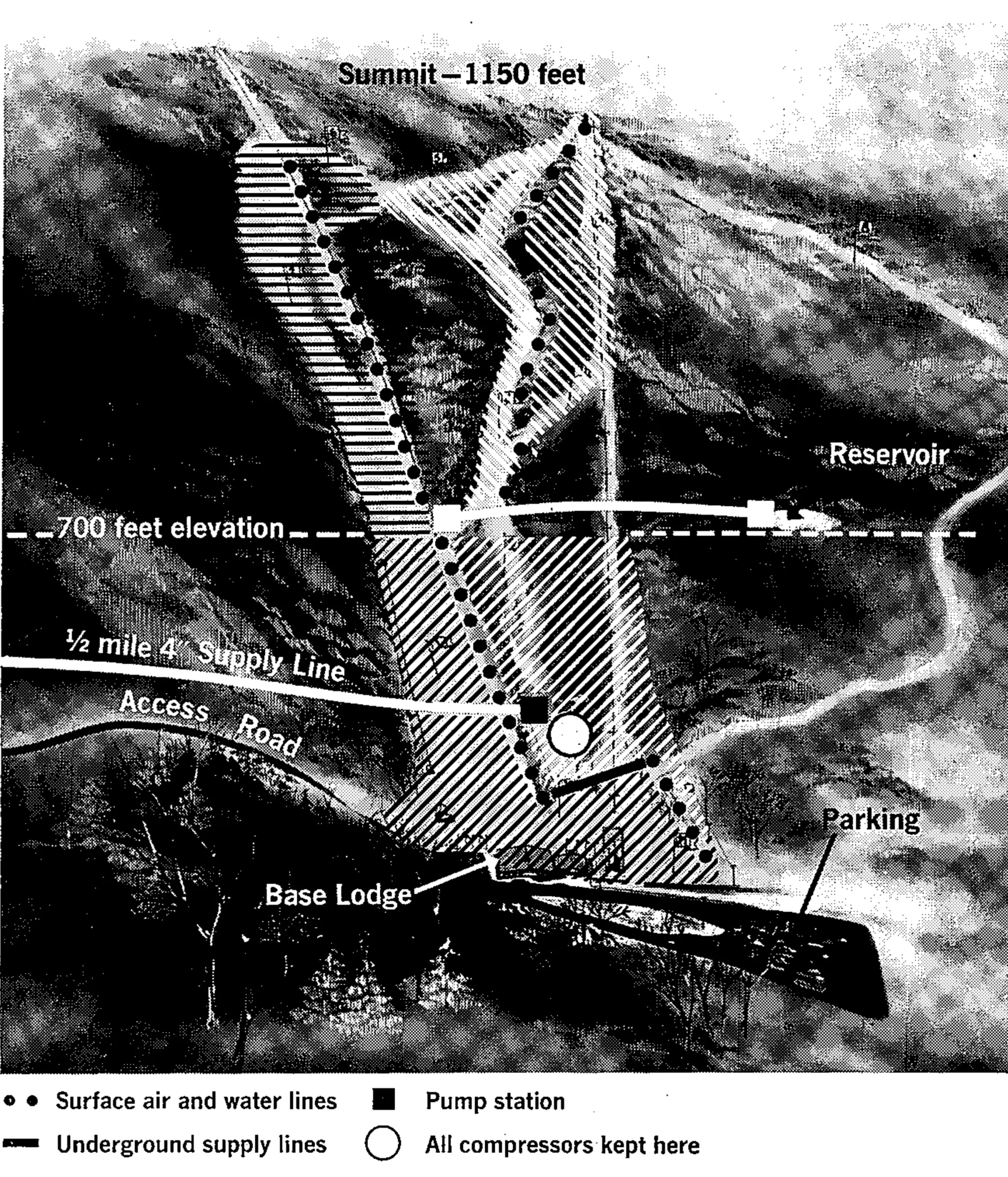
Mt. Tom Ski area, which crests at a modest 1,150 feet above sea level, claimed the title “ski capital of the East” for a two-week period last January. Twenty acres of machine-made snow, up to three feet deep in spots, two T-bars and a 3,450-foot Roebling double chairlift, drew skiers and out-of-work instructors from Philadelphia to Montreal. Adding strength to this claim were batteries of powerful lights which flooded the slopes with man-made sunshine and extended skiing to the evening hours six nights a week.
What carried Mt. Tom from a 1,300-foot T-bar area five years ago, to the coveted title? It was the largest system of Larchmont Engineering snowmaking equipment in New England, operating day and night and converting more than 100,000 gallons of water into snow every 24 hours.
Even when a long overdue supply of the natural product fell in late January, Manager Cal Conniff continued to make snow. This followed the practice set the first year by Daniel O’Connell, Mt. Tom President and one of Western Massachusetts’ largest general contractors—”make snow whenever conditions permit, regardless of the amount on the slopes.”
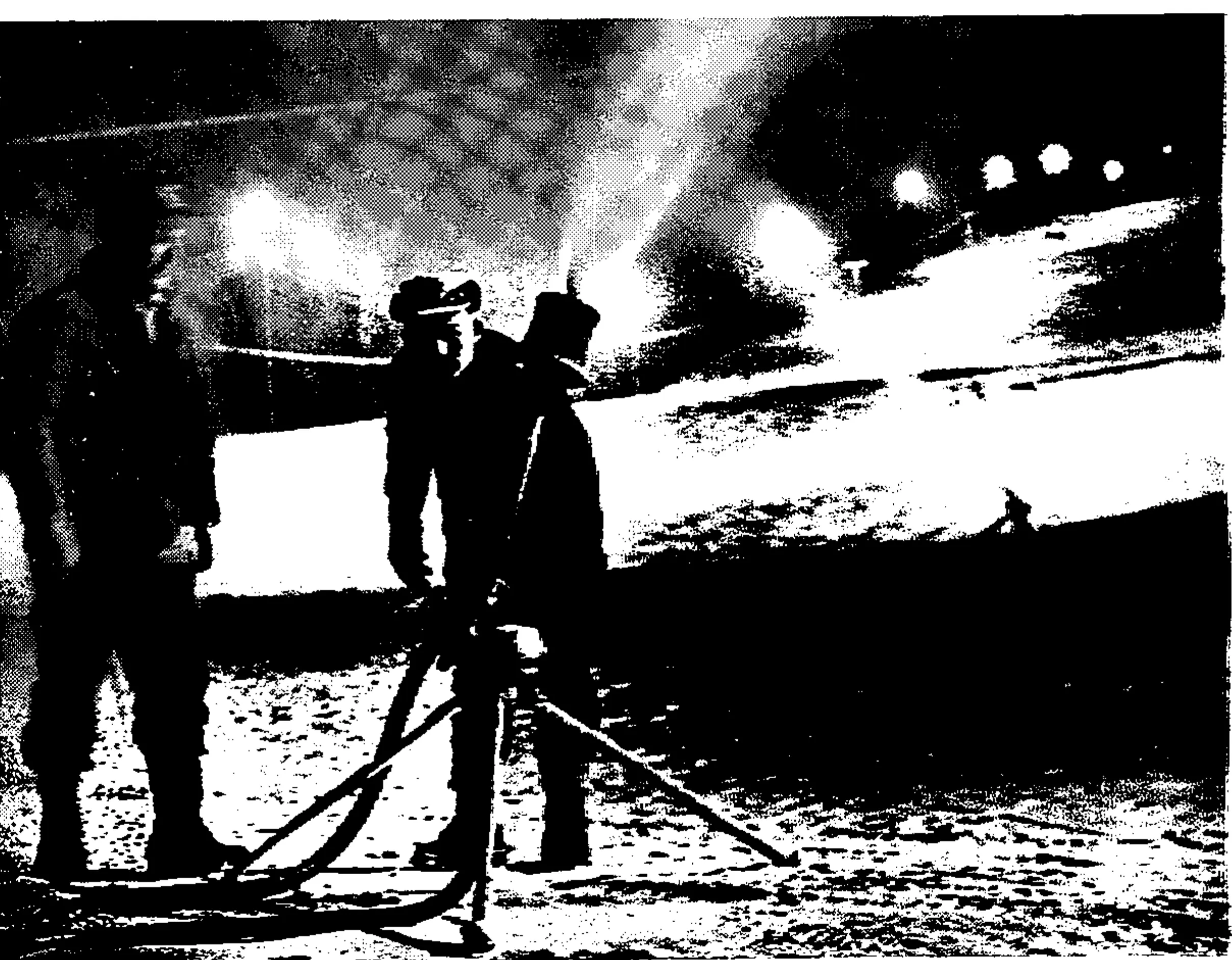
This rule paid off handsomely when the entire East was hit with another paralyzing blow in early February—hot drenching rains. As areas saw their newly-acquired natural snow bases washing through the parking lots, Mt. Tom opened as soon as the rain ceased. They still had up to three feet of base and “good” conditions. A drop in temperature put boiler-plate conditions on the slopes, but snow-making foreman Alex Gutowski, a four-year veteran at the business, turned on the switches to patch and replenish the frozen granular surface.
“While we have an abundance of natural snow from time to time, we regard it as merely an incidental bonus and concentrate on our main job of making snow,” said Conniff.
“We had plenty of natural snow the first year, 1960-1961, and drew 28,851 skiers in 79 days and nights of operation,” he said, “but we still made snow at every chance—it was ideal. We got the experience without the pressure.”
The next year when Mt. Tom added a chairlift and more snow-making equipment, there was less natural snow and greater need of the manufactured product. Business more than doubled, with 62,252 skiers in 81 days. The third year brought 91,563 skiers in 95 days, and the fourth year saw the addition of a 2,200-foot Doppelmayr T-bar above the original T-bar lift to produce a slope nearly 4,000 feet long.
This year Mt. Tom opened five days ahead of schedule with a machine-made base, but was hit by the first thaw of the season three days later. Furious snow-making permitted operations from December 17 to 24, but record-breaking Christmas temperatures forced another shut-down from December 25 to 29. More round-the-clock operations enabled Mt. Tom to be one of the few areas in Southern New England to open Saturday, December 30.
While Stowe’s lofty Mount Mansfield was forced to shut down in an unprecedented move January 8 through 19, Mt. Tom had record-shattering crowds with 44 straight days and nights of operation through February 8.
Disappointed Northern New England skiers joined the Mt. Tom regulars (and they are legion, as the area is within an hour’s drive of an estimated one million population, and less than three hours from New York City) to try the machine-made snow for the first time. The previous record crowd was 1,100. But on the Sunday after New Year’s, ticket sales were halted at 3,300. Massachusetts State Police were given the job of turning away a traffic snarl extending down the mile-and-a-half approach road and more than a mile each way on Route 5. Night operations doubled, with as many as 1,100 skiers under the arcs.
The end of the holiday rush saw fewer skiers, but more ski area operators and instructors. After viewing the Mt. Tom operation, Haystack, Mt. Snow, Stratton and Berkshire Snow Basin joined the rush to the Larchmont sales office.
However, it is one thing to install the equipment, and another to make good snow.
“There is no substitute for experience and I even offered to let some of the snow-making resorts have their foremen work side by side with our crew,” Conniff said. “Strangely enough, none accepted.”
Cloud-seeding experts and meterologists from the neighboring University of Masachusetts have come to Mt. Tom to study the theory and practice of snow-making. Most of them agree that much more compressed air is used to make snow than should be required, but they do not have a better answer—yet.
For the time being, Conniff is satisfied to cover his trails and slopes using the basic Larchmont operation. This year, he has budgeted approximately $28,000 for snow-making, which amounts to about 12 weeks of operations. Through February 11 of this season, Mt. Tom had an average of 16 nozzles or guns in operation for 677 hours, at a cost of about $2,300 per week. Labor and salaries accounted for $1,600, with fuel for the Diesel compressors and electricity for the pumps and incidental expenses making up the difference. The night crew has worked up to 12 hours a night, although once the system was in continuous operation for nine days and nights. Six snow makers on the night shift and three during the day comprise the total crew.
The cost of the equipment purchased and rented is in excess of $100,000. Conniff figures that it has been paid for in the first five seasons.
The weekly operating expenses for snowmaking, figured through the year, come to approximately eight per cent of the area’s total gross. Without snowmaking, Mt. Tom would probably operate less than 30 days most seasons. There is no question that the system is economically justified.
Every trail and slope, except one long beginners’ trail, is laid out to be covered with machine-made snow. Emphasis is put on covering the Big Tom Slope, which has two T-bars, the ski school and beginners, two ropetow areas and the Big Tom Trail, a 75-foot wide swath running down from the top of the chairlift. The upper chairlift-line, several shorter trails and the Pump House slope are also covered, when the three main sections are done to satisfaction.
Snowmaking is done in one-third sections, although now and then two of the three sections are covered at once. Usually 16 nozzles are in operation on one of the three sections, each covering about 6½ acres. The slopes are about 250 feet wide at the top, fanning out to 1,000 feet at the bottom.
In a normal 10 to 12 hour night, about three inches of slightly wet snow is laid on each six-and-one-half acre section. This makes a durable base and dries out in a few hours. The surface is always dragged with the two Tucker Sno-Cats, hauling Magic Carpets and other devices. “It is unthinkable to make snow and then not prepare the surface, except in rare weather conditions,” Conniff says. Without dragging, a hard glaze or crust usually forms and workers’ footprints freeze into solid ruts.
Mt. Tom has two reservoirs on its property and a metered pipeline running to one of Holyoke’s secondary reservoirs more than a half mile away. The pipeline was put in two years ago for emergencies. The upper reservoir is a natural pond, about half-way up the mountain, holding six million gallons. The lower reservoir, located about 1,000 feet from the base lodge and some 150 vertical feet up the slope, holds nearly one million gallons. When city water is needed, as it was this winter, it is pumped directly into the upper reservoir.

The pump which serves the lower one-third of the system, the first T-bar and the rope tow areas, is a Worthington, producing 240 gallons per minute at 225 pounds p.s.i. pressure. At the upper-reservoir is another Worthington which produces 250 g.p.m. at 300 p.s.i. and serves the upper T-bar area and the upper chairlift area. (The lower chairlift line is not skiable, as it is mainly uncovered rocks.)
Pumps push the water through aluminum 3 and 4-inch pipes, which are tapped at approximately 90-foot intervals to take valves and one-inch rubber hoses. The hoses average 100 feet in length for each nozzle, with a few running 150 feet in length. Freeze-ups do occur in the longer lengths.
Pressure regulators are used on the hoses to keep the pressure in the area of 80 p.s.i. Without the regulators, there would be very high pressures on the downhill end of the line and no water at all at the top. The pressure regulators are adjusted to suit the temperature. At low temperatures, it is possible to raise the pressure to 90 or 100 p.s.i., but they are normally set at about 80 p.s.i.
The air supply is furnished by a group of 600 and 900 c.f.m. portable rotary type compressors, leased on a monthly basis. Normal operations require at least five of the 600 models, as about 3,000 c.f.m. is used, although a peak of 4,500 c.f.m. was produced during the worst days of the snow draught. All the compressors are located at the lower pumping station and are connected with hoses to a common pipe manifold. The air is fed through an after-cooler and separator, which removes moisture and oil to prevent freeze-ups and clogging in the valves and nozzles further along the line. Immediately beyond the after-cooler, Methanol is introduced into the system. It is similar to radiator alcohol and keeps the air from freezing as it expands at different portions in the pipe line system. The air is introduced into a system of 6 and 4-inch aluminum pipe which parallels the water system. The air is taken off with hoses and valves at the same intervals as the water.
The temperature must be down to 28 degrees to make snow, and under conditions of high humidity, it is difficult even at 28 degrees. Theoretically, there is no limit to how cold the weather can be and still make snow, but as a practical matter it has been found not worth the effort to operate much below zero. Lines begin to freeze and even the most conditioned workers cannot function at anything like peak efficiency.
Most of the Mt. Tom crew members work for the Daniel O’Connell’s Sons construction firm in the non-winter months and are veterans of several seasons of making snow, but they do not relish the sub-zero conditions.
The fact that the Mt. Tom ski area is owned by one of the East’s largest construction companies has a great deal to do with its success in snow-making. Conniff has on tap some of the best union labor in the state, and equipment not usually found in a ski area. As one nearby ski area operator put it: “Cal Conniff can get his hands on more heavy equipment in 15 minutes than the average ski area manager sees in a year.”
Snow Summit, California — A $400,000 Investment
Hiring a good crew is vital to the success of man-made snow, according to Bjorn Hallin, foreman of the Snow Summit area operation at Big Bear Lake, California, where the largest snowmaking installation in Western America was completed this season. Hallin has found that crew members must not only be able to stand night work and severe cold, but they must constantly be alert to temperature and humidity changes. Even a slight fluctuation can instantly change snow to water. The ability to hear a gun out of key enables an alert operator to make necessary equipment adjustments much more quickly than periodic checking of themometers and barometers or patrolling the guns visually.
“We were all bunnies the first year,” Hallin said. “Occasionally we’d make snow on marginal nights when temperatures were as high as 36 degrees. We found this did more harm than good. This year we’ve found we make it less often but we make it better.”
Jo Tyndall, area manager since the death of her huband Tommi last December, said, “We still make snow at higher temperatures if we expect a big weekend, but only for special cases. This used to be a wetter job than it is now,” Jo continued. “We’d walk under the guns. If the snow crystals on our sweaters turned to water immediately, the adjustments weren’t right.”
“Now we have the crew use flashlights as they patrol,” said Hallin. “The combined water and compressed air is blown out of the guns as a vapor. It creates a curtain of snow crystals like very small hail as it drops and freezes. The curtain shows clearly in the flashlight beam as a sign we’re making snow. When it changes, we make adjustments. But listening as we walk up and down the row to hear if a gun is out of tune usually tells us first.”
The Guy T. Martin Engineering and Construction Co., Gardena, California, installed the air compressors for the Snow Summit system at a price of about $27,000. Hallin, working with the installation crew of two pipefitters, a welder and a foreman, collaborated with Martin to devise an automatic bypass system for the water lines. This innovation, not included on the regular Larchmont Engineering Co. plans, keeps the pressure constant at the guns by feeding water back into the pump at the suction side.
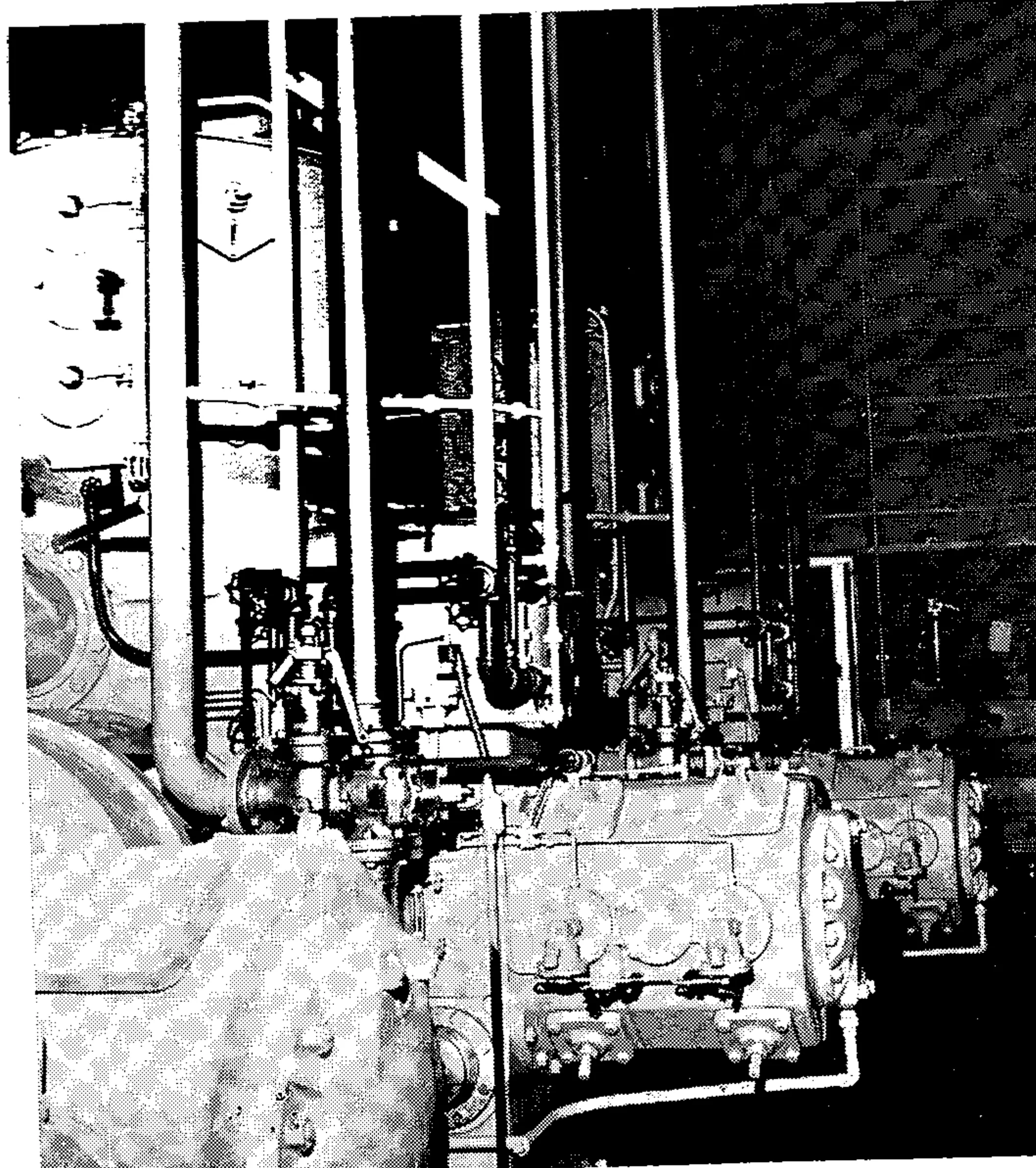
The 18,000 feet of galvanized and aluminum piping, the guns and the pumps were included in the Larchmont plans at a cost of about $42,000. Another $87,000 was required for installation and miscellaneous engineering costs. At the heart of the snowmaking system are three Ingersoll-Rand, motor-driven, two-stage compressors worth over $31,000 each. Cylinder heat is drawn off the compressors by means of a cooler treated with glycol circulating through a water jacket.
An especially built $19,500 A-frame houses the three compressors. The compressor house, which measures 24×50 ft., leaves enough room for a fourth compressor if the operation is expanded. Rates of the present three compressors total 6,000 c.f.m at 120 p.s.i., which is more than adequate for the 28-gun system.
Related to the installation costs was a bill for $22,000 worth of hill grading for landscaping to hold the man-made snow. The final cost was set at $400,000.
Today Snow Summit produces snow over three slopes, usually covering one per night and concentrating on the heavily-used beginners’ area. One complete loop services the beginner area and the intermediate area on its right. Fifty outlets are spaced along the loop, twenty-eight of which may be used at one time. Above is a second loop which reaches to the chairlift midway station and covers the third snowmaking section. A valve releases water to this loop from the lower section. With the fourth compressor in the hookup, Hallin estimates another 35 guns could be operated.
Water for the system comes in at approximately 50 p.s.i. This rate is kept constant by Martin and Hallin’s bypass system. At the top of the first loop the pressure has dropped to 100 p.s.i. and a 75 hp. booster pump is needed to raise the pressure to 200 p.s.i. as it enters the second loop. Pressure again drops to 100 p.s.i. at the top of the system.
The water is pumped into the ski area through 8-inch pipes by the Southern California Water Company, which owns a franchise on the underground spring water in the locale. The utility company, which supplies both water and electric power, built a $35,000 electrical installation to bring water into Snow Summit and nearby Summit Estates. Snow Summit contributed $8,000 for the installation with the understanding that this would be credited to their account. Monthly water and power costs amounting to $1,400 have exhausted this credit and the area is now billed monthly.
“When the wind blows,” says Jo Tyndall, “we make all the snow we can. We can usually make lots of it right after a storm, too. Of course that’s when we need it least, but we make it anyway to add to the base.”
Wind affects both humidity and temperature and all three elements are definite factors in snowmaking. Wind blows away humid air, which produces better snowmaking conditions. If snowmaking begins at seven p.m. with a humidity of 10 and no wind, the guns may create a humidity reading of 90 near the compressor house by eight a.m. Eventually a pocket of high humidity occurs in a snow-making area, slowing down the operation.
The five-man crews work in two shifts. The first shift from seven p.m. to midnight is usually made up of men who put in three hours during the day at other jobs. Each crew consists of a compressor man, a hill foreman and three crewmen. They are paid $3.00, $2.25 and $2.00 per hour respectively. The second shift works from midnight to eight a.m., each man in charge of a specified number of guns.
In a 13-hour period, at 10 degrees, the two crews can spread six inches of snow over approximately one-third of the 40-acre area at a cost of about $200.
Are the snowmaking expenses and investment worth it? The plague of continued drought could not have been met forever. Without snowmaking many area operators say that Snow Summit might have “gone under.” Instead, the season was lengthened from 60 to 90 days last year after the mid-January snowmaking installation was complete. This year Snow Summit has been able to operate all but three days since its opening in early November despite the drought conditions which followed the unseasonably early snows.