

However, if a ski area is ‘way out in the boondocks, the cost of running in a hot line can be astronomical. In addition, there usually is a minimum annual usage requirement. Because costs vary from place to place, it is best to visit your local power company for specific price details.
Generally speaking, ski lifts require motors ranging from 10 hp to 250 hp designed to accommodate the standard type of electric power available in North America: three-phase, 60-cycle alternating current. Usually an area has a choice of using this power at either 220 or 440 volts.
In addition to simply driving the lift, an electric motor has other requirements to meet. The drive unit must be able to start the lift smoothly and accelerate the lift to full speed when fully loaded and when empty. It must provide a means of varying the operating speed of the lift. And it must provide a means of braking the lift when over-running loads are encountered (i.e. when the downhill side of the lift is loaded and the uphill side is empty). Not all motors will fulfill these requirements, but the three types of electric motor drive that are most popular in ski lift applications are as follows:
Squirrel Cage Motors
This type of motor is a fixed-speed design and is the simplest and most economical of the three. However, it requires either special starting controls or auxiliary accelerating devices, such as a fluid coupling, to get a smooth start. With the squirrel cage motor, lift speed cannot be varied and braking action occurs only when the design speed of the motor is exceeded.
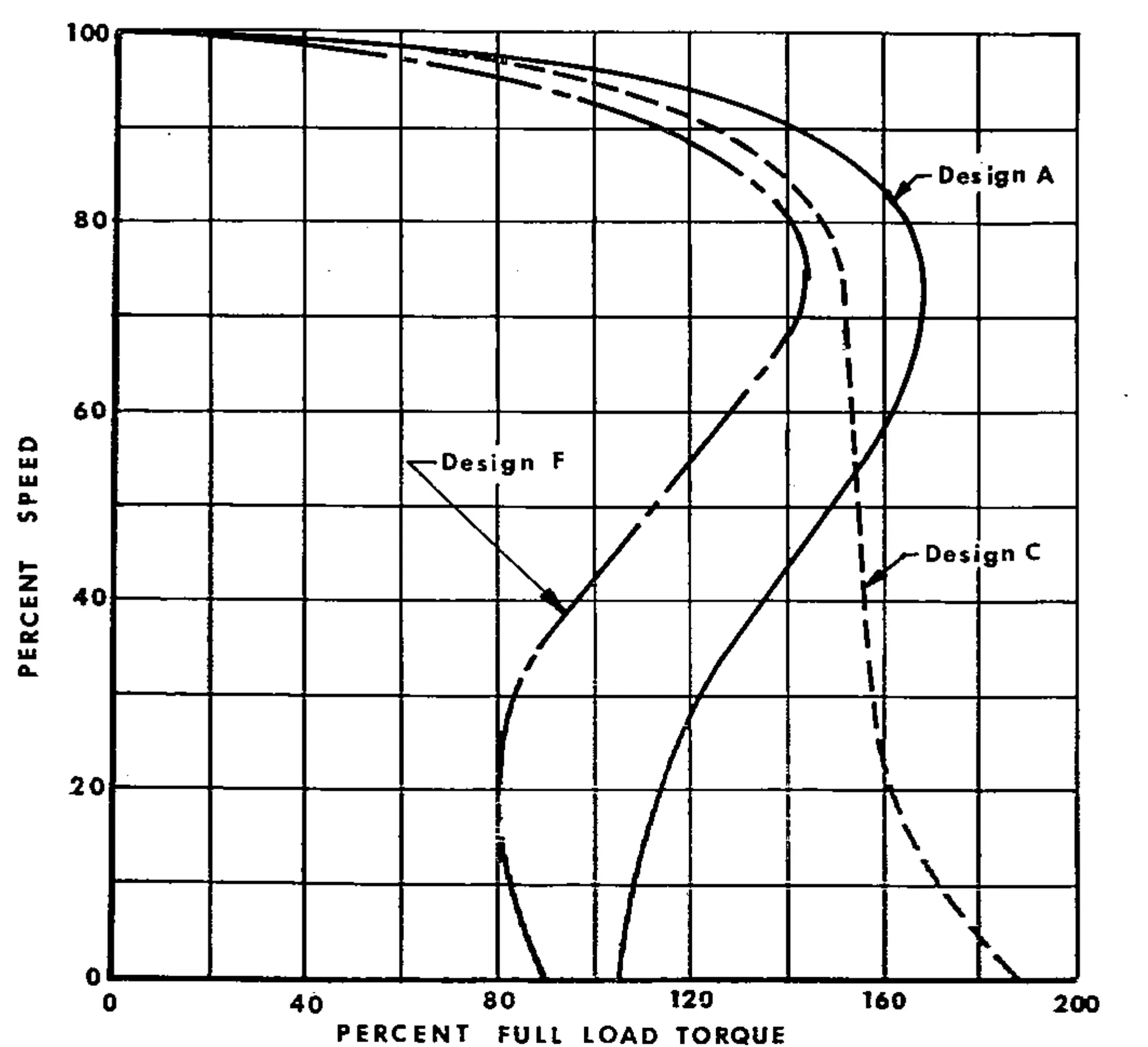
It is possible to achieve desirable starting characteristics by modifying the basic design of the motor so that the starting torque is reduced and a “softer” start is achieved (See Figure 1). However, smaller modified squirrel cage motors can be used successfully on surface lifts without special starting devices.
The squirrel cage design is also made in two-speed models which allow more flexibility, but not intermediate variations of speed.
Wound Rotor Motors
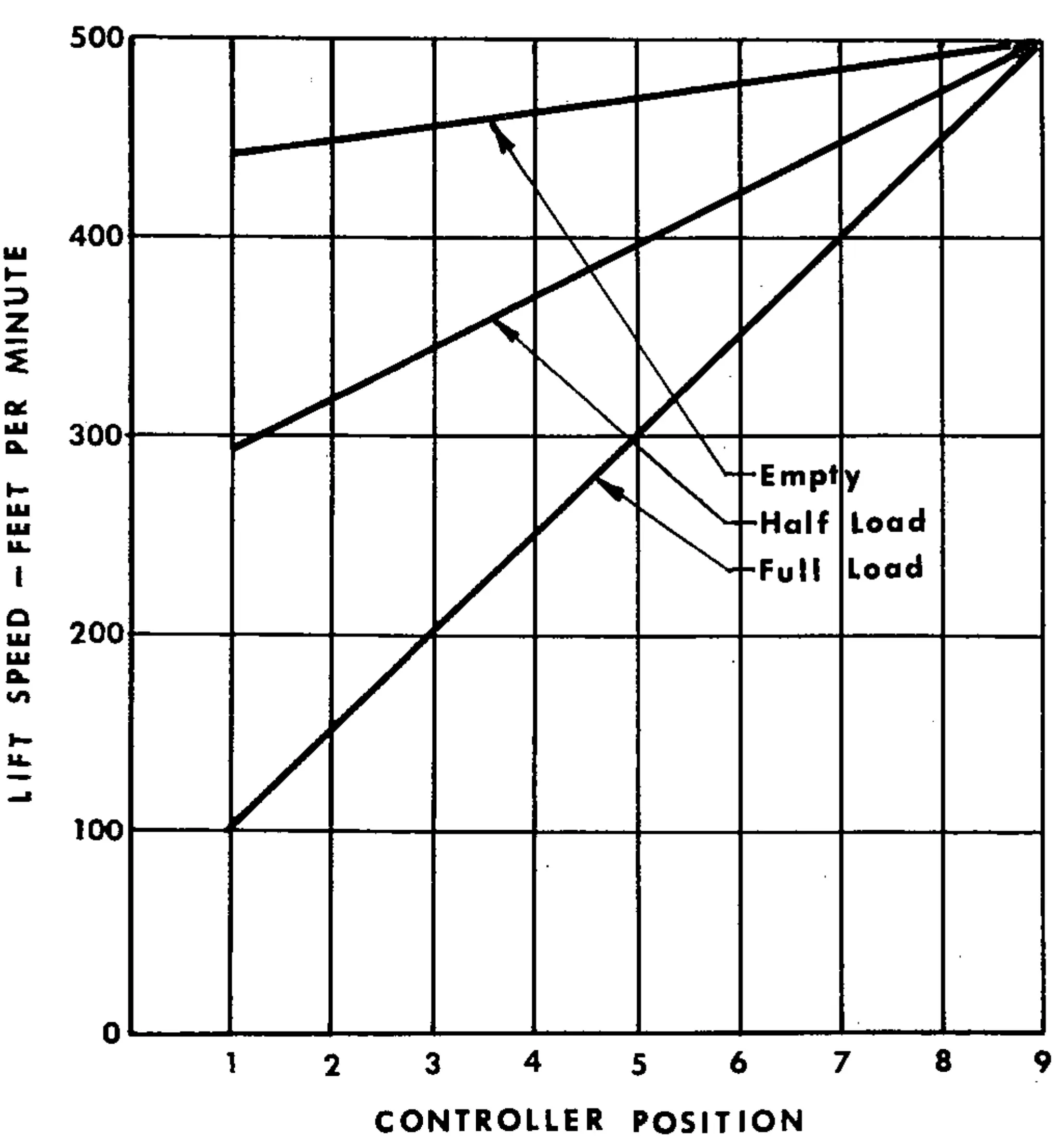
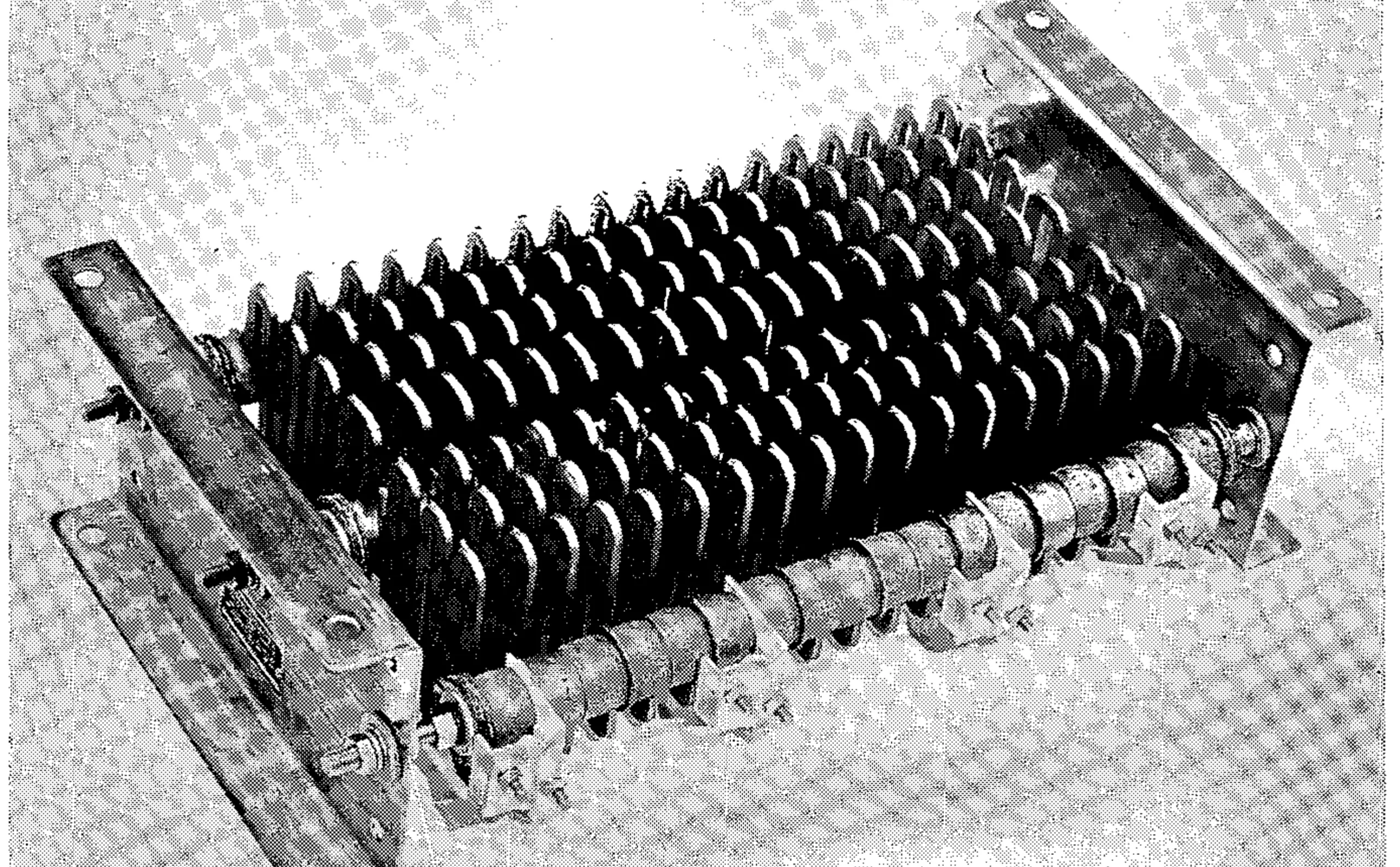
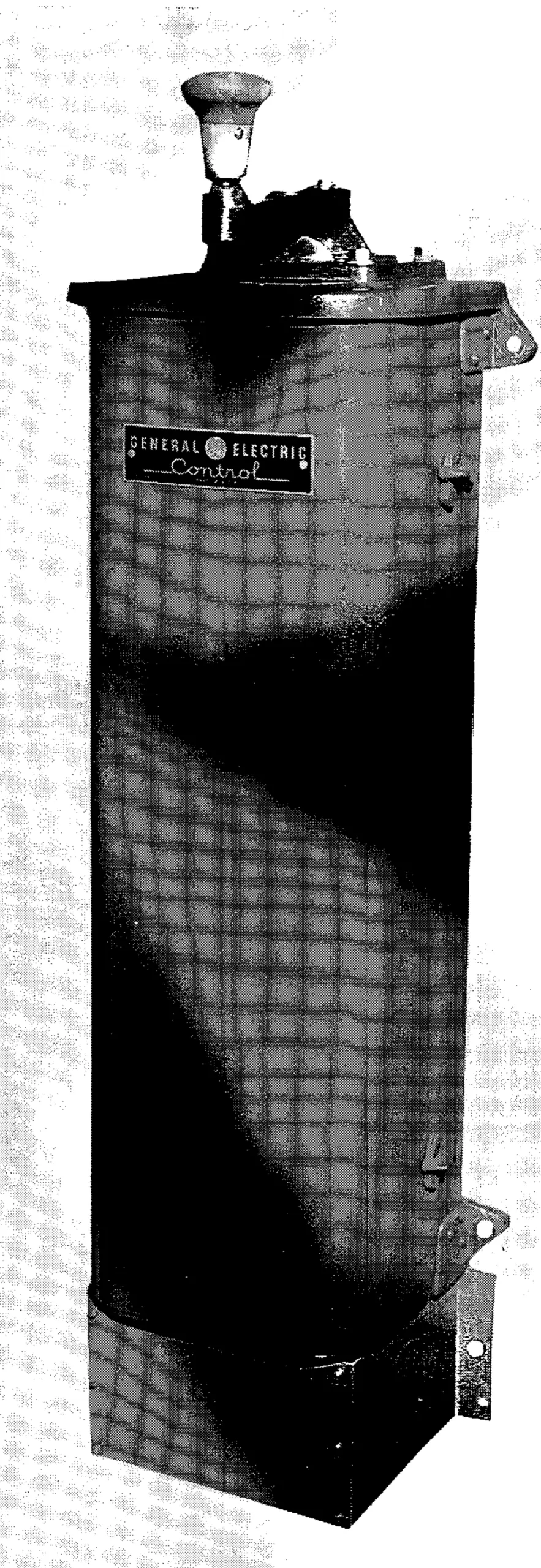
This type is an adjustable, varying-speed motor with intermediate speeds between maximum and minimum depending on the motor load and the design and number of registors in the secondary circuit (See Figure 2). The wound rotor design operates with a controller and a group of resistors—the controller cuts out resistors in the secondary circuit as the motor is started. As more and more resistors are cut out, the torque characteristics of the motor are altered and the lift can be accelerated with selected degrees of torque. A smooth start is a characteristic of this design.
Speed control is not positive with the wound rotor motor and should there be no external load on the motor, it will reach close to full speed regardless of the number of resistors in the secondary circuit. The greater the load on the motor, the lower the speed will be for a given controller setting. This condition is very noticeable where a lift is operating with some resistors in the circuit, the controller on the third point, and skiers reach the top and unload without additional skiers loading at the base. The lift would pick up speed appreciably.
The wound rotor motor can act as a brake much like the squirrel cage motor only when the controller is set at full speed with all external resistors disconnected. When the controller is set at any of the intermediate positions, the amount of braking is reduced and the degree of overspeeding increased.
Direct Current Motors
When conventional alternating current is the available power, a direct current motor can be used with an A.C.-driven generator providing D.C. current. Naturally, the transfer of electrical current from A.C. to D.C. requires additional equipment and additional cost. However, the control characteristics of the direct current motor yield the most satisfactory solution to obtaining the desired starting, speed-control and braking characteristics for a ski lift.
With the correct choice of equipment, the D.C. motor will give smooth acceleration at all loading conditions, permit infinite adjustable speed, hold any desired speed and permit braking at any set speed. The cost of the entire system usually prohibits its use except with the larger, more complex tramways. Multi-passenger reversible tramways, where exact speed control entering terminals is mandatory, are usually designed with the D.C. motor as the power unit.
Auxiliary Motor Components
In order to overcome the “jackrabbit” starts and high starting-current requirements of the squirrel cage motor, a reduced voltage starter is often employed. These starters come in two types: manual and automatic. With the manual unit, the operator pushes the handle to start and holds it there until the lift accelerates. Then he pulls the handle to run and full voltage is applied to the motor.
With the automatic reduced-voltage starter, the change-over from reduced voltage to full voltage is accomplished by a timing device. The initial starting phase, which is carried out at reduced voltage, results in a reduced torque. Often this means a fine margin between having sufficient torque to start a fully-loaded lift, yet having a reduced voltage system which permits smooth starting without excessive current demands.

To achieve the desired starting and control characteristics that are found in the D.C. motor, yet keep the costs down, and eddy-current coupling may be used with the basic squirrel cage motor. In this application, the motor drives the lift through a magnetic coupling. By manipulating the control to the coupling (exication), the degree of slippage between the motor and output shaft is varied; thus the motor may be started and allowed to reach full speed under a virtually “no-load” condition. Then the coupling slippage is adjusted to achieve the desired speed characteristics. However, this coupling does not work in reverse and an additional eddy-current brake is installed integrally in the drive unit to obtain the desired braking.
Within limits, the design of resistors in the basic wound rotor motor determines the degree of control that can be obtained from the motor. The more resistors and the more steps on the controller, the greater the control during starting and the greater the control over the lift speed. Normally the amount of control is referred to as the per cent of speed regulation at full load. Fifty per cent speed regulation at full load means, with a fully loaded lift, the speed may be reduced to half the design speed. If only partially loaded, the speed with the controller connecting all the resistors will be greater than half speed.
It is imperative that the power characteristics of the lift be accurately known to the designer of the wound rotor system to achieve the desired speed regulation. Should an oversized motor be installed (i.e., the lift requires 70 hp at full speed and load, and a 100 hp wound rotor motor is installed with 50 per cent speed regulation at 90 hp), the actual minimum speed at full load will be only about 61 per cent of full speed at full load.
Normally, the resistors employed in liftdrives are of the cast grid type, mounted on steel frames. These require considerable space as well as adequate protection and ventilation, since operation with all resistors cut-in results in heat.
The manually driven controller must be located at the operator’s station so that he can move the controller handle and progressively cut out resistors as he speeds up the lift. The first position on the controller beyond off has all resistors connected. As he moves from point to point, he progressively removes resistors from the circuit until at the final point all resistors are removed from the circuit and the motor is, in effect, acting as a squirrel cage motor. Remote control units are on the market, which allow a relatively large controller to be located in the drive room. A controller should always be wired so that after every stop it must be returned to start and proceed through the same starting procedure.
The relative initial costs of the various motors and accessories are presented in Table I. The squirrel cage motor with a simple starter is taken as a unit and the other types compared to it. It must be kept in mind, however, that the simple squirrel cage motor will not do everything demanded of a complete starting, running and braking system for larger lifts.
Operating costs of the basic drive motors do not vary greatly when the lift is operated at full speed. The squirrel cage motor and wound rotor motor are almost equal at full speed, with the direct current motor and eddy-current coupling drives showing only slightly higher operating costs. The major cost factor to consider when comparing the various systems is the initial cost. There is little weight to be given to the variations in operating and maintenance costs. Study what may be expected from the motors under consideration and choose on the basis of the performance that may be expected against the cost.
The squirrel cage motor should require the least in the line of maintenance expenditures. The reduced voltage starter, if manually operated, and the manually operated drum controller, will be affected by the care with which they are operated. Rapid, decisive movements from point to point on a drum controller are necessary. Slow, indecisive movements result in arcing across contacts and frequent replacement of burned contacts. The D.C. drive requires some extra care, but basically all systems need little in the line of maintenance if proper care is taken of the equipment.
While nearly all the motors in the range considered are available in either 220 or 440 volts and some with dual voltage connections, the cost of controls, switch gear, wiring and conduit result in economies if a 440 volt system is used (See Table II).
| Drive | Cost index |
|---|---|
| Squirrel Cage Motor, Full Voltage Starter | 1.0 |
| Squirrel Cage Motor, Reduced Voltage Starter | 1.3 |
| Wound Rotor Motor with Drum Controller, Regulating Duty Resistors, Starter | 3.2 |
| Squirrel Cage Motor with Eddy-Current Coupling, Overspeed Braking, and Full Voltage Starter | 8.4 |
| Direct Current Motor, Ward Leonard Control System with Dynamic Braking | 10.7 |
| Motor Horsepower | 440 Volt | 220 Volt |
|---|---|---|
| 10 | 1.00 | 1.53 |
| 50 | 1.00 | 2.05 |
| 100 | 1.00 | 2.33 |
| Type | Total Reported | Electric | Gasoline | Diesel |
|---|---|---|---|---|
| Rope | 241 | 136 | 102 | 3 |
| T-Bar | 88 | 54 | 26 | 8 |
| Chair | 58 | 43 | 3 | 12 |
| Poma | 47 | 26 | 16 | 5 |
| J-Bar | 5 | 2 | 3 | — |
| Gondola | 3 | 2 | — | 1 |
| Total | 442 | 263 | 150 | 29 |