


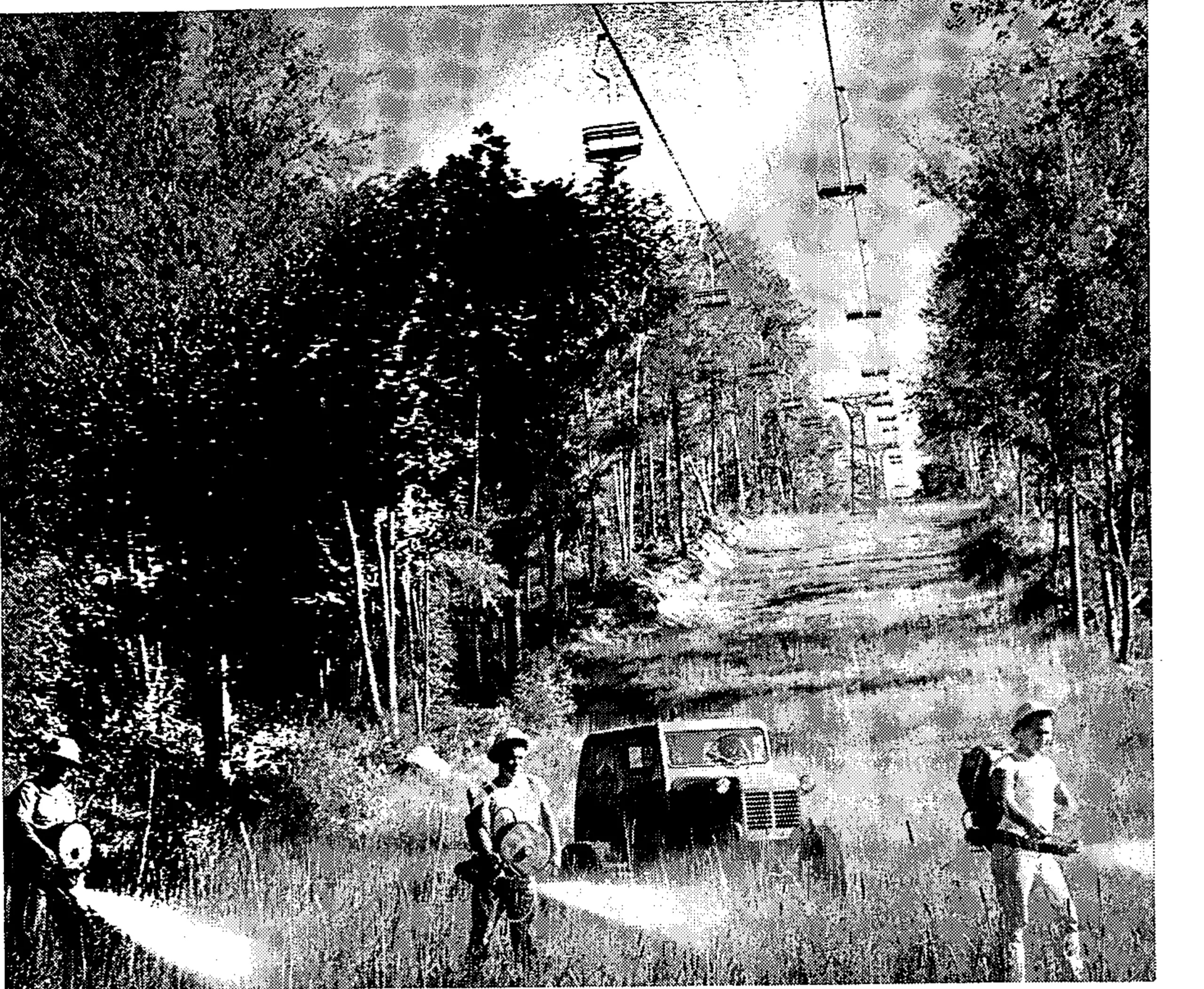
One of the most serious and expensive ski trail maintenance problems is controlling the growth of hardwood such as seedling trees, brambles and thistle. The forest at the sides of the trails annually produces an abundance of wind-born hardwood seed that invades areas which have been seeded for grass. In many cases it takes only about three years after new trails are cut and cleared before brush becomes so widespread that it must be eliminated by chemical or mechanical treatment.
Common methods of hardwood control are mowing by hand or with power equipment. Usually the hardwood brush can be mowed with the grass. But each year it becomes thicker and tougher, especially at the edges of the trails where mowing is difficult. Even after cutting, hardwoods sprout vigorously and the root systems become larger crowding out the more desirable grass. What is needed is a low-cost technique of killing this brush without damaging the grass on the ski slopes or the nearby forest area.
Aerial and ground application of herbicides to control hardwoods as used by power line companies and forest owners for the past ten years is suitable for use on ski slopes. Both fixed wing aircraft and helicopters have been employed successfully to spray power line rights-of-way and forest stands. Helicopters are best for spraying ski trails because the trails are not straight enough to make airplanes efficient. Large areas may be treated by helicopters for about $30.00 per acre.
Various apparatus such as conventional hydraulic sprayers and tractor-mounted and shoulder-mounted mist blowers have been used for ground spraying. Costs of these operations vary from $6.00 to $60.00 per acre. Hydraulic spraying is most expensive and is least appropriate for ski areas because of the high volume of spray used and the difficulty of directing it accurately on ski trails. Tractor-mounted mist blowers use low volume, high concentration sprays but many ski trails are too steep for easy tractor operation. Ground applications of herbicide to ski slopes can probably best be made with shoulder-mounted mist blowers.
Hydraulic sprays are usually mixed at a ratio of 1 part herbicide in about 100 parts of diluent. Aerial and mist blower sprays are usually mixed at a ratio of about 1 to 10. Hydraulic sprays are applied at 50 to 100 gallons or more per acre while aerial and mist sprays are applied at the rate of 2½ to 5 gallons per acre.
In the tests described here, two herbicide spray mixtures commonly used in both aerial and mist blower application to control hardwood brush were applied with a shoulder-mounted mist blower. In the first test 1 quart or 1 pound acid equivalent of 2,4,5-T in 2¼ gallons of no. 1 fuel oil was applied per acre. In the second test 2 quarts of an invert emulsion of 2,4,5-T and 2,4-D combined at one pound acid equivalent of each was applied in 2 quarts of no. 1 fuel oil and 2 gallons of water per acre.
An invert emulsion is a thick, white, water-in-oil emulsion as opposed to the conventional oil-in-water emulsion. The herbicide is on the outside of the invert emulsion droplet instead of on the inside as is the case in a conventional emulsion. The invert emulsion is about as thick as no. 30 engine oil and flows well through a mist blower. Droplets of invert emulsion are larger than conventional mist spray droplets and this reduces drift hazard. This emulsion, which has been much used in helicopter spraying of power line rights-of-way, is easy to make up and is very stable. It should be used where susceptible vegetation is vulnerable to spray drift.
Three shoulder-mounted mist blowers of Dutch manufacture and ranging in weight from 25 to 45 pounds empty were used. These machines are capable of spreading mist from 30 to 50 feet. Under normal operating conditions 2½ gallons of spray is spread onto an acre in 20 to 30 minutes. Mist blowers are economical to purchase ($200 to $300), use and maintain and they may be operated anywhere a man can go on foot. They can also be used in mosquito control work and to blow hardwood leaves or dust from areas where they are not desired.
The Tucker Sno-Cat used in this operation has been converted to be used on rubber tires. Steve Lyman, manager of the Thunder Mountain Ski Area, Charlemont, Massachusetts, made the conversion using second-hand wheels and tires purchased for $80.00. The unit is very efficient on steep ground when the tires have low air pressure. The gear ratio is suitable for mountain work and the vehicle is fast on highways.
Three men operated the mist blowers while the fourth man replenished the supply of herbicide when needed and drove the Tucker Sno-Cat carrying spray material, gasoline, tools, etc. Each machine can complete an acre in 20 to 30 minutes of operation. Twenty acres or more may be sprayed in a day by a four-man crew. The machine operators walked down the trail spraying vegetation in the trails, at the sides of the trails, and the lower branches of trees which needed removal. A trail 70 to 80 feet wide can be treated at a cost of $40 to $80 per mile using 20 gallons of spray.

Any quiet day with a wind velocity less than 5 m.p.h. is suitable for spraying. When the air is still at dusk or very early in the morning are often the best times to spray ski slopes. Then the mist can be seen close to the ground and flowing down the slopes.
Spraying with 2,4,5-T in August after the conifers have “hardened off” for winter produces good results on hardwood and little damage to conifers. Conifers caught in the direct blast of the spray will brown out where spray hits but they will usually make a good recovery the year after spraying. Where desirable conifers grow at the edges of ski trails, 2,4,5-T should be used during August to minimize the damage.
Where conifers are not growing, an earlier spraying with 2,4,5-T will do greater damage to hardwoods. If, on the other hand, there are conifers in the ski trails which need treatment, earlier spraying with 2,4,5-T will damage them more. The invert emulsion of 2,4,5-T and 2,4-D will do greater damage to conifers in any season.
| Item | Cost |
|---|---|
| 1 pound 2,4,5-T acid equivalent @ $45.00 per 5 gal. | $2.25 |
| 2¼ gallons of fuel oil @ $.20 per gal. | .45 |
| Labor costs: 4 men @ $80.00 per day | 4.00 |
| Mist blow cost:1 operation ($.05), depreciation ($.38) maintenance ($.04) | .47 |
| Tucker Sno Cat cost:2 operation, depreciation, maintenance—$40.00 per day of use | 2.00 |
| $9.17 |
If it is necessary to mow the material sprayed, then maximum damage to the plant can be achieved by spraying hardwoods as soon as the leaves are fully grown in the spring. This gives the chemical a longer time to act on the plant before the aerial parts are cut. At this time conifers hit by the spray will be badly damaged or die.
During the first week of June, 1961, ten acres of open slope and two ski trails, both nearly 20 years old, were sprayed on Tinker Hill in Hadley and Thatcher Hill in Amherst, Massachusetts. In this treatment, 2,4,5-T at 1 to 9 in no. 1 fuel oil was applied at the rate of one pound acid equivalent of herbicide in 2¼ gallons of fuel oil per acre. The area was mowed in late November of the same year. In November of the following year over 60% of the hardwood sprayed was dead down into the roots.
In June of 1963, both areas were again sprayed because the farmer who mowed the open slope refused to mow unless the area was sprayed again. This time the invert emulsion of 2,4,5-T and 2,4-D in oil and water diluent described earlier was used. The kill measured by a stem count in November of the same year before mowing was over 70%. In August of 1964 the same slopes were sprayed again with the invert emulsion, but it was difficult to find hardwoods to spray. It would appear that annual spraying to control hardwoods is not necessary.
In August, 1964, over 40 acres of ski trails, open slopes and wooded area at the base of the mountain were sprayed at three-year-old Thunder Mountain. Hardwood brush was very sparse on the 80 acres of trails and open slopes, but by starting a spray program early and spraying some each year, brush cutting may be completely eliminated. A spray mixture of 2,4,5-T in oil was used in August because conifers had been thickly planted at the sides of the trails. One hundred gallons of spray mixture was applied in two days of work employing 3 mist blowers, a Tucker Sno-Cat and four men. This work can be done for $9.17 per acre (see Table) if done by area personnel using area equipment. Spraying with invert emulsion would cost about $1.00 more per acre because of increased herbicide cost. Mist blowing for brush control may be contracted for $20.00 to $30.00 per acre. If the work is repeated as needed, mowing may be completely eliminated, the grass grows better and skiing is improved.
Mr. MacConnell is varsity ski coach and professor of forestry and Mr. Kenerson is a research assistant at the University of Massachusetts.