


Someone once said, “A man should keep his friendships in constant repair.” The admonition might have been equally well addressed to the ski business, for there is no such thing as a one-shot public relations-marketing program. Not in a time of both mobile and fickle consumers and shrinking profit trends. To accomplish anything of lasting value, your program must be a continuous, long-range, year-to-year performance. The goodwill that generates revenues cannot be written on the books overnight. And it can never be written on the books so that it will stay there without subsequent entries. It takes more than deep snows to fatten your profit picture; it also requires professional budgeting and all that it implies.
Beneath much ski area budgeting lies a gut feeling or convictions based on tradition—marketing success stories of the past. But times are rapidly changing, and so is the consumer who is a prospect for your operation. His life styles and mobility are being wooed more than ever before by leisure-time interests outside the ski industry. In short, effective budgeting for public relations-marketing is a prerequisite for survival in the broader market place where Americans are bent on going places and doing things.
If you have not already designed and launched your 1971-72 marketing plan and budget, get started today. Any ski area, in fact, would do well to be committed to such a plan by July 1st at the very latest.
Plan first
You shouldn’t lift a pencil to structure next season’s budget until you’ve reflected on your plans and goals. Planning is based on the common-sense idea that people ought to know what they are doing. Yet there are too many programs devised on impulse or pure intuition.
In line with this, two other points should be kept in mind: (1) Plans and projects cannot be created in isolation—they must be related to your basic policies and objectives; (2) Those who will be called upon to implement the plans should have a voice in shaping them.
Planning that precedes budgeting requires a searching look backward to determine all the factors which have led to your proposed program; a look inside where the assembled facts and opinions are considered in light of your area’s objectives, a look about you to measure the mood of the times and to see what the competition is doing, and a look to the future, that point in time at which your area’s goals are aimed and for which your marketing program is committed.
Planning without factual data can be just so much daydreaming. You must surround yourself with information on the results of previous marketing budgets as well as external influences which might affect next year’s plans. At the very least, the following information should be available:
- Past experience expressed in ratios of expenditure to sales, preferably by department.
- Degree of promotion and advertising being carried on by your competition.
- Measured results of any specific tests you may have attempted. For example, a strong advertising schedule in a brand-new market.
- Customer demographics, including residence, spending habits, skiing ability, frequency of visits.
- Detailed ticket-sales data, both a comparison of types sold and the pattern of sales from season’s start to finish.
- Comparative analysis of sources of mail inquiries, lodging reservations, advertising response, season ticket sales, ski week sales, any others available.
- Costs of each marketing tool employed last year broken down precisely by media and item.
- Precise data on what you can afford to spend for increased sales volume after considering cash needs for other purposes.
- Details on the introduction of any new service or product you are planning.
A budget should flow from your departments whether your area represents a 3- or 30-man management staff. A budget imposed from above seldom works. People will adhere to one they help make, but they’ll defend themselves from one handed down from above. People who know they will be held responsible for portions of a budget just won’t give you their all, unless they feel they have had some authority in making up the budget in the first place.
Be realistic
An economically sound budget can afford neither undue optimism nor pessimism. It must be an absolutely objective measurement of what you think you will do. Many ineffective budgets stem from last-minute wild guessing. Assumptions must be reasonable. You can’t call every turn for the coming year, but you can examine in depth these areas mentioned under planning.
Some ski areas set artificially high revenue levels as a quota. They don’t really expect to attain their goals. The weakness of this approach is that it distorts the entire year’s planning picture—you can’t possibly forecast expenses accurately. Likewise, there are temptations in the opposite direction which have accurately been termed by others as “preoccupation with yesterday.” Typically, some area managers and/or marketing heads sit down to budget and rather casually add up last year’s expenses, plus that total by an unfounded percentage and print up the budget. Both approaches are unrealistic.
Aim at specific targets
“Bottom-line marketing” is a safe route to increasing profits. If you know what profit you require, then it’s relatively easy to do the math needed to establish other financial targets. Let’s assume a ski area knows from observation and measurement that it is getting, say, 9 per cent of the mid-week package business in the state. A 14 per cent share of the present market would generate profits needed to produce badly needed beds and entertainment facilities. It follows that this specific target (a 5 per cent increase) becomes the focal point of many ingredients of the budget and predetermines how much revenue must be realized.
Provide for a green Christmas
It happens when you least expect it, so pretend it will be this year. Make sure your budget provides for emergencies. What kind of emergency is of little importance. More important is that you pre-plan the action you will take. Your safety valve need be nothing more than a blueprint for drastically reducing expenses where it will hurt the least over the long pull. It might call for a reduction in force, reduced promotion and advertising expenditures or cancellation of a film you were planning to produce for next season. Whatever the expendables, rank items now so there will be no second-guessing on cutting later.
You might rank your budgets by two classes: primary, that is, fixed expenses such as preseason printed matter, advertising which will have already run, and other goods and services contracted for; and secondary or “Black Friday” items which, as painful as it may be at the time, can get dumped over the side in a hurry. This list could be lengthy and would undoubtedly include spring-skiing ads, most promotions, excessive staff for the conditions, etc.
How much?
How much can you afford is the answer. Beyond that, it’s a matter of what amount of money you feel is required to deliver the revenues you have projected. Forget all you’ve heard about percentages. What can you afford? Don’t be wild, but be a bit bold. If your rough estimate of marketing expenditures is, say, 4 per cent of your projected gross rather than 10 per cent (often, and sometimes inaccurately, used as a rule of thumb), stop worrying and start planning. But nowadays, with anything under $20,000 or 5 per cent of your projected gross (whichever is smaller) you’ll have your job cut out for you. One thing is certain: Allocate your marketing dollars based on what you feel you can generate next season, not a percentage of last year’s gross. Budgets are intended to deliver revenue tomorrow, not yesterday.
Your budget should be ambitious, possibly divided into primary and secondary (“Black Friday”) sections. Just make sure the former is adequate to handle a tight situation. In most cases this figure ought not drop below 5 per cent of your projected gross. The balance is then used if the variables are favorable. Keep in mind that if you have a real cash problem but still the need to promote actively remains, you can always consider coat-tail promotions, co-op advertising and even “trade” deals (your services for advertising space and time).

There’s a simple formula for budget allocation. It’s the “80-10-10” Formula and it works like this:
80¢ of every dollar is placed in a budget category you’ve experienced success with, using a message you know is effective.
10¢ of every dollar is placed in a new, unfamiliar category, but using a message you know gets results.
10¢ of every dollar is allocated to an area you have no previous experience with, using a brand-new idea or message.
Beyond your own financial capabilities and limitations and how they influence the size of your marketing budget, there are certain external factors which can affect your budgeting:
- State and regional ski advertising/promotional programs.
- Available cooperative ventures with transportation groups such as airlines, bus companies, car-rental firms, etc.
- Tie-in potential with manufacturers, both skiing and nonskiing.
- Your proximity to the market place and the percentage of skiers there.
- The uniqueness of your particular area (or the lack of it) and the popularity you now enjoy.
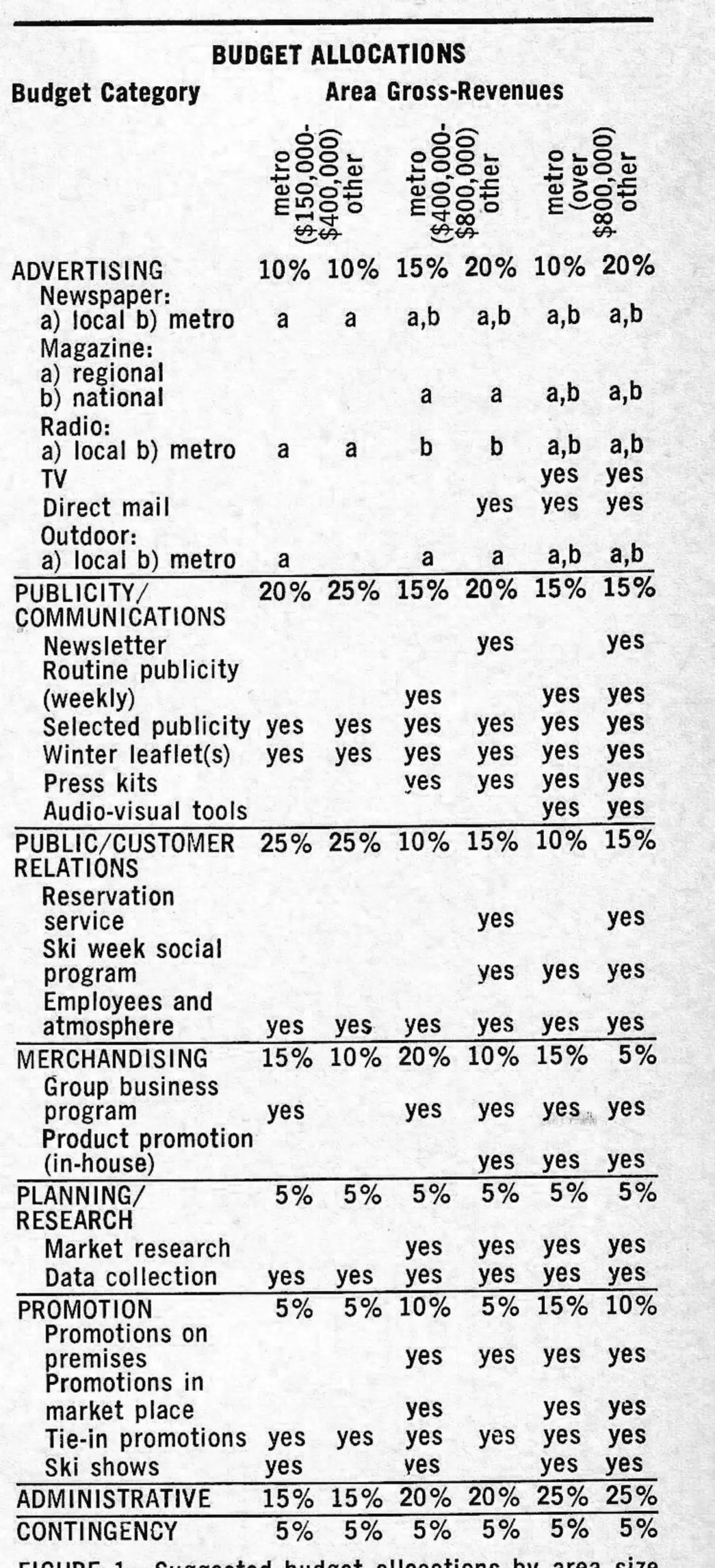
It should be clearly stated that no suggested “standard” budget allocation will necessarily fit any particular ski area. To be profitable, budgeting must be a very individual matter.
The “standard” chart in Fig. 1, drawn up here only for purposes of example, reflects the basic truth that the closer you are to the people (in operating a metropolitan facility, for instance) the better your chance of attracting their attention and getting them to respond. And the farther you are from the market, the harder it becomes to draw the customer past your competitor and into your parking lot.
Flexibility is vital
Your budget should create an area of latitude within which you can move with both freedom and peace of mind. It should not become a straight jacket. If your expenditures are generating a high return and there’s good reason to believe more revenue would continue to roll in, spend more money, even though the budget ceiling will be surpassed. Likewise, don’t try to get water from a dry well. If repeated effort in a budget area yields little or no return, seriously consider killing the balance and use the funds elsewhere.
Review regularly
Unless you have some sort of reporting system which provides you with information, right now, on what happened yesterday or last week, your budget will be lukewarm at best. Constant review of performance against conceived plan will spot the variances which you can head off before they become crises. If, for instance, you have planned a three-part direct mail campaign and justified the expense on a response rate of 8 per cent but your weekly tabulations show you’re running at half that, beware of future expenditure until you’ve re-examined the program. Or if mail inquiries are costing you $3 each, rather than $1, consider reviewing your media choices before insertions. In contrast, you may determine that response to these programs is far beyond projections and there may be real argument for transferring funds from another program to maximize a going thing.
Timing and flow control productivity
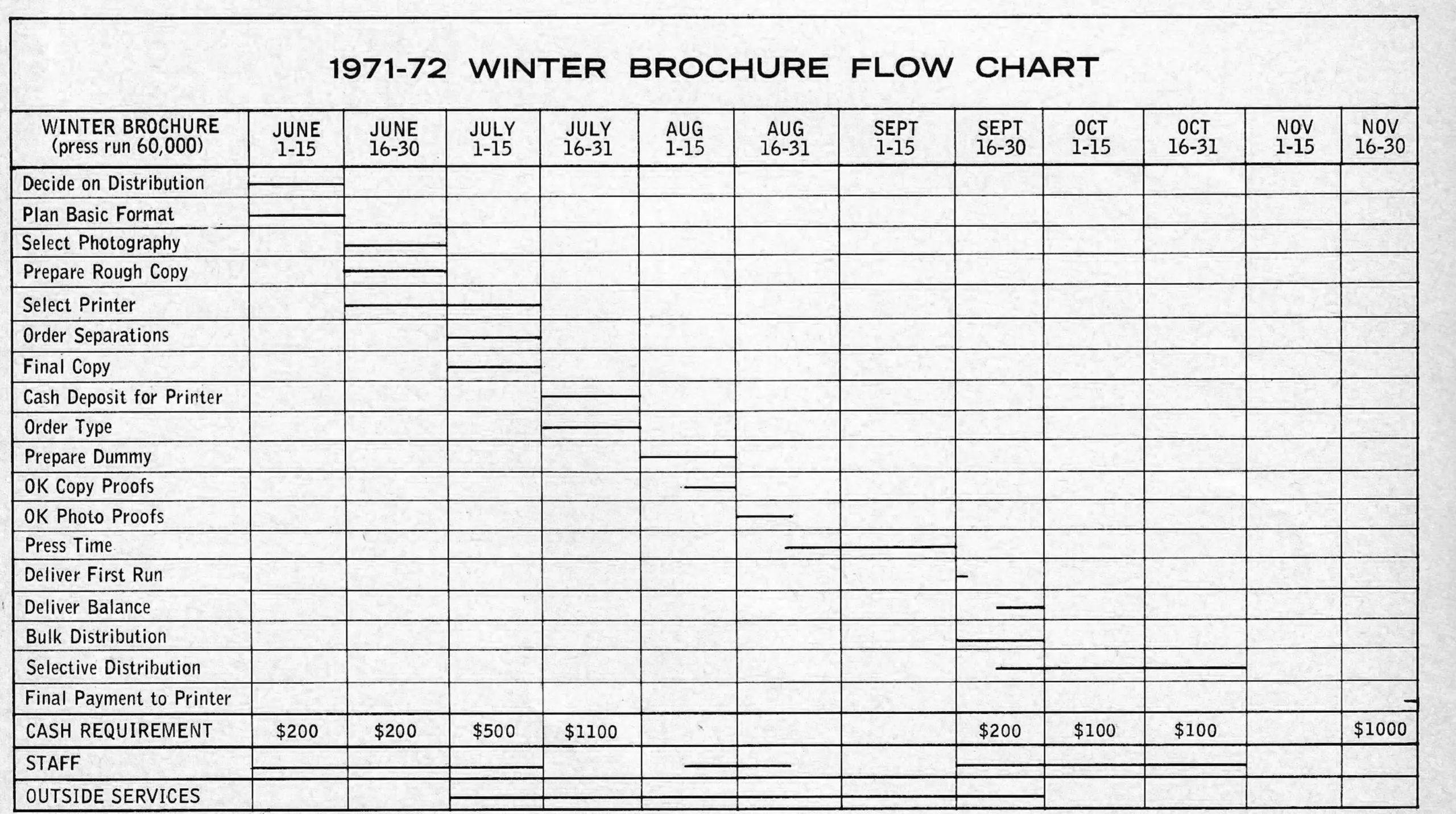
The best policeman you can hire to guard budget performance is a flow chart. Keeping it simple will insure that you will set up one and use it. The secret is to combine the budget category (or subcategory) with the corresponding staff requirement and cash flow. At a glance you can then compare any data on actual performance to the “standard” which you forecast.
Below is a sample of how one item under publicity, the winter brochure, might appear. Keep in mind that in a full flow chart this item would be combined with others so that you could easily visualize the relationships of all elements of the budget at any given time. With this view at hand, you will be able to avoid over- or under-involvement by staff and maintain closer control of your marketing expenditures. As a comprehensive flow chart gives you timing and control, it also gives continuity to your overall marketing effort. With an overall view you can move your various marketing resources about to produce the most profitable results, based on the constant input of fresh data which tells you whether your plan is working or not.