


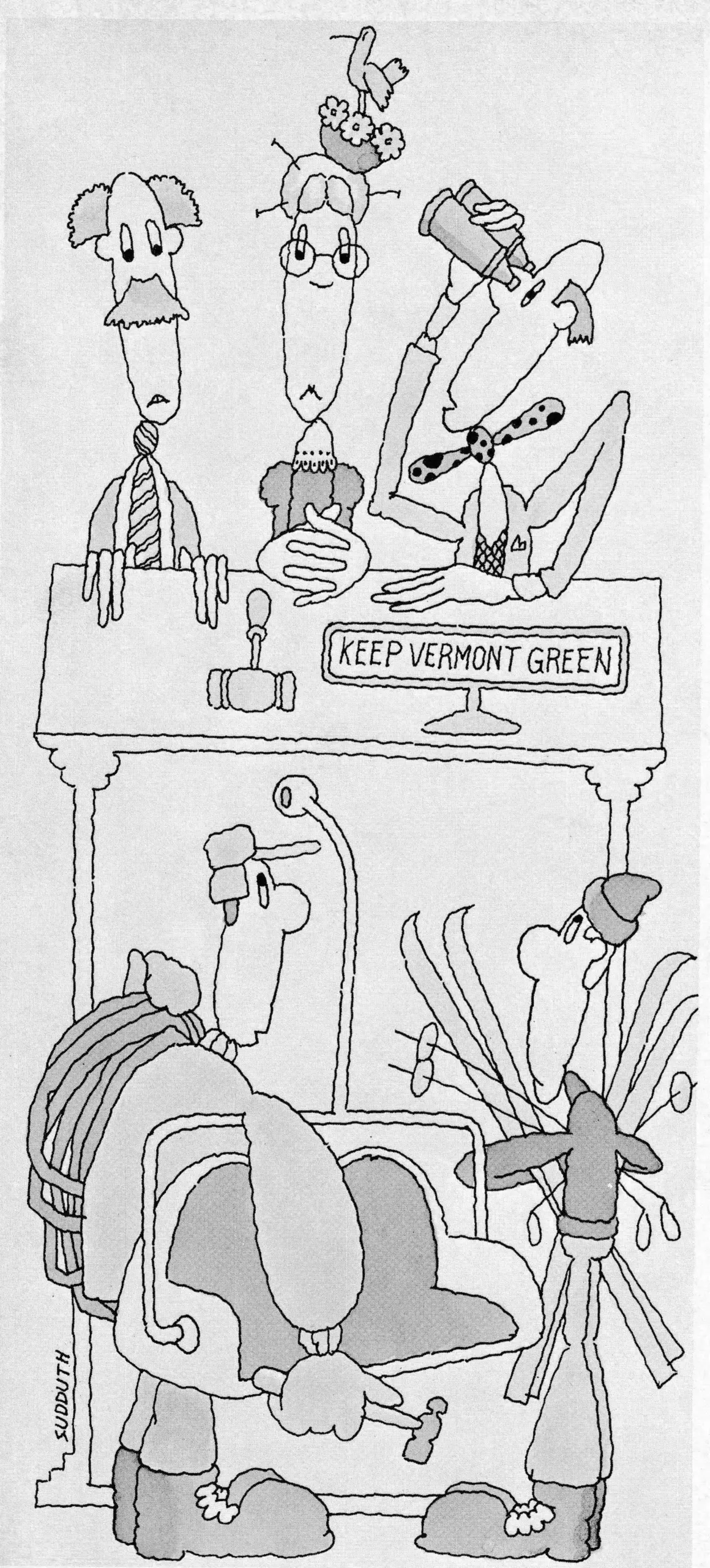
When Vermont’s environmental control bill was enacted last year, it was widely hailed as a model piece of legislation. The aim of the law, which had the full support of ski area operators, was to preserve Vermont’s essentially rural and wooded environment and at the same time permit orderly development of quality resorts.
A nine-man State Environmental Commission was appointed and seven district commissions made up of three members each—some with backgrounds in conservation, others not—were also appointed to rule on specific projects in their districts under control of the law.
An alarming and unchecked quarter century of ski and recreational area development impressed nearly everyone with the need to take steps to save Vermont’s “green.” Yet less than a year later, overzealous enforcement of the law, combined with individual interpretation of the law, has resulted in a backlash that could well result in amendment or repeal of the statute.
What normally would be considered routine expansion has taken on the controversial nature of major exploitation, and several Vermont ski areas have been stymied in their attempts to make modest and essential improvements at long-established resorts.
Killington finds itself blocked in completion of its summit station and restaurant building for its three-mile gondola. In addition, installation of snowmaking equipment on the area’s Snowden Peak and routine trail work are being held up. Ironically, Killington started the gondola station before passage of the bill and it is debatable whether the district commission should have gotten into the picture at all. Moreover, Killington president Preston Leete Smith is a member of the state commission—the only ski area man, incidentally, who holds a seat.
Stratton Mountain applied for approval of two new chair lifts and ten trails (see “Frank Snyder: At Home At The Helm,” August SAM) and only after 18 hours of testimony at three hearings was approval granted. The district environmental commission gave its approval only after invoking a number of restrictions. Selectmen from the towns of Winhall and Stratton both testified that additional skiers at Stratton would create a hardship for the two towns. The bulk of the questions concerned the capacity of the Stratton Mountain sewage treatment plant to handle increased skiers.
Fortunately, in a way, 1971 was not destined as a year of big ski area projects in Vermont anyway, thus what could have been numerous problems and delays were avoided. About the only other projects coming before the commissions involved Mt. Snow, Pico, Burke Mountain and Glen Ellen. These, primarily because they involved no new cutting of trails, were approved. Mt. Snow is eliminating one of its original monorail chairlifts and a converted T-bar and is adding a new gondola, while Pico is replacing its oldest T-bar with a chairlift. Burke Mountain is widening four trails, and Glen Ellen is installing a new chairlift, but the lift line and trails had been cut for two years.
Fearful that conservationists will forget entirely about the economic needs of the state’s ski areas, the Vermont Ski Area Operators Association met August 6 of this year with Governor Deane Davis to point out the dangerous precedents being established by the first-year commission rulings. Although the Governor was happy to get the areas’ views, he was satisfied with the present environmental law. A spokesman for the Governor’s office said that a land-use master plan, now underway, will serve as a guide to future development throughout the state and, it is hoped, alleviate some of the confusion that now exists in the environmental area. To further clear the air, the state commission has issued an 11-point guide to its district bodies to help them in determining the environmental feasibility of projects in their areas. One of the chief criteria on the list and a plus that should help tip the balance in favor of the state’s ski areas: economic interest.
Walt Elliott, president of Glen Ellen and chairman of the area operators’ committee on environmental study, has said that the real impact lies in the “psychological discouragement to area operators.” He pointed out that the biggest problem facing the ski industry is sewage disposal, since the Vermont Water Resources Board (of which Elliott is a member) has classified streams and rivers into three categories, with the first two making it particularly tough for the approval of ski area sewage treatment plants.
The first category, “pristine stream,” includes any stream of 1,500 feet elevation or with a flow of less than 1½ cubic feet of water per second. This would apply to almost every ski area in Vermont. The second category is the “upland brook,” which includes any portion of the stream above the highest sewage treatment plant on the stream. Treated sewage may be entered into upland streams, but only when there is a dilution ratio of 30 to 1, or in such case as may be approved by the Health Department. The third category covers streams and rivers at lower elevations, into which sewage wastes may be discharged if they do not “degrade” the water. Elliott said that even the 30 to 1 dilution ratio will be impossible to meet in many cases at all times of the year.

Elliott said that the many present district commissions are overzealous and that an “anti-business” attitude prevails. “Who picks up the bill? Where do the unemployed look for new jobs when ski areas cannot expand or must curtail their operations,” he asked. He pointed out that agriculture is steadily declining in Vermont, industry is stable at best, but that the recreational business is growing rapidly, taking up the slack found in farming and industry. In terms of revenue, recreation still ranks behind industry in the state but outdistances agriculture by a considerable margin.
“There will have to be some type of pollution if the state is to have any jobs,” Elliott said. He added that the problem is not limited to ski areas alone; it extends to all types of resort and recreational developments and to such vital projects as power generating stations.
Elliott pointed out that all projects must now meet local, regional and state requirements regarding zoning, planning and health ordinances. “If the state’s ski and recreational business flounders for a year or two,” he said, “the conservationists and isolationists will then see that they cannot exist without some type of revenues.”
Other operators have been more pessimistic in their views and have predicted a near complete shutdown of all new projects. One area manager pointed out that most Vermont communities are requiring at least one acre of land for each building lot and because this will lead to low-density housing and a resultant higher tax rate per household, the state will find collection of tax revenue tough going. Vermont’s news media, which in many instances has run highly slanted, negative reports on pending area projects, has also been blamed by several operators for building unduly dire pictures of Vermont ski areas.
One operator, pointing to the state’s ability to survive and reforest itself, said that 100 years ago Vermont lost approximately 80 per cent of its forest to the potash industry, which was selling nearly a million tons of its products every year. Potash is produced by burning trees. Since the decline of the potash industry, Vermont is once again nearly completely forested, although logging interests have now entered the picture and have been cutting down hundreds of thousands of trees each year for the past two decades.
The new law, of course, has also had many beneficial results, in that it has completely eliminated the fly-by-night, A-frame-with-outhouse type of development. It has also saved vast tracts of land from being cut up into 1,000-lot villages.
The environmentalists will gain strength in the other New England states, with Maine probably having the second most powerful controls. The Evergreen Valley resort project in Stoneham-Lovell, for instance, has already been temporarily grounded due to the unexpected cost of a tertiary sewage treatment plant.
The impact of Vermont’s environmental control law, if it continues to be enforced as rigorously as it has been to date, is clear—a halt in ski area development and expansion is certain. The courts are the areas’ final resort, and this may well be where the fate of Vermont’s ski industry is decided.