

The first thing about Bill Janss, sole owner of Sun Valley, resort and legend, is that he descends from a wealthy California family known as The Janss. Founder of the Janss dynasty was a country doctor who took his fees in land and controlled some 47,000 acres in the San Fernando Valley around the turn of the century. By 1928, The Janss were building Westwood in outer Los Angeles, a “new city,” probably the first such in the country.
It was a good start. From there on The Janss have been rich. Sun Valley-ite Ernest Hemingway once observed that the rich are much like you and me except they have more money. The corollary is that the silver cord is strengthened. If the wealthy family wants its sons around, the family can make staying around pretty attractive.
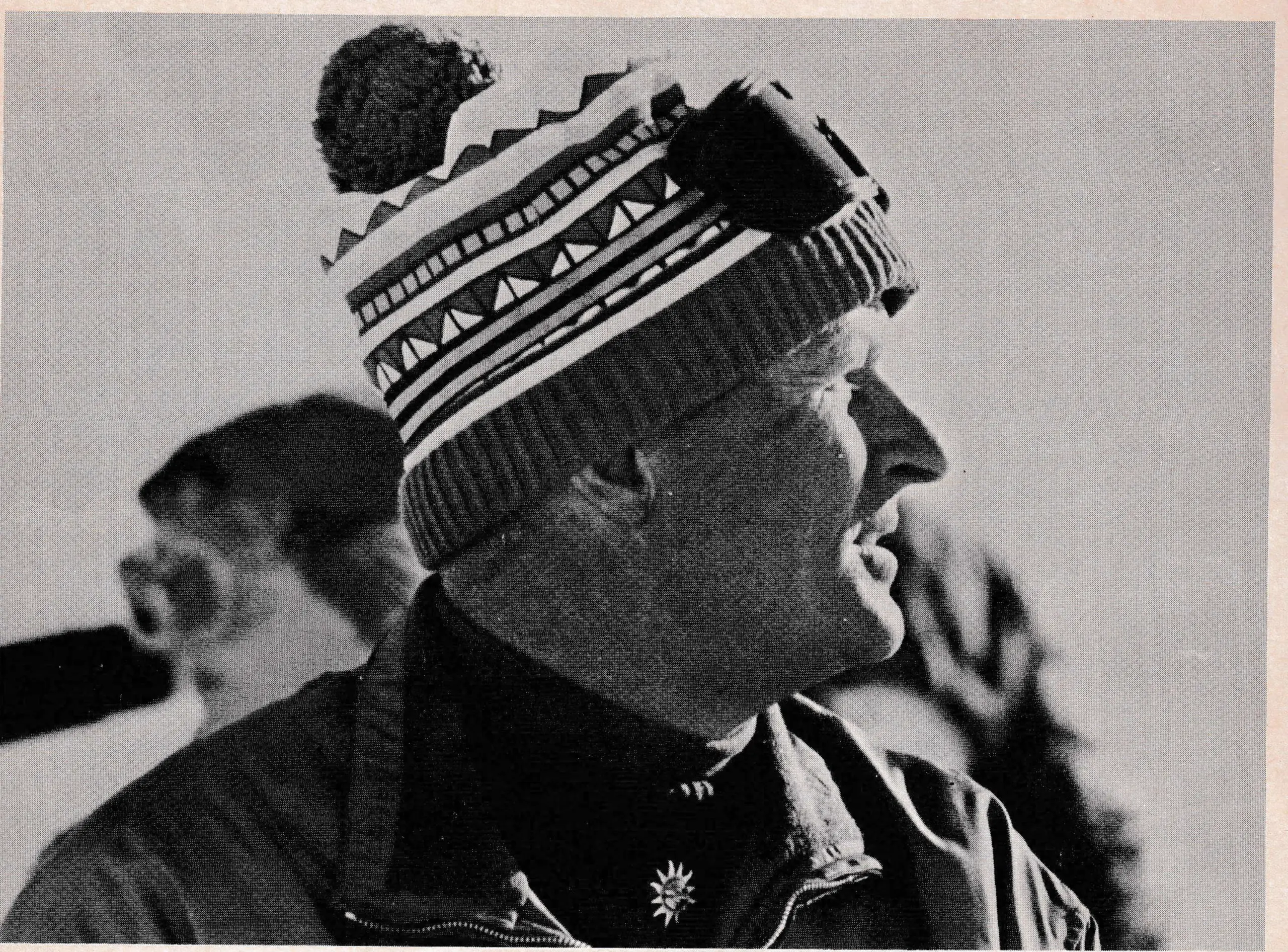
How does Bill Janss feel now that he is on his own, silver cord cut completely? “Great,” he said, sitting in his formal worksuit at an heirloom desk in the Sun Valley Lodge: short-sleeved shirt in riot colors and unmatched baggy corduroys. (There’s a rumor Janss is color-blind.) Janss’ light blue eyes, wide in perpetual surprise, seem to take in the whole scene, whatever it is, at once, and tuck it away up in the memory tapes spinning around in a capacious professorial head fronted by an intent expression that keeps Janss from appearing intellectual in the ivory tower sense. Said Janss, “I love it. If anything goes wrong, it’s my fault.”
Bill Janss’ first job was managing a family cattle ranch in Conejo, 40 miles outside Los Angeles, and he rode the range and punched cattle with the best of the cowhands. He also played a crack game of polo. By then, Janss had already sowed his wild oats, graduated from Stanford (1940), skied in Europe, made the 1940 U.S. Olympic ski team as an alternate, met and married his wife Anne and honeymooned at Sun Valley.
As an aside, he had invented the first ski racing helmet, devised from one of his old polo hats.
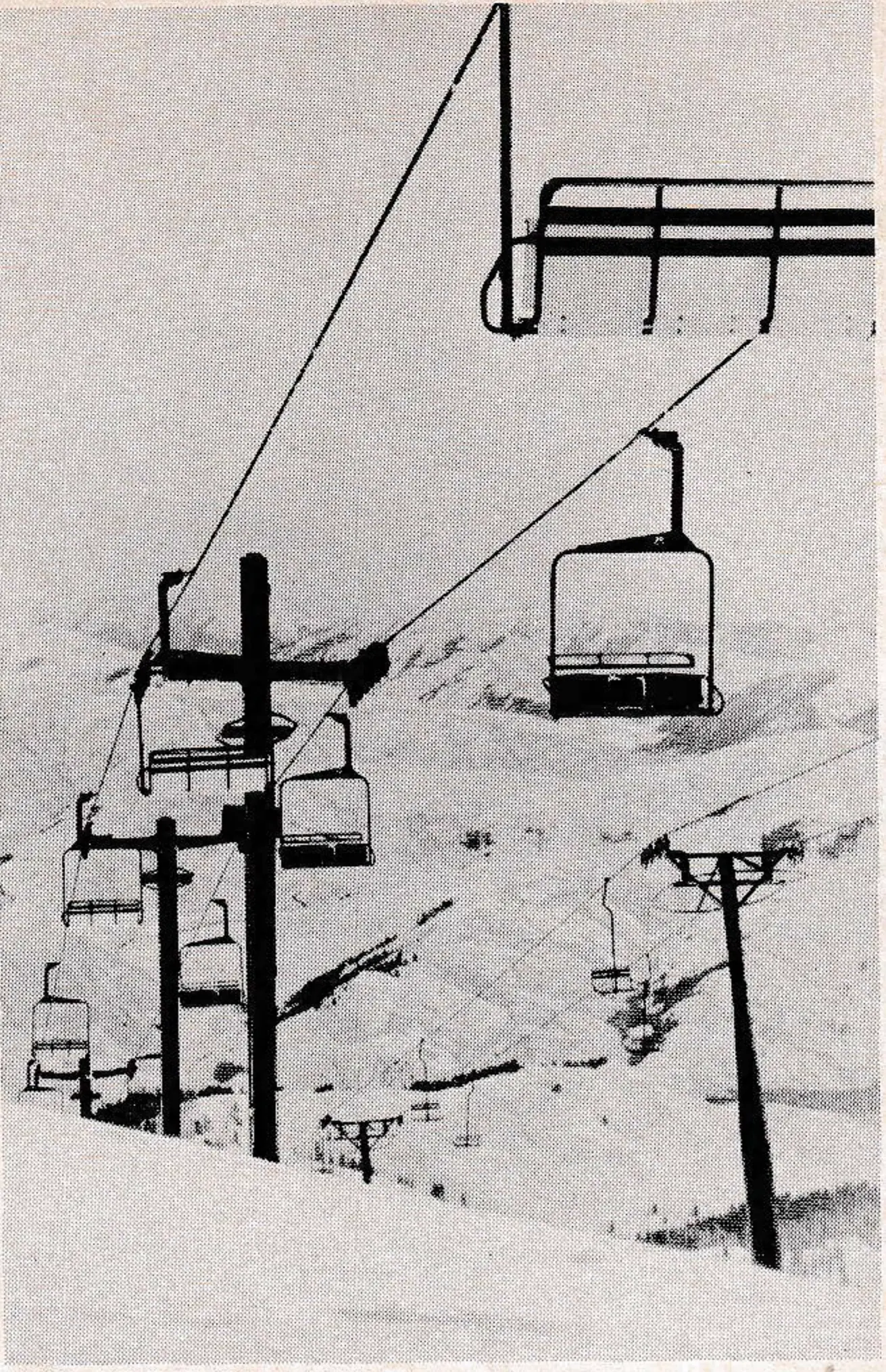
Cow ponies or polo ponies or skis, Janss loves to move fast. Last year he was still racing: he came in third (racing with an improved helmet) in the National Veterans just behind Franz Gabl, having risen from his desk without a day’s practice. Janss has also been running fast at the desk. In the last six years, Sun Valley has built an average of a lift a year, and the gross sales have quadrupled, from $3 million in 1964 to $12 million today. (More than $4.5 million has been invested in the area since Janss took over ownership, and assets have increased to $10 million.)
While Janss was working on the Conejo ranch, his uncle Harold, one of the two reigning Janss pharaohs, called him in and said he’d noticed that he had taken a day off in the middle of the week. Bill pointed out that he’d worked a month straight.
Uncle Harold then niggled on through the record, and boggled at an item: young Bill had charged the company $5.75 for a set of spurs. By this time Bill had enough. He resigned on the spot and went in with his brother Ed on a cattle feeding enterprise in Thermal, Calif., the closest winter feeding ground to Los Angeles. It was an inspired move and soon young Bill was a wealthy young entrepreneur.
While Bill was in his temporary, remunerative, self-imposed exile from the main body of Janss’s, the family went into its second “new city,” Thousand Oaks at Conejo. The family bought out Harold, who retired, Bill was brought back to help with Conejo, and the Bill-Ed cattle feeding operation was “folded back in” to the family. Then the Janss’s bought a ranch outside of Aspen, a ranch that, in co-operation with Aspen Ski Corp., qiuckly became Snowmass, helping Aspen draw enough skiers of the wide, wide trail variety to keep Vail at bay.
The Janss family kept on going—into real estate in Hawaii, with a big $60 million plan at Kaanapali Beach, and in California with another big one at Lake Nacimiento. Then they put some of the remaining chips—guess where—into Bill’s old honeymoon spot, Sun Valley.
This is where the Bill Janss story really begins because he finally ransomed himself out of the family, trading his shares of Janss Corporation stock for what the family had of Sun Valley stock. Today Sun Valley is held by Bill Janss, his wife and three children. Period.
It was no secret that Sun Valley at the time of purchase had ridden through history as a Union Pacific Railroad write-off. Averill Harriman had commissioned Sun Valley’s existence because 1) Harriman liked to ski and 2) because it was the snowiest spot at any terminal of Harriman’s railroad. Every year the budget meeting of Union Pacific opened with the same question, how much to put in to cover the annual Sun Valley operating loss.
“As a consultant to Union Pacific,” Janss said, “we made an in-depth study of the valley. Then one day we realized the place was so perfect and had so much potential that we ought to buy it.” So Janss bought this annual loss and showed Union Pacific how to make money on Sun Valley—sell it to a Janss.
“Sun Valley was not a destination point for Union Pacific,” is the way Janss puts it. (He likes to talk in terms of “destination points.”) But for Bill Janss, Sun Valley was a destination point. Thus it was that for the first time Bill Janss was in a losing business.
The first thing to do was to look at the books, and they looked mighty strange. The coal had come in free from Union Pacific and there was no corresponding charge to Sun Valley; all the Sun Valley Lodge laundry was done free down in Omaha at the Union Pacific laundry. Sun Valley was losing money faster than it looked.
The difference between Janss and Union Pacific, however, was that Janss had land development experience. “I saw Thousand Oaks grow,” said Janss, “and got a feel for what could be done with land.” Janss felt the bottom lands of Sun Valley, 4,300 acres, in conjunction with an extended capacity on Mt. Baldy and Dollar Mt., could be a gold mine—in fact they have been. Janss immediately expanded the lodge capacity by building a series of condominiums right next to the venerable Sun Valley Lodge, perfectly in taste and tune.
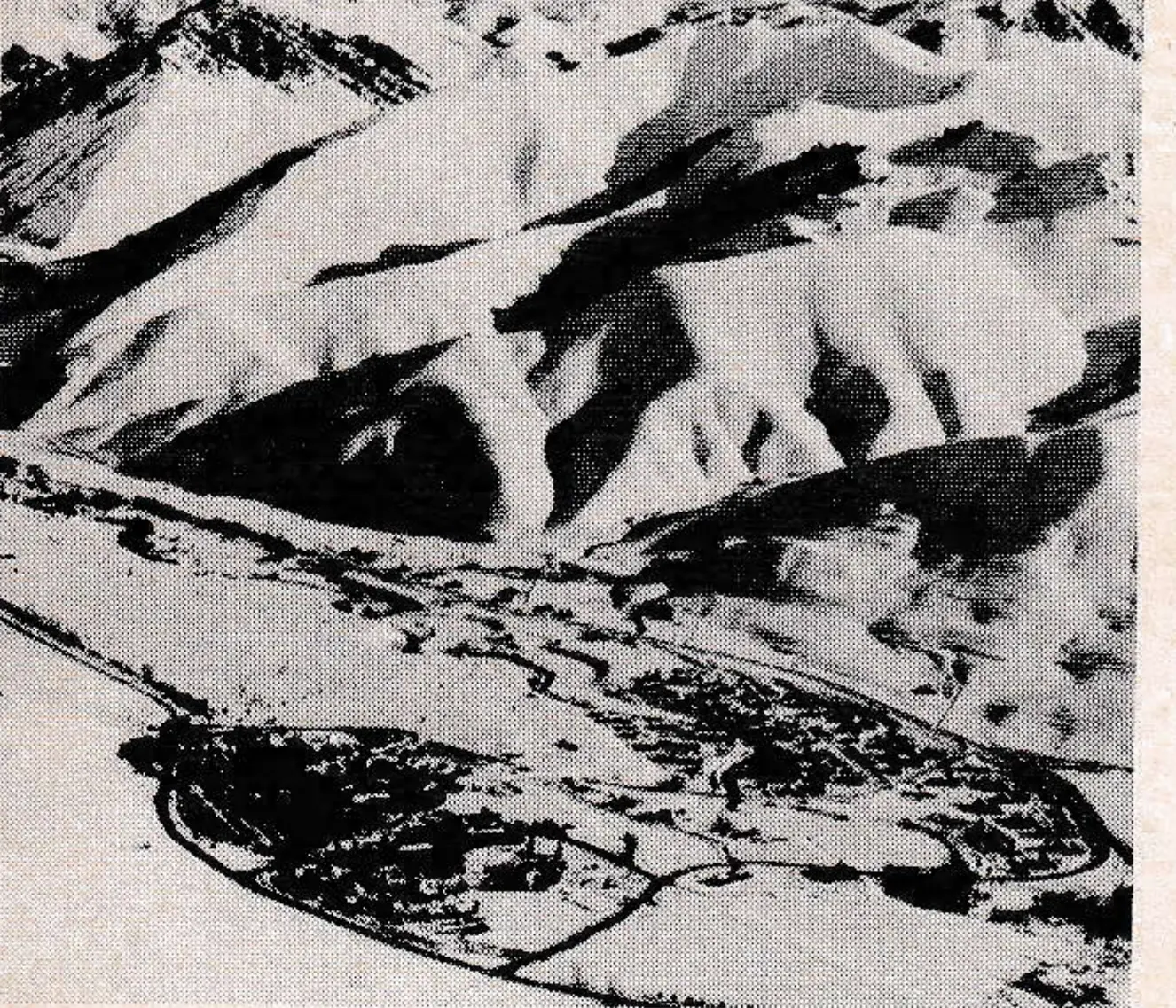
“I realized that one problem with Sun Valley was that the village had to have a certain size. You had to have enough people to support five or six good restaurants, and more than one night spot.” (Brother Ed helped out there, bringing in a steel drum band from Los Angeles and ensconcing it in the boiler room, now known as “The Boiler Room.” Brother Ed is the swinger in the family.) After the Lodge condominiums, Janss put in a sizeable shopping mall right next to the lodge and backed it with a parking lot that is not visible from the village. In fact, there’s no vehicular traffic from one edge of the original Sun Valley village to the other.
In the next few years, Janss doubled the village’s beds, to 2,500 plus, by putting in four clusters of condominiums in succession—the Ateliers, the Villagers, the Dollar Meadow condominiums and the Cottonwoods—across Sun Valley Lake from the original Sun Valley buildings.

This year Janss went in with Johns-Manville to form a whole “sister city” over the next 10 years in a secluded adjacent valley: Elkhorn village, with its own intermediate and beginner lifts that will connect with those of Dollar Mt., now in place. Sun Valley has 15 per cent of the action.
The projected development costs over the 10 years at Elkhorn are $38 million or more, but, as Janss pointed out, the Johns-Manville equity is in land and institutional lenders will be used for the remainder of the funds.
Elkhorn will again double the number of people; to Sun Valley and Ketchum’s 4,000, it will add another 4,000 over 10 years, This will put the Wood River skiing population in the same league as Aspen.
Janss is not only a developer, but a skier. He’s up the lifts nearly every other day. “If something goes wrong on the mountain, it really gets to Janss,” said a friend. “He likes to ski.” The mountain at Sun Valley has come alive. Every ski mountain designer worth his salt knows you can’t just let a mountain go stale. Something has to be happening and it has to be good. “I could see that when we took over. Right away we had to get some land sales and plow that back into the mountain,” said Janss. The mountain has been humming ever since. Janss opened up the whole north-side, and this, together with new high capacity lifts on the south side, just “made the skiing on Mt. Baldy 10 times better,” according to one longtime Sun Valley-ite.
The Janss formula has been simple. Give the people a hill that equals any in the country (and keep it groomed for the intermediate), give them a place to stay nearby, financed by the owner of the hill—and stand back.
Janss has infused some $35 million in the first six years and this so stirred up the people of Ketchum, a town that used to be a spot where Sun Valleyites went slumming, that “Janss fever” is rampant. Ketchum’s people, new and old, have started condominiums on their own. More people for Janss’ lifts.
The new problem, of course, is the one that now crops up everywhere: total planning for the long run—or, in a loaded word, ecology.
Today, everybody’s got ecology and Bill Janss is no exception. “We will limit size and restrict expansion to new satellite villages with plenty of space in between,” he says, “and we will not destroy our principal attractions, space and quality.”
Janss has his own planning expert, who has laid out inviolate greenbelts and recreational areas; Sun Valley, the city, which has incorporated, has its own planning people, and so does Ketchum; and down the line 10 miles, so does Hailey. There’s also a county planner, John Vhay, to fill in between, in spots like the new Bigwood project, a hotel and condominium complex near the Hemingway Memorial, which could eventually put another 4,000 beds into the town.
Vhay is starting a council of governments to integrate the planning of the entities that in the future will determine the shape of the valley’s expansion. The result will be significant for all of skiing, because Sun Valley’s preeminence has always been a mark for the rest of the ski industry to shoot at.
Janss knows that the key to continued preeminence is the skiing. “Our policy is no lift lines and lots of space. We like to give skiers options. The skier doesn’t come all the way here to stand in line or ski one congested trail over and over. He can do that where he came from.”
Sun Valley grooms the steepest runs of any resort in the country, including four of its famous bowls. When one trail gets over-used, Janss shuts it down and puts his snow blower in to take the snow from the sides and put it back in the trail. Then he cuts the moguls down and re-opens. Next year Janss will have a $400,000 mountaintop restaurant, another lift on the Warm Springs side, a new lift to circulate more people into the four large bowls and a new Elkhorn Dollar Mt. lift. He knows he has to stay ahead of the skiers.
“Our goal is a quality resort,” said Janss. “We’ve plowed everything back. I don’t think anyone is going to touch us from here on in.”