

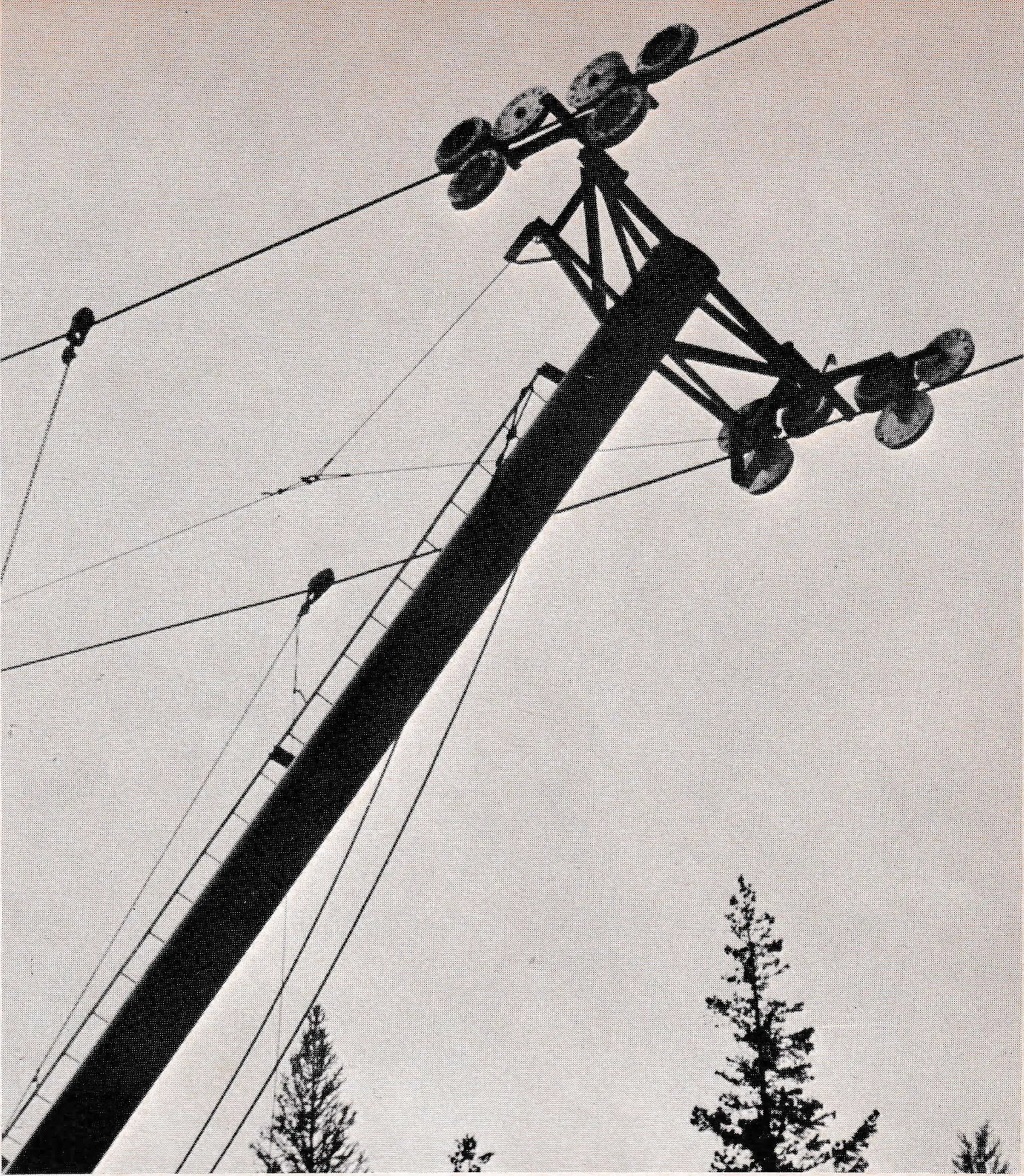
The request presented us with a problem for the towers were to be erected on excessively steep slopes. Tower 4, 37 feet long, was to be built on a face 180-foot lineal and 75-foot vertical from the nearest access area. Tower 8, 27 feet long, was on a face of 200-foot lineal and 80-foot vertical and Tower 9, 35 feet long, was on a face 510-foot lineal and 216-foot vertical from the nearest access road.
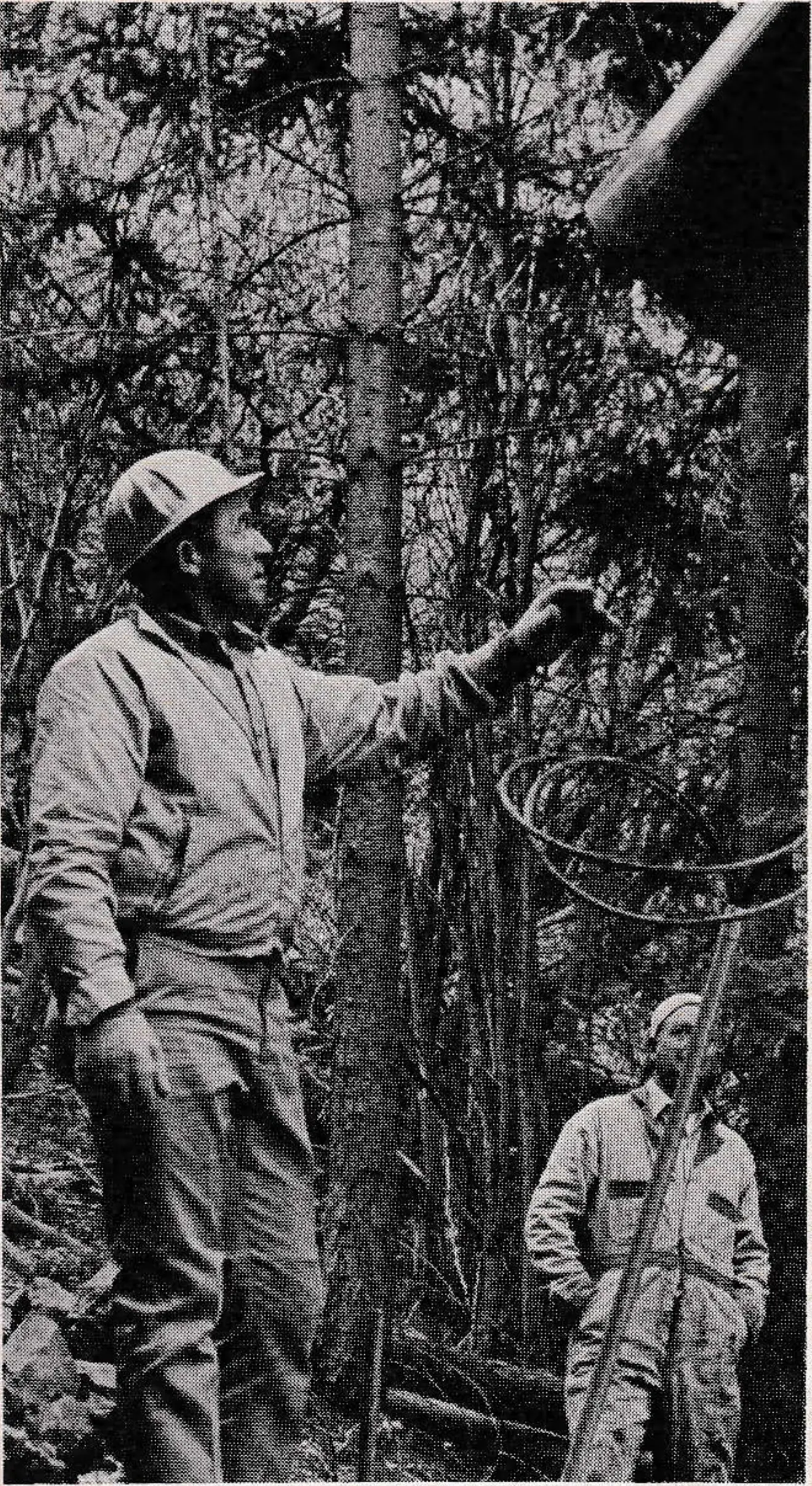
Our first plan was to high-lead the towers to the sites, but an overly ambitious clearing crew felled the only tree suitable for a spar. With the tree gone, mountain manager Al Hampton hit upon the idea of putting the main lift cable in before the three towers were erected, then setting the towers on the cable below the sites and towing them into position with a winch located further up the liftline.
A completed tower was set on the cable with a crane with the counterweight lowered. When the tower was in position, the radioman called the top to have the counterweight raised, lifting the tower off the ground.
As none of us had any experience with this method, it wasn’t known whether the cable would carry Tower 4, the highest of the three, free of the ground. To insure that it would, we put additional sheaves on the cable with chains, that could be used to lift the base, running to the bottom of the tower. With Tower 4, the first that we tried, we found the additional sheaves and chains were unnecessary, and Towers 8 and 9 were towed up the cable supported only by the tower machinery. As an added precaution and to insure that the cable would not derail, two of the sheaves on each side of the tower were reversed so that their flanges were on the outside.
After the tower was towed into position the top was radioed to lower the counterweight and the tower moved down into the base section, perfectly aligned and ready to weld.
Using this method, it took only four hours to erect Towers 8 and 9. Although a detailed cost analysis was not made, it was estimated that this method was no more expensive and possibly less costly than clearing and building access roads to the sites, an alternative that would surely have come under environmental challenge.
Walter Hampton is general manager at Mission Ridge, Wash.