


A review of the most serious lift accidents in recent years indicates that one cause of such accidents far outweighs all others—lift roll-back. Though a detailed study of accidents fails to show that lift-slippage, or reverse rotation, was caused by a specific failure or malfunction, a continuing analysis proves that not a single roll-back accident would have occurred if the braking systems had operated correctly.
The failure of a lift’s brakes to function properly can be attributed to a variety of factors—poor design, poor maintenance, operator error, etc. The fact remains, however, that had all lifts been equipped with properly designed, maintained and operated brakes, all major lift accidents in recent years could have been cut in half.
When we think of roll-back, the first thought is of a chairlift slipping backwards with passengers jumping from the lift or being carried into the lower terminal at high speeds. This description, of course, does fit the majority of the accidents, and such accidents are not limited to chairlifts. In one instance, a skier was carried around a bull wheel on a wire rope tow when the backstop failed to keep the tow from slipping backwards. Thus, although the potential danger is far greater on aerial lifts and tramways, it exists on all types of lifts and tows.
What brakes are needed? An examination of the American National Standards Institute B77. 1-1970 Standard outlines minimum requirements for braking. On the chart at right is a list of these basic requirements.
The fundamental requirement for lifts and tows where the skier remains in contact with the snow surface is to prevent roll-back when the lift or tow stops. The wire rope tow accident mentioned above is an extreme example of the serious injury that can result from roll-back, yet even rear movement of a few feet can cause skiers to fall.
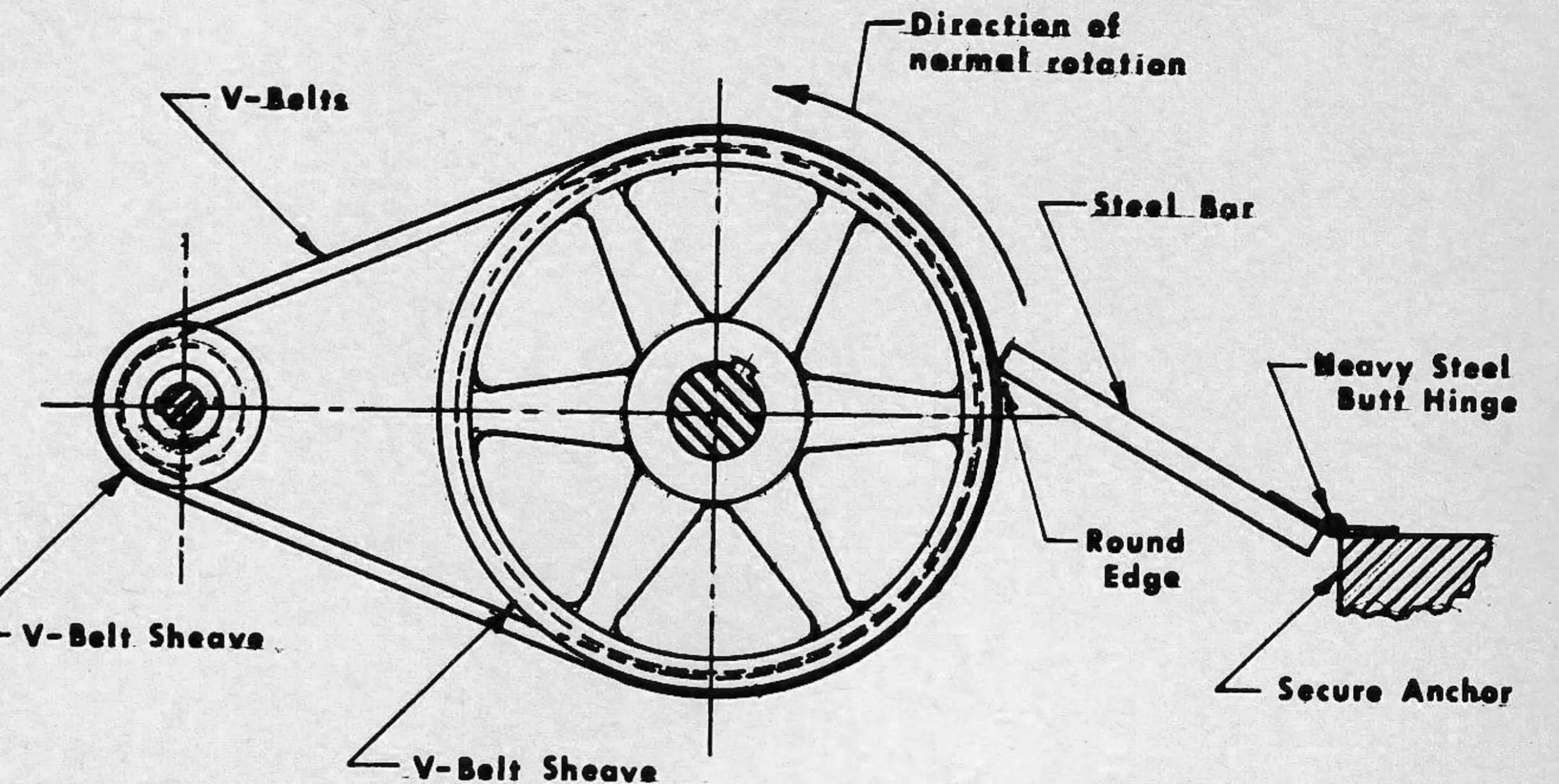
The types and arrangements of backstops used on lifts and tows are varied. It should be noted that the backstop need not be attached directly to the drive sheave, although an increased degree of safety can be achieved by so locating the backstop. The primary requirement is a backstop brake that is reliable. Extremely simple and effective backstops—one type is shown in Figure 1—can be rigged for tows that require little maintenance.
Where lifts and tows have excessively long stopping distances, a second brake is needed. This type of brake, frequently a motor-mounted electric solenoid, has brake shoes or discs applied by spring pressure and an electromagnet to pull the brake off. When electric current is applied to the motor, the magnet energizes and releases the brake. Cutting the current to the motor also cuts the current to the brake magnet and allows it to snap on.

Usually the braking effort and the abruptness of the stop can be adjusted by adjusting the springs in the brake. Care must be taken to see that the magnet is correctly positioned in the electrical holding coils to prevent these coils from burning out. The brake should be checked daily by having a member of the ski patrol or lift crew ski through the safety gate, noting the stopping distance beyond the gate.
Aerial lifts
The potential danger of a roll-back on an aerial lift is many times greater than for a surface lift. On a typical 4,000-foot double chairlift more than 180 passengers can be upward bound, representing an unbalanced weight of over 30,000 pounds. Should a mechanical failure occur in the drive system, the resulting effect of a free-wheeling reversal with inoperative brakes can be disastrous.
Tows
- If the average grade is over 10 per cent, a backstop brake is required.
- If the tow, when empty and operating at maximum speed, will stop in 25 feet or less, no additional brake is required. If not, an automatic brake must be installed that will stop the tow within 25 feet. This brake must operate automatically when any safety gate is actuated.
Surface Lifts
- A backstop brake is required.
- The backstop brake is identical to the requirement for tows in regard to stopping distance except that for lifts operating at speeds of over 670 feet per minute, an increased stopping distance is permissible based on the following formula:
d = V2 / 18,000
(d = stopping distance in feet; V = lift speed in feet per minute.)
For example, at a lift speed of 750 feet per minute, a stopping distance of 31 feet is permissible.
| Lift Speed (feet per minute) | Maximum Stopping (distance in feet) |
|---|---|
| Up to 316 | 10 |
| 387 | 15 |
| 447 | 20 |
| 500 | 25 |
| 546 | 30 |
Aerial Lifts
- A backstop brake is required that acts directly on the bull wheel, bull wheel ring gear or the haul rope.
- A service brake, also required, should stop the lift in the distance shown in Table above without undue swinging of the carriers or cause excessive oscillations of the haul rope. This brake must be applied to the drive shaft with no clutch or similar device located between the brake and the drive sheave.
- An emergency brake is required, this to be located on the drive sheave with the manual controls for applying the brake located at the operating station.