


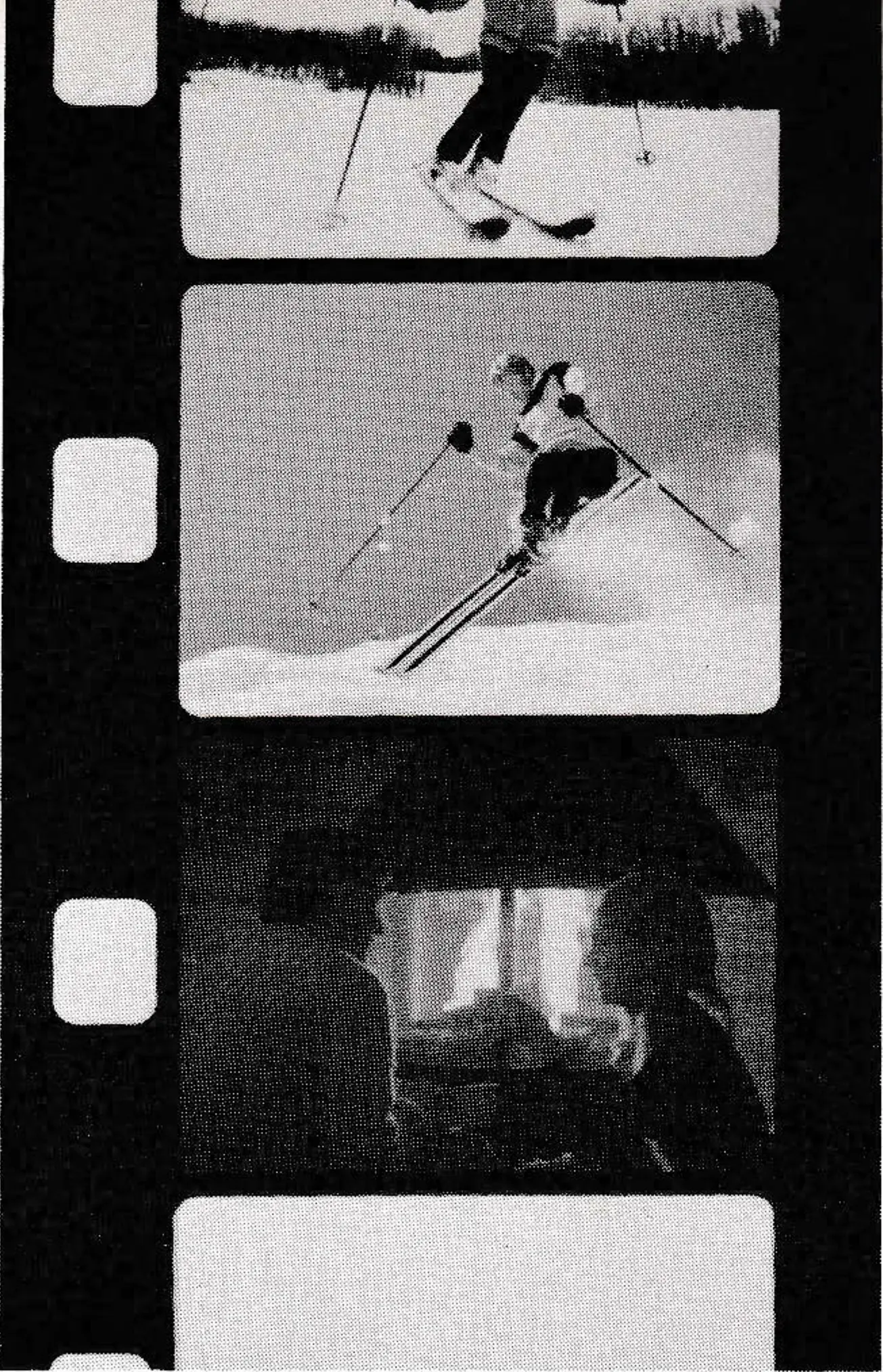
Because you can’t create such ideal conditions at will, the next best way is to show them the same thing in a color, sound movie. An impossible dream on your operating budget? Until recently, perhaps, but not any more, with movie cameras, like the Kodak Ektasound super 8 sound film, and a well-thought-out plan you can do it yourself.
The plan is the place to start. Begin by listing, on cards, the features of your area you want to emphasize. Do you have a choice of slopes from beginner to expert? Are your lifts unusually impressive? Does your lodge include a bar, fireplace, restaurant, and night life? Do you have trails for cross-country skiers? Are the lessons you offer GLM or an other perhaps unique, system?
Fast films and modern camera developments allow you to film virtually anything you can see through the viewfinder. This permits you to shoot indoors or out without movie lights, so including apres-ski scenes in the lodge is no problem.
When your list is complete, arrange the cards in a logical sequence to tell your story, noting on the card the approximate time each subject is worth and bearing in mind the overall length you plan for your movie. Twenty minutes to half an hour is probably enough for most audiences.
Now you are ready to consider each subject segment in terms of the scenes which will be included in it. This is where you start thinking of camera angles, scene lengths, and camera-to-subject distance. In all three, the procedure for maintaining visual interest is to vary the angle, time, or distance involved.
This detailed planning may seem to be time-consuming, but the results will be worth it. And, since you can’t start shooting until the snow comes back, you can plan now. Not only will a plan help your film do a better selling job for you, but it will also save film and editing time later.
With your plan completed, you are ready to move on to the subject of camera handling. The most important thing to remember in using a movie camera is that the action should be in the movie, not in the camera. Hold the camera steady for the duration of a scene. Stop filming. Move to a new angle and film again.
Panning (moving the camera sideways) should be done seldom and slowly. When you feel there is some advantage to panning, move the upper part of your body and the camera slowly and steadily until you have filmed the whole panarama in front of you.
For action shots on the slopes, position yourself so that the skiers will be coming toward you for a 10-or15-seconds or even longer. Remember that some falls as well as expert skiing, hot-dogging and even clowning will add interest to the finished film.

When you do want sound the movie camera will record with lip-synch, allowing you to record voice-over as you film, or with some units like the Kodak you can postrecord on an Ektasound 245B movie projector.
To film with sound, you plug the microphone into the camera. On the whole, the microphone should be closer to the source of the sound than to the camera, and always at least three feet from the camera. Indoors, place the microphone on a soft surface (hard surfaces reflect sound), such as a carpet or a cushion, in the center of the group you are recording.
Be alert for extraneous noises. The microphone does not tune out background noises the way the human ear does, so you have to edit the sound the way you edit the content of your pictures.
Remember that sound does not necessarily mean a voice or voices talking all the time. There are times, such as a scene of an expert skier swooping through fresh powder, where a musical background would be much more effective than a distracting voice. Or, at other times, the natural ambient noise of a scene sets the mood better than any commentary. The happy chattering in the lift line, the more boisterous laughter in the bar, or the subdued murmurings in front of the late-night crackling fire are all cases in point.
The addition of sound to your movie can give its selling impact a boost. A sound track allows you to provide necessary information, such as cost of lift tickets, slope statistics, rates for lessons, and so on. Avoid explaining things that are perfectly obvious to the viewer. “This is the chair lift,” for example, is clearly unnecessary and A verges on insulting the intelligence of your viewers.
Editing your finished film is an important part of your effort. For free instructions on how to edit sound films write for “Sound Movies,” publication Ad-14, to Dept. 841, Eastman Kodak Company, Rochester, N.Y. 14650.
Sound Cameras
While Eastman Kodak originated the super 8 sound cameras with the advent of film cartridges with sound recording capability, other manufacturers are coming on the market with cameras which accept this film. Here are some of the brands and models currently available:
- Bell & Howell — Filmosonic XL 1230, $319.95.
- Bolex — 550 XL, $460, and 580, $460.
- Eastman Kodak — 130, $199.95; 140, $284.95; 150, $363.50; and 160, $413.50.
- Elmo — 600S, about $400.
- Eumig — Sound 30XL, $369.95.
- GAF — 250 XL, $349.50; SS 605, $399.50; and SS 805, $449.50.
- Sankyo — Sound XL-40S, $400.