


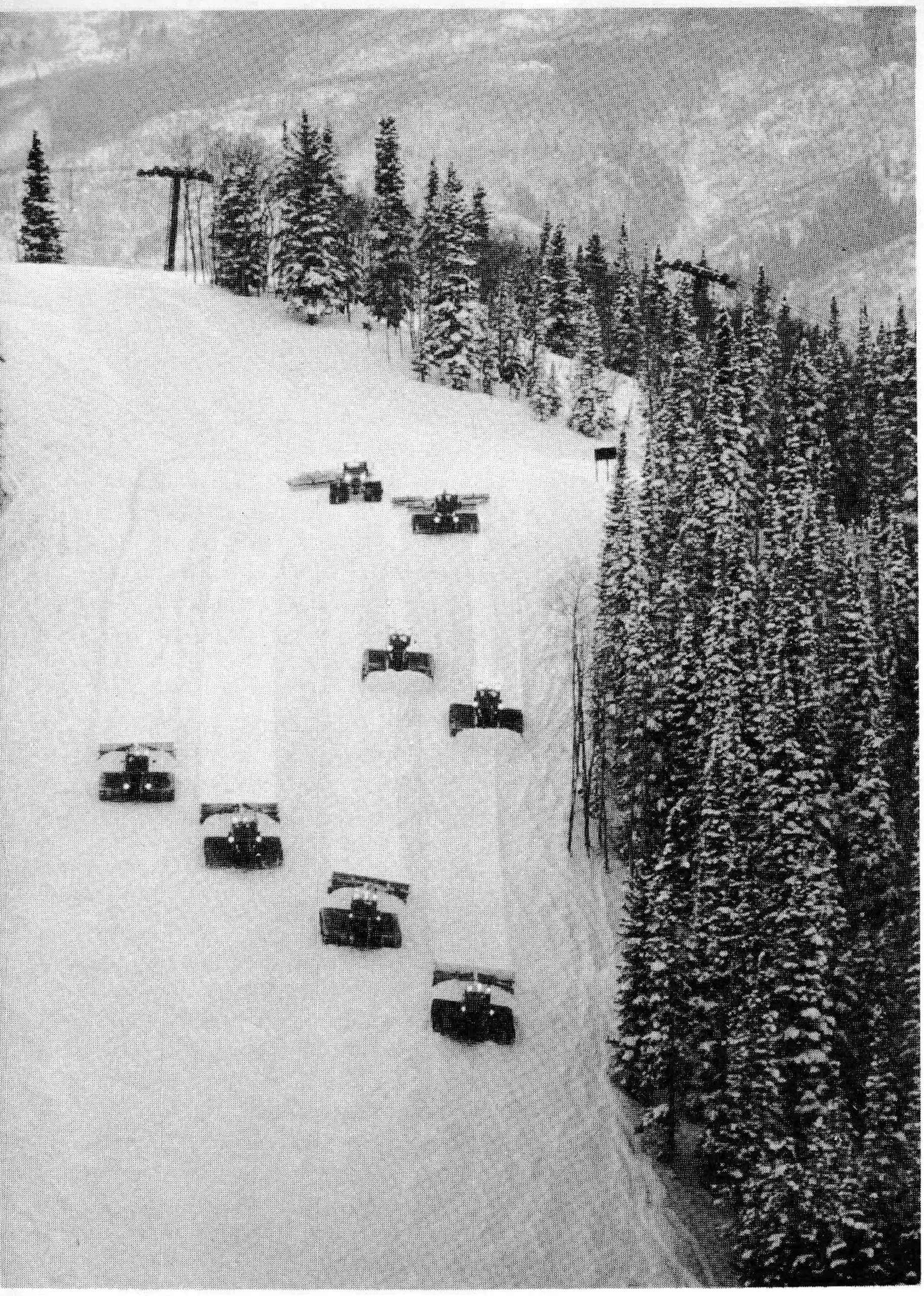
“We’re working at night. It’s too dangerous and too complicated to try to work in the day time periods,” says Gary Kline, mountain manager. “I don’t care how careful the operators are, or how many precautions you take, there’s still a chance that an out of control skier can tangle with one of the machines if you work during the day.”
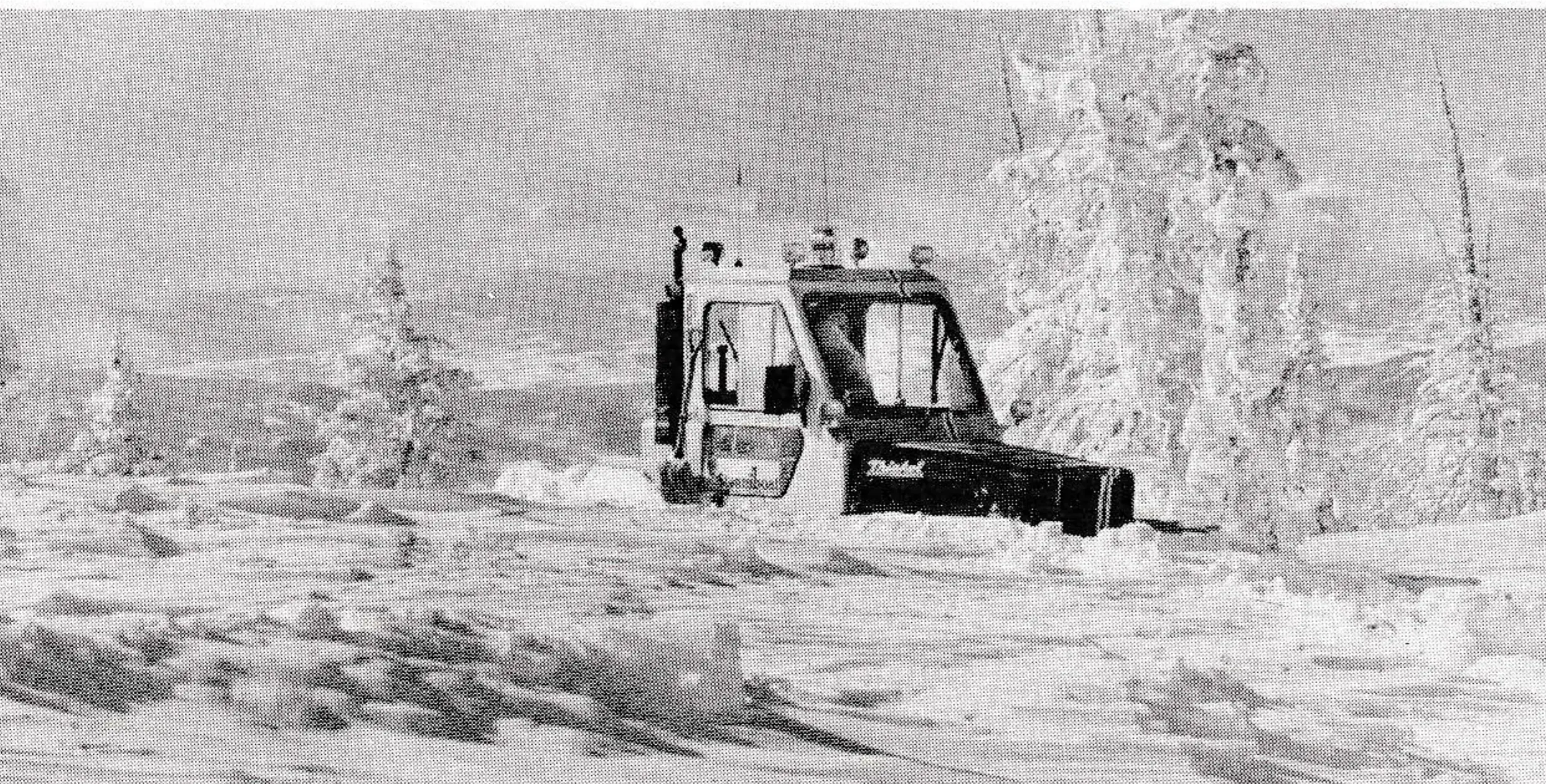
There’s also the chance that a machine might malfunction, says Kline, who has over ten years experience perfecting snow and skiing conditions. Although it takes some time getting used to working at night, the operators prefer it that way. Since most are avid skiers, night work allows them to ski in the daytime, and also view their handiwork.
Another important reason for nighttime slope maintenance is the time it takes for re-worked snow to “cure” or “set up.” Maximum density is reached in 24 hours, with half of the cure occurring in the first six hours. If a re-worked trail is skied right away it will last only a few hours, compared to a trail that has been cured for 8 to 14 hours which lasts up to five days. This is why high priority trails are cut first, to give them maximum time to cure.
Cat crew boss Ted Cordova and seven operators begin work at 4 p.m. and continue to 2 a.m. They utilize seven 2100 Thiokols and one 542A Tucker each night to maintain Steamboat’s 580 acres of trails. Two additional operators arrive at 12:30 a.m. and continue till 8:30 a.m.
Cordova’s crew works a schedule prepared by Kline, who skis the trails daily and also relies on ski school and ski patrol reports for needed trail work. In addition, trail work is decided on a priority basis worked around degree of difficulty of the trails and those with high wear rates.
“The one thing we try to shoot for in slope maintenance is to make sure the beginner’s area is groomed. That’s an everday (night) project we never miss,” explains Kline. “We can’t put a rank beginner or even a good recreational skier into six inches of brand new powder and expect him to learn how to ski with ease.”
As a result, the beginners trails receive top priority followed by the heavily trafficked intermediate runs. The advanced powder skiing areas are almost never touched. “Every trail’s different. You have to work every trail differently because of different snow conditions.”
Cordova’s crew ended the season with approximately 40,000 acres of trail work and 8600 hours of equipment time logged. Equipment used that heavily requires maintenance, and that’s where shop foreman Walt Trout comes in.
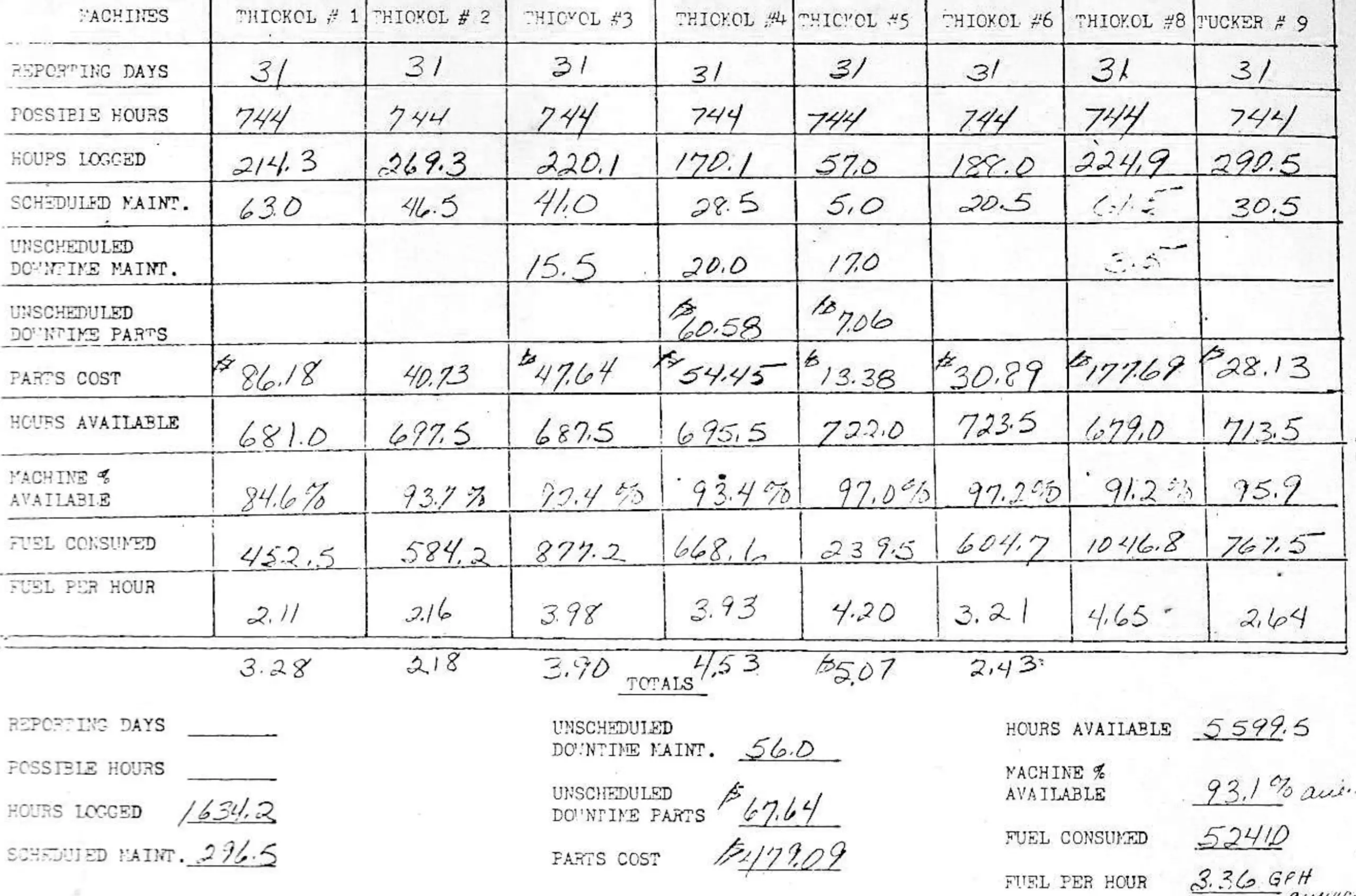
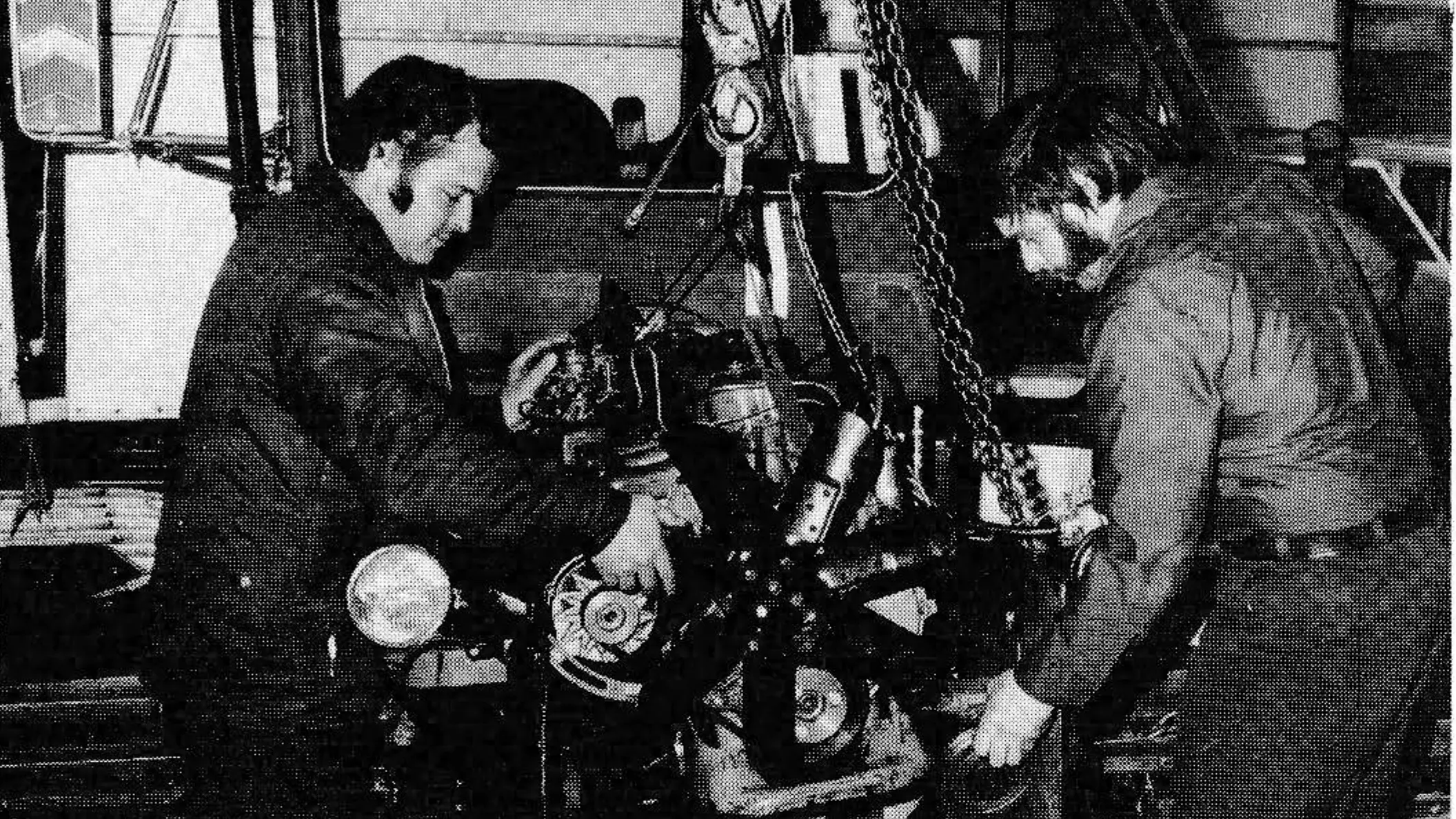
Trout’s daily schedule begins with reviewing the “bitch” sheets turned in by the cat crew on repairs or malfunctions on the machines. From this work orders are written and submitted to the mechanics responsible for their assigned machines. Slope maintenance equipment is checked daily even if no problems exist, and each machine is serviced every day, lubed and checked out to make sure it’s running okay. After every hundred hours of operation it undergoes a complete service. After two hundred hours it is placed on the analoscope to determine it it needs new points and plugs, and to check the overall running condition of the machine.
The maintenance shop at Steamboat is ultra-modern, with 5400 square feet of floor space equipped to handle all major repairs. The work goes on seven days a week, 10 hours a day, during ski season. Kline’s operation is responsible for eight slope maintenance vehicles, one lift maintenance cat, five construction and road machines, and 26 road vehicles belonging to LTV Recreation Development, Inc., developers of the ski area.
Excerpts from the Steamboat manual
On the machines: “These machines are brainless. So when you pile one into a tree or bury it up to the windshield wipers, or it just plain won’t run right; remember, it was designed by humans, built by humans, maintained by humans and operated by humans. Don’t cuss the poor chunk of iron; it is only as smart as the operator sitting in the seat.”
On radios: “That small official looking instrument is vital to you and your job. Leave it off, and you will receive a paycheck faster than you thought possible. Forget to mention that “it don’t work” and you’ll find out how dark and cold that mountain can be when your machine breaks down.”

On Powder-making: “Traveling too fast will cause the rollers to start bouncing, leaving miniature ripples, which turn into big ones in no time. . .Give me mini-ripples and ridges, and I’ll give you a snow shovel!!!”
On results desired: “There are two things that really rag my a–: a) spinouts that haven’t been cleaned up; and b) turnarounds in the middle of the trail. There are exceptions, but don’t count on them.”
On fuel: “If you have to stop for more than ten minutes, shut your machine off! Fuel is damn scarce!!!
On repair procedures: “You must remember it’s easy for you to visualize your problem as you are writing it down after working all night. But try to put yourself in place of the mechanic who reads these first thing in the morning and finds a few words, four-lettered and otherwise, scrawled on a piece of paper. He must then try to find the problem that goes buzzzz-skree-fazoom when the whatchacallit hits the thingamajig on the right track every once in a while when you have the radio turned down low enough so you can hear it.”
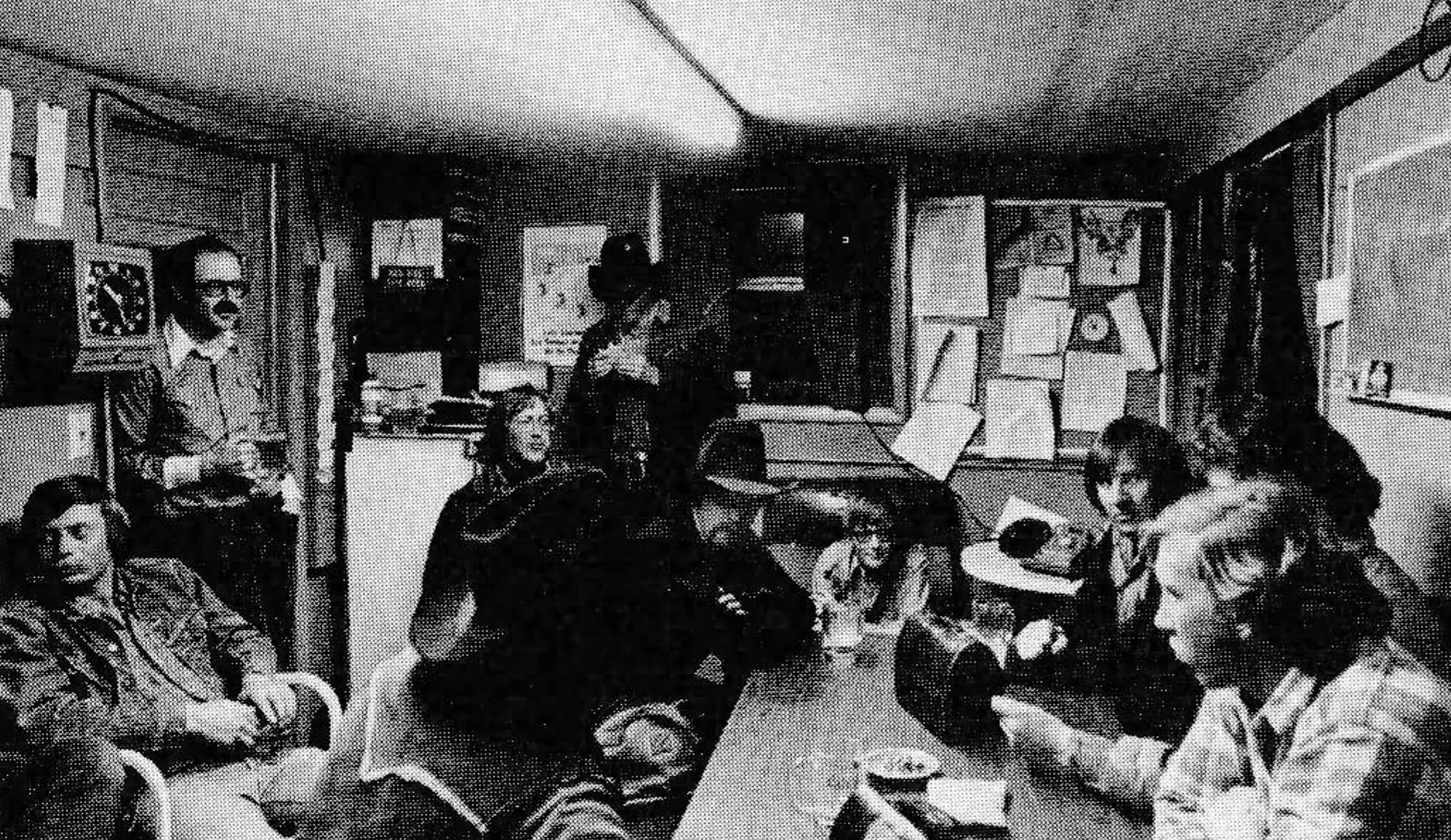
Two of the keys to Kline’s success are personnel training and personnel motivation. “It takes sort of a special person to do what we want,” says Kline. “He’s got to be able to work alone on a lonely mountain at night, but at the same time he has to be part of the team. These guys—and we’ve had some good girls too—have a lot of respect for each other. A trainee who isn’t accepted by the regular crew doesn’t make it with me either.” The sort of person Kline finds ideal is a youngster who has grown up working on a farm. Such a person has probably learned to work long and hard, have pride in what he does, has been used to machinery and knows what it’s like to be depended upon.
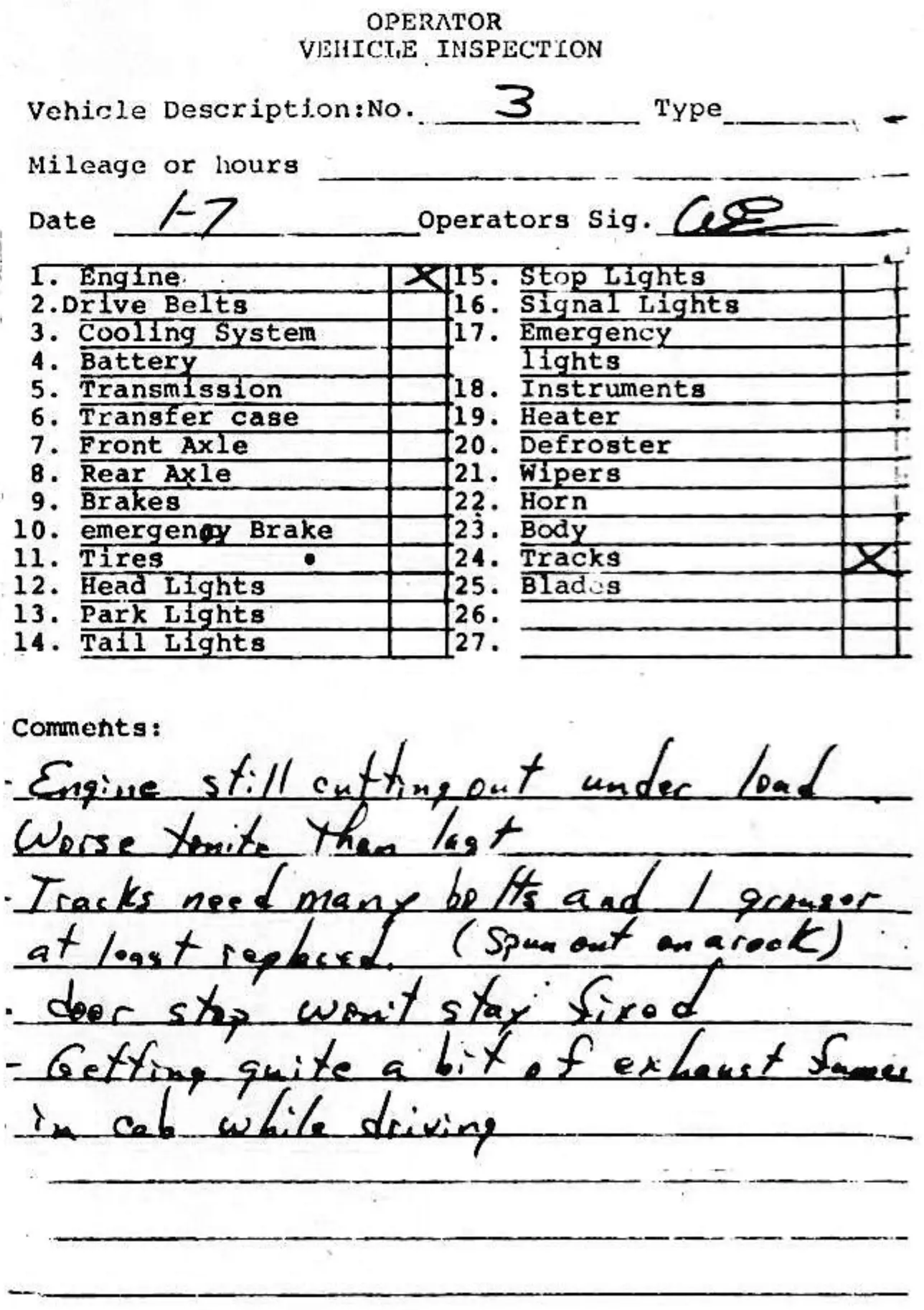
The training is methodical and careful, and is based on a 23-page operations manual written by Kline and Trout, entitled, “Mountain Procedures: Slope maintenance equipment operation and methods.” Blunt, clear and sometimes salty, this manual covers about everything the operator needs to know. Trainees must demonstrate their familiarity with it when they undergo their final operational check-out. This operational exam makes sure the trainee makes all the right moves on: pre-operation inspection, starting procedures, steep terrain parking and end-of-shift parking. The examiner has a two-page check-off list of correct procedures which all Steamboat vehicle operators must follow.
The last paragraph of the manual really sums up what is expected of a Steamboat slope crewman: “Slope maintenance is an art. It’s relatively new, and in a state of constant revision. Don’t be discouraged if you have trouble understanding the complexities, because it is complex! Think like a skier. This will give you an idea of what the finished product should look like.”
There are thousands of skiers around who think that finished product is about the best there is anywhere.