


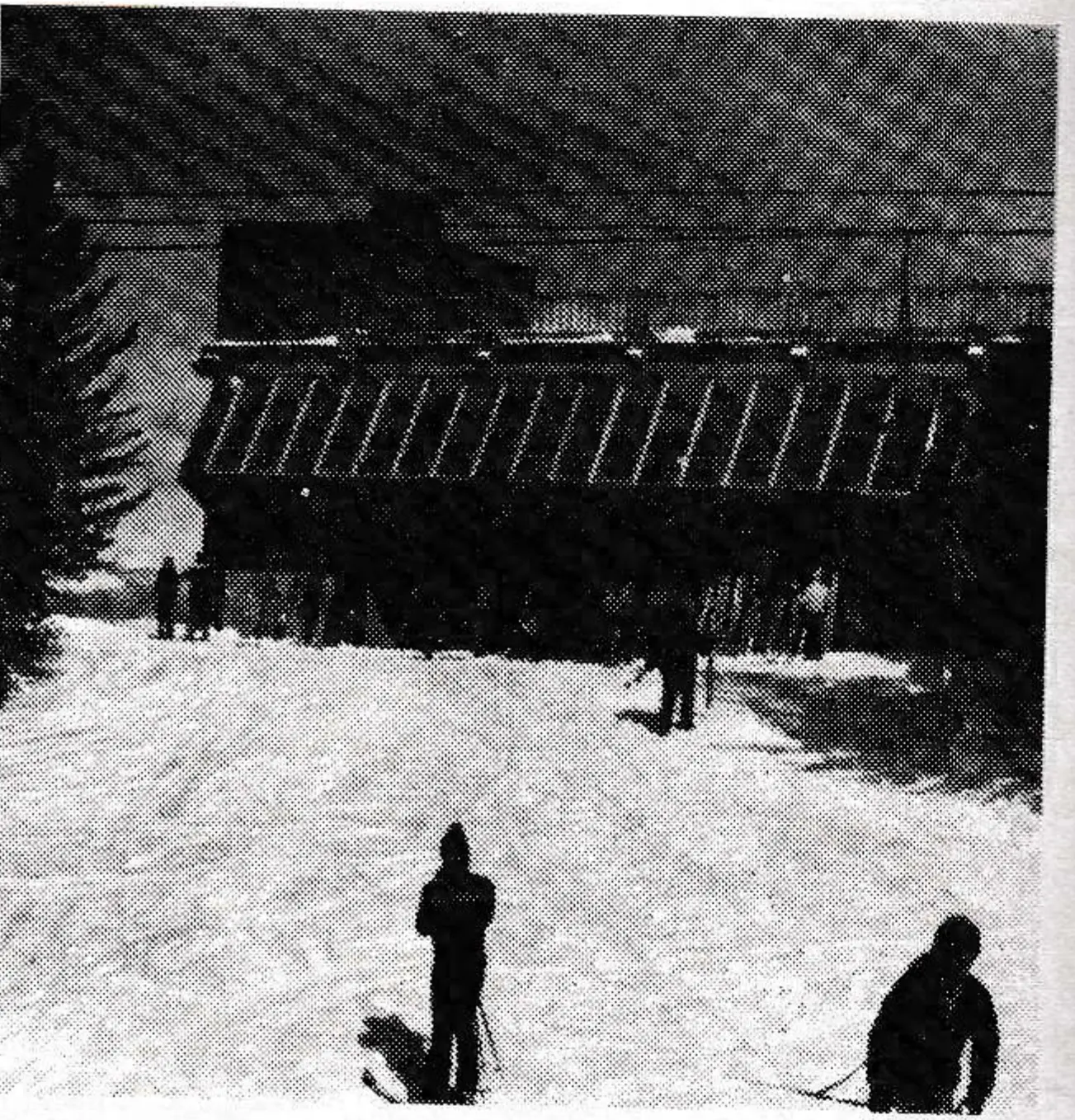
The new lodge is different in a special and important way. There are 24 solar panels providing 50% of the heating and hot water for the building. The cost of the system was about 8% of the total cost of the building. The expected savings on heat and hot water will be about $2000 per ski season. The lodge is only used during the winter months and open to the public for 6 hours daily.
The best way to truly evaluate the solar input is to compare the demand with the solar gain. The building uses an average of 95,000 BTU per hour to keep the temperature at 65 degrees Farenheit. The hot water need is about 200,000 BTU per day. This works out to 2,500,000 BTU per day. The solar panels will individually collect 6000 BTU per hour at this elevation.* This works out to 1,008,000 BTU per day. The solar panels will provide about 50% of the heating and hot water per day.
The system starts as early as 7:00 A.M. and runs as late as 5:00 P.M. The sun hits the top of Huckleberry Mountain first thing in the morning. The lodge is sitting on the very top. What better place for solar heating. Literally on top of the world.
In northern climates such as this, where there are more than 30 days of freezing, a system such as this requires a fluid other than water running through the collectors. This system uses a silicone transfer fluid because its special properties enable it to meet the stringent conditions, i.e., high temperature, non-toxic, non-corrosive, freezing point is -85 degrees centigrade. The silicone is circulated through the collectors, picking up heat from the sun and is transferred by tube-shell heat exchanger to the water stored in a 2000 gallon tank.
The whole system is controlled by two thermostats. The pumps circulating the water and silicone are activated by the thermostats. The thermostats are connected by heat sensors to the storage tank and the collectors. When the temperature difference is 18 degrees, the pumps are turned on by the thermostats. When the temperatures are 6 degrees apart, the pumps are shut off.
To make the system even more effective, a complimentary heating system was selected using three fancoil heating units. Complimentary because the solar collectors operate very efficiently at 150 degrees F. and the fancoil heaters operate efficiently with 120 degree F. water.

The building, all piping in the solar and heating systems, the heat exchanger, the storage tank, and the collectors are very well insulated – half or more of the energy collected can be lost without adequate insulation.
To further improve upon the situation, a 10 Kilowatt per hour windmill was installed. The windmill generates electricity to power three 240 watt resistance heaters in the 2000 gallon storage tank. The windmill when in full operation will contribute about 30,000 BTU per hour to the tank. When the wind blows, more heat is being put into the storage tank for heating the building.
The equipment and design of the Solar system were provided by GGM Solar Enterprise, a retail dealer of GED (General Energy Devices, Inc.) of Clearwarer, Florida. The windmill equipment came from Real Gas & Electric Co., of Santa Clara, California. The “Ranchouse” was built by Chapek Construction Inc. of Sacramento, California.
*The amount of information available concerning energy available at 9000 feet elevation is hard to find. The solar constant is measured 100 miles from the earth’s surface. The constant fluctuates from 428 BTU per foot squared in July to 444 BTU per foot squared in January. The amount of energy reaching sea level is about 35% of the constant. The amount reaching 9000 feet is about 90% of the constant. The 90% figure is an estimate based upon data gathered from U.C. Davis air quality control studies.