

It grew out of a lift accident in the late 1940s, a fatal one. The small skiing community of that time was shaken, area operators as badly as anybody, for they knew many of their skiers by name. These were good friends, for whom they were personally concerned.
But accidents would happen, and serious ones were rare, all things considered. Skiing was young and uphill transportation younger. When an operator started an area—in those days you didn’t buy one, you started it—he himself designed his trails, advertising program, lodge, ticket system, canteen, tows and even lifts. He was spread pretty thin, but he did his best.
Was that best enough? Not satisfied that it was, Roland Palmedo of Stowe and Mad River wrote a few friends in 1949—Perry Williams of Snow Ridge, Phil Robertson of Cranmore, Fred Pabst of Bromley, John Dunham of Haystack, Bill Whitney of Black Mountain, Sepp Ruschp of Stowe—and they met several times at Roland’s chalet on Mt. Aeolus, Manchester, Vermont, hammered out a constitution and launched the Eastern Ski Area Operators’ Association. Its aims were the orderly growth of what would some day be a nationwide industry and the establishment of sound safety and engineering standards.
It was well situated for its task, for the destination resort of the West was still a rarity, and eastern day-skiing or weekend areas close to population centers were predominant. Logically it took the lead, and although nominally an eastern organization it pursued policies that were nationally oriented.
It was equally logical, as skiing burgeoned in the West and the industry acquired national stature, for those policies to be pursued by a national organization, and in the course of time ESAOA played an active part in forming the National Ski Areas Association, serving as its major support both financially and in membership until it was strong enough countrywide to stand by itself.
The ESAOA’s contribution to the ski industry over its early years is a matter of record, but the time and effort and often personal sacrifice of the members responsible for that contribution is not.
Their successes were many: creation of the B-77 Code, authoring model state legislation which has since been followed by other parts of the country, and establishment of the doctrine of skiers’ assumption of risk (lately seriously threatened), to name only a few of the benefits we now take for granted.
Its impressive accomplishments, however, threaten to overshadow ESAOA’s most striking quality, an almost indefinable one, a strange mixture of purposeful drive, misleadingly casual approach to major tasks, and convivial socializing. Every meeting was a social event. Every informal gathering was a business meeting.
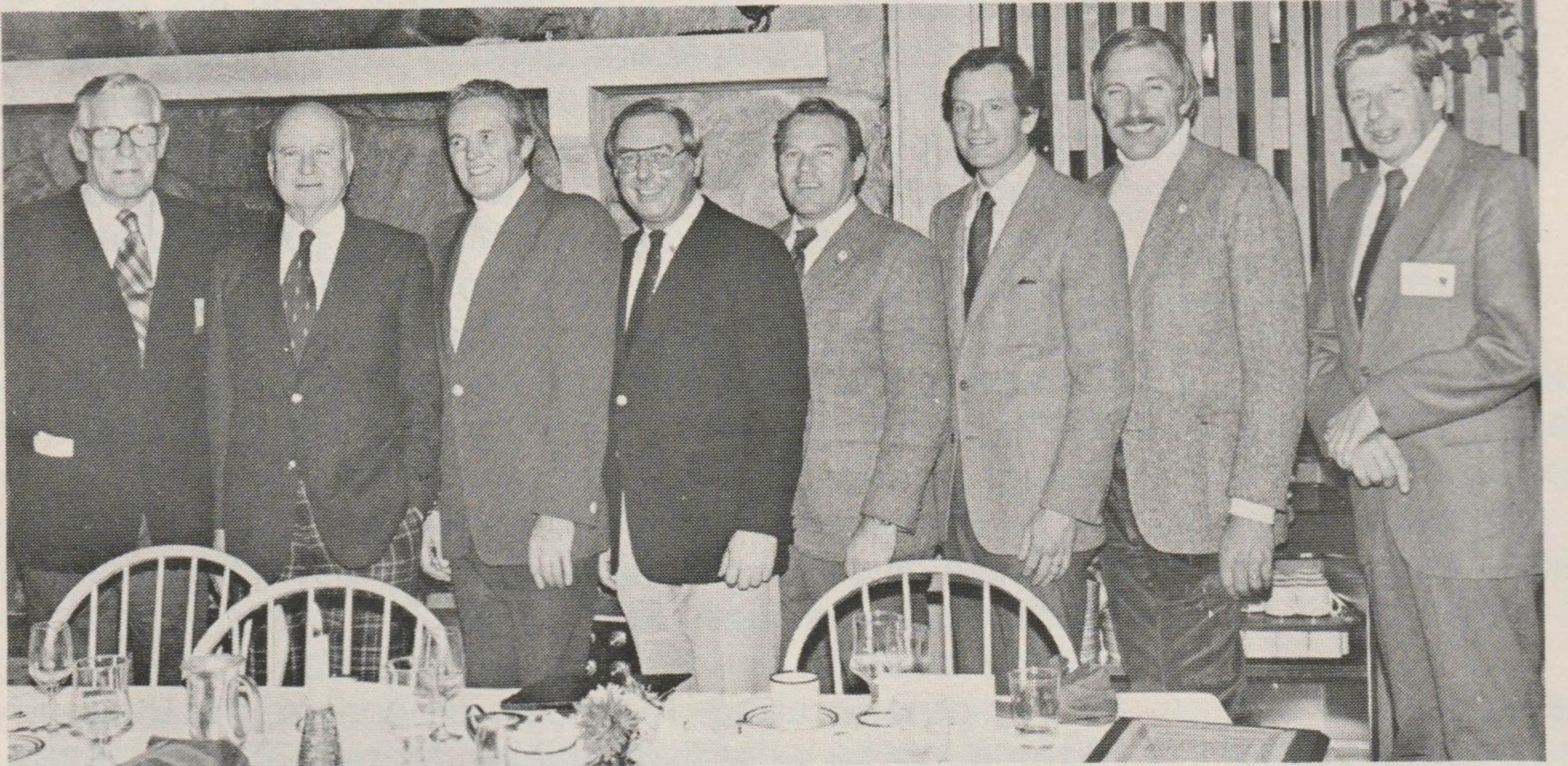
In the early days of the industry (Correction! . . . before there was any industry), if you had been foolhardy enough to start a ski area you were ipso facto a little—well, different. ESAOA consequently had its full share of “characters”, independent-minded and eager to voice their opinions long before the drop of a hat. It made for lively meetings, but after the smoke cleared they were also constructive meetings.
From the very beginning they were exciting gatherings. You wedged yourself into the Orvis Inn’s jammed dining room with an anticipatory “What are we going to accomplish this time?”, an attitude that turned a milling herd of mavericks into a closely knit team. The informal air emboldened the one-tow man or the stand-in pinch-hitting wife to speak up freely and effectively. Big or small, pro or con, you were heard. And all the time behind the casual manner, Roberts Rules of Order were going clickety-click. When it came down to the nitty-gritty, perennial secretary and anchor-man Bill Norton of Cannon always knew which motion had precedence.
This meant prompt decisions and hard commitments. Nobody temporized until reaching home and winning his boss’ approval because the boss was at the meeting. Pabst, Ruschp, Phil Robertson, Palmedo, Bill Whitney, Schoenknecht (then of Mohawk, remember?), Perry Williams, Gadd, Judge—these were some who rarely sent a surrogate. Norton never did. Nobody was enmeshed by computers, and nobody involved himself in making sophisticated executive decisions in keeping with every aspect of corporate policy. He just made up his mind. Things got done.
Not always smoothly. B-77, for example, raised a storm. The procedural requirements of the American Standards Association for writing a national code for an industry, together with those of the American Society of Mechanical Engineers, were understandably lengthy and complicated and therefore staggeringly expensive for little ESAOA. Dues would have to sky-rocket. The dues discussion became, to put it mildly, incandescent, but in the end the increase was carried, the dissenters remained loyal, ESAOA survived and B-77 was born.
The ability of ESAOA’s disparate membership to work together was startling. Their gluttony, when it came to hard work, was even more so. If there were statistics for the time its members devoted to their tasks they would add up, quite literally, to years.
Why did they do it? Why did a member responsible for overseeing the legal departments of an international group of insurance companies join the ESAOA’s long and tedious efforts to win recognition in the courts, of the doctrine of skiers’ assumption of risk?
Why did a western New York rope tow operator bundle his wife and kids into the family jalopy and drive all the way to Vermont to the annual meeting? (Some years he didn’t make it. Some years the fall grooming was behind schedule and it was imperative the area’s entire manpower stay home to mow trails. So he did.)
What made this organization so tightly knit, so electric, so successful in recruiting members willing to contribute efforts far beyond any possible personal advantage, for the benefit of the industry? The answer lies in the era when there was no ski industry. No consultants or advisers. No snow-making. No blue-prints. No precedents to guide you.

And no insurance, unless Lloyds of London accepted you at a handsome premium, or unless your own insurance company deigned to underwrite your scatterbrained project because you were already a good customer in more circumspect ventures. Areas folded for lack of coverage.
Ski business was uncharted country then, explored by a few isolated pioneers. It was lonely. If you encountered another area operator in the wilderness, he wasn’t a competitor. He was a kindred spirit. You basked in his company. You helped him. (He always needed help.) And he helped you. (Did you ever!) Following the example of other pioneers in unmapped country you parked your wagons in a circle. And presto! There was ESAOA.
That, in all seriousness, is what welded them into a team that laid the groundwork for ski business as we now know it and molded a scattering of small, isolated enterprises into a structured industry that began—none too soon—to command the attention and respect of bankers and insurance underwriters. It was a mixed bag of originals, whose very diversity made for an innovative, imaginative approach to whatever new and obviously unprecedented difficulties confronted them, season after season. Their differences, their distinct personalities, their quirks added spice to their deliberations. And however important their individual contributions, it is as much by their quirks that we remember them.
Roland Palmedo’s memos to fellow members were often written on odd scraps of paper as he drove to or from the snow country, a habit which affected neither his driving nor his succinctness.
Fred Pabst’s bourbon and steaks were irreproachable, but not so his vocabulary. You were not Fred’s good friend until he began calling you an old bastard, or worse.
Quiet and retiring Amos Winter from Sugarloaf spoke seldom and softly. When he did, his Maine twang was listened to.
Treasurer John Dunham of Hogback handled the tedious accounts and dues cheerfully and efficiently for years, never pressing you for delinquent dues. He just looked at you amiably over his spectacles. Seemed to work.
Volatile Hans Thorner appeared never to harbor a dispassionate thought. After a hearty lunch, perhaps preceded by a martini or two, the members attending afternoon meetings sometimes lapsed into lethargy. At that point if the chair knew his business he called on Hans for an opinion. No matter the topic, Hans’ delivery was reliably fervid. You wondered whether he was going to ask you to elect him mayor or to come up to the front of the tent and confess your sins. Everybody woke up.
Perry Williams’ resolutions were flowery as an Alpine meadow in spring. When he intoned one of his mellifluous masterpieces, grinning from ear to ear, a resolution complimenting the chef on the annual banquet sounded like an announcement of the second coming.
Bill Norton didn’t know how to do anything half-heartedly. Whether he was clamming or condemning litter bugs—preferably face to face—he threw himself into it fiercely.
How name them all? How describe them, no two from the same mold?
Now their job is done. The NSAA has been ably holding the reins for some time, state area associations play their important role and the ESAOA has come to the end of the road. The area operator who travelled that road was a breed apart. Now past his apogee and eclipsed by the board of directors, the business management team and the computer, he none the less cut a brilliant trajectory in his day. He shaped an industry. We won’t see anything quite like him again. Let his ESAOA not pass unsung.