


“Gearheads.” That’s what some people call those of us who are always tinkering on our cars or trucks; adding suspension lifters, swapping out transmissions, installing see-thru exhaust systems or just enjoying the banter with other gearheads. Well, gear ratios, not gearheads, is the topic we will discuss next — as they relate to ski lifts, of course. Not quite as sexy as double-overhead cams but, what the heck.
Before we tackle the average ski lift, let’s take a look at the average (mine) 1/2 tone 4X4 Pickem-up truck. My F-150 has a 5-speed manual overdrive tranny with factory supplied tach. At a steady 55 mph, the tach reads about 2000 RPM of fuel-injected, neck-snapping power. But what happens in-between to generate the revs screaming out of that mighty 5.0-liter 8-banger? To help with the solution, I called my trusty Ford dealer to find out what the drive ratio is in the rear differential in my truck. Because it has a snow plow, a mid-range ratio of 3.73 to 1 was spec’d by the dealer. A lower and higher ratio are also available with a total spread of about 15 percent. That means, for every complete revolution of the rear tires, the drive shaft rotates 3.73 times. The differential is really just a right-angle gearbox. If you would refer to the sketch below, the rest is pretty simple.
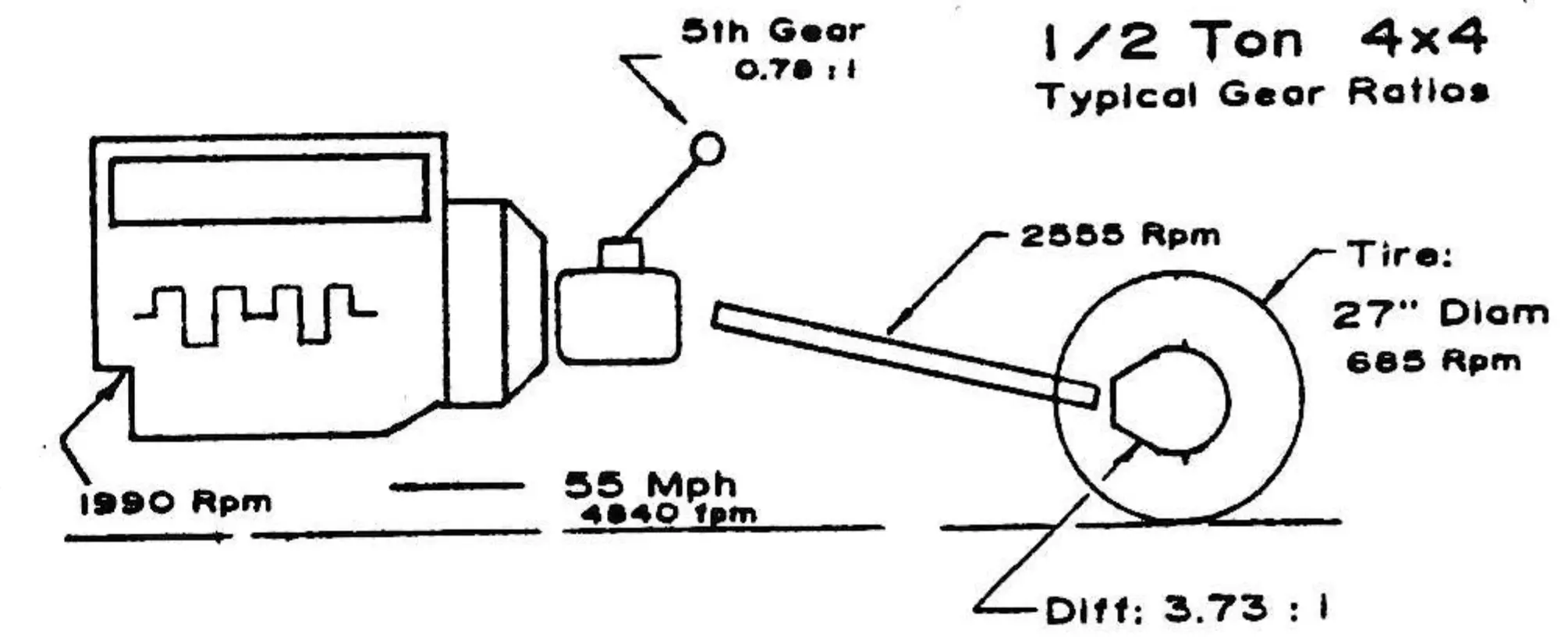
First, I measured the tire height at 27” and calculated the circumference to be 7.07 feet (27 X pi/12). Since one mph is 88 feet per minute, then 55 mph is 4840 fpm, which, when divided by 7.07, should be 685 RPM for the tires. Now we just multiply the differential ratio of 3.73 times the tire RPM of 685 and the result is a drive shaft speed of 2555 RPM. In fifth gear, the transmission ratio is about 0.78 to 1. Multiply that ratio by 2555 and you have, miraculously, 1990 engine rpm’s. (If you find any errors, they are obviously typos.)
The reason for the above exercise should be intuitively obvious even to the most laid-back management type. Ski lifts are really no different when it comes to calculating gear set ratios than pickup trucks or other similar machinery. For example, look at Figure 1. Here we have a very basic motor/gearbox operation (brakes and other stuff omitted). In ski lift design, it’s normal to begin with the desired rope speed and work toward the motor (prime mover) to develop the required ratios. Thus, we begin with the “tire” which in this case just happens to be a bullwheel 12 feet in diameter. Multiply that by 3.14 (pi) and you get a round trip of 37.7 feet or one bullwheel revolution. Assuming we want a final rope speed of 500 fpm, we need a bullwheel speed of 13.36 RPM (500/37.7). Since the DC motor being used in this example normally runs as 1750 RPM, we need a total reduction ratio of 1750/13.36, or in this case 130 to 1.
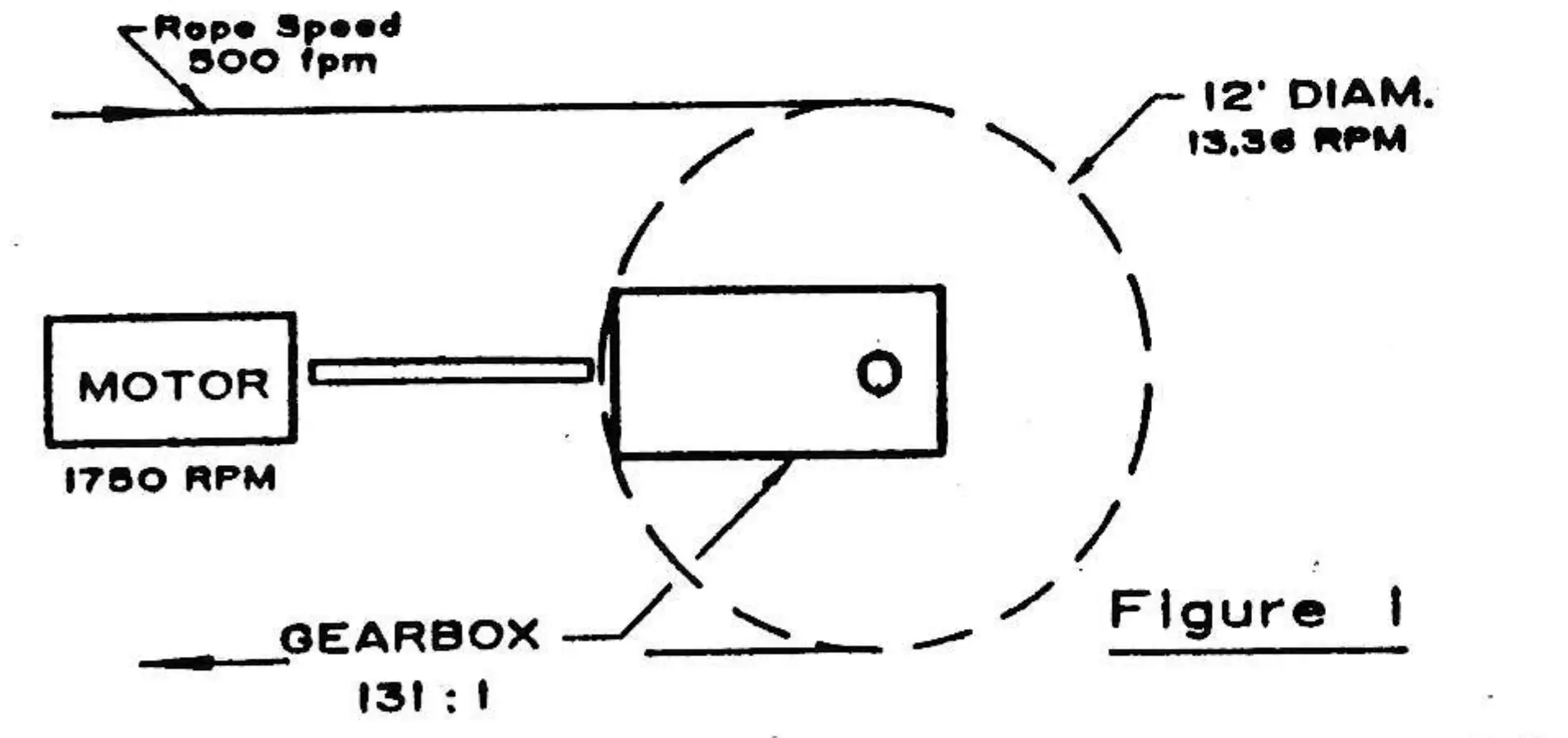
For our example, I chose a Kissling 940 VKDS triple reduction gearbox with a factory ratio of 131 to 1 — not quite 130 but in this business, that is close enough.
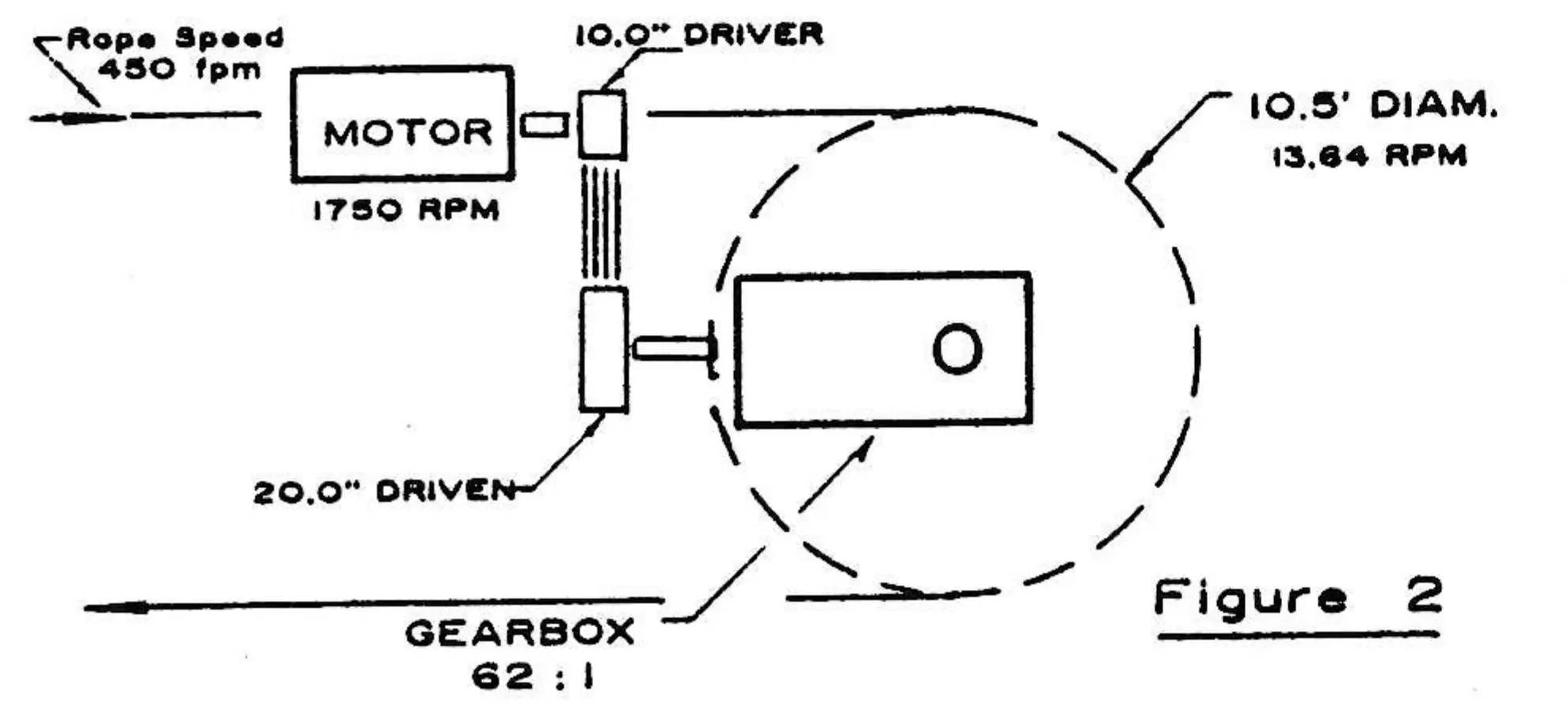
Now that you have mastered that one, let’s go to Figure 2 for another alternative. Sometimes, it is more economical to buy a gearbox with only a double reduction and add the remainder of the speed change with a belt drive. In this case, we have a 10-inch “driver” sheave (pulley) on the motor and a 20-inch “driven” sheave on the input shaft to the gearbox. With this arrangement, the input shaft will turn one-half (10/20) the speed of the motor. Therefore, the belt drive now supplies the missing reduction of the two-speed box. The catalog ratio of this gearbox is 62 to 1 and when multiplied by 20/10 (2) we get 134 to 1. Again, close enough.
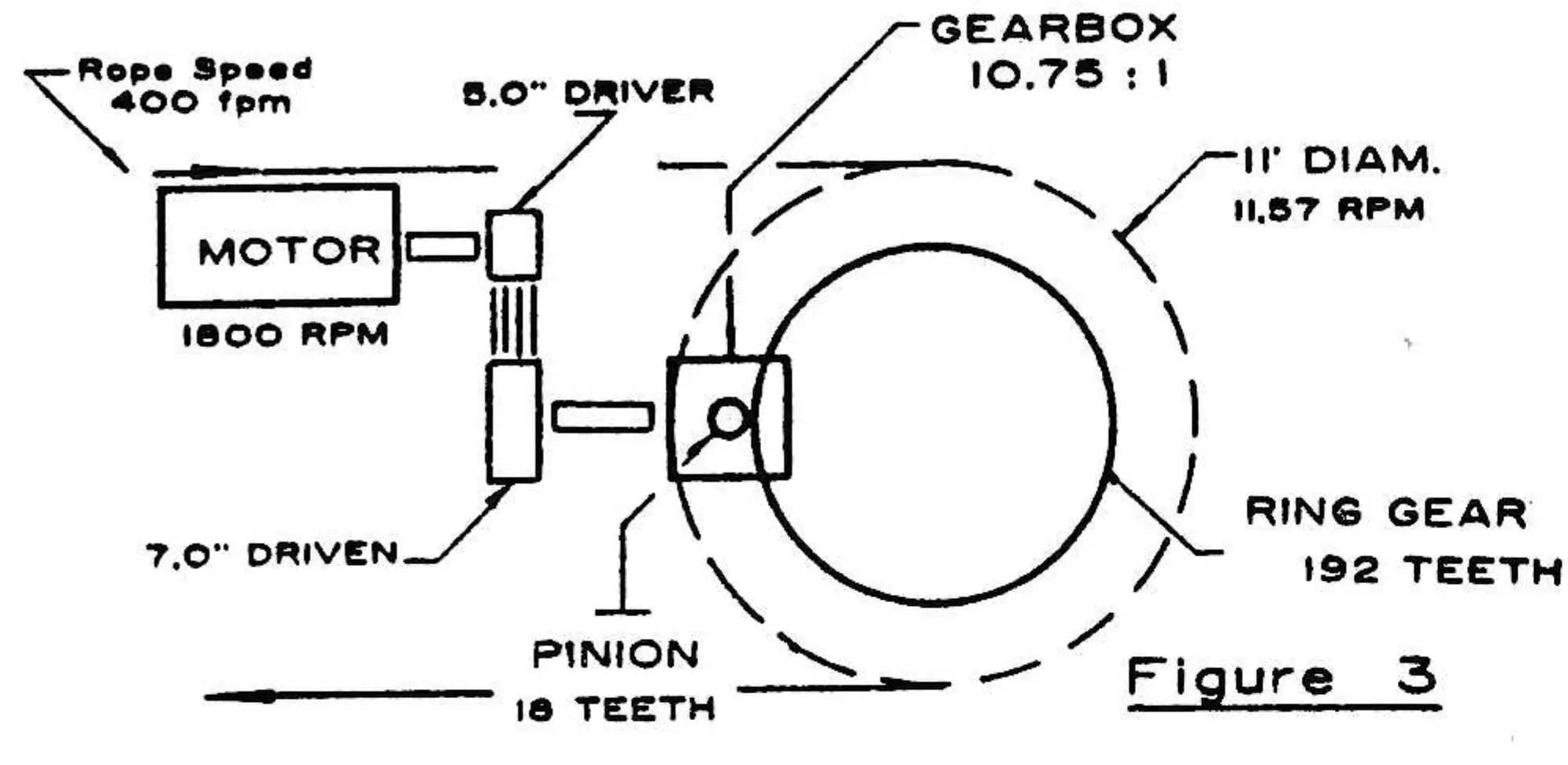
Noisy, smelly, difficult to lubricate and adjust are usual comments about the “transmission” we will discuss Figure 3. This represents a typical “open gear” transmission found in numer-
| FIG | ROPE SPEED | B/W DIA | B/W RPM | MOTOR RPM | DESIGN RATIO | RATIOS — OPEN GEAR | RATIOS — GEARBOX | RATIOS — BELTS | ACTUAL RATIO |
|---|---|---|---|---|---|---|---|---|---|
| 1 | 500 | 12’0 | 13.36 | 1750 | 130.1 | – | 131 | – | 131:1 |
| 2 | 450 | 10’6 | 13.64 | 1750 | 128.3 | – | 62 | 2.00 | 134:1 |
| 3 | 400 | 11’0 | 11.57 | 1800 | 155.5 | 10.67 | 10.75 | 1.40 | 161:1 |