


Technology
Stratton reports new method for fertilizing slopes
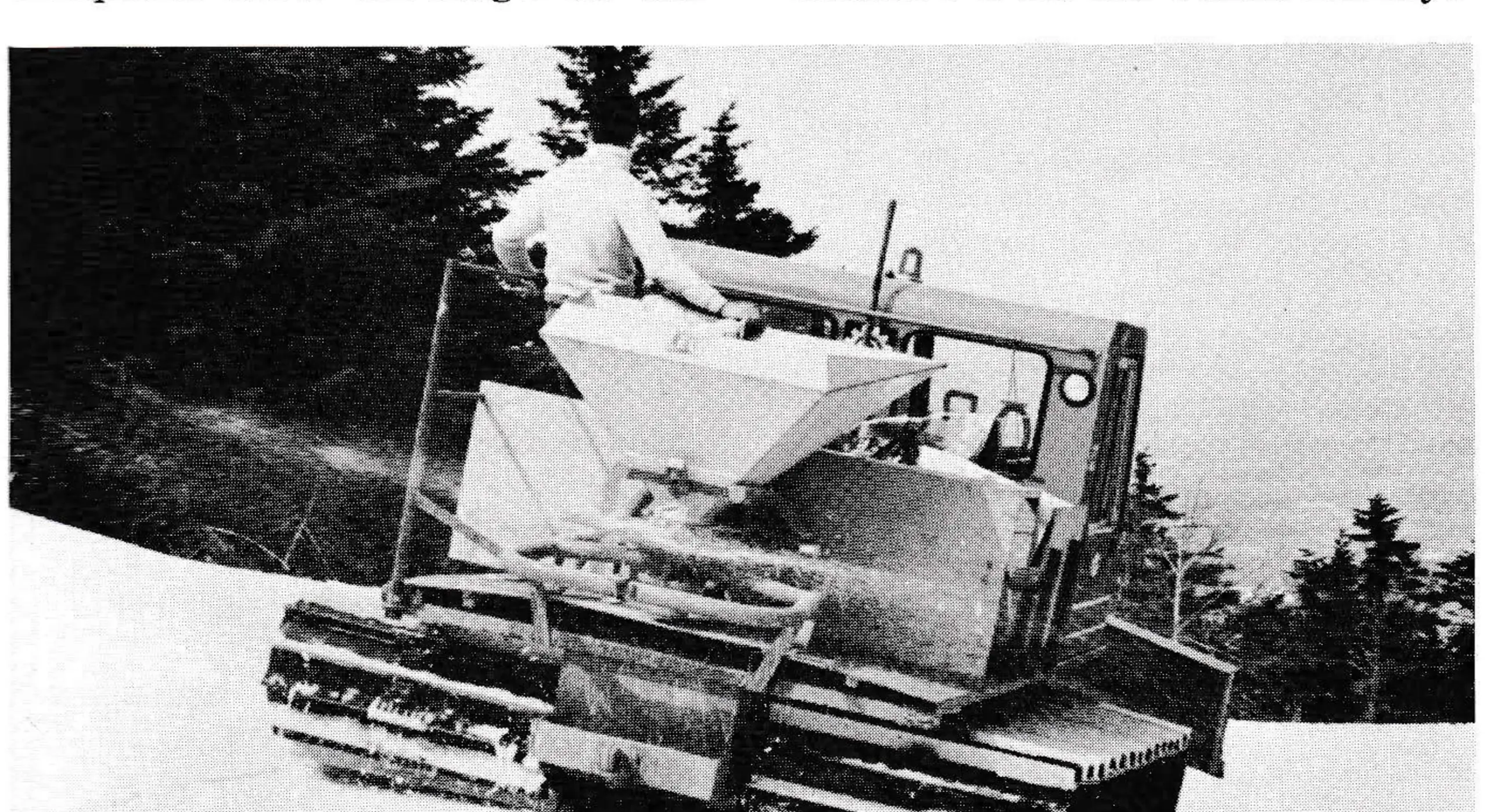
Stratton uses a Bombardier Skidozer with a gasoline-powered Lely spreader mounted on the back. The fertilizer is Fel-Mel 20-12-8 at a rate of 1½ lbs. of nitrogen per acre and a high-magnesium lime is spread at one ton an acre.
The fertilizer is distributed with the spreader set at six, the spreader engine at half throttle and the Bombardier run at 2,000 r.p.m. uphill and 1,200 downhill. Most trails can be done in two passes, as the spreader impeller covers a 30-ft. swath. The liming procedure is basically the same, except the Bombardier is run at 1,500 r.p.m. uphill and 800 downhill, with the spreader set at 10 and the spreader engine on ¾ throttle. Because the lime is lighter than the fertilizer, the spreader only covers a 20-ft. swath, so more passes are required.
Stratton carries out the fertilizing operation while there is still adequate snow coverage on the slopes for the Bombardier to work on. When the fertilizer hits the snow, it melts 1-2 in. into it, so it doesn’t interfere with skiing and as the snow melts, the materials are left behind on the grass. Another benefit is that the lime does not blow around after it is spread.
Stratton reports considerable savings in time, labor and machines with this method of fertilizing, because material is distributed quickly and evenly. Over 20 acres can be fertilized in five hours, with little wear on the machinery.
NOAA study determines cloud seeding can re-distribute snow
NOAA (National Oceanic and Atmospheric Administration) experiments in the Great Lakes region of New York state have determined that cloud seeding can effectively redistribute snowfall. The scientists also claimed that dry ice was a more effective seeding agent than two silver iodide solutions which were also tried.
The typical lake effect snowstorm that dumps as much as three feet of snow on the shore forms in late fall or early winter when intensely cold air flows over the still unfrozen lake, picking up heat and moisture from the water. Ice crystals form naturally in the colder cloud tops and then grow rapidly as they fall through the cloud. These aggregate crystals form a heavy snow and account for the deep snow accumulation on the lake shore.
When dry ice or silver iodide is introduced into the cloud, they act as nucleating agents causing the cloud water to condense on them. The increased number of nuclei cause smaller crystals to form, which then fall slowly and are more easily blown inland because they are lighter. The result is a decreased amount of snowfall on the lake shore and a more even distribution of the same snowfall over a much larger area inland.
With this data, NOAA scientists will now start a more intensified mathematical study of the cloud physics and precipitation mechanisms of lake effect convective snowstorms. With a better understanding of air and moisture flow in the storms, they will then be able to determine optimum seeding techniques.
Development
Keystone to add two double chairs this summer
Keystone International Inc. will spend $1,300,000 on two Heron Poma double chairlifts this summer, doubling the area’s capacity to 5,000 skiers a day.
In addition, Keystone plans to clear 125 acres of new trails and will make a minor expansion of the Keytop and Keybase buildings to accommodate the larger crowds.
The new lifts have lengths of 6,600 and 6,800 feet respectively, with vertical rises of 1,590 feet and 1,585 feet.
Keystone has retained David Jay Flood and Associates to prepare a master plan for the resort village, while Economic Research Associates will handle the economic feasibility study. Construction of the resort village is slated to begin in the summer of 1972.
Breckenridge adds two chairlifts, trails and 600 beds
Breckenridge ski area in Colorado will be the scene of a $4,500,000 expansion program this summer. Aspen Skiing Corp. operates the area, while The Breckenridge Co. is developing the Four Seasons resort there.
D. R. C. Brown, Aspen president said two Riblet double chairlifts will be installed. Over 200 acres of trails will be cleared on Peak 9, adjacent to the existing area, bringing lift capacity to 8,000 skiers an hour. The area currently has four chairlifts, two pomas and two T-bars.
One of the new chairs will be based in the Four Seasons village, running 7,600 feet to a connecting 6,300-foot-long chair. Trails will be laid out by Aspen’s mountain department and Lowell Northrop, of Tahoe City, Calif., will handle lift construction.
Donald S. Fowler, president of The Breckenridge Co., said contracts have been let for construction of 158 condominium-townhouse units in the Four Seasons resort. Over 600 commercial beds will be added as a result.
Old No. 1 at Aspen replaced by double chair
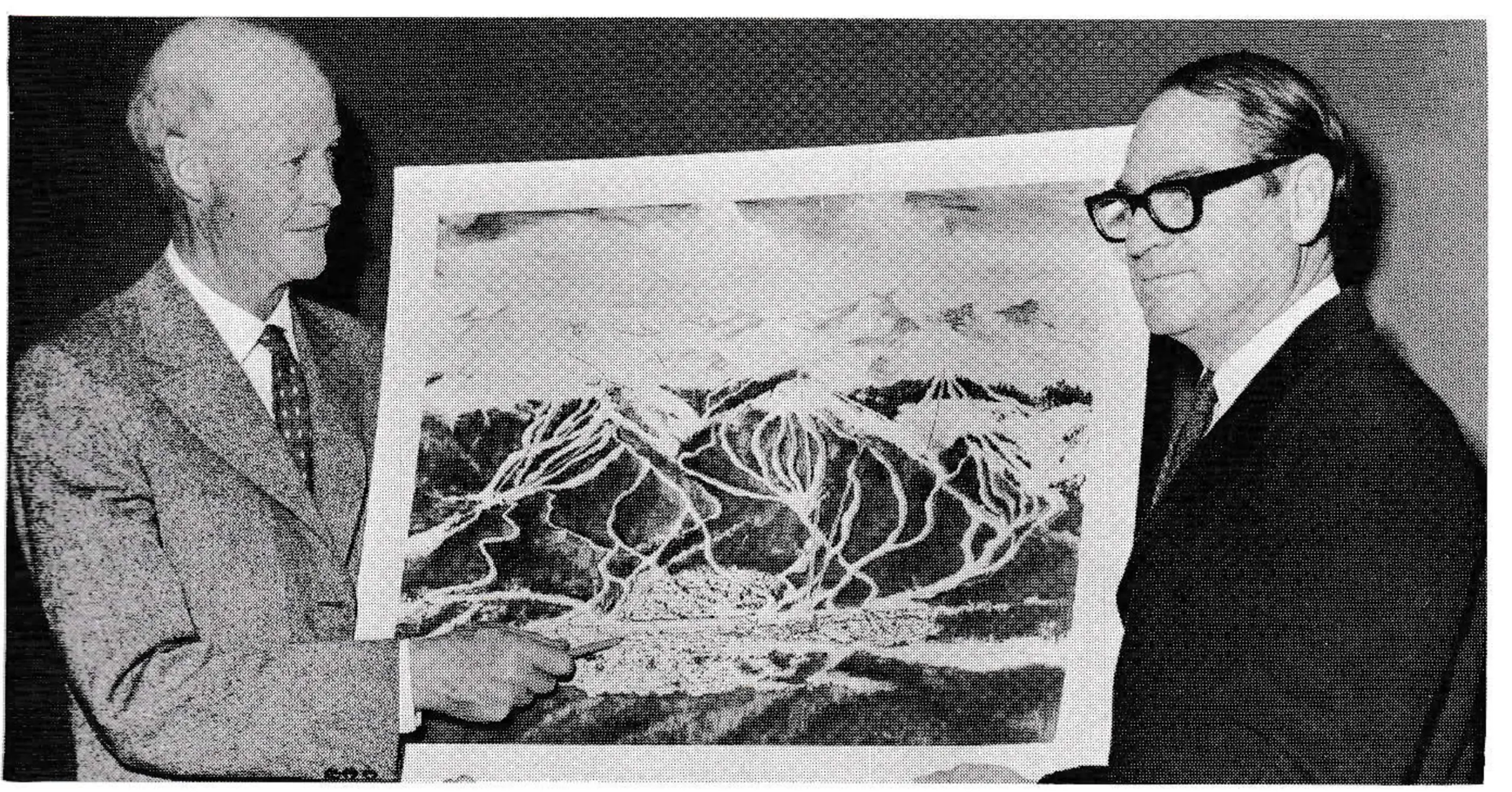
Aspen Skiing Corp. is replacing its 25-year-old No. 1 single chair with a double this summer and selling the chairs to sentimentalists for $15 each.
The new Ski Lift International double chair will not go to Midway, but will end above the bottom of No. 8 (Ruthies).
The old No. 1 was billed as the longest single chairlift in the world. It had a vertical rise of 2,574 feet and was 8,480 feet long, taking skiers to an elevation of 10,485 feet.
Those wishing to buy the old chairs at $15 should contact Aspen Skiing Corp. around the beginning of June.
Hall chairlift scheduled for Maine’s Lost Valley
Lost Valley ski area in Auburn, Me., has purchased a 1,200-foot Hall double chairlift with an hourly capacity of 1,200 skiers.
The new lift will cost around $150,000 and will make possible the addition of five more trails, increasing the skiing terrain by 50 percent.
Lost Valley also plans to extend its snowmaking system to cover the new area and will make some minor base lodge improvements.
Colorado areas show solid gains for 1970-71 season
A survey of Colorado’s ski resorts has shown that the 1970-71 season was a record year for the state. Steve Knowlton, managing director of Ski Country, U.S.A., said lift ticket and ski school lesson sales showed an overall increase of 30 per cent over last season.
Knowlton said final 1969-70 figures show total income from lift tickets and ski lessons was $15,694,528, a gain of 29 per cent over the previous season.
A Denver Post survey of Colorado areas showed only three with problems—and in two cases the problems involved too much business.
Larry Jump, manager of Arapahoe Basin, said he was forced this season to raise lift ticket prices and to ration skiers on week-ends to a maximum of 1,600 a day.
At Winter Park the problem is too many skiers all week long. Midweek attendance accounts for 57.2 per cent of total business which topped 268,820 skier days for an increase of 10.8 per cent and a revenue increase of 12.2 per cent over last season. The Winter Park board currently is completing plans for a new 7,000-ft. lift, parking lot enlargement and other improvements for next season.
Lake Eldora reports business down 20 per cent this season after a 76 per cent gain a year ago. The drop was attributed to constant cold weather which kept the “blue-jean set,” which frequents Lake Eldora, away.
Ticket sales were up 24 per cent at Vail, while an Aspen spokesman said skier visits dropped 1.61 per cent, “pretty good when you consider that the previous season set a new record of 874,000 skier-days and our prices are geared to the jet set when now is a time of national economy worry.”
Gus Larkin, general manager of Crested Butte, said the area showed a 58 per cent gain over last year and is planning to add two new lifts this summer. He attributed the gain to a Lockheed Electra passenger plane, owned by the area’s new management, which has been making weekly trips from Atlanta and other big cities in southeast America with full loads of 87 skiers.
Also reporting an increase was John Rahn, vice president and general manager of the Breckenridge Ski Corp. He said skier days were up 33 per cent over a record 162,000 during the 1969-70 season.

Skier days were also reported ahead 29 per cent at Steamboat this year, with ski revenues at $800,000, up 50 per cent, according to John McGuyrt, area manager. LTV Recreation Development, Inc., a subsidiary of LTV Aerospace Corp., has spent $10,000,000 on new ski facilities and accommodations and has a budget of $60,000,000 more set up for the next decade.
Vail plans program for summer expansion
Vail Associates Inc. plans to spend $1,000,000 on expansion and improvements this summer, with emphasis on Vail LionsHead and two major projects in Vail Village.
Vail’s lift ticket sales increased 24 per cent last season to $3,025,000 from $2,400,000 the previous winter. Ski school revenue jumped 66 per cent to $715,000 from $445,000, while restaurant sales increased 21 per cent to $545,000 from $450,000.
Richard L. Peterson, Vail president, said $412,000 will be spent this summer on Vail Mountain, including a two-mile trail with a 2,400 vertical drop, running from the top of the LionsHead gondola to the base, between Born Free and Simba.
Vail will also manicure the lower parts of all slopes leading into the village to improve early and late season skiing. A new restaurant and day lodge will be built at Golden Peak.
Vail will construct a new maintenance and shop building, new pump house and water lines for the mountain water system and plans to purchase two new Thiokol snow cats and new cars for number one gondola.
Peterson said $466,000 will be spent on landscaping and developing real estate, mostly at LionsHead.
Finance
Fibreboard invests in Northstar area, seven-year plan
Northstar, a new ski area planned by Fibreboard Corp. for the north shore of Lake Tahoe, moved closer to reality when the Placer County Planning Commission approved all requested zoning changes and special-use permits.
Ron Anderson, president of Trimont Land Co., a wholly-owned Fibreboard subsidiary, said Northstar will ultimately represent a $100,000,000 investment. There will be 14 uphill lifts and four transportation lifts, these last to move skiers from lodges and dwelling units to the mountain.
Of 2,560 acres scheduled for development over the next seven years, 1,340 will be for skiing, with 70 per cent of the terrain rated intermediate. On completion, skier capacity will be 10,200.
Mt. Pluto, one of the three mountains in the development, has an elevation of 8,609 feet. A day lodge is planned for the 6,850 ft. level.
Initial lift construction is planned for next year, with three uphill lifts and one transportation lift slated to open in late 1972. Land clearing will continue this summer.
Luggi Foeger, general manager of nearby Ski Incline, advised Fibreboard as a special consultant on lift types and locations.
Olympics
Minority groups put heat on Olympic committee
Although the 1976 Winter Olympic Games are more than five years away, Denver officials organizing the event are already under critical fire from two special-interest citizen groups.
Protect Our Mountain Environment (POME) is protesting the use of Evergreen, Colo., about 30 miles southwest of Denver, as a site for the Olympic Nordic ski and sledding events. Citizens Interested in Equitable Olympics (CIEO) is seeking to have Denver minority group members appointed to an Olympic organizing committee board.
POME, composed of about 300 Evergreen citizens, has opposed the Evergreen site ever since Denver was designated as host for the games in Amsterdam last May. The group recently passed a resolution which states that staging the Nordic events in the Evergreen-Indian Hills area would be “inconsistent with broader concepts of preserving the environment.” Specifically, the resolution contends that staging Olympic contests in the area would create artificial hazards and “attractive nuisances” while “degrading” the quality of life in the mountain community.
Members previously have stated the Olympics will require hills to be leveled for parking lots, a new network of unwanted highways, access roads and ski trails which, if built as currently planned, will run to “or over” standing homes.
Adding support to POME’s complaints is Richard Taylor, a member of the 1964 U.S. Olympic Nordic team, who has denounced the plan from the skier’s point of view. “Evergreen never has had an over-abundance of snow,” Taylor says, “and artificial snow isn’t suitable for Olympic-level competition. It’s like training a horse for years to be a racer and then running him in the mud,” he adds.
In answer to POME’s request, the Denver Olympic Committee (DOC) recently appointed Sno-Engineering, Inc. of Evergreen to review preliminary Olympic site selections. However, POME criticized the selection stating that vice president Ted Farwell has already made up his mind. Farwell and Sno-Engineering insist they have made up their minds about nothing and that they have both been retained to make an impartial study.
The latest move by POME is an attempt to quash the plans for the Olympic events by asking the state legislature to cut off funds until DOC finds another site. The state already has granted DOC $475,000 and the committee is seeking $310,000 more for the rest of the fiscal year.
In answer to POME’s requests, Robert J. Pringle, DOC president, has promised to attempt to change the sites “if it’s feasible.” He said Evergreen was selected as the site originally because it is near enough to Denver so that city still can be called the host and at a low enough altitude to allow athletes to function.
The other citizen group giving DOC headaches is CIEO, which protested persons appointed to a Colorado Olympic Commission executive council—the governor of Colorado, the mayor of Denver, and six leaders of the original campaign to bring the Olympics to Denver. CIEO says the council is composed of Denver’s affluent society and should include minority and economically disadvantaged citizens.
Denver Mayor Bill McNichols, however, called the complaints “premature” and said they should be postponed until the executive council names a 30-member board of directors. Later McNichols announced six persons representing the minority community had been named to the board, which now has 25 members with five left to be appointed. The six include:
- —Floyd Little, running back for the Denver Broncos and leading ground gainer in the American Conference of the National Football League;
- —Outgoing State Rep. Paco Sanchez (D-Denver), founder of the Denver Spanish-language radio station DFSC and president of the Good Americans Organization;
- —The Rev. Joseph Torres, a Roman Catholic priest who is the archbishop’s assistant for Hispano affairs in the Denver Archdiocese;
- —Charles R. Cousins, a real estate investor, president of Equity Savings and Loan Association and a member of the Colorado State Athletic Commission;
- —William Roberts, newly-appointed director of the Metropolitan Denver Construction Plan and former consultant to the Denver Commission on Community Relations;
- —Donald E. Cordova, an attorney, member of the Denver County Court Judicial Commission and a board member of the Latin American Educational Foundation.
CIEO, however, still isn’t happy. They claim they weren’t consulted about the appointments and that the minority community still isn’t properly represented. CIEO suggested the appointments be made through the group’s screening committee, composed of six minority members of the State House of Representatives. The mayor has advised the group he will meet with committee representatives about the appointments. There also is speculation that the dispute may have to be settled in court.
—Lois Barr
Promotion
Midwest challenges airlines on promotion policies
The West Michigan Tourist Assn. has charged that airlines put too