

Screwing around with image
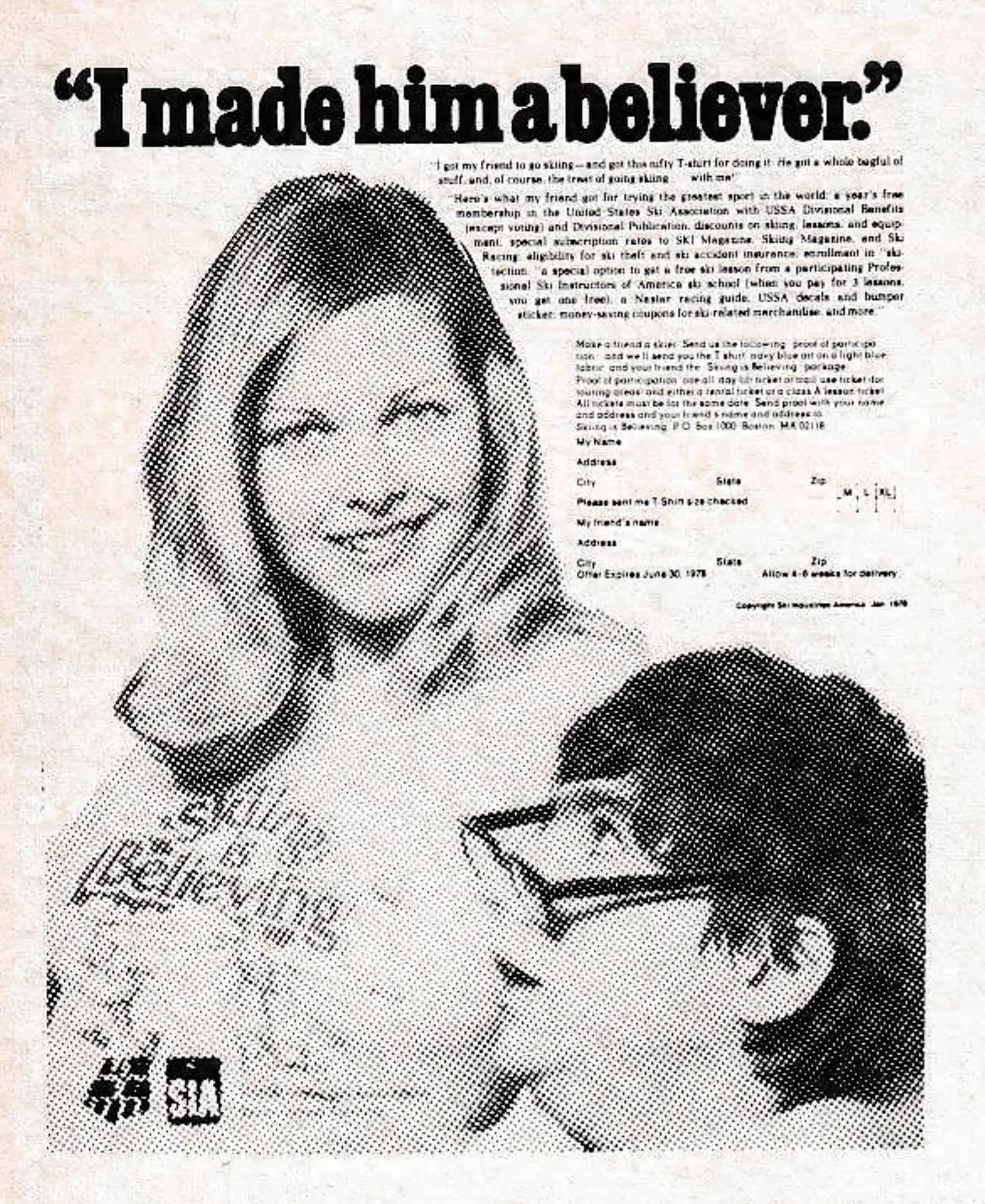
First of all, we think — and always have thought — that it is a waste of money for organizations like SIA and NSAA to go around “creating” skiers. The individual suppliers and areas do a much better job of this, as do natural marketing groups like Ski 93 and Ski The Rockies. And, as this winter has proved again,there is nothing wrong with our business that a good snow year won’t cure.
But, in the (unlikely) event that we are wrong in this opinion, the promotion illustrated above is simply bad marketing. It doesn’t sell the product, it identifies with a small and rather unimportant market segment and it is offensive to a significant part of the market. If SIA wants to build business this way, and if USSA wants to promote membership this way, they are both in for a lot of disappointments.
Mind you, we don’t doubt for a moment that a lot of T-shirts will be pushed out as “proof” of effectiveness, but I doubt if one new skier is created. (There is absolutely nothing to prevent an existing skier from sending in a lift ticket, a rental or lesson ticket and the name and address of a friend and claiming a free T-shirt. Big deal!)
But quite apart from its ineffectiveness, we find it alarming that SIA is apparently so out-of-tune with the market place and its changing demographics. We refer anyone interested in this to a Special Report in the February 20 issue of Business Week, entitled “Americans Change.”
We quote from this excellent report: “The U.S. . . . is going through some fundamental demographic changes that forecasters and policy makers will have to take into account. The economy is already feeling the impact of these shifts, and there is more — much more — to come in the future . . . The most obvious change in the U.S. population is simply that it is growing older . . . Such a change means a shift in patterns of consumption and incomes. And, inevitably, changes in social attitudes as well.” The article goes on to cite one expert discussing the “maturation of the population and the waning of the youth culture.”
The tables that accompany the article show that right now the 0-4 age bracket is lower than it has been since 1947; that the 5-14 bracket is in a sharp decline; that the 15-24 bracket has peaked and is headed down; that the 25-44 bracket is on a very sharp increase and will remain so for the next 15 years.
We feel the SIA/USSA promotion misses today’s and tomorrow’s target by a wide mark. The SIA marketing people being very bright and able, we have to assume they know all this and went ahead anyway.
The SIA approach also ignores the increasing role of the independent female in the market. We’re not talking about bra burning and lib activism: we’re simply aware, as is the rest of the commercial world, that the buying influence of the independent female is a major and growing factor in today’s marketplace.
She is financially independent, she makes her own buying decisions and at the very best, she will see the SIA promotion as childish; at worst, insulting. And this includes the working wife. (“The rise of the double-income family is the most significant change to hit consumer marketing in a decade.”—Los Angles department store executive, J. Janvier Wetzel, as quoted in Business Week.)
Pam Conklin, the very able publicist for Colorado Ski Country, first blew the whistle on SIA’s “I made him a believer” promotion back in January in an open letter in which she presented her personal reaction. We quote a couple of sentences: “It gave me a great deal of satisfaction to be able to vote ‘No’, along with the members of the Board of the Rocky Mountain Ski Association, regarding publishing such an advertisement in Rocky Mountain Skiing. . . There are a number of personal reasons why I continue to enjoy and participate in the sport of skiing (alpine). They have absolutely nothing to do with the archaic, ‘macho’ image that this industry continues to perpetuate.”
We also point the reader to the ‘Late Winter’ issue of Ski where our own Janet Nelson writes about the extremely successful Woman’s Way Skiing Seminars in California.
But, we don’t want to belabor this one hokey part of SIA’s total efforts since so much of what that strong, heads-up organization does is first-rate. We did, however, want to put the spotlight on this one bad initiative lest the same thing infect the efforts of the so-called “Future of Skiing” committees of NSAA and SIA.
These committees recently agreed “to establish a national public relations program to improve the image of the ski sport and the ski industry. . .(and) that the first phase of this program would be conducted by the SIA Marketing Director with input and financial assistance from NSAA.”
If the T-shirt promotion is the sort of thing we can expect, then we think the right place to start “improving the image of the ski sport” is right smack in the middle of those committees!
Come to think of it, though, we are alarmed that these folk want to fool around with the image at all, let alone how. It has always been a fatal fascination of organizations like SIA and NSAA to want to have a bigger and better and costlier public relations toy to play with. But there is so much important—indeed, vital—work these organizations do—more than justifying the respective dues—that they should avoid such temptations as tinkering with the image of our sport—an image which has always been excellent, and which is the main reason for the continued growth of the sport. This image is the projection of the sum total of the ski experiences of all skiers—and it is excellent. Sure, there are exceptions: ski areas with stinking rest rooms and dishonest snow reports, ski schools with incompetent teachers, shoddy equipment from suppliers sold by inexpert retailers. But the free choice in the marketplace sorts this all out much better, faster and inexpensively than any industry-wide “image-improving” PR effort can.
Likewise, “image improvement” won’t do anything that truth can’t in the way of countering adverse publicity from lift accidents. Let’s save the image money and put it into preventive maintenance. And then there’s the understandable confusion of those who want to change the image of skiing as a dangerous sport at the same time that they are being advised to educate skiers to the risks that do inhere.
We do not deny a basic PR function to SIA and NSAA. As spokesmen for the industry—and as information sources—they play a vital role, especially with the media. We also hope they will play a major role in harnessing the collective support of the skier population in support of ski industry positions on such areas of concern as land use, energy and safety.
But please, NSAA and SIA gurus, help us in Washington, help us with the energy and insurance gnomes and do other good works, but don’t screw around with the image of skiing. With snow and our present image we do just fine. And please, no more “I made him a believer” promotions!
A SAM Editorial

Evacuation Rope Caution
I have recently been informed of, and exposed to, situations that I feel justify a word of caution being passed on to the entire ski industry. This caution applies to the art and technology of removing stranded passengers, in an emergency situation, from an aerial tramway by means of a lowering rope being manipulated from the ground.
My experience in this matter takes me back to my early association with the National Ski Patrol System, my attendance at the first NSAA Insurance Program Evacuation Seminar and my many years with the Hall Ski-Lift.
There has been a great deal of thinking and experimenting done to insure that a practical, secure method of passenger evacuation takes place from the above-mentioned situation. Most facets of the ski industry have contributed to the mental and physical input necessary to solve the problem in the best possible manner. There has been significant progress made in the techniques and equipment used in the evacuation procedures up until now but there is still an area of concern that must be dealt with.
My concern is where the evacuation lowering rope runs directly on the main haul cable of the aerial tramway with the evacuated passengers being lowered on one end and the individuals performing the lowering operations holding on to the other end. This has been an acceptable practice in the past; however, I honestly feel it should not longer be! I will state my reasons as follows:
- At the present time the suggested rope specifications for the evacuation or lowering rope call for a minimum diameter of 7/16” of polyester fibre. It is suggested that a short, hard lay rope be used for sharp radius bends like that of the main haul cable, or a softer, longer lay, (even braided) rope if it is to be used over a larger smooth radius or wheel. These ropes are being confused in the field and are being used out of prescription with the soft, long lay being used directly over the main haul rope in many instances.
- Due to the nature of the terrain on which ski lifts are built the main haul cable slopes in various degrees. On the steeper terrain the lowering or evacuation rope tends to slide down the main haul cable when the weight of the evacuated passenger is applied, and only comes to stop once it bears against the gripping device that connects the carrier, (chair or gondola) to the main haul cable. Sometimes the lowering rope even “climbs” up onto the gripping device if the slope is steep enough. These gripping devices are not always designed to provide for smooth radius surfaces, so consequently the lowering rope is not being operated over or against a very abrasive surface under load.
- Main haul cables are lubricated with various types of lubricants. If evacuation ropes were used over a main haul cable lubricated with a detergent, mineral-based lubricant, under load and then stored, the lubricant would remain impregnated with the rope, perhaps reducing its strength when used at a later date.
- I have mentioned above the consequences of an evacuation rope abrading over or against a carrier gripping device. It is also possible for a soft, long lay rope, used out of prescription, to slide in under the end or “finger” of the carrier gripping device thus being pinched and hung up so that the rope will not lower even with the passenger’s weight.
- Assuming the proper hard, short lay rope is always used over the main haul cable, it is very difficult to exactly assess how many of the outer fibres get damaged, broken and worn off at any given time. We know that a main haul cable, even with the proper lubricant, is a very rough surface and consequently will cause wear and damage to a polyester fibre rope if it is worked over it under load, at 300 to 360 degrees. Therefore, when does one know when to take it out of use and replace it with a new one?
My suggestion to help cope with the above problem would be to use a protective curved sleeve over the rope so that the rope does not contact the main haul cable or carrier gripping devices while being used under load. This idea is not new and there are such devices available on the market today at a very reasonable price. They are not being used universally, however, and consequently problems and situations are arising that could be virtually eliminated by complete and total acceptance of the idea. There is less friction of the rope passing through the sleeve than there is over a main haul cable and consequently the personnel on the ground may need to adjust their procedures to accommodate the change. However, this is a minimal aspect when compared to the benefits derived when dealing with such a serious matter.
The above information has been put forth only to bring it to the attention of the people involved. I am in no way recommending this method of evacuation procedure over any other method, of which there are many. As long as there are ski lifts and aerial passenger tramways carrying passengers there will always be a need for a pre-determined plan, plus equipment and personnel to carry out an emergency evacuation. I personally feel we should all do our best to maintain the highest level of competence in knowledge as well as material and personnel regarding this matter.
Phillip D. Savage
Dangling in mid-air
Following are the comments of Panel Member Raymond Rodgers at the first meeting of the Vancouver Advisory Panel, Standards Council of Canada. Dr. Rodgers represents the Board of the Community Planning Association in BC on the Advisory Panel. The panel met February 28 to review Canadian standards for passenger ropeways (chairlifts, gondola cars, etc.) Dr Rodgers is a planner and economist who practises town planning from Vancouver, Canada. He wrote an article on the planning problems of ski communities in the Fall 1976 issue of SAM.
When this Panel was formed, we were given examples of how Canadian Standards Association technical committees had arrived at intricate construction and safety standards for certain products, but overlooked such consumer concerns as a handle with which to pick up the product. It took meetings of the Toronto Advisory Panel to supply the elementary consumer input.
With respect to the most widely-used passenger “ropeway”, I want to put in a basic suggestion to the manufacturers and purchasers (ski area managements), and suggest to them that without knowing it they are losing potential customers, by not realizing that many of us are scared of being stuck in mid-air on the contemporary super chair systems.
My hobby is mountain climbing or alpine hiking, and I am used to walking the edges of glacier crevasses and vertical cliffs. But there is still then the feeling of being on solid ground or tied to a rope. But I get nervous when the big modern chairs stop for some reason and there I am, dangling in mid-air, in an open chair. At most resorts, the passengers don’t know whether it is going to be fifty seconds or fifty minutes, because there is no loudspeaker system to inform them. I interpret an “audible signal system and a two-way voice communication” (9.7.1) to imply the need for some loud-speaker system along the route — but the reference to “stations” would seem to confine the communications to on-off points and drive station only.
I would also like to see each chair equipped with sufficient gold-line (light, strong rope) so that people could lower themselves in the event of some audible or visible signal system indicating a long wait due to drive breakdown or similar problems.
The economics of modern lifts pushes manufacturers and operators into fewer and higher towers. But as chair systems move in that direction, cowards like myself quietly switch to cross-country, or table tennis. I think it is time some coward yelled “the emperor is losing his clothes.” Ski areas are losing customers and potential customers. By all means let’s have big lifts for some — but also ground-huggers, like those at Manning Park, for us others.
Ed Note: Reader Rodgers might find support for “ground-hugging” lifts, but safety-conscious—and insurance-conscious—area operators are not going to like his idea of equipping chairs with a do-it-yourself evacuation system.