

Heavy work chairs, slippery tower ladders, 40-ft extension ladders are now gathering dust (or snow) at Okemo in Vermont. Last October we committed ourselves to a “better way” and designed an over-the-snow aerial ladder. Our first two decisions: 1) the type of aerial hoist; and 2) the type of prime mover or snow vehicle.
As might be expected, there are numerous manufacturers of aerial lifts on the market. However, there are essentially two basic types: 1) hydraulic boom; and 2) electric or manual ladder. We chose the latter — the ladder — but we should record the pluses and minuses that went into the decision making.
- Weight was important. The ladder was in the 500-lbs range, as compared to 1,000-1,400-lbs for the hydraulic units.
- Price was a factor. Our unit cost $4,300, which looked good next to the $6-8,000 for the hydraulic types. (Used hydraulic units are available, but are still too heavy for this application.)
- We liked the safety factor that it is not possible to overreach with a ladder — a hazardous situation on steep trails.
- The welded aluminum ladder is maintenance-free, and allows passing of tools and material to a man in the bucket.
- Continuous rotation and a 35-ft working height add to the versatility of this setup.
- We weighed the fact that hydraulic units normally require a large pedestal base which consumes valuable storage space on the bed of the vehicle.
On the minus side, we had to acknowledge there were limitations to what we got:
- The 12/24 volt motors are not as quick as hydraulic units, nor as powerful.
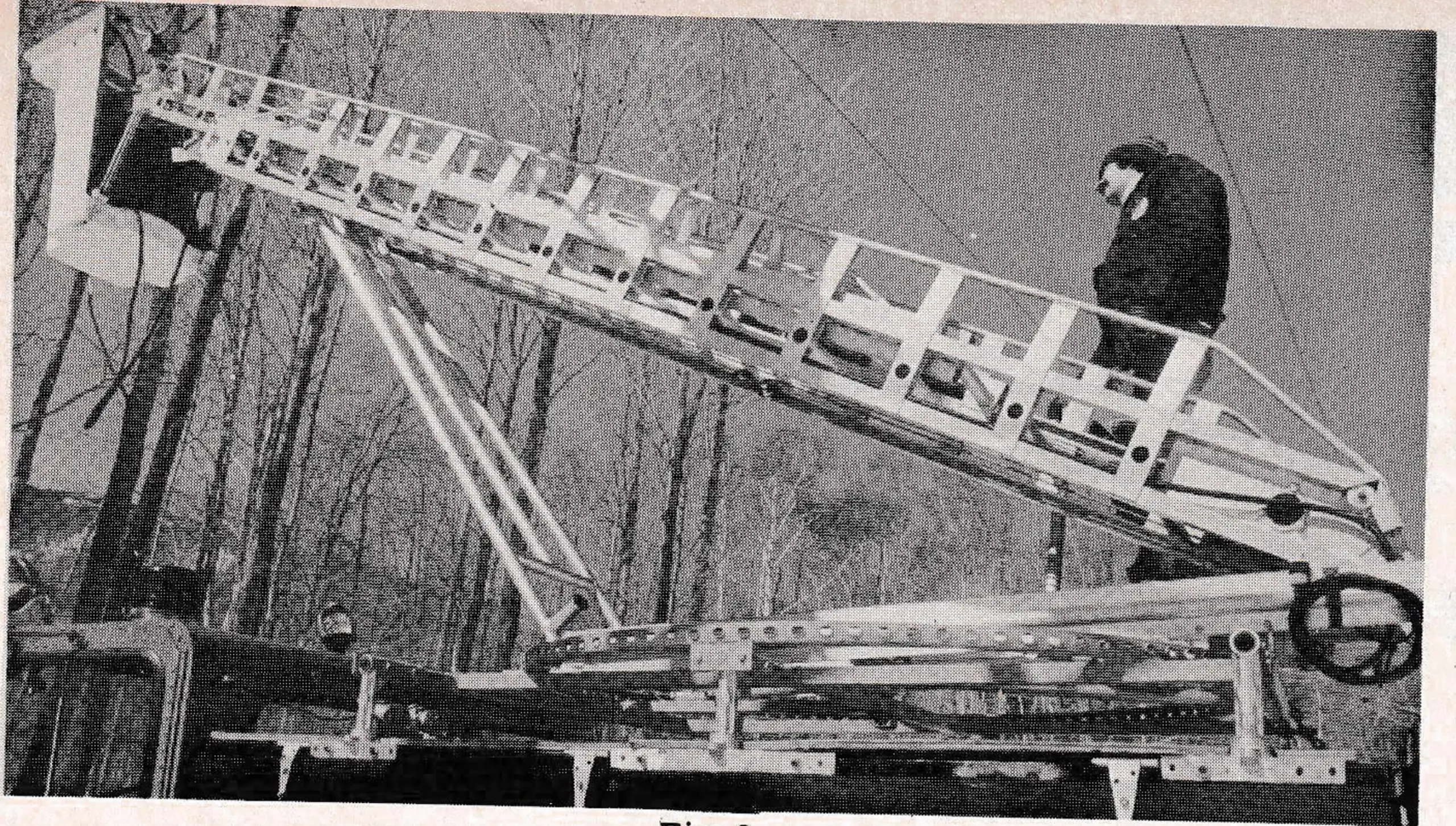
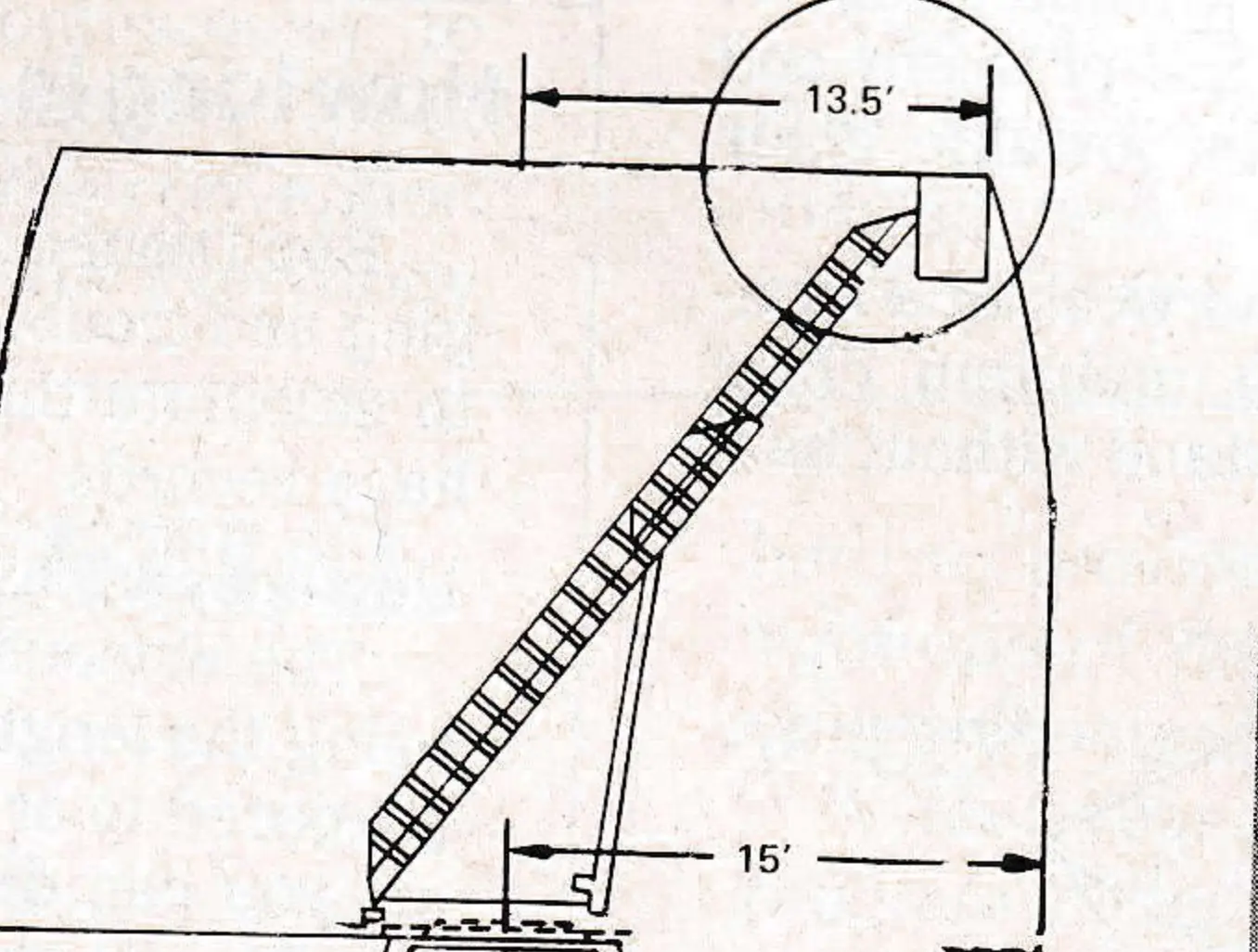
- The ladder must be extended roughly 10 feet above ground (Fig. 2) before the operator can ascend (Fig. 3) and continue operating from inside the bucket.
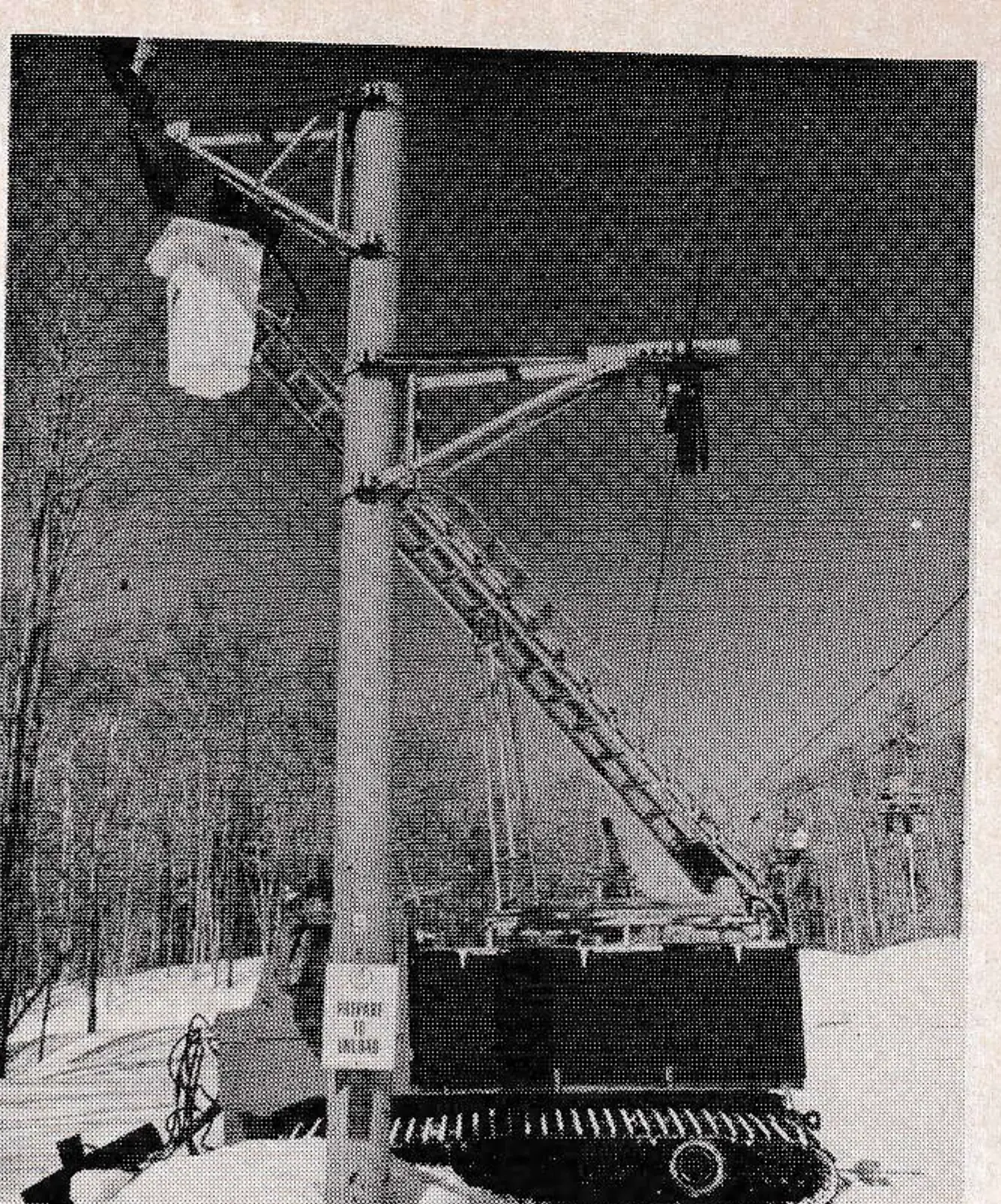
- Perhaps the most difficult aspect of this lift is its controlled “flight pattern.” The upward motion and ladder extension is wrapped up in one control cable hoist. (Fig. 4.) Thus, if the prime mover is not driven to nearly the right location, the bucket when raised may miss its intended target, requiring the machine to be relocated. However, since the “flight pattern” is always known — essentially straight up — the bucket can be located by placing the front-most part of the prime mover directly under the work area. (Fig. 5).
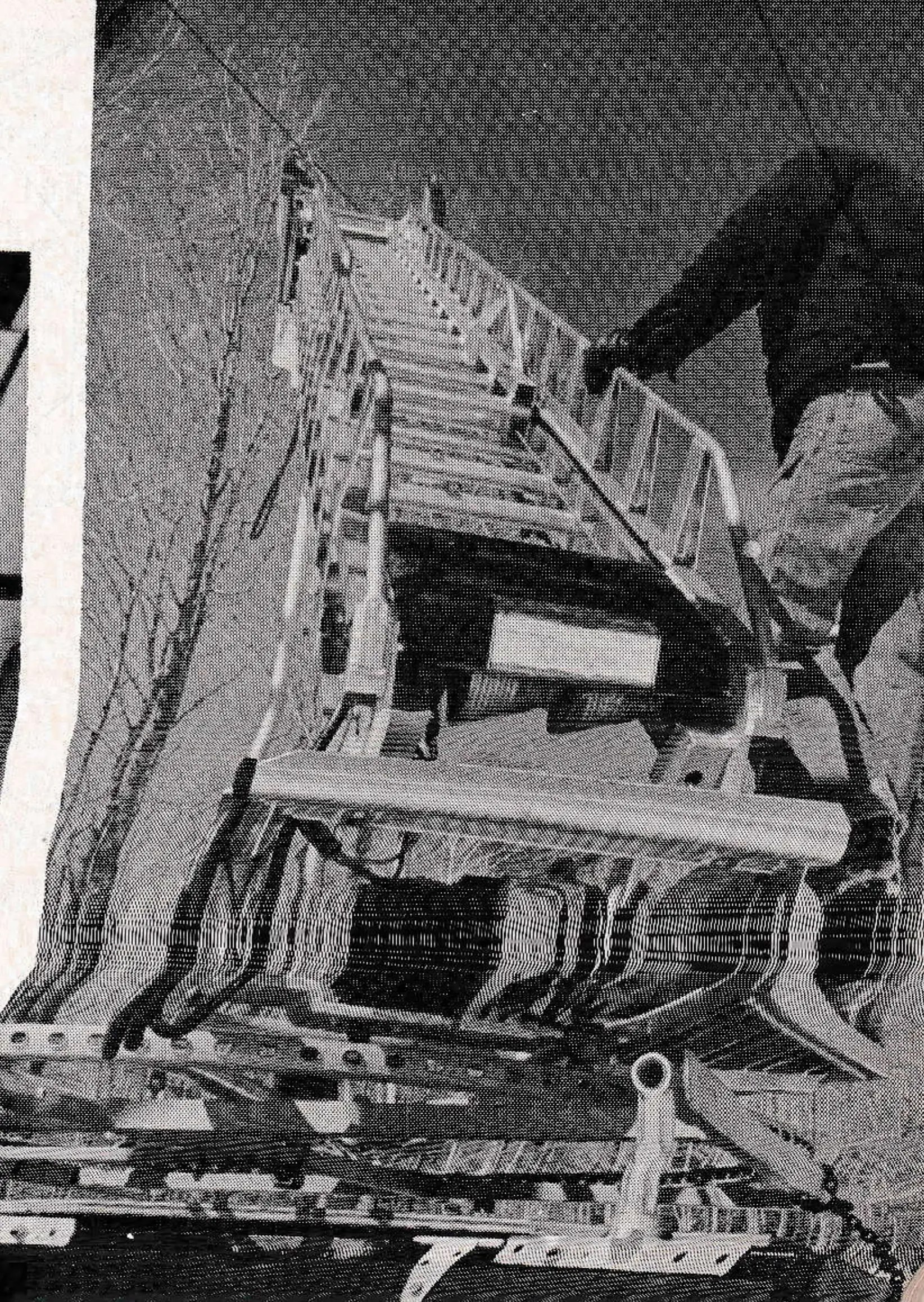
Prime Mover: As the pictures indicate, we chose a Thiokol Spryte (used) to carry the ladder. The Spryte payload is 1900 lb., including driver and passenger, which leaves roughly 1500-1600 lb. for the aerial lift and tools, and is just adequate. Only one other vehicle, a Bombardier SV 250 was given final consideration. The Tucker is too narrow, too high and has excessive sway for this particular purpose. The Packmaster’s rear deck is small and the cab only provides room for one person safely. Bombardier was ruled out due to the “pan type” frame construction which we felt was too light.
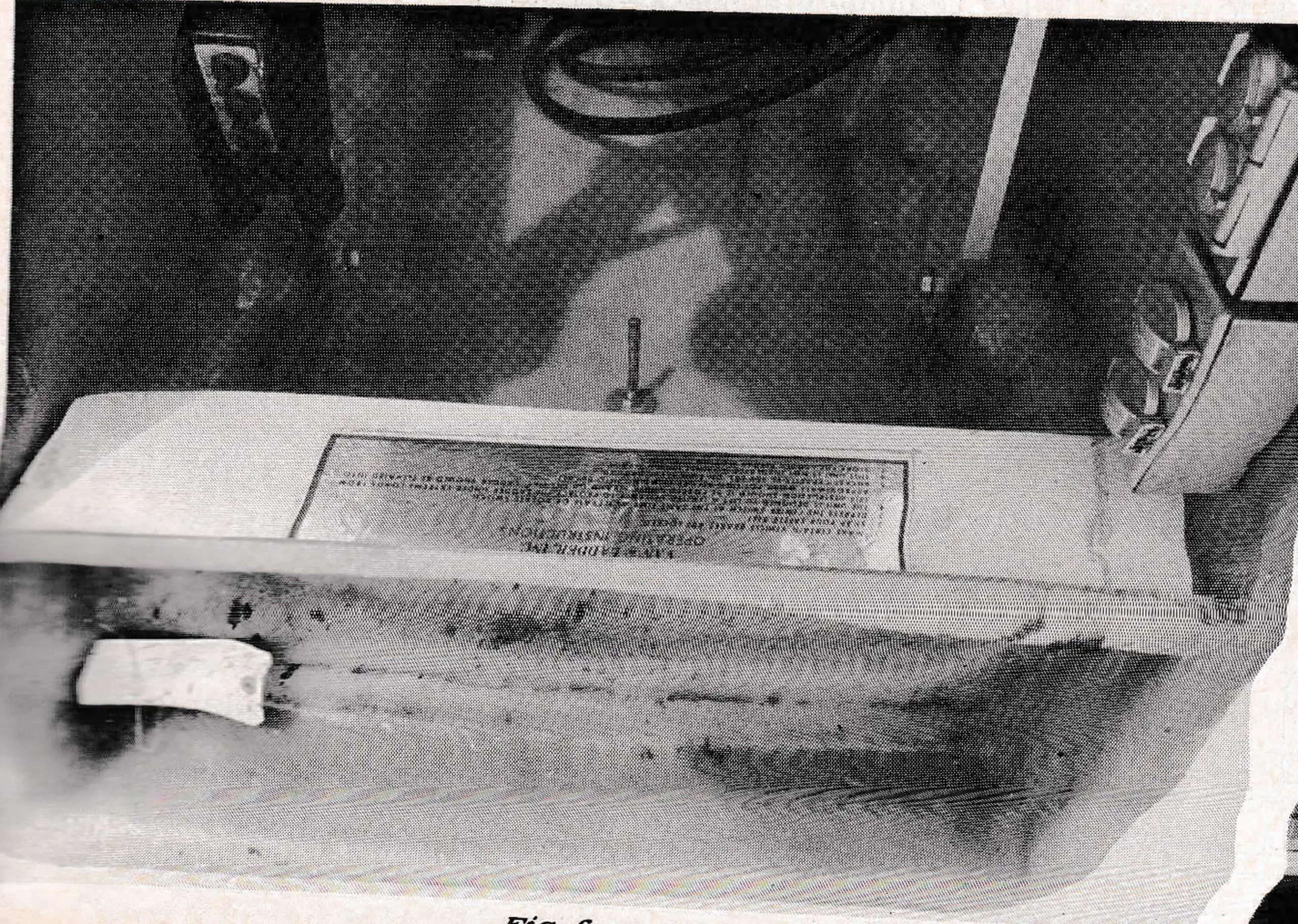
Accessories: Hind sight, being what it is, strongly suggests the need for an independently extensible ladder section, which we don’t have, but which is available from the supplier for $600. The standard fiberglass bucket is factory-wired with a 12-volt outlet. We added 4:120V weatherproof outlets for emergency lights and power tools (Fig. 6). The 10-foot, front-mounted blade on the Spryte is a welcome and necessary extra. It stabilizes the machine and allows for clearing excess snow when required. Rear-mounted hydraulics shouldn’t be discounted since we intend to use ours to operate a hydraulic cable lifter (SAM Idea File) to service our sheaves.
The Spryte is completely outfitted (Fig. 7) with every hand tool needed and some larger special jigs. In addition, there are lifting chains, coffin hoists, a gin pole, air compressor with tools, 2 kw generator, vise, emergency lights, oxy-acetylene tanks and torches, extension cords etc. A 2-way radio, fire extinguisher and remote control spot light in the cab complete the list.
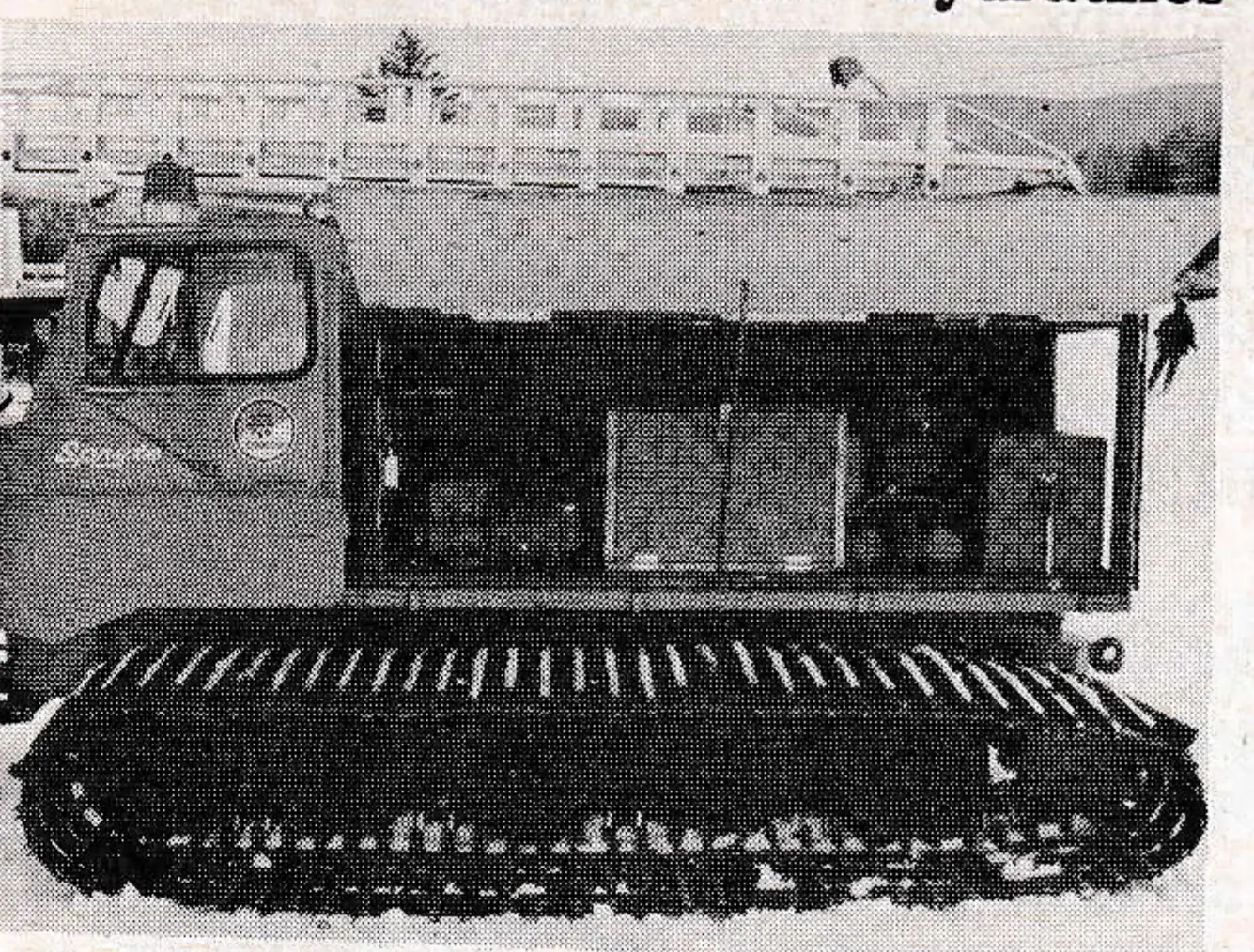
Additional Comments: Our shop foreman, Roger Neal, designed and welded the 2” square-tube box frame that supports the ladder and encloses the tool area. Lift maintenance foreman, Keith Hall, fully enclosed the frame with ½” hinged exterior plywood sides and a solid top. With the addition of interior lights, paint and an Okemo decal, we were in business. Total cost, about $15,000 and worth every cent.

We haven’t experienced any difficulties with ice or snow even though the rig is outside all day. Chair lift evacuation has been considered but not yet tried.
For further details, contact Okemo Mountain in Ludlow, Vt., (802-228-4041) or the Van Ladder Corporation in Spencer, Iowa at (712-262-5810.
Other areas we know of that are using or have used similar devices are Bromley Mountain, Vt., Waterville Valley, N.H., and Gore Mountain, N.Y.
Nils Ericksen put away his consultant’s shingle last October to become General Manager of Okemo Mt. in Central Vermont.