


Re: Rope Alignment
The article by Bob Diener in Fall SAM was certainly timely for all of us in the aerial passenger tramway business. It should be well known by now that “proper alignment” on lifts is the first line of defense against deropement and can save the owner a great deal of time and money for worn parts and labor. So it is that we should work toward the goal of “proper alignment.”
I must take issue with Bob, however, on his “Fact #5” concerning rope lay retardation. First, let’s assume that we are talking here about ropes which are running only on sheaves with grooves consisting of neoprene or similar elastomer compounds. Second, let’s assume the sheaves are equipped with free-running, anti-friction bearings. Now, we’ll let the rope move over the sheave with enough weight (or pressure) so that the surface speed of the tire and the rope are the same. Under these conditions, the force created to apply torque to the rope is so small it does not show up as torque in ropes of the size used on most aerial tramways. The sheave sees the rope as a round bar in which lay makes no difference.
Now, let’s retard the sheave and let the rope slip or slide as it crosses. The helix of the rope now has all the properties of an extra long screw and, depending on the resistance of the two materials, the rope will either twist or it will slip and file the sheave groove. Only under this condition does right lay or left lay affect the rope as it does its job. The easist way to get rid of this “rope torque” is to keep the line sheave bearings in good shape. Note: This “flow of lay” was more of a problem in the past with small ropes and small steel sheaves and, for all practical purposes, has disappeared today.
Due to the elasticity of the aerial tramway system and the various configurations of loadings, many times the rope is seen to “go backwards” under very normal circumstances. This is caused by acceleration and breathing of the various spans. This tells us that we should have our sheave assemblies parallel and in line with the path of the rope. To do otherwise is to invite potential disaster. Sorry I have to disagree with Bob on this, but I feel the point is extremely important. Having load tested close to 100 aerial tramways, at which time we let them go backwards, my experience has indicated that this is the proof of good alignment.
Finally, there is one point which should be brought out that is of vital importance. “Keep the sheave(s) in the plane of the bend.” What is that? Perhaps a picture will help…
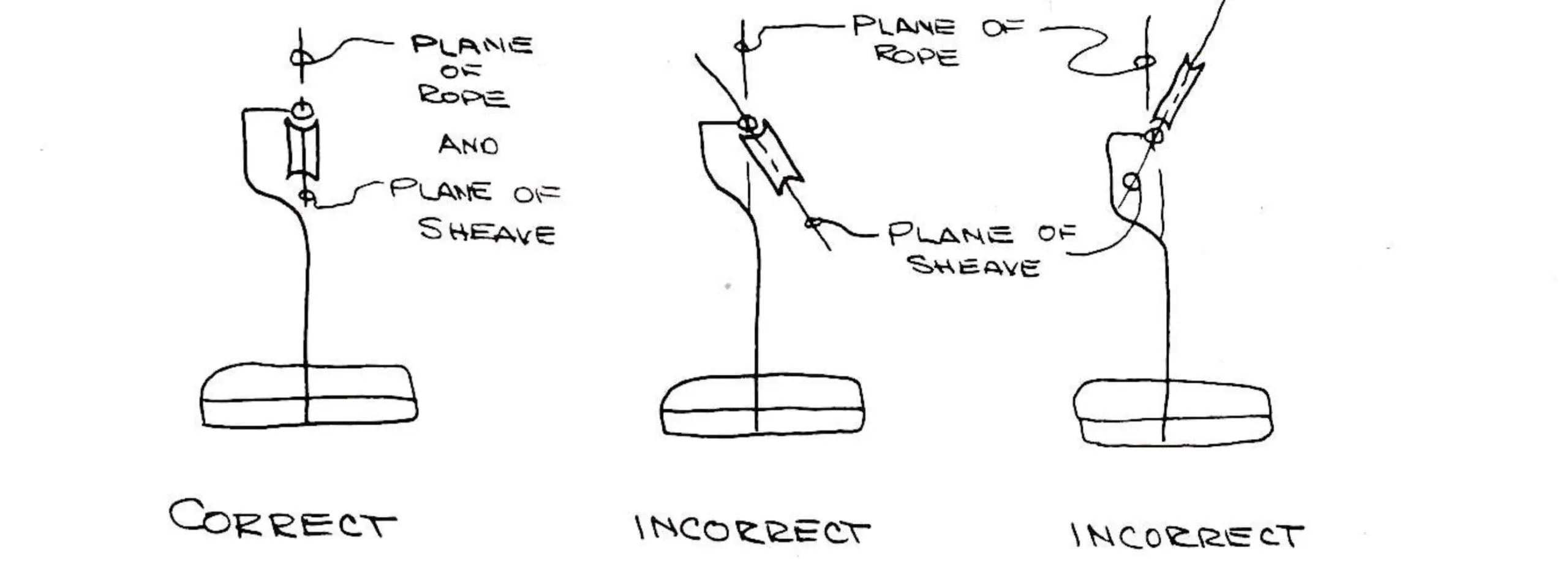
On special occasions the designer may offset the terminal or vary the gauge of the lift, in which case the plane of the bend may differ from the vertical and horizontal planes to which we are more accustomed.
If you’d like to check your alignment, try this trick (first seen by the writer in Sun Valley). Place a piece of flagging in the rope about twenty to thirty feet ahead of the viewer, midway between chairs, and ride the lift circuit.
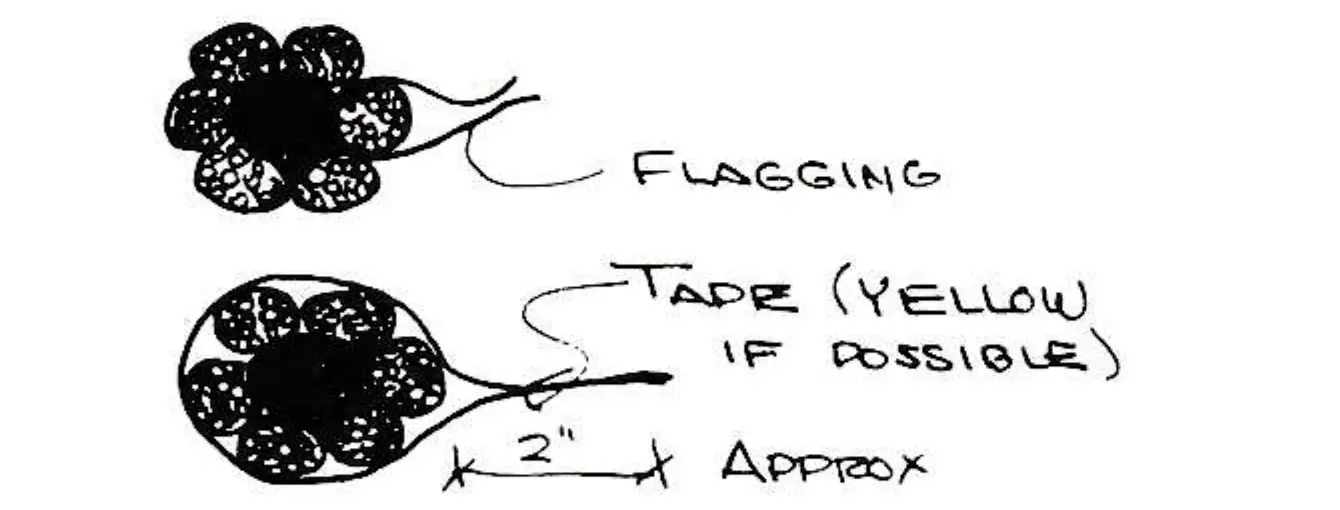
As this marker approaches the towers, it will rotate if misalignment is present. Tape may be wrapped around the rope at the midpoint between chairs, which will also act as this indicator.
Since friction is necessary to roll the rope, lubrication on the rope and sheaves may reduce the visual rolling. Rope twist may show up later as the rope dries out.
In conclusion, let’s keep the sheaves in the plane of the bend and keep our sheave trains in proper alignment, parallel to the rope.
James L. Ellis, P.E.
Director of Application Engineering
Riblet Tramway Co.

Re: Evacuation Rope
Sir:
I would like to comment on the piece by Phillip Savage on “Evacuation Rope Caution” in Spring SAM. The article is well written but in my opinion is far too sophisticated and drawn out to attract many readers. Really, what it says is, “if your evacuation rope goes over the haul cable, better use a Line Saver.”
As Lift Evacuation Coordinator for the Eastern Division of the National Ski Patrol System, I can say we regularly recommend the use of line saving devices in all our literature, manuals, slide presentations, etc.
Further, we emphasize repeatedly that area management should participate in all lift evacuation practice sessions and that area employees should be trained in lift evacuation techniques. Also, management is urged to have an approved written evacuation plan plus records including names and addresses of patrollers, area employees and others who are properly trained.
In spite of all the above-mentioned efforts, each year I run into patrollers who say “we use 5/8″ rope and go right over the cable.” When I ask why, and point out that 7/16″ rope costs about 50% less than 5/8″ they reply, “We don’t worry — management pays for it.” I don’t believe this alibi because I don’t think management is silly enough to spend this much extra for ropes only to have them ruined by going over the haul cable. I’d rather think the purchase of 5/8″ rope is a carry-over from the days of the lower original strength, wear and deterioration due to age, etc. Also, Line Savers are not available for larger than 1/2″ rope and our suppliers tell us there is little or no demand for larger sizes.
To be more to the point, my price list shows 7/16″ rope costs about 28¢ per foot and 5/8″ costs about 42¢ per foot or 50% more. On one 100-foot evacuation rope the savings are just about enough to buy a $15.00 Line Saver. After that, it’s more money in the bank for management.
My hope in writing in such detail is that your magazine will reprint all or part of this information in a “not too distant” future issue. This will be one “sure fire” way for N.S.P.S. and area management to get together on a matter that will be mutually beneficial.
Jack Shaffer
Evacuation Coordinator, E. Div.
N.S.P.S.