
“Some liken it to a new utility—like electricity or the telephone,” he opined. “Others describe it as the continental railroad or the interstate highway system.” He called it a digital revolution that would change the way we communicate, and added that Steamboat would soon open a Web site on the Internet.
Could that have been just two years ago? As electronic events move at warp speed, it seems like 20 years ago.
Even though the Internet is still not profitable for businesses, over the past two years thousands of companies have opened Web sites on the net to get into the boom in electronic shopping. Forrester Research, a market research company in Cambridge, Mass., estimates that the Internet economy was $14.8 billion in 1996 and predicts that 1997 will be the year when real on-line action gets going. The difference probably will be that start-up costs are completed for many entities and the public is ready to deal via e-mail.
More and more ski resorts are also getting into cyberspace. Some do it to meet the competition, some to make a statement that says they are young and cool and some plain don’t know why they are there. Because Rod Hanna was so prescient about the growth of the Internet and so optimistic about its benefits, we thought it would be worthwhile to check on his progress with this developing medium.
“We are absolutely meeting our goals on the Internet,” Hanna said in a recent interview. “Just as an advertising tool, it is a low-cost impact on lots of people. Much less than we would have to spend for equivalent impact in many magazines.”
By January 1995, Steamboat had a home page on the Internet; the area now has a Web site with over 200 pages of information and pictures of the resort. Originally, Hanna and his staff designed the Web site; now two people—an office coordinator and a Central Reservations agent—work full-time on Internet communications. The cost for set-up he estimates at somewhere under $5,000, including the computer, software and costs for getting on a server, and the first year expenses were about $40,000. Ongoing costs are now less than $1,000 a month with labor and other in-house expenses adding $3,000 to $4,000 a month.
“Hits are misleading, because each graphic can count as a hit,” Hanna said. “We get about 60,000 different people and returning visitors per month during ski season and average 25,000 per month annually. But the cost per visit is still only 13 cents and the average time per visit to the site is 3.5 minutes.”
“We want to build repeat visits among people who come on line,” said Hanna. “So we have specific reasons for having a Web site. One is to inform and enter-tain; two, because it’s more targeted than other forms of communication; three, we can interact through e-mail with customers (at a rate of about 125 contacts per day); four, with a mountain cam, we send a different video image every five minutes; and five, to close sales—book reservations.

“Right now, the conversions from Internet are done on the phone where we get the credit card information. But, the commissions earned [by the resort rather than by travel agents] more than cover the costs of Internet.”
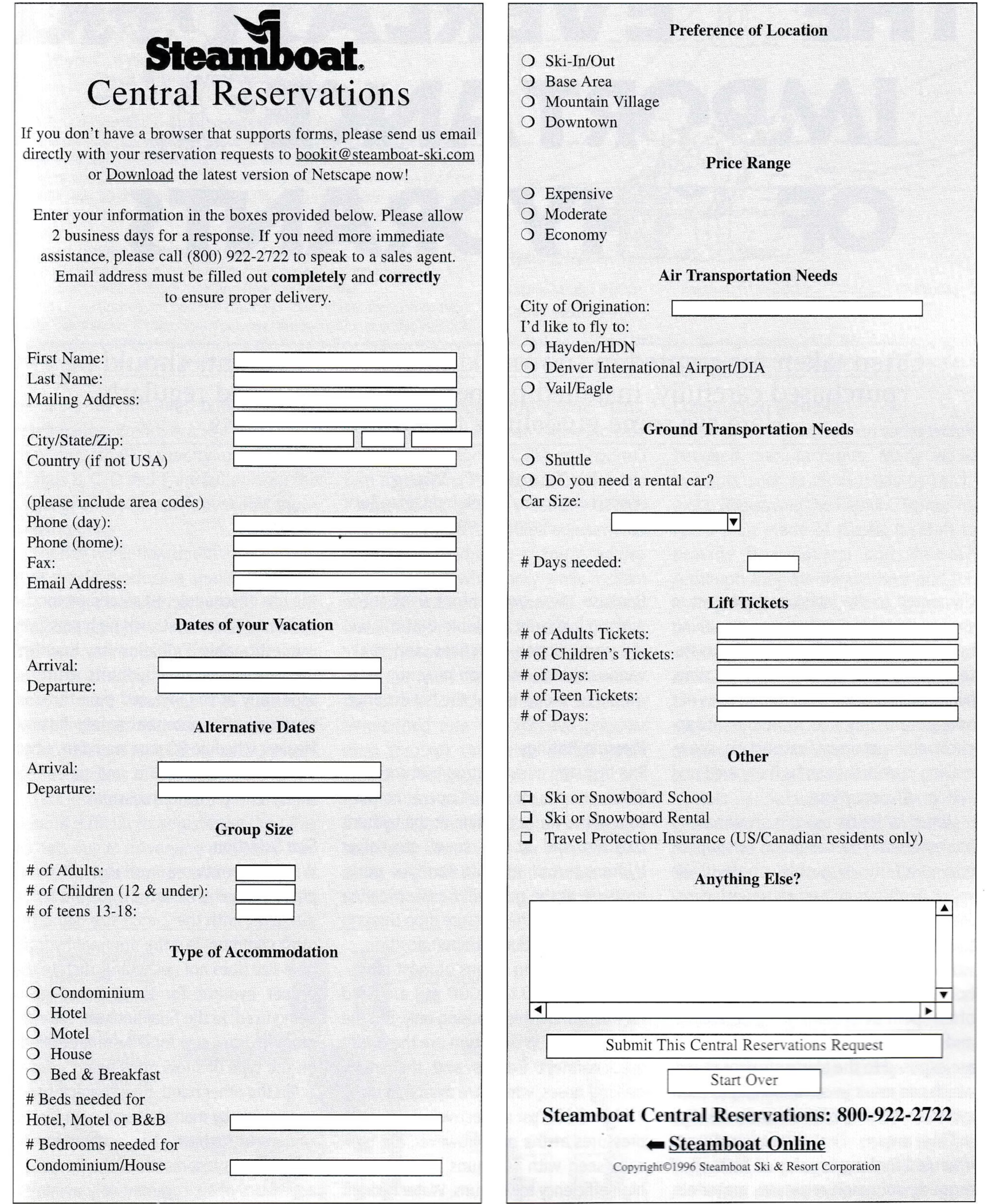
Each of the 79 lodging properties at the resort has a page on the Web site that guests can peruse to plan their trips. To save paperwork and aid in making reservations, Steamboat developed a Book-It form that guests fill out and send by e-mail. One reservation clerk is assigned to handle the 60 to 80 contacts per day. She checks the inventory and e-mails a response. Guests then call in or fax the necessary credit confirmation, but Hanna sees a time—relatively soon—when customers will trust e-mail with their credit card numbers.
“One thing I didn’t anticipate was that agents at Central Reservations often discover customers on the phone are looking at the Web site Travel Planner as they are talking,” said Hanna. “I don’t know the exact figures on this, but it happens a significant number of times a day.” Chairlift surveys also indicate that many people use the Internet to plan vacations, he said. The busiest response time on the Steamboat Web site is around lunch hour, from 10 a.m. to 2 p.m. Although many employees may have e-mail numbers at work, said Hanna, they probably don’t have the ability to surf freely. Steamboat also has a daily ski report that is sent free to 1,345 skiers who subscribe to the service.
Right now Hanna said the Internet is not taking the place of other forms of marketing for Steamboat. The resort still produces and distributes brochures, advertises in magazines and newspapers and does direct mail promotions. An increasing number of publications are getting press releases and photos through satellite up-link, but press kits are also sent out by snail mail.
“I do see the Internet as supplanting traditional marketing in the future,” said Hanna. “But it is so dynamic and changes so fast that it’s hard to say when this will happen. As computers get smaller and smaller, everything will change.”