


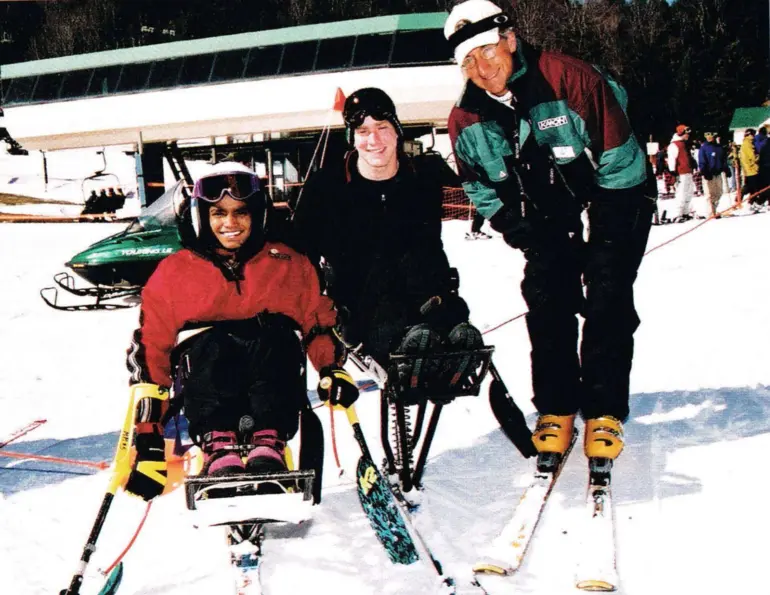
Managers of ski areas on U.S. Forest Service land are intimately familiar with Section 504 of the Rehabilitation Act and its companion, the Americans with Disabilities Act of 1990. These are the regulations for special parking, wheelchair ramps and hand rails in bathrooms of public buildings. They also require many resorts to make slopes and facilities accessible to the physically challenged.
Regardless of obligation to government edicts, resorts can be well served by establishing adaptive programs. Modifications that improve accessibility around a resort often enhance the experience for able-bodied skiers clomping to and fro in alpine boots. And disabled skiers are typically accompanied to the slopes by an average of 3.2 family members and friends, according to Disabled Sports USA, a nonprofit organization that offers nationwide sports rehabilitation programs. The entourage is captive and opens wallets for lift tickets, lodging, food, gear and souvenirs.
Moreover, adaptive programs are a perennial source of upbeat media coverage. Local newspapers, radio and television stations are always looking for human interest stories and will send reporters to cover adaptive events, generally painting resorts in a positive light.
“We’ve received a ton of press,” says Gwen Allard, president and director of the Adaptive Sports Foundation (ASF) at Ski Windham, N.Y., about three hours north of Manhattan. “We were on the front page of The New York Times sports section, in the Wall Street Journal and on CNN. The goodwill we provide Ski Windham is beyond measure.”
“If you don’t have an adaptive program,” says Kathy Chandler, a principal in Ability Plus, which helps resorts start and manage such programs, “you’re missing out on a viable market.”
Aside from good press and widening the market for customers, however, Daniel Frank, Windham’s president and GM, says there are other benefits. “What adaptive programs do for the overall image of the sport is very valuable,” he says. “It sends the message that you can participate in skiing at all levels.”
Allard also credits the ASF for modestly invigorating the local real estate market. “Families have come up to Windham for the adaptive program, turned around and bought homes in the valley,” she says. “One family built a $750,000 home.” Allard estimates about 25 disabled students or instructors live in the immediate area.
The ASF is a separate, nonprofit entity from Ski Windham. It has its own $286,000 annual budget, not including lift tickets, office space, storage and other facilities provided by the ski area. Four full-time employees run the program with the help of 130 volunteers.
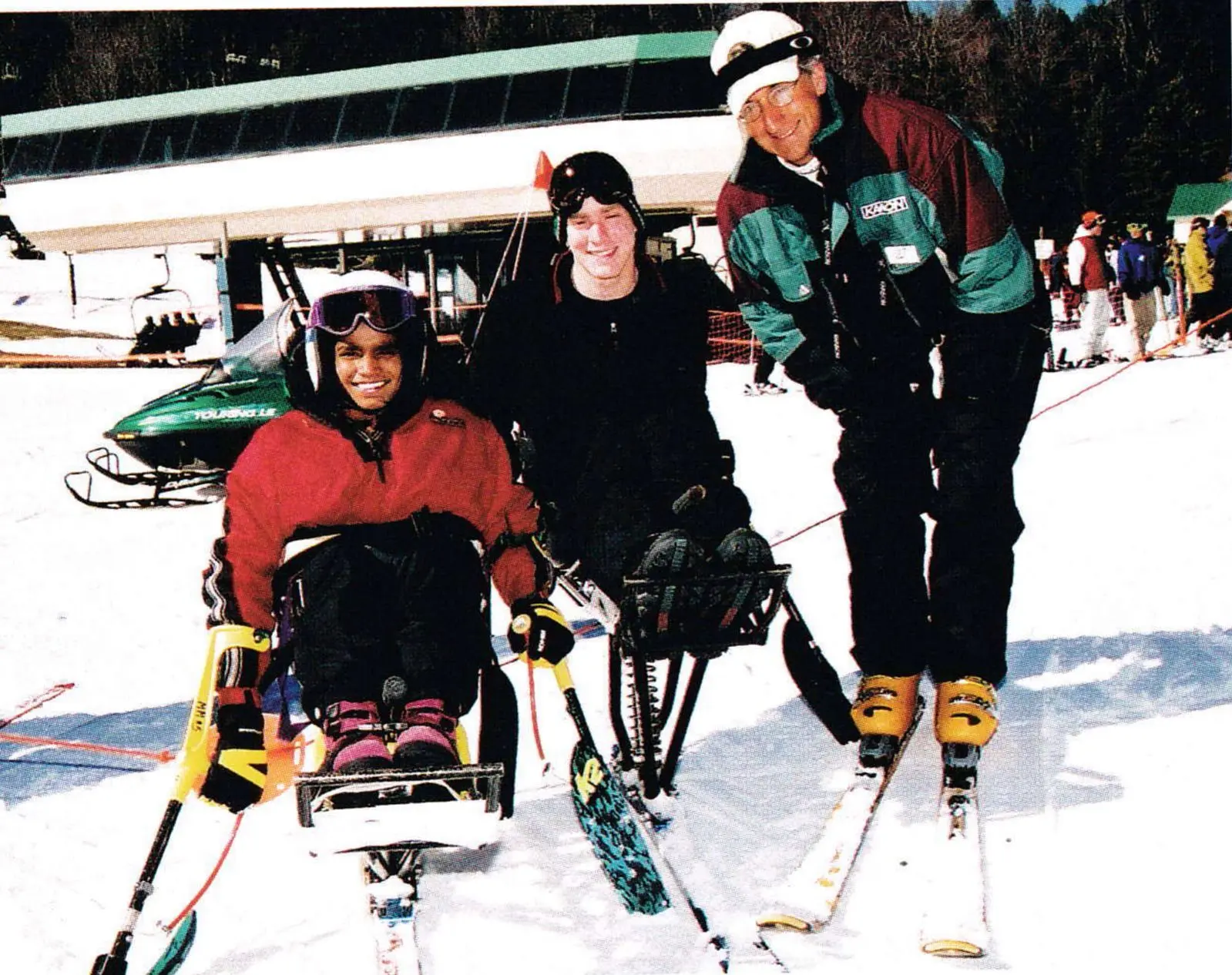
Photo by John Waldron
Allard says the ASF keeps a detailed file on every adaptive skier it serves. The information includes primary and secondary disabilities, medical history, physician info, ability to see and hear and emotional state. “If the ski patrol gets a call about one of our skiers, there’s an immediate profile available,” says Allard. After lessons, instructors write evaluations of students to help prepare for future lessons. “We want an environment that is safe and successful. The more we know, the better we do our jobs.”
Windham is burnishing its reputation as an adaptive center by increasing summer offerings to disabled guests. This season’s menu includes golf, tennis, biking, swimming, overnight camping, fishing, fitness and field sports.
ASF provides one of the most comprehensive programs in the East, on par with STRIDE (Sports & Therapeutic Recreation Instruction/Developmental Education) at Jiminy Peak, Mass., and Ability Plus at Waterville Valley, N.H. While Ability Plus also has satellite programs at Attitash Bear Peak and Bretton Woods in New Hampshire, Mount Snow Resort, Vt., Wachusett Mountain Ski Area, Mass., and will start one at Gunstock, N.H., next season, STRIDE maintains its only program at Jiminy Peak.
In the Rockies, the gold standard of adaptive programs is the National Sports Center for the Disabled (NSCD) at Winter Park, Colo. Consider its prodigious annual numbers:
- $3 million budget
- 19 PSIA-certified instructors
- 28,000 lessons
- 3,000 guests
- 55 full-time employees
- 1,000 volunteers
- 60,000 hours of volunteer time
The NSCD was founded by Hal O’Leary, a Winter Park instructor who taught 23 child amputees to ski in 1970. O’Leary then discovered a ready, willing and disabled group of Vietnam veterans looking for a good time. He built one of the biggest and most progressive handicapped sports programs in the country. He is still its director and manages to teach almost every day of the season.
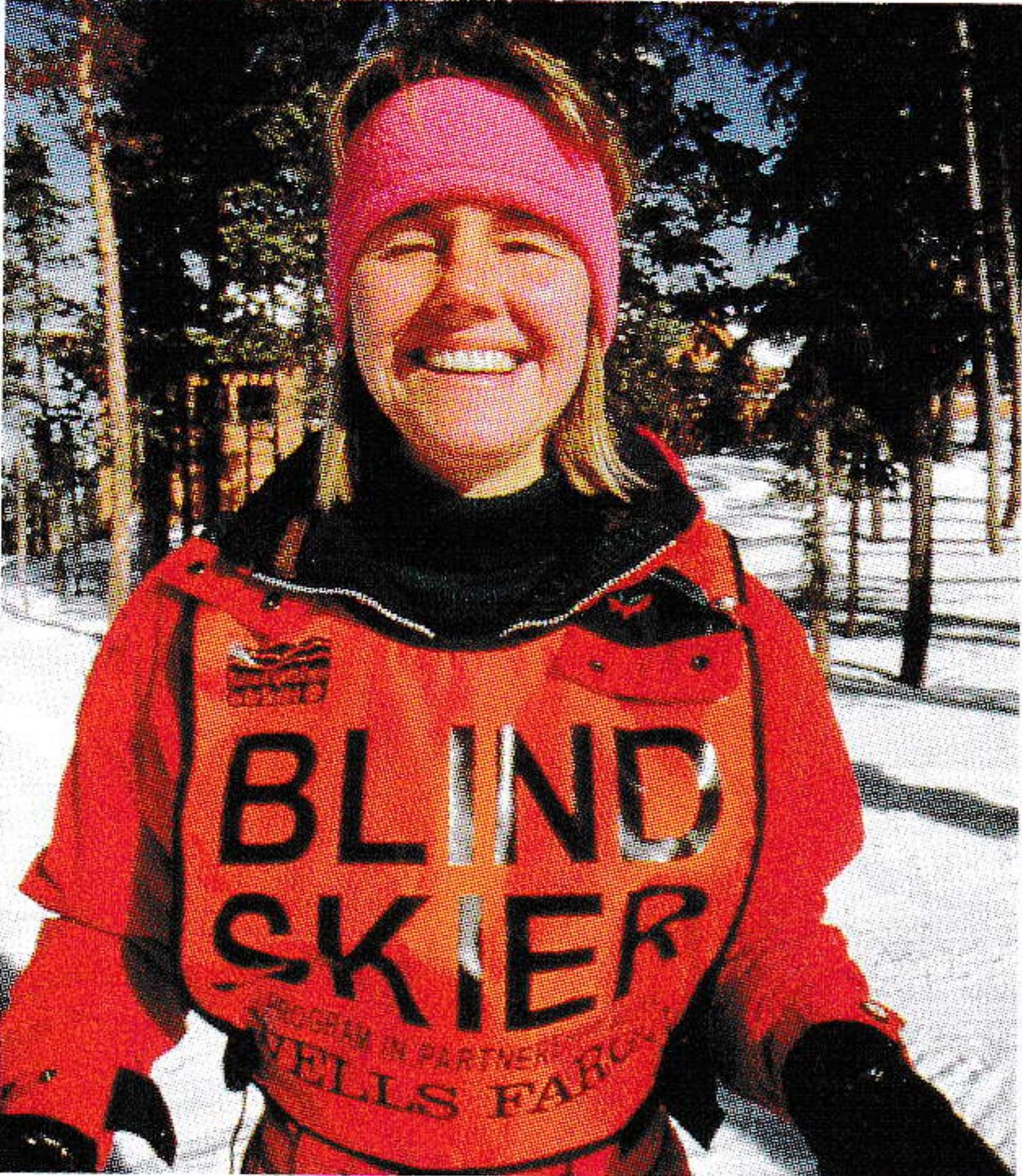
The NSCD has grown into a year-round, multi-sport operation. In addition to recreational alpine and cross-country skiing, snowboarding and snowshoeing lessons, NSCD trains ski racers with disabilities. Summer recreation includes biking, hiking, in-line skating, sailing, horseback riding, white-water rafting, baseball, fishing, rock climbing for the blind and camping. Golf and fly fishing are being added this summer.
Like the ASF, the NSCD is a nonprofit group, distinct from Winter Park. Lift tickets are donated by the resort and count as budget contributions.
Jack Buchheister, president of the NSCD, points out that skiing is an adaptive sport for everyone. Hard-shell boots are akin to orthopedic shoes; ski poles are glorified crutches.

“It’s just a matter of what level of adaptation,” says Buchheister. “Our line is that adaptive is good for everyone. Ramps, larger bathroom stalls and wide aisles in stores make it easier for everyone, especially the elderly and people with strollers. For the 1990 World Disabled Championships, we added a ramp next to one of our stairways. Now, nearly all able-bodied skiers prefer the ramp.”
The NSCD, which maintains its headquarters at Winter Park and a satellite office in Denver, is taking its adaptive show on the road. An outreach program offers training and clinics around the world on how to accommodate adaptive skiers. An annual symposium enables professionals in recreation to meet and learn about new adaptations in sliding sports and to gain insight into accommodating the needs of the disabled.
“We have a dedicated outreach team that can help other ski schools comply with ADA and 504 requirements,” says Buchheister. “We help with things like building modifications, training lift operators and managing adaptive equipment. Our team recently visited Schweitzer Mountain in Idaho to train mountain staff in dealing with the Americans with Disabilities Act.”
The NSCD also will partner with other ski areas to share adaptive equipment. Sit-skis start at about $2,800 apiece, outriggers are $300 a pair, and the equipment can be customized with an array of costly accessories for various disabilities. And any equipment more than a few seasons old predates a host of technological advancements that include lighter, stronger materials and the ability to change the type and length of skis attached to the unit.
“If a ski area has a relationship with us and they know in advance that they’re going to need equipment for a mono-skier, for example, we can ship it to them,” Buchheister says. Waterville’s Ability Plus has a similar program for lending equipment to other ski areas around the Northeast.
Resorts interested in starting adaptive programs should begin by getting instructors PSIA certified to teach adaptive skiing, Buchheister advises. Training typically means instructors study the six disciplines of adaptive skiing (mono-ski, bi-ski, three-track, four-track, blind skiing and developmentally delayed or cognitively impaired skiing), the medical implications of each disability and the proper care of adaptive skiers.
The next step is to develop a plan for training front-line staff. Lift operators obviously need to be schooled in loading adaptive skiers and procedures for misloads. The National Ski Areas Association recommends (it’s a proposed change to the B77 code) ski areas post seat-height clearances at all bottom terminals so both adaptive and able-bodied skiers and snowboarders can make adjustments in loading techniques. Just as important, employees in all departments need to be prepared for physically challenged situations and have the right attitude for dealing with them. Windham goes so far as to put parking attendants in wheelchairs and has them maneuver themselves uphill to the lodge to experience a trip from the parking lot.
Likewise, a customer service operator who stammers through an explanation of an adaptive program will not engender confidence. But there’s nothing wrong with requiring advance notice. “We encourage resorts to publish that appointments must be made 24 or 48 hours ahead of time,” says NSCD’s Buchheister. “It allows time to arrange for an instructor and equipment.”
Among the greatest challenges in serving the physically challenged are raising money and enlisting volunteers. “We’ve got to scratch together $3 million,” Buchheister says. “We do three or four major events a year to raise funds.”
At Winter Park, volunteer instructors dedicate 10 days on the slopes to adaptive training, attend seminars, on-hill clinics and continuing education courses. Volunteers are rewarded with free skiing, but that carrot hasn’t been as effective since the trend toward bargain-basement season passes. Increasing competition for volunteer opportunities also contributed to a shortfall of the NSCD’s 1000-volunteer target last season.
At the opposite end of the spectrum from the NSCD is Kirkwood Mountain Resort, Calif. Kirkwood doesn’t have much call for adaptive lessons—about 20 last season—so it relies on a single instructor. Gordie Heimerer teaches with his own sit-ski and other gear, and requires at least a day’s notice for lessons.
Mike Frye, Kirkwood’s skiing director, speculates that Kirkwood’s adaptive traffic is so light because of the resort’s proximity to the top-notch Tahoe Adaptive Ski School at Alpine Meadows. Tahoe Adaptive even predates the Winter Park program by three years.
Why even bother serving a 20-skier market? “We just wanted to accommodate individuals with special needs,” says Frye, explaining that adaptive programs, whether large or small, go beyond opening the doors of new markets to creating great moral satisfaction. It’s a chance to gain immeasurable personal rewards while providing people the opportunity to begin a lifetime of enjoyment.
Adaptive Programs
- Ability Plus
Waterville Valley, N.H. (978) 365-6200
www.abilityplus.org - Adaptive Sports Foundation
Ski Windham, N.Y. (518) 734-5070
www.wdski.org - Disabled Sports USA
Rockville, Md. (301) 217-0960
www.dsusa.org - National Sports Center for the Disabled
Winter Park, Colo. (970) 726-1518
www.nscd.org - STRIDE
Jiminy Peak, Mass (518) 598-1279
www.stride.org
Equipment Suppliers
- Freedom Factory/Mogul Master (mono-skis)
(903) 629-3945 - LaCome, Inc (outriggers)
(505) 586-0356 - Milty’s Bi-Ski Skistar Technologies (bi-skis)
(916) 581-2441 - Mountain Man Bi-Ski FFS Dual Ski (bi-skis)
(406) 587-0310 - Reliable Racing (bibs, minivox, harnesses)
1-800-274-6815
(518) 793-5677 - Shadow Rehabilitation Equip. (mono-skis)
(603) 645-5200 - Ski Doctor: Shockshaft (outriggers)
(916) 488-5398 - Ski Eze (tip retainers, ski bras)
(517) 882-4608 - Spokes N Motion Bi-Ski (bi-skis, outriggers)
(303) 922-0605 - XC Glider Hall’s Wheels (Nordic sit-skis)
1-800-628-7956
(617) 628-7955 - Yetti Radventure, Inc. (mono-skis)
(503) 628-2895

