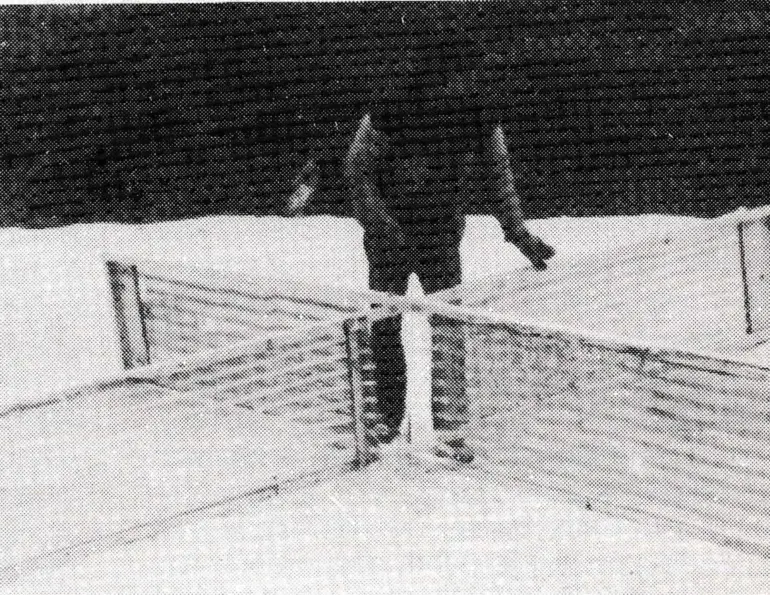
Blessed with 300 to 400 inches of snow each year, Sunshine Village in the Canadian Rockies would seem to have all the qualifications for an ideal ski resort. Unfortunately, there is one hitch in this very nearly perfect situation: wind. Persistant winds on the open slopes above tree line sweep snow off many sections of trail.
Because Sunshine Village is located inside Banff National Park there are inherent limitations on the water supply as well as environmental concerns about the use of snowmaking to patch wind-blown trails. In addition, the number of skiers coming to the resort has increased over the past few years causing more wear and tear on high traffic sections of terrain. And, there is a natural desire to open the area as early in the season as possible and to keep it open late in the spring.
Facing these problems, the mountain operations staff decided the only way to control the snow cover was to develop snow fencing and grooming techniques to catch and hold snow. Over the past several seasons they have developed a unique snow control program that could be useful at other ski areas.
Types of Snow Fence
The snow fencing at Sunshine Village is based on the two types of fences commercially available. One is the wooden slat and wire type commonly used on highways and the other is the nylon mesh type manufactured specifically for ski area use. Both of these present a surface to the wind of alternating slots and solid strips that produces the most turbulence and deposits the snow. (See SAM, Vol. 12, pg. 44, “Wind Barriers Trafficing Your Snow”) Both types in large rolls of four-foot-high material.
For highway use, the standard method of setting up fence is on “T” steel posts driven into the ground and supported by guy wires pegged into the ground on either side. The fence is strung out and pulled tight with a tractor or block and tackle. This method makes it possible to support the fence very well and get it tight so it doesn’t flap and wear or blow down. Also, this method of support makes it possible to elevate the fence so there is a gap under it, which may be desirable depending on the shape and location of the drift required.
This type of very permanent set-up has some applications in the ski area, but it has several drawbacks as well. The guy wires are a hazard for anyone skiing near the fence and they make it difficult to blade snow away from the fence with a cat. Instead of “T” steel and guy wires we use 8 inch diameter, 10-foot-long wooden posts. These do not bend like “T” steel posts would when used without guy wires. In the fall we plant the posts two feet into the ground and 16 feet apart in a row perpendicular to the prevailing wind. Frozen in, even with the double heights of slat fence we use, they stand up to the strongest winds. We make each span an individual section so it can be taken down independently. This feature and the wide span of the posts mean that a cat can easily push the snow from the fences to where it is needed.
Not all situations can be handled by these permanent fences. In many situations we find it advantageous to have fences that can be set-up and taken down more easily. For instance, some places need fences for a couple of weeks early in the season, while in other places permanent fences would block or severely restrict a run. For quick set-up and take-down time, if there is a bit of packed snow on the ground, slat type fences can be used by pounding the end of the slats into the snow. These can be made more stable by folding back 12 to 18 inches at each end and at right angles to the main part of the fence. We have used nylon mesh in the same manner by nailing it to 2″ x 2″ posts with pointed ends which can be pounded into the snow, but this requires even more packed snow.
There are a few problems setting up fences in this way. The most obvious one is that snow is necessary before a fence can be set up. Secondly, fences like this are not very stable in a strong wind. Thirdly, we found this method to be hard on fences causing breakage of slats and 2″ x 2″‘s when trying to hammer them into the snow that is too hard or too shallow.
Another solution we tried at Sunshine Village was frames made of 4 feet high and 10 feet long, but they turned out to be difficult to support and too fragile.
In developing these frames, I recalled that years ago, I had seen a snow fence made of two frames of 2″ x 2″ each, about 2 feet high and 16 feet long. These were hinged together at the center and covered with vertical strips of 1″ x 2″. They worked quite well, were self-supporting, stood up in the wind and folded flat for storage. They were, however, quite heavy to move around.
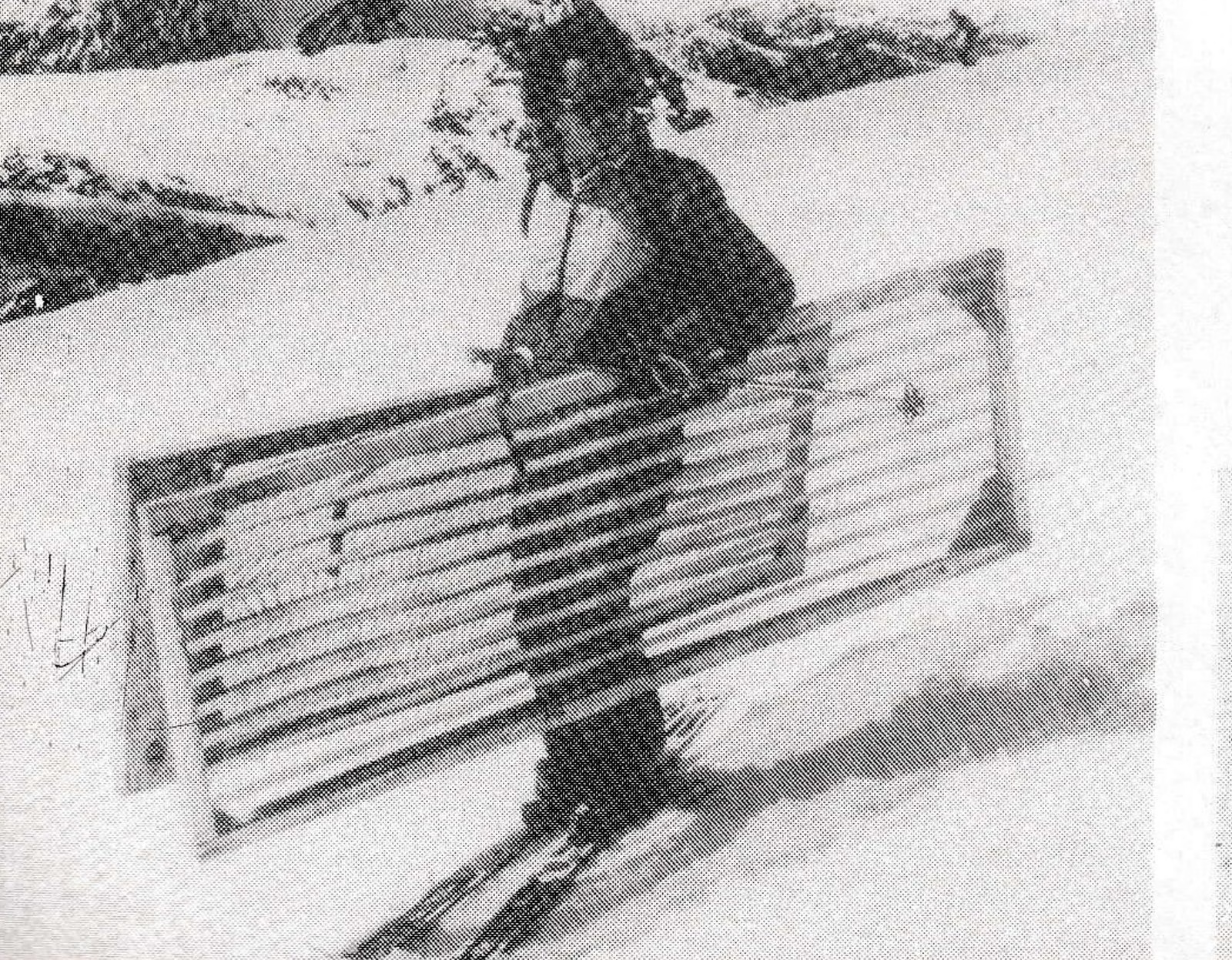
We came up with a modification that worked well. Instead of 1″ x 2″ slats, we covered the frame with nylon mesh and called this “the cross-portable fence”. As most of the snow transported by wind is carried within a foot of the ground, a two-foot-high fence is sufficient. The cross-portables are easy to set up and move, they fold up to store and a strong skier can carry one fairly easily, they can be folded and taken up a chairlift, and they have the great advantage of collecting snow equally well no matter what direction the wind is coming from.
The cross-portable fences are not, however, suitable for a permanent or winter-long set-up because they have a limited capacity and fill up rapidly. They have to be lifted or moved frequently when snow is accumulating. Although none but the very strongest winds (over 50 mph) will damage them, skiers crash into them and sit on them and this does cause damage. When they are buried in snow the trail crew has to be careful not to damage them when pulling them out, particularly at the hinge, which is the weakest point. We gave a lot of thought to reinforcing the cross-portables with aluminium or some other metal, but decided the cost and weight would be prohibitive. Fences made of wood can be easily repaired by a worker without special skills.
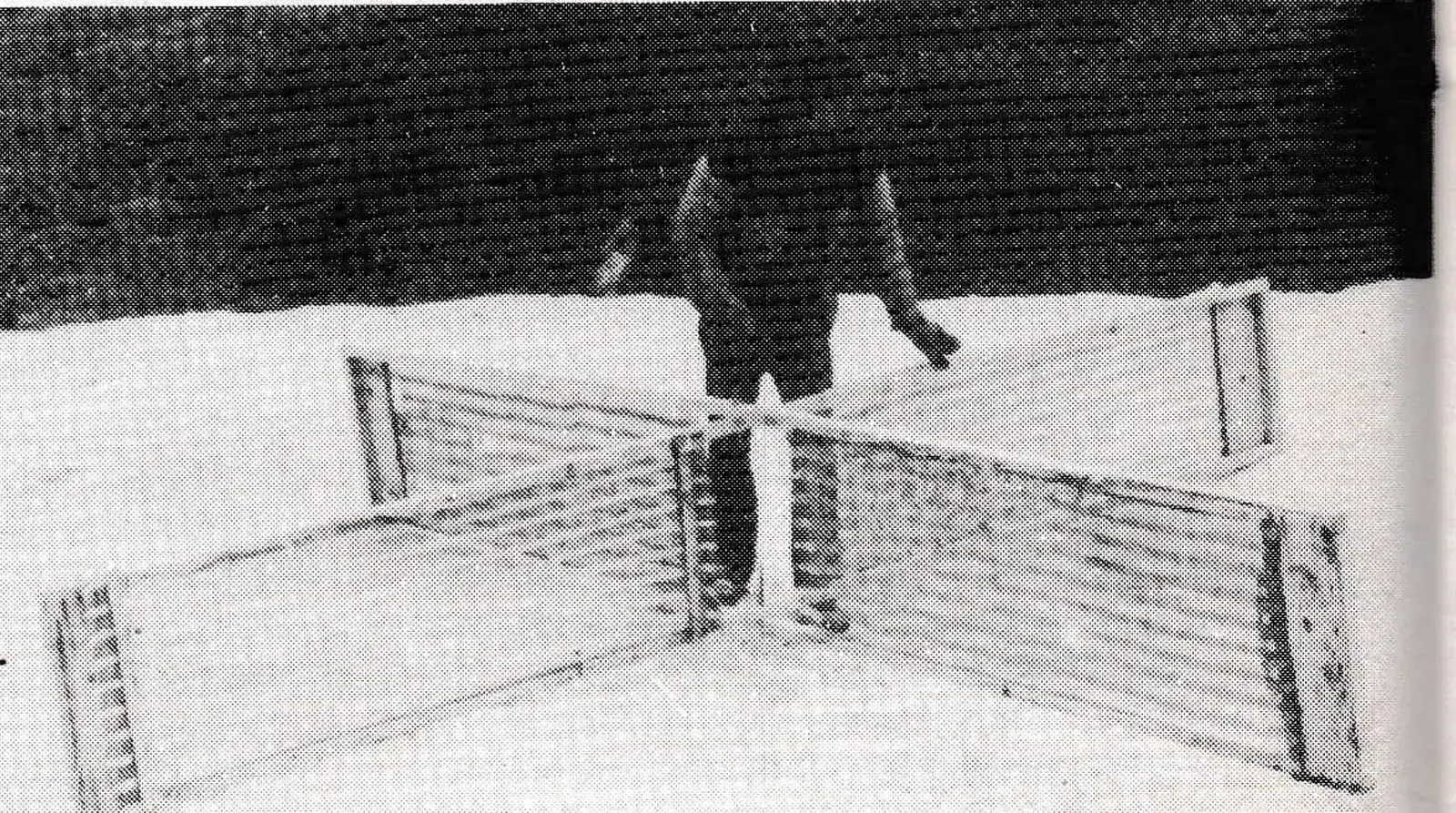
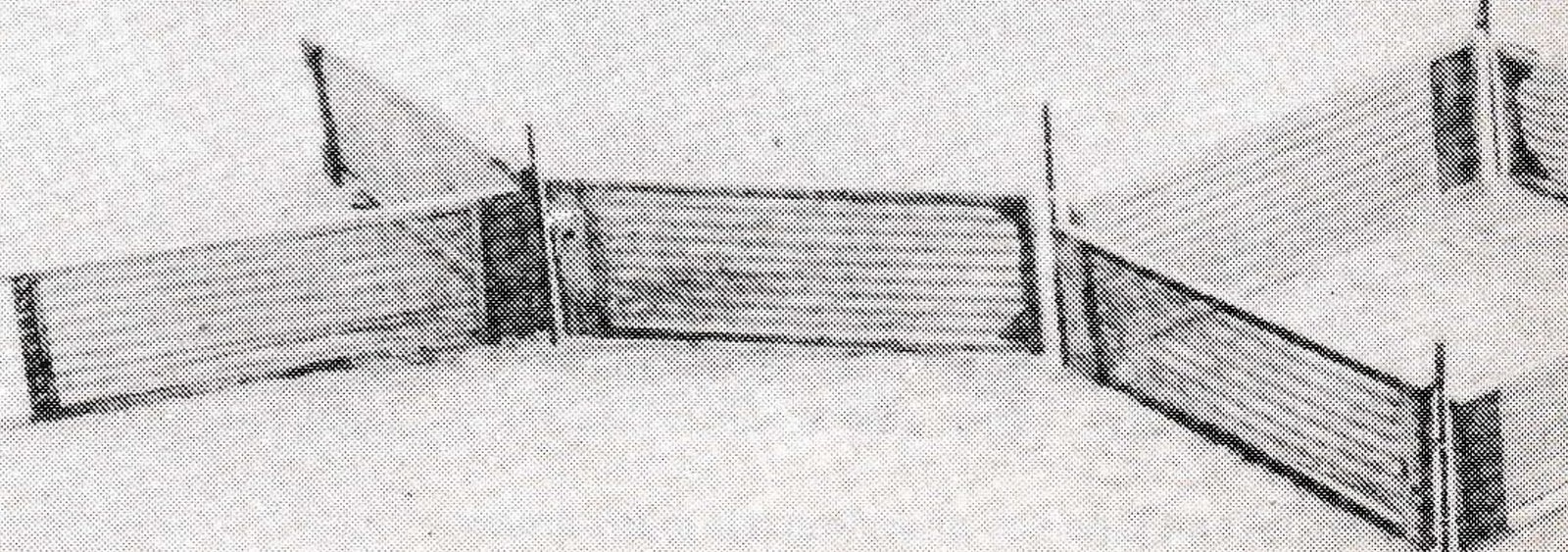
The next fence development that grew out of this and the one we are currently using, is what we call “the modular fence.” We retain the idea that fences two feet high are sufficient if they are moved frequently enough, so we made panels of 2″ x 2″ fence covered with nylon mesh, but now only eight feet long. At each end we put a couple eyebolts so that by sticking a rod (a broken ski pole, cheap and abundant at a ski area) through the eyebolts we can link fences together with a hinge joint. Two, three or four panels can be attached to the same rod so all kinds of patterns are possible—crosses, linked crosses, zig zags, linked boxes—for different locations and different results. These modular fences have all the good points of cross-portables, but do not have the weak hinge point and are much easier to carry and store. If one panel is broken it doesn’t put three other panels out of service at the same time.
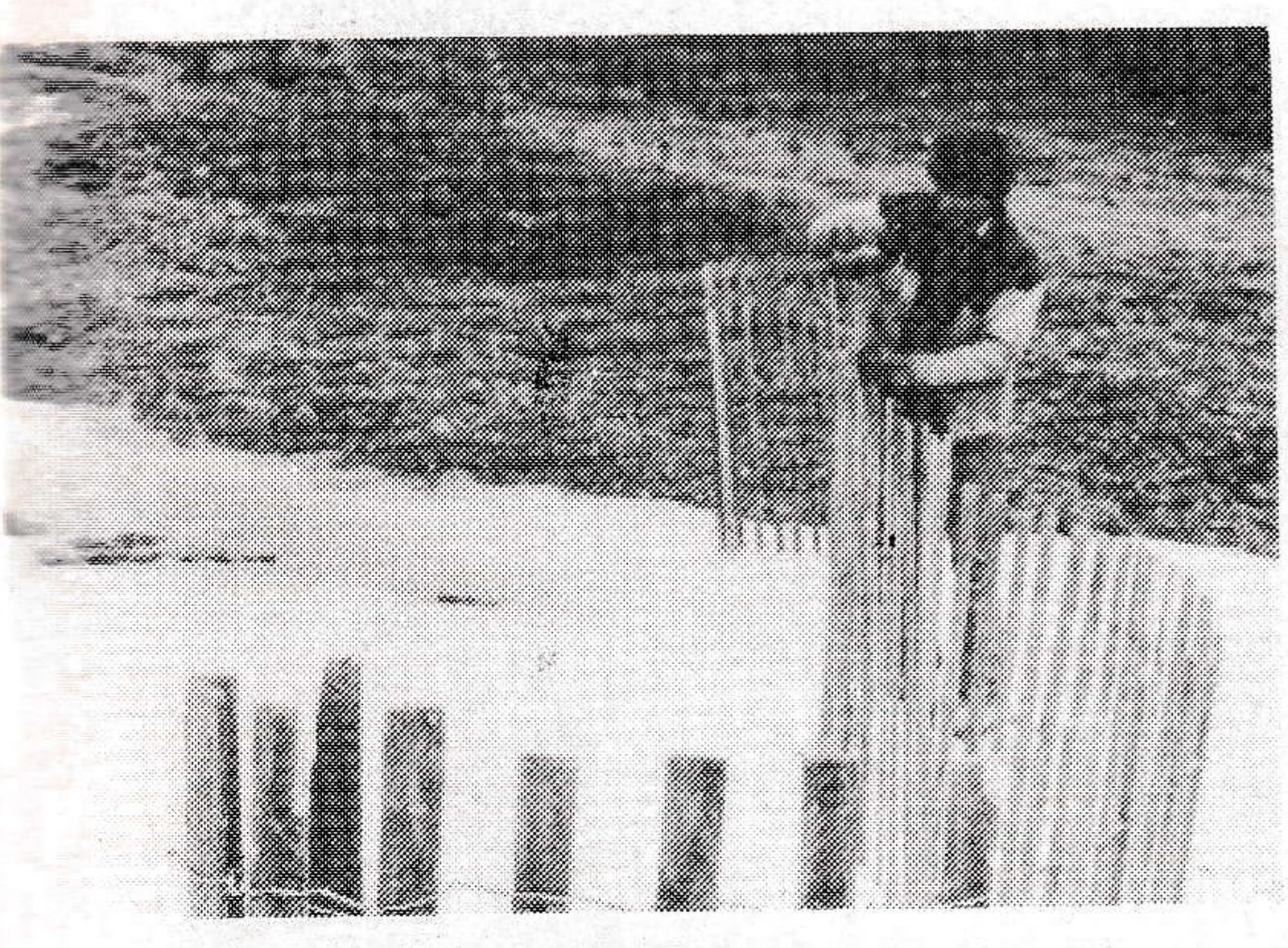
Fencing Situations
Perhaps the simplest snow-deficiency situation to handle is a restricted area that needs more snow and where a permanent fence can be set up close at hand, such as the unloading area of a lift. At Sunshine, three of our lifts sometimes need additional snow in the unloading area and on the unloading ramp, especially early and late in the season. Around the ramps we have used various types of temporary fences, even in dire need, putting them up every night and taking them down every morning. But clearly, the best answer is what we have done with our upper lift.
A few feet beyond the unload area we built a semi-permanent (it is up all winter, but in the Park we have to remove it for the summer) fence of the wooden posts and double-height slat type screening. The area at the top of our upper lift collects one to two feet of snow naturally, but with the fences in place it collects drifts up to 12 feet deep, 20 feet wide and as long as the fence. At this location the wind direction is fairly constant and a lot of drifting snow moves across it. If the wind direction were variable, it would be necessary to build other fences at right angles to prevent the wind from running along the fence and removing the accumulated snow. As there is a large open area extending a couple of miles up-wind from this spot, even if it isn’t snowing the wind carries large amounts of snow into this reservoir. When the unload area needs more snow we open up one or more sections of fence and plow the snow to where we need it.
Fencing in Open Areas of Uniform Slope
Large areas of open, uniform slope collect a certain amount of snow naturally, but early in the season and in low snow years there may not be enough snow to ski on. Extensive fencing in these areas has enabled us to open runs, and in some cases, entire lifts up to a month earlier than if we had waited for snowfall to accumulate naturally. Throughout the winter, fencing in these areas often makes the difference between skiing a slope with occasional bare spots and scattered small stones, and skiing a slope with complete snow cover.
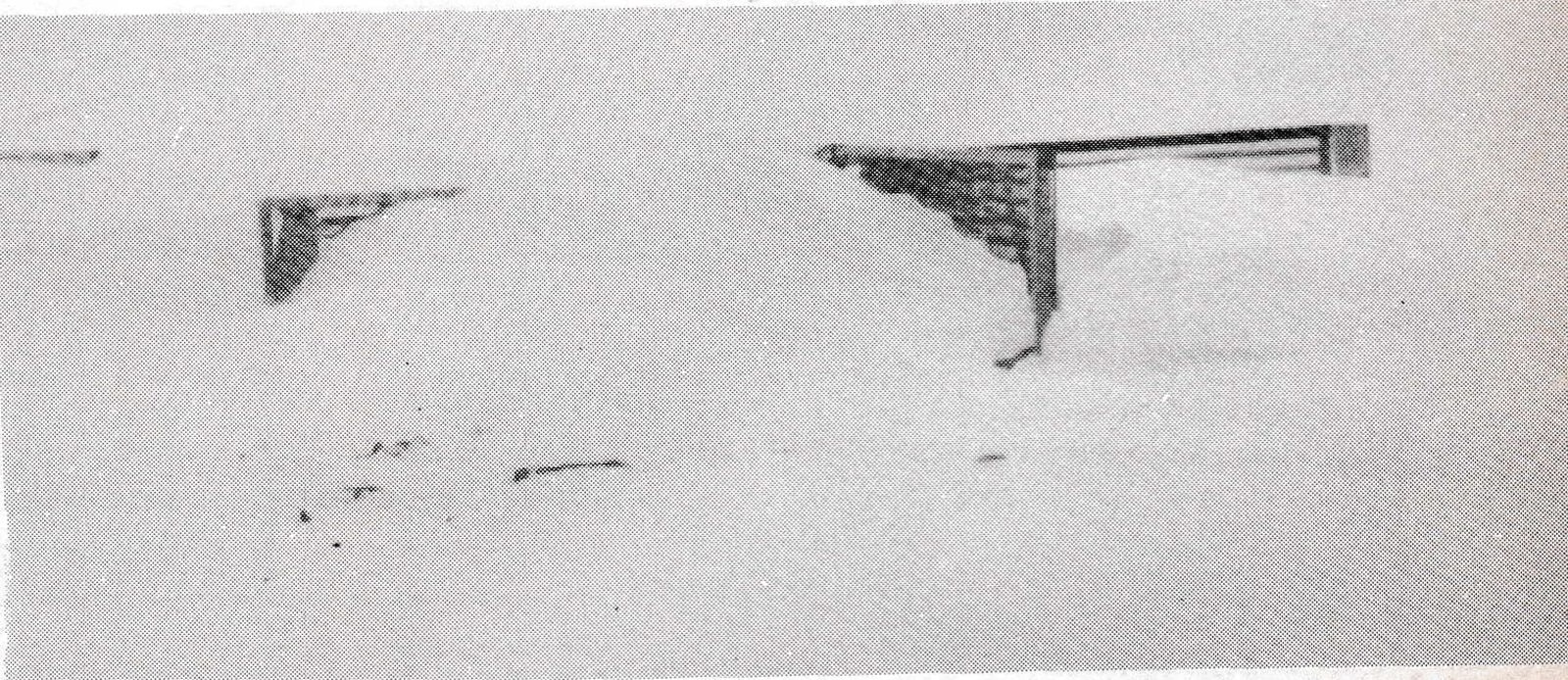
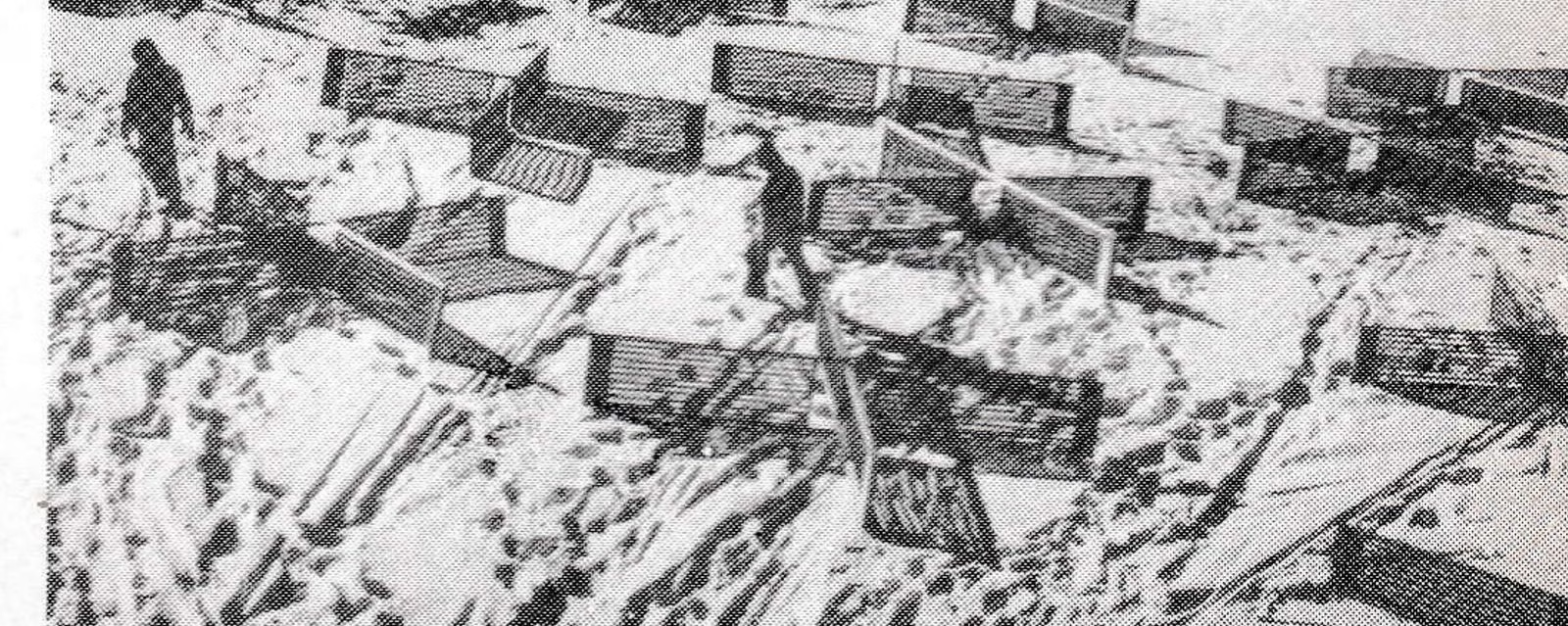
In this type of situation we originally used rows of slat fence with all the problems discussed earlier. However, we soon found that the cross-portable and later modular fences were ideal for this situation. Quick set-up and removal are essential on these slopes because large numbers of fences are required and a storm can easily fill them overnight. Then all the fences must either be lifted and reset on top of the drifts so they will catch more snow, or removed from the hill so it can be machine packed and opened to the public.
Some years we have enough snow to open by early November, so we start to get our fences out in early October. We never have enough fence to cover all the areas we would like, so we concentrate on the areas that are necessary to get each lift open, placing the fences in such dense patterns that no bare spots will be left between them. Later, when we have established a good base in the critical areas, we move the fences to less critical areas to expand the skiable terrain. After the first few snowfalls, we ski-pack everything caught by the fences to make the snow denser and harder. Once we have enough snow to drive cats on the hill and there is no danger of the wind removing snow while the fences are out, we pull all the fences to track-pack with a cat and then replace the fences.
It may take one good snowfall or several lesser ones to get enough packed base. How much packed base is enough before you can open an area? If you open too soon, the ski traffic destroys what you have collected and you have to close the run again, but if you wait too long, you lose the revenue that would come from having more terrain available. The timing is based on a very complicated equation. Some of the factors are how much snow is on the ground, what type of snow at what temperature, how well did we succeed in hardening it, how steep the slope is and how many skiers can we expect. Someday we might be able to collect the data so that a computer could handle it, but at this time it is a decision made by the seat of the pants system by the mountain manager and the concerned supervisors.
If we guess correctly and the snow falls frequently enough through the winter, once the base is established, successive snowfalls add to it and there is no problem maintaining good skiing throughout the winter. If we guess wrong and open too soon, or the skier traffic is more than the rate of snowfall can handle, rocks and bare patches will appear. If that happens, it is best to close the terrain, put the fences up and wait for a good snowfall.
Some sections of the mountain however, are so critical that we have to keep them open no matter how bad the snow. The upper chair at Sunshine is our real “money” lift and if it is not open, many of our customers will either not ski or go elsewhere. Frequently, the rest of the hill has pretty good coverage, but the terrain just below the chair often has very little snow in spite of our effort.
When our conditions are bad we want to keep as much fence on this section as we can, yet still let skiers through. At first we tried scattering fences all over the hill with lots of space between them. However, when we did get snow and wind, we ended up with a few drifts spaced across a generally rocky slope.
A better plan was to divide the snow-deficient section into four zones. We put a very dense fence pattern on three zones and opened the fourth zone to skiers. When we got a good snowfall, the zones that were fully fenced caught a fair amount and we were able to open them with good conditions and close the area that had taken all the pressure. We then shovelled all the snow we could onto the fourth zone and roped traverses back and forth across it so skiers couldn’t make turns. They had to traverse back and forth until they were down to the area of good snow. In spite of this and a lot of shovelling, trying to keep the traverses in good condition during extreme droughts is difficult. But by judging the opening and closing of the different zones, we have caught the most possible snow and kept the mountain open at the same time.
Break-Offs
One of the most difficult areas to fence is a break-off from a gentle to a steep slope where the prevailing wind is into the slope. We have one classic situatuion of this type at Sunshine, and it is on a very important run. The wind erosion is concentrated at and just below the break-off, so that even without ski traffic no snow collects here. The additional factors of heavy ski traffic and the characteristic of skiers to check hard or even side-slip on the first part of a steep pitch, tends to remove whatever snow might be there.
Our first solution was to put a lot of fence on this area using whatever type and means of support we had. At first we used slat type and nylon mesh tacked to 2″ x 2″‘s, supported by guy ropes tied to pegs driven into rock or tied to piles of rocks. This was laborious and the high wind velocity here knocked down and damaged a lot of fence. What fence remained upright caught little snow.

The next Summer we drove rows of “T” steel posts across the critical area with the posts 20 feet apart in the rows and the rows 20 feet from each other. This was also laborious because the area consists of loose rock. However, with posts in place we could set fence all over in a box-work pattern, so no matter which direction or how strong the wind blew, we had fences catching snow. With the 20 foot spacing we drove snowcats between the rows of fences to pack the drifts permitting us to open individual sections for skiing, while keeping other parts closed. All this worked quite well, but we still didn’t catch enough snow.
We did discover that on the flat just above the break-off, almost any kind of fence worked very well. This was a natural snow accumulation area anyway and with fence we got huge drifts, so we put up to three rows of fences, either modular or slat type, just above the break-off. When we wanted to open the run, we took down some fences and pushed the snow over the break-off with a snow cat. To keep the snow from rolling all the way to the bottom of the slope, we set up or manually held slat fences just below the bare part. If we had lots of snow, we pushed it over until we were able to drive a snow cat over to pack it into place. If we were still short of snow or needed to make it last longer, we might use some of our patching techniques (See below), watering the snow and boot packing it into place. We have obtained excellent results with this system, and have greatly improved the length of time we can keep the run open as well as the quality of skiing.
Creating a Cat Walk
We had a terrain problem in a section serviced by our newest chair. The upper part is wide open intermediate terrain, the lower part mostly intermediate trails among scattered trees. In between is a steep pitch (up to 30 degrees), 200 to 300 feet high and running right across the mountain. This pitch is very intimidating to most skiers, but there is no way around it that allows them to use the excellent intermediate terrain above and below. Anywhere else but in a National Park the solution would be obvious, with a bulldozer build a cat walk in the summer. National Park regulations do not permit this, so we decided to create a cat walk out of snow.
We selected a traverse line that least interfered with the expert runs down the steep pitch, that was gentle enough for a low intermediate skier and had good routes to and from it. We set up a line of slat-type fences to mark the lower edge of the traverse, then shovelled snow from above down to the fence to build the traverse. Part of the route had very little snow, in fact it was semi-covered talus. The wind sweeps strongly across this pitch and blows along the traverse line. To catch snow for the traverse we set up a series of fences at right angles to and above the main traverse fence to create large drifts which could be shovelled to the traverse. Before we opened the traverse to the public, the right-angle fences were butted against the main fence, but when we opened the traverse we moved them uphill a few feet to allow passage of skiers. At full development the traverse is about four feet wide— wide enough for Skidoo’s including the heavy dual track type.
The traverse carries large amounts of traffic. Formerly the runs served by this lift were used mainly by experts, but now they are used by intermediates as well. The one problem we have with it is that the traffic is so heavy that the snow is constantly being worn out. The traverse is only 100 yards long yet sometimes to keep it in shape requires up to two hours per day of shovelling by a crew of seven people.
Patching
Throughout the season we get small sections of trail that lose snow cover, either because of wind erosion or high skier traffic. Some can be cured by putting up snow fences and waiting for snow, but others must be covered immediately because they are crucial to skiing patterns or are in areas where snow drifting does not occur, that is on runs sheltered by heavy trees. We had to work out ways to move snow over to these areas and making it stick, but more important, we needed a source of snow.
Above the tree line we built a reservoir with snow fences as discussed above. In some places a natural drift occurs behind a clump of trees or a small ridge which is close enough to push on to the bare patch with a cat. Beside our heavily wooded runs, we have clearings in the woods big enough so that a snow cat can back in and push snow out. These are located above the trouble spots and out of the way of the skiers. We have found that snow can be pushed effectively with a U-blade for 100 to 150 feet, but not much more.
We do these patching jobs as a combined effort between the cat crew and trail crew. On a really big job we might have two cats with U-blades and ten or twelve trail crew members. However, most of the patches are smaller and we only use one cat and three or four trail crew.
We prefer to do patching in daylight hours so the crews can see what they are doing. Typically one trail crew member probes snow depth in the reservoir area and directs the cat driver, while another probes the patch area showing the driver how much snow he has put on. While we are working on an area we either close the entire run or at least fence off a big area. In either case, we post at least one guard to make sure no one skis into the working area.
If we think a patched area is going to be subjected to heavy wear or if we are running out of snow in the reservoirs, we ice the patch. We mount two 45 gallon drums of water on the back of a snow cat and use a hand-crank, rotary-type pump to spray it. We put 12 to 18 inches of snow on the patch, spray it with water, boot-pack it, then repeat the process three or four times. We find this gives a very durable patch. (We used to mix straw into the patch to give even more durability, but we stopped that because the straw remains on the hill and is unsightly in the summer. At our elevation (7200 – 9000 ft.), straw does not deteriorate and so accumulates year after year.)
In the low snow year of 1976-1977 we used some pretty extreme methods to transport snow for patches. We went along the edge of the trails shovelling snow out of the trees. We loaded ski patrol toboggans in the bush and pulled them out. We built big wooden boxes lined with polyethylene sheets for the back of one of the cats, and loaded the cat by backing it up to a mound of snow that was bladed up from a drift area and pushing it in with another cat. Then we drove the load to the area where we needed it and unloaded it by running the cat uphill and opening the tail gate.
In locations where we had a snow source uphill of a bare spot and we could not use a cat, we devised a snow chute system. Usually from the source area to the bare spot there was at least five or six inches of snow on the ground. We dug a two feet wide trench in this snow and covered it with a long roll of four feet wide plastic sheeting.
We held the plastic in place by putting rocks on the sides or by sticking skis and ski poles through the plastic. Then a couple of trail crew shoveled snow into the top letting it slide down to the bottom where another crew member shoveled it onto the bare spot. On flatter grades one or two people might be needed to push the snow in the chute.
These methods are expensive, but when it makes the difference between being open or closed it is worth it. In November of that year we had weekdays of 500 to 1000 skiers and weekends of up to 1500 skiers, so we could afford the effort.
Whether a patch is made with water or not, it is very important that it not be skied on right away. Obviously if water has been mixed with snow it needs some time to freeze. But even without water, if snow is boot packed or machine packed, a little melting occurs on the surface of each grain where the grains touch each other. Left alone for awhile the grains freeze together. In daytime when a patch is being made the temperature may be warm, which encourages this melting; at night the temperature drops and grains freeze together—the snow “sets up.”
Personnel and Costs
Trail work was originally done by the Ski Patrol, but as our skier usage became higher and higher it was obvious that we needed a crew for this work alone. In the beginning we thought the trail crew could be flexible in numbers. When conditions were bad we needed up to 25 people, when conditions were good as few as 5. Thus, we hired five full-time people capable of supervising a small crew, and then hire up to 20 more on a temporary basis prepared to lay them off when we didn’t need them.
Over the years we have found that most of the casual help we get is not worth the wages. Kids think it would be fun to work on the trail crew, to be outside and skiing all day. After they are hired we discover that many of them don’t have adequate equipment, aren’t in good physical shape and don’t want to do the amount of hard physical labour we expect. Now, when we find the few who like crew work, enjoy the hard work, will stay the entire season and are good workers we keep them. We maintain a full-time crew of 10 members who are highly skilled and effective.
Costs for fencing and patching are fairly easy to determine. We determine the cost per hour for snow cats and add materials needed—fences, rope, shovels, etc. The largest single item is the wages of the crew and this is labor—intensive work.
One interesting side effect of our efforts has been the reaction of the skiing public. People comment to area personnel about the work of the trail crew when they see them shovelling, packing snow and moving fences. Skiers come back to an area that is doing everything possible to upgrade conditions. As our traffic has increased year by year, we have had to work harder to maintain the conditions our customers expect at Sunshine. It has been well worth the effort and expense.