Morten Lund
The “progression” employed by a ski school is the most important, least-discussed part of the ski school’s contribution to the resort’s profitability. It’s least-discussed—as between managers and ski school directors—because it’s an area of dark and magical expertise.
So it’s treated.
Like most dark and magical things, there exists under the cover of the darkness and magic a simple logic: in this case, the logic is that a progression can be arranged to make life beautiful for the instructors or to make money, but not both. We’ll come back to this point later.
Let’s procede by taking a quick look at progression. A progression is simply a series of exercises graded in difficulty leading toward the desired technical expertise, or “steps on the ladder” leading from the bottom rung (customers who have never skied) and thence upward. Hannes Schneider of St. Anton, Austria was the first to discover the profitability potential of a proper progression.
Back in the 1920’s, Schneider put together the first ladder which logically led upward, beginning with the formidable Arlberg snowplow. From there the “Arlberg Method” went through stem turns, stem christie and parallel christie. The present American Teaching Method (ATM) as developed and espoused by the Professional Ski Instructors of America (PSIA) is a descendent of Schneider’s moneymaker, but the early stages of ATM are much more easy and simple than was the Arlberg. ATM is unqualifiedly the best system in the world of its kind. PSIA can take a bow.
The Skiing Majority: Self-Taught
Even given this sophisticated method, ATM, the majority of skiers are self taught: they can in turn teach a keen observer something about the capabilities of people who take up skiing.
The self taught skiers fall into three groups:
Group One: aggressive skiers who can use the edged ski to check their speed somewhat, enabling them to descend steep pitches provided they do it nonstop, carving and checking as they go.
Group Two: less aggressive skiers who control their speed with a sliding turn, which is a much easier way of descending, once you have learned to slide the ski around the turn. These skiers can stop at the end of any turn, even on steep slopes. Therefore they are not committed (as are the more aggressive skiers) to nonstop runs down a steep pitch. The less aggressive skiers use sliding turns as a beautiful slow down.
Group Three: (which is unfortunately the largest): these skiers cannot check properly and yet they do use an edged ski, and build up greater speed than they can handle. In a sense, this group does not carve well nor does it make a slow-down sliding turn well. These are the “unsuccessful intermediates” who are always half in trouble.
These same three groups exist within almost every intermediate ski school class as well!
Unless the instructor is able to take the “unsuccessful intermediates” in his class and convert them either to (1) functional carving skiers or (2) functional sliding skiers, then these “unsuccessful intermediates” will be unsuccessful still, at the end of the lesson.
And here is Point Number 2:
Most instructors are well-trained to teach aggressive skiers, that is, to take skiers toward carving. And this is what they do. But unfortunately, most skiers of the “unsuccessful” type don’t take to carving and checking. They are not very aggressive on the slope. And so at the end of the lesson, they are still unable to control their speed on steeper slopes. They lack the aggressiveness to ski steep pitches nonstop, which is what carving requires. They don’t have the “looseness” needed to make quick checks at the end of the turn, which is also what a carving approach requires, on steeper slopes.
Even more: as the sliding skiers in the class attempt carving, some of them, previously successful sliders, will now become unsuccessful carvers (on steep slopes—anyone can carve on easy slopes). So, for most intermediates in this all-too-common kind of class, the lesson is unsuccessful. They can’t handle steeper slopes any better than they could before. and in some cases, not as well as before. And yet handling steep slopes is precisely what 90 per cent of the skiers who come to intermediate classes expect that a lesson should do for them.
And so they quit taking lessons, justifiably.
Again, the reason is that the training of most instructors is geared to a “single track,” the “A Track” or “aggressive track” and most intermediates simply don’t make it on that track.
The teacher who tries to get his less aggressive skiers into carving on the steep before teaching sliding turns on the steep will only leave his pupils unable to handle the steeps: they simply are not ready yet for high-speed nonstop turning down a steep pitch, as required by carving.
On the other hand, by providing less aggressive skiers with Track B, they can always be progressing and they will keep coming back. You can teach skiers all kinds of fancy things such as anticipation, independent leg action, total motion… but if they can’t control themselves better on steep pitches by the end of the lessons they will consider the lesson a waste.
NST is easy to teach, doesn’t require an aggressive committment to nonstop turning on a steep pitch and does allow the skier to get better and better handling steeper and steeper slopes.
Given unlimited time, instructors could take everybody into carving along Track A, the surest route. But the ability to go Track A in a short time lies only with a small minority of pupils. Given the promise of the ski school that “You will ski better with us” then Track B is needed for most skiers—because they will then and only then “ski better” (handle steeper slopes more confidently). Some schools, including those at Stratton, Vt. and Camelback, Pa. where I work, and all instructors who are successful with intermediates (where the money is) make a point of distinguishing A Track and B Track skiers and treating them differently, accordingly; they make liberal use of the sliding turn, as needed. Their students keep coming back.
The Three Reasons
The first reason that this situation exists is that instructors want to have everybody carve. It’s more elegant, stylish and efficient giving good control at higher speeds a beautiful way of skiing.
Secondly (and this is where “making life beautiful for ski instructor” comes in), instructors like to teach carving, and in fact do not like to teach sliding. The instuctor has achieved carving and doesn’t want to “go back to” sliding. In one New York state area where I once was doing a photo story, the demonstrating instructor told me flat out that he could not meet my request to demonstrate a sliding turn because “I spent two winters getting up on my edges and now I can’t get off them.” So what about that large percentage of skiers who need the slowdown effect of the sliding turn? Where are they to get it if instructors are not happy to give it?
Third: there is almost no training for instructors in making the sliding turn work on steeper slopes, which is where it comes in most effectively for the less aggressive skier. Therefore either the pupils learn carve-and-check (most of them won’t be able to in the short time they spend with a teacher) or they go out of control on steeper slopes. This is the choice offered by too many ski schools, and is the reason that intermediates leave class never to come back. And thereby profitability goes down.
The Solution: Splitting Classes
What ski schools need to do is split classes into A Track and B Track skiers and to teach them different turns. A Track (aggressive) skiers get to carve-and-check, while B Track get to slide-and-slow-down, at least until they feel comfortable enough on steeper slopes to start learning to carve on them.
If it’s not possible to split the class, then the whole class needs to be taught B Track.
To make this “splitting solution” effective:
1) Instructors need to be trained to size up the aggressive quotient of particular pupils, and not treat them all as if they were physically aggressive.
2) Instructors need to be trained in teaching sliding turn technique for steep slopes.
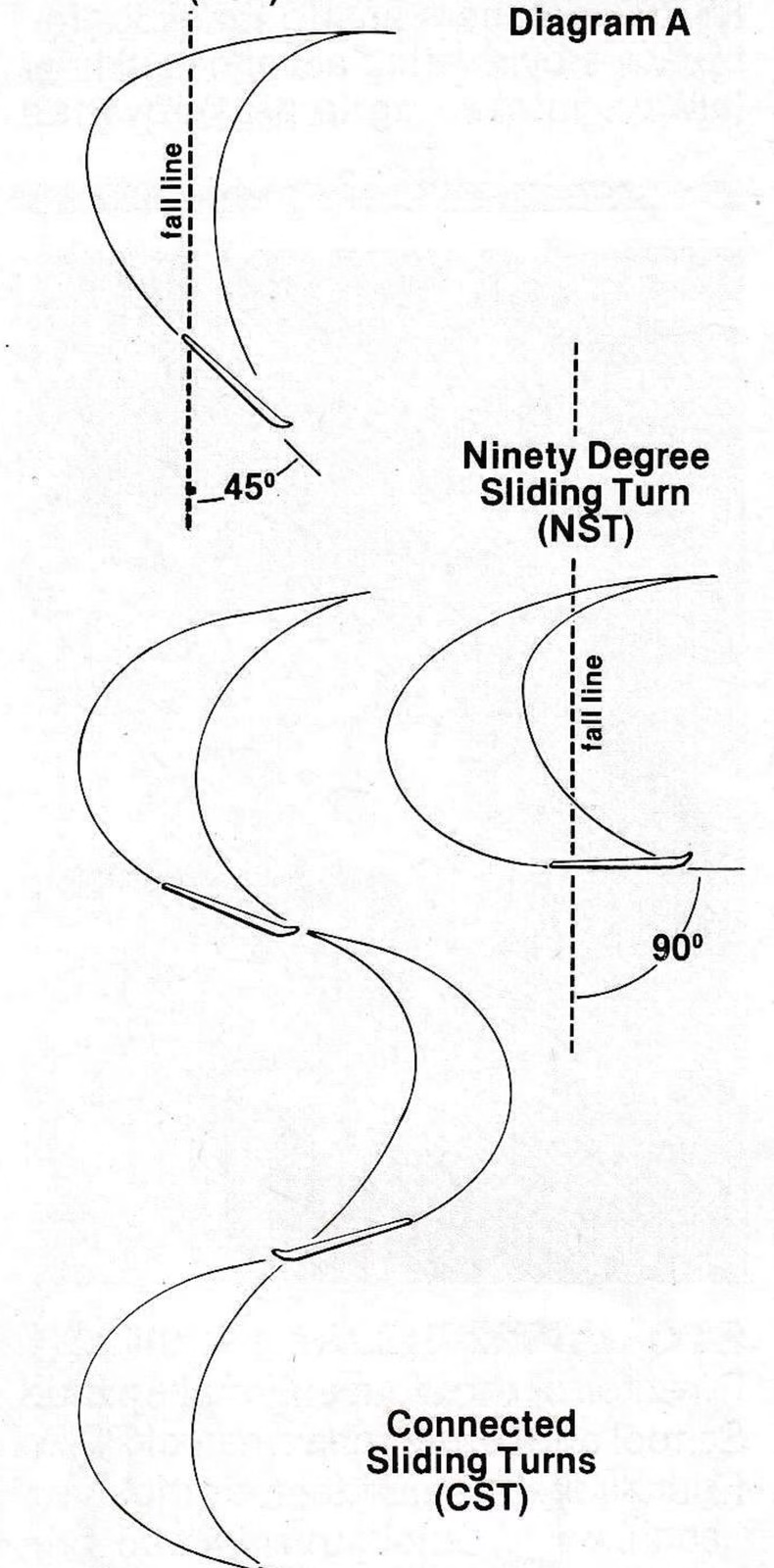
All instructors can teach the sliding turn on easy slopes. On easy slopes the sliding turn will provide enough braking if carried around 45 degrees from the fall line (See diagram A.) Here’s the catch: on steeper slopes, the turn has to be carried around to ninety degrees from the fall line to an absolutely horizontal traverse. (I call this particular turn “NST”, or “Ninety-degree Sliding Turn.”) A sliding turn carried less than ninety degrees—even up to seventy five or eighty—won’t slow the skier down enough on steep slopes. It’s these “incomplete” sliding turns that give the sliding turn a bad name as a way of controlling your speed on steeper stuff.
(By sliding turn, in this context, I mean the true Christie, which travels through the arc of the turn at even speed, not the “jerked sliding turn” which travels unevenly and jerkily through the arc of the turn. The “Christie” which was developed by Hannes Scheider was the highest final form in Arlberg and a distinctive turn in it’s own right—before the days of carving skis.)
By connecting his sliding turns (Connected Sliding Turns or CST), the skier can come down any expert slope (short of one covered with ice) at a relatively slow speed in easy control. From there, having gotten used to the “exposure” of the steeper slopes, the less aggressive skier can go on to learning carve-and-check on the steeps. In no way will the less aggressive skier learn to carve on anything but easy slopes, unless this skier has lots and lots of time.
How Ski Schools Adapt To Two Tracks
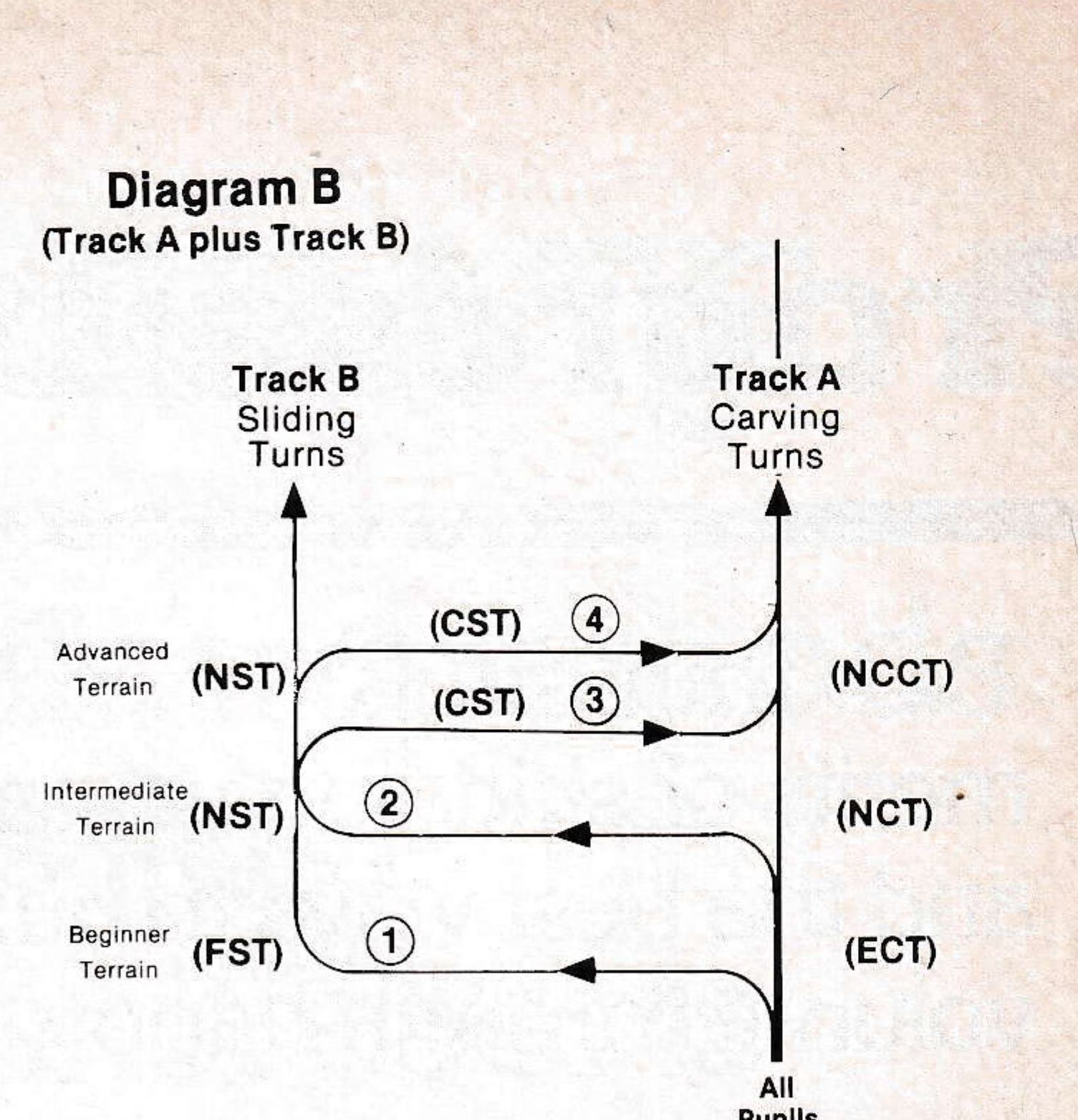
Look at Diagram B: here is a twotrack progression: in one, the A Track, there is carving from the beginning; Track B detours through sliding. Whenever the skier has trouble on Track A, he is promptly taken over to Track B, so he can keep progressing, and hopefully re-enter Track A at some later point, as in (3) and (4) of the diagram.
How GLM Fits Into Two-Track
GLM, or Graduated Length Method, using three, four and five foot learning skis simply is a way of starting the learner on Track B. The ease of turning the ski makes the sliding turn very much more easy to accomplish. The popularity of GLM is due to this ease. The advantage of GLM is easy sliding turns and consequently, easy braking, (and thus allows for fast progress to steeper terrain) more than that short skis are easy to handle.
GLM has not been gaining in popularity with the ski schools these past few years—losing ground, if anything. The reasons are the same as the reason for the neglect of the sliding turn: instructors do not like to teach sliding turns, and therefore do not like skiing on GLM skis, which are stiff, and relatively straight-sided (for the most part), so that making a carved turn on them is difficult if not impossible.
Assignment to GLM class is therefore not sought out, rather avoided.
GLM, taught in a wide stance for stability (rather than with skis-together as in the original version) has the best chance of all of keeping the skier coming back to ski school. Almost every instructor, even though he himself does not like to teach GLM, is honest enough to admit that. So, from the instructors point of view, it’s better (more beautiful) to teach on minimum five foot skis, and teach only to the aggressive skiers (Track A). But that’s not where the profit is.
Sliding turns are comfortable and appreciated by those skiers (the majority) who are much happier taking one turn at a time when the slope is steeper, that is, having the option to stop at the end of any turn.
Carving is “going for it,” committing yourself to higher speed nonstop turns down the steeper pitches.
Carving, then is the ideal, and sliding is the practicality.
As an instructor, I would love to teach only a carving progression—take everyone througn Track A. This is a beautiful dynamic way of skiing for both instructor and class. But the practicality is that the greater number of skiers in order to keep progressing (in the sense of handling steeper pitches comfortably) will have to detour through Track B. They will have to go through NST and CST along the way. They either lack the time (in most cases), or the desire (in some cases) to take the number of lessons which would be necessary for them to go through via a carving progression. (Even given unlimited time, it’s probable some skiers still wouldn’t make it.)
The ATM manuals written by Horst Abraham clearly indicate there’s a sliding option within ATM. It’s up to ski schools to take up that option as a serious alternative on steeper slopes as well as on easy slopes. The profit of the resort depends upon it.
Why American Teaching Method Is Not Working For More Pupils
ATM is technically the most sophisticated way to get skiers from novice to expert. Yet there has been—since the adoption of ATM—very little year by year improvement in the ease with which intermediates go on to advanced technique. Most intermediates end up “stuck” even though they do take lessons from time to time.
The reasons:
- ATM is taught in most places as if all skiers were aggressive skiers, that is, as if they were all capable of learning to carve fairly high speed turns within a short time.
- The sliding turn, which is easier to learn and easier to do on steeper slopes (because of the lower speed of the sliding turn), is neglected. Skiers therefore have the choice of learning to carve or staying off steeper slopes, that is, being an intermediate on intermediate terrain for their whole ski career.
- The instructors are trained in teaching carving and graded in their own skiing on how well they carve; the sliding turn is thereby relegated to the status of an inferior turn (which it is not, for most skiers).
Stu Campbell
Two thinking ski instructors argue the merits of skidding vs. carving, ATM vs. GLM and the best ways to build ski school volume through happy skiers.
Mort Lund is right about ski schools. And wrong.
In many resorts, ski school is regarded, at best, as another amenity like lifts, cafeterias, parking lots, and rental facilities. At worst, ski area managers see the ski instructor as an expensive prima donna who clogs up slope space, cuts lift lines and in comparison to lift-ticket sales, generates little income for the mountain.
There’s no doubt that some of the best ski instruction in the world goes on right here in the United States. The American Teaching Method (ATM), espoused by the Professional Ski Instructors of America (PSIA), has gained international recognition—even acclaim—in the past couple of years. Simple, straight-forward, flexible and effective as ATM is, management, as Mort Lund points out, still sees its ski school “progression” as something shrouded in mystical mumbo-jumbo.
Here’s the crux of the problem. Area operators want beginning skiers taught enough to buy lift tickets and to use the mountain’s facilities with a reasonable degree of safety. They’re often not interested, in how this is accomplished, or in how the novice skier progresses beyond the point of a lift-ticket purchase. Lift tickets are their business.
At the same time PSIA’s efforts to market itself and promote its membership to the American public have been feeble and amateurish, to say the least. In its defense, PSIA has maintained that it’s not an advertising agency for ski instruction, but a research-and-development organization designed to provide ongoing educational services to its members.
This educational service takes on two forms. First, PSIA members are furnished with a series of manuals describing ATM. Though helpful to the ski instructor, ATM Manuals and PSIA’s in-house newsletter, SkiPro, are completely devoid of hype—dry, academic-sounding, and let’s face it, boring reading for the average skier.
PSIA’s second educational arm is its Demonstration Team, consisting of talented skier/teachers like Jerry Warren of Snowbird, Chris Ryman of Vail, and Shawn Smith of Waterville Valley. Their job is to sell ATM to PSIA’s members and to teach its intricacies by relating advanced skiing (always interesting to pros) to what novices are doing.
The result of the ineffecient communication is that ATM is unknown by most people, and largely misunderstood, even by knowledgeable people like Morten Lund.
What’s Being Taught
The public knows about GLM—the Graduated Length Method—because it was promoted successfully a dozen years ago by a number of sources, including Ski magazine. Ironically, ATM is the “official” teaching method used in the majority of ski schools in the United States, and often a student is being taught ATM when he thinks he’s learning GLM.
Not that it really matters. Any ski instructor worth his salt knowns he must respond directly to each student’s fundamental question, “How are you going to make me ski better?” When a good teacher reaches into his bag of tricks to help another skier, strict methodologies and progressions usually get thrown to the wind anyway. That’s when students learn, go away happy…to return for more.
But in this decade a more specific question seems to lurk in the mind of the average recreational skier: “Should I be carving or should I be skidding?” Lund has put his finger on the pulse of America’s skiing consciousness. Our people need to understand what “carving” and “skidding” mean in the first place and they need to know when, where, and how to do which.
Where Lund is wrong is in his assumption that ATM is an “exclusive carving” philosophy. Actually, ATM stresses three skiing skills—edging, turning, and pressuring the ski—and insists that they’re each of equal importance.
Where Lund is right on, is in his suggestion that there be a two-track approach to ski teaching—one avenue for skidded turns, and one for carved turns.
Carving and Skidding
Let’s look at how this would work.
Most American adults drive cars. Skiing is like driving.
What makes skiing fun is a skier’s ability to influence his speed—faster or slower—in a short distance, on a given piece of terrain. Efficient skis, like a good car, let us accelerate readily once we let up on the brake. Some skiers, like some drivers, brake almost constantly while they’re in motion. That’s fine. But they’re missing half the fun.
Not everyone needs a Ferrari or a Porsche, but a car that can’t brake, steer and accelerate adequately is a menace. This is why shorter skis, used in the ski schools and stocked in the rental shops of the near future, will have characteristics similar to those of longer, modern high-performance skis. Such learning-length skis are readily available now, at reasonable prices from a number of domestic and foreign manufacturers.
We should recognize that a ski is rarely meant to be ridden on its base, except in the straight downhill run, but almost always on a combination of its base and its sidewall. That corner of the ski, known as the edge, is where skiing really happens.
A ski’s steel edge is more than something meant to suddenly grip and grab at the snow. Its great length, and the flexible nature of the ski itself, makes it a slicing implement, rather than a hacking tool. These factors, combined with the greatly elongated hour-glass shape of the ski—its “sidecut” to use the technical term—allow the ski to cut an even arc through the snow.
As an edged and bending ski makes a narrow curving path through the snow, its energy is directed forward for the most part, and the ski is said to be “carving.” Carving is a matter of degree, as is skidding. The extreme “pure” carved turn, where all points along the ski’s edge pass through the exact same spot on the snow, demands an extremely long arc—so long that a pure carved turn becomes impractical (even useless) in most normal skiing situations. Nonetheless, a carving ski is generally understood to carry greater speed through a turn than does a skidding ski.
On the other hand, a ski said to be “skidding” dissipates some of its energy to the outside of the turn, so it slows down as it changes direction. This skid is largely the result of the ski’s being ridden more on its base and less on its edge.
The “perfect” turn for any skiing situation is the correct blend of these two extremes—carving and skidding. And the possibilities for exploration between these two poles is infinite.
At Heavenly Valley we’re meeting the carving-skidding question head-on with a dual-track teaching system. We call it Natural Easy Carve, NEC for short.
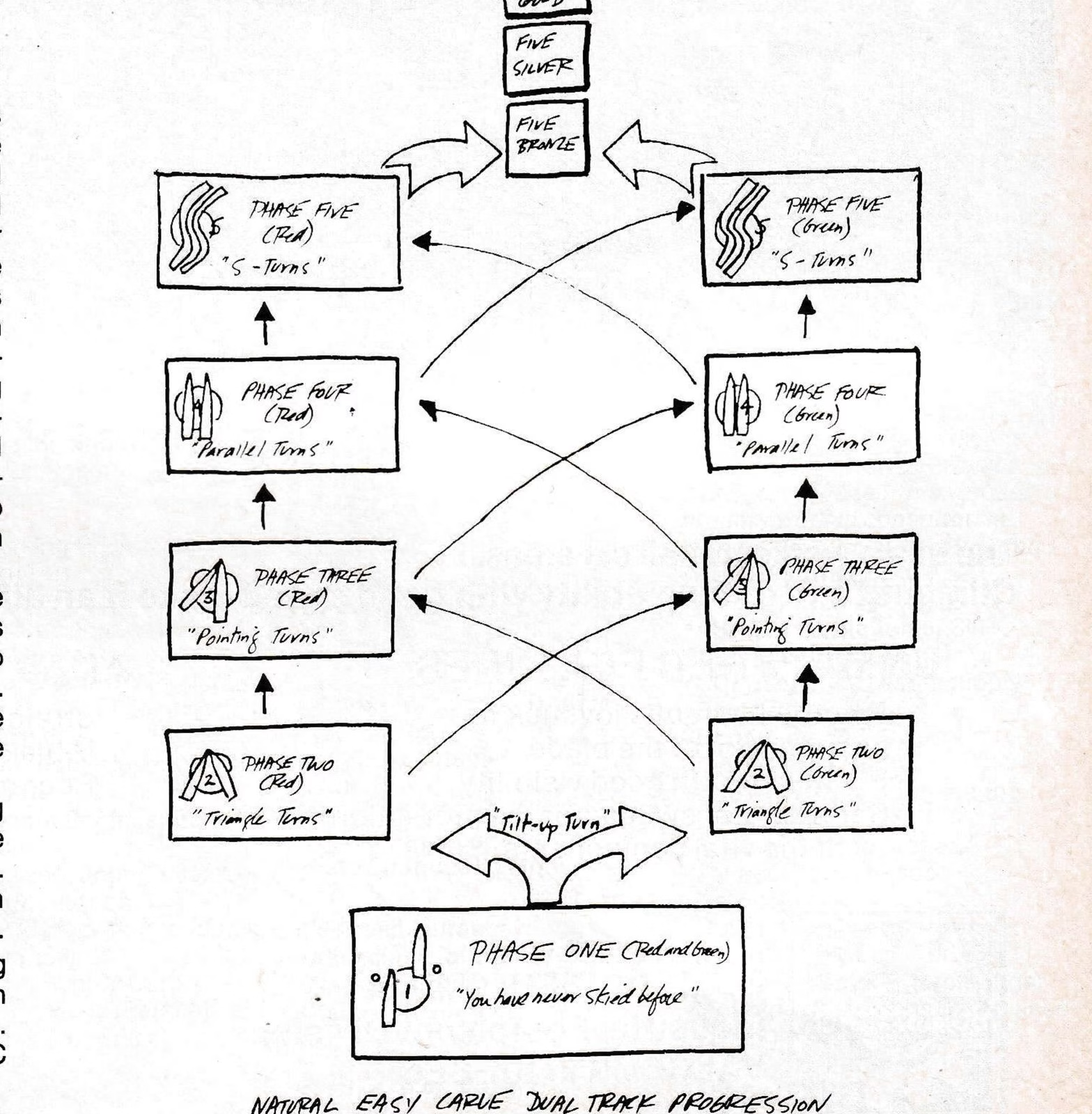
Natural Easy Carve has two distinct progressions—one Red and one Green. Neither is better or worse than the other. In fact, throughout a skiing career, a student might flip-flop-back and forth between the two systems regularly. On a given day when personal progress or snow conditions demand it, this student may need to work on slowing. He and/or his instructor may decide he should join a Red class—at whatever his ability level might be. Another day, when physical and psychological conditions warrant, he may choose to enter a Green class, where the emphasis is on going. Here he’ll be using his equipment to bring him quickly and easily through turns with a minimum of braking.
In NEC, Green lessons emphasize carving (or retaining speed) while Red lessons stress skidding (or slowing down). From the very beginning, the NEC student understands the difference between balancing on a ski that’s a relatively flat platform moving across the snow, and balancing against a ski that’s tipped toward its side and flexing.
The whole idea behind the Green progression is to avoid crippling and otherwise hindering the potentially gifted skier—by making him overly defensive. If a properly equipped beginner is allowed to relate immediately to what more advanced skiers are doing, it may be possible to move him/her to more advanced stages quickly. In doing so, we are less likely to have students drop out of ski school. We believe that ski school is not just for beginners.
GLM’s Contribution
GLM offers great inspiration for a break-away from ski-teaching tradition. The Graduated Length Method, conceived originally by Cliff Taylor, developed and advocated further by Karl Pfeiffer and Mort Lund, made monumental contributions to skiing. By reducing the length of the lever arm (the ski), GLM made it possible for new skiers to turn almost immediately—easily and without frustration. Instant lift patrons.
The eventual problem with GLM was that short skis began to evolve toward wider, stiffer skis that tended to lack sidecut, while competition skis moved toward longer, shapelier, but more torsionally-rigid designs.
Development of “shorts” and “mid-length” skis, which were nearly impossible to carve, resulted in a whole generation of slippers and skidders. Many say it’s these new people who abuse ski slopes, scraping snow from one place, depositing it elsewhere in close, awkwardly shaped moguls. Hence the need for more expensive grooming equipment.
The ability to make safe, rounded turns by engaging an early edge is a basic skill taught in NEC at a very low level. This easy turn is made possible by advancements in ski design and materials which permit a ski to be short, but also soft and fairly “radical” in sidecut. In this sense, Natural Easy Carve must not be regarded as “revolutionary,” since it does no more than try to use today’s equipment with optimal efficiency. Better to call it “evolutionary”—beyond GLM.
A look into a personal crystal ball suggests that all ski schools will move in this direction sooner or later. Continued research in new equipment for beginners and innovative teaching methods can provide positive, favorable learning experiences for everybody, at all levels. Hopefully the end result will be an ever-increasing number of skiers.
Our experience with NEC—albeit shortlived—is already teaching us a number of valuable lessons.
First: ski school, if it’s to be a viable profit center for the resort, must be a creative, distinctive, publicity-oriented department with a thoroughly-trained, professional staff. Good instructors, with credentials, must be sought, fairly paid, and constantly stimulated by new information about their own skiing and about alternative teaching methods. Instructors who are learning themselves teach well and bring customers back.
Second: to be successful, a school must create its own identity. It can’t be an atrophied appendage of the corporate whole, however renowned the resort itself may be. Further, for a ski school director to rely on advertising support from an educational-licensing organization like PSIA is suicidal. A school must work closely with the area’s marketing director to develop special programs, must aggressively seek out tour groups and should consider the possibility of its own marketing budget.
Third: excellent beginning lessons which relate visibly to more advanced skiing, followed up by continuity in teaching language and concern for individual students, increases numbers (and student/teacher ratios) in upper-level classes. These advanced customers are our best advertising.
Fourth: Daring to be different will be painful. New approaches are apt to receive lots of press, much of it damaging if the school’s program is not sound, proven valid and well thought-out. Conservative leaders of instructor organizations tend to attack their black sheep viciously, doing everything possible to discredit new thinking and keep everyone in line. We’ve seen it from both sides. This can take a lot of the fun and camaraderie out of the ski-school business.
Still, if our very favorable figures since the inception of NEC mean anything, we’re doing something right. We’re making money and morale is high. Our percentage of ski school students to overall lift-ticket sales is steadily on the rise. And that’s what ski school is all about.