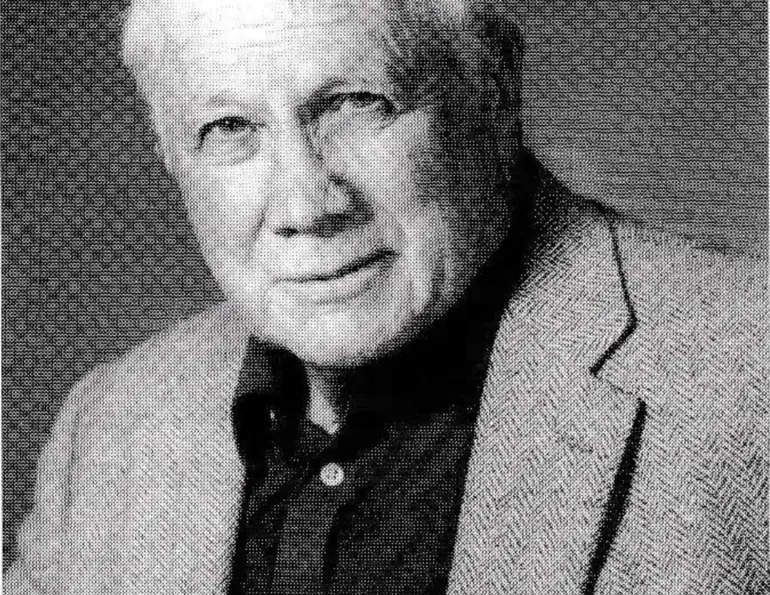
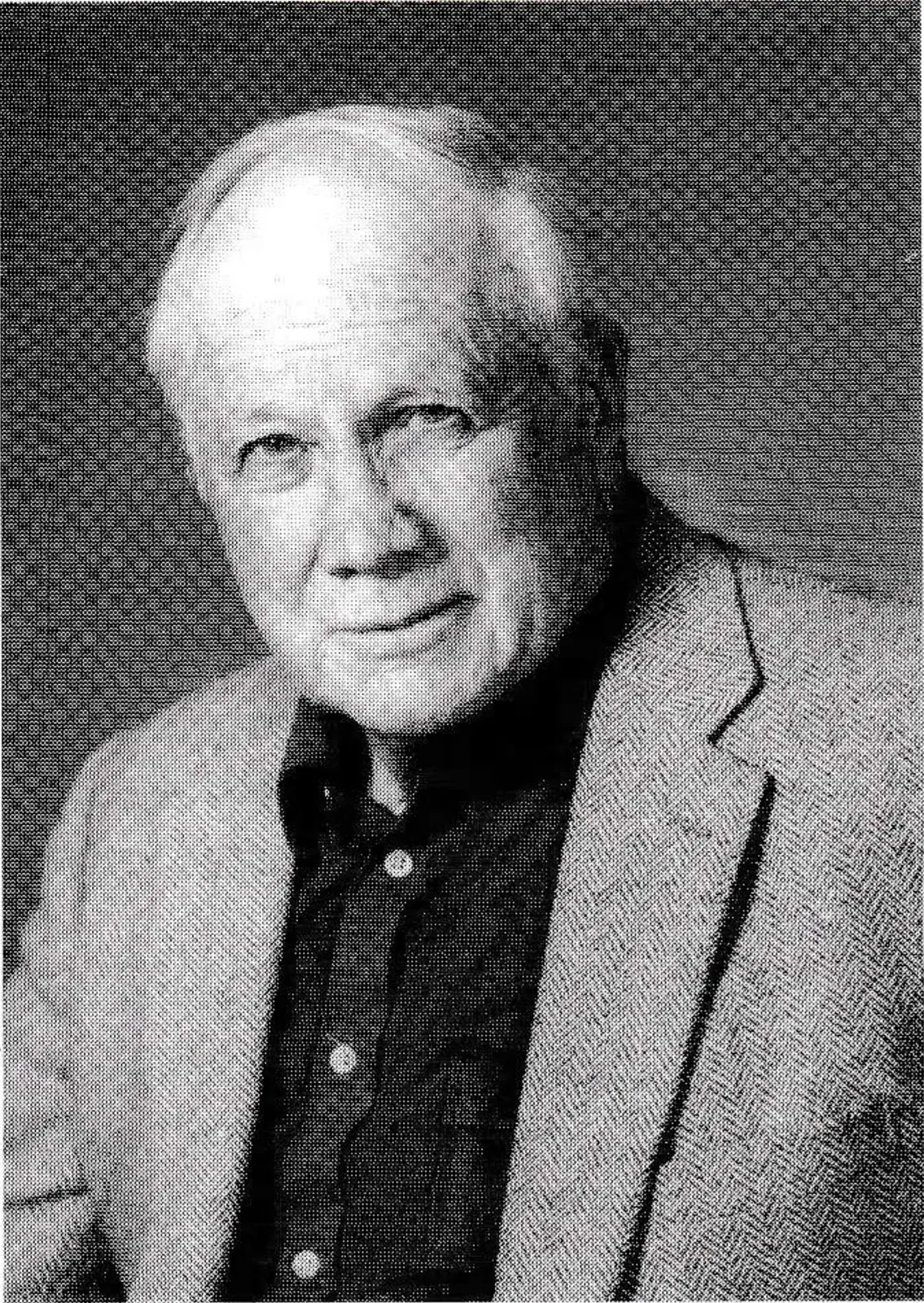
Photo courtesy of Colorado Ski Museum—Ski Hall of Fame, Vail, Colo.
The first ski lifts Bob Heron ever rode were the trains of the Combres and Toltec Railroad in New Mexico. As teenagers, Heron and his buddies would catch the trains to the top of Combres Pass, hop off and ski back down, blazing their own trails home through the woods to the small town of Chama. Heron continued to blaze trails throughout his career as a pioneer in the ropeway industry, always in the forefront as ski lifts advanced from early mining trams to modern detachables.
Born in Canon City, Colo., in 1914, Heron was six when his family moved to Chama, where his father—an engineer and a lawyer—became well known for his work in diverting water to the region from the far side of the Continental Divide. The Heron Reservoir was named for Bob’s father and the small town of Rutheron was named for his mother, Ruth.
Continuing in his father’s profession, Heron studied civil engineering at the University of New Mexico. Tempted by a promising engineering position with the Kennicott Copper Company, he left the university after three years without a diploma, but not empty-handed, marrying fellow student Nell Francis Naylor.
It was as a structural and mechanical engineer with Kennicott that Heron got his first taste of ropeway design in the form of a materials-handling tram. After five and a half years with Kennicott and a short stint designing TNT explosive plants, he joined Stearns-Roger Manufacturing Company of Denver in 1943. Based on his experience at Kennicott, Heron was selected to design—with input from Fred Carstarphen, North America’s preeminent ropeway engineer—several portable military tramways, literally writing the book in the form of army instruction manuals for the erection and operation of the trams. Oddly enough, this assignment would turn out to be his first connection to the ski industry; one of his trams would be used by the 10th Mountain Division in the battle on Riva Ridge, where many future ski industry leaders battled the Germans. (See sidebar)
In 1945, Heron decided it was time to go out on his own. One of the Heron Engineering Company’s first projects was the site engineering and installation of an American Steel and Wire single chair in Aspen, Colo.—known appropriately as #1—that extended 8,000 feet up to the Midway. During the project, when Heron discovered that Aspen developers Friedl Pfeiffer and Walter Paepcke were removing an abandoned Park mining tram, he quickly designed and built a 6,000-foot-long bicable single chair known as #2 using the tram’s old track ropes and carriages. This extended lift transportation from the top of #1 at Midway to the Sundeck area at the top of Aspen Mountain.
Heron’s brother, Kenneth Webster “Webb” Heron, joined his company in 1946, along with another early employee, Chuck Dwyer, who had answered an ad reading simply “steel detailer wanted.” Dwyer, who remained with Heron until 1960, said, “They were an excellent team. Bob loved the out-of-office promotional contacts, site location, construction and operational work; Webb kept a busy office functioning flawlessly.”
With the auspicious beginning of the Aspen lifts, Heron was in the ski business. Unfortunately, however, the banks were not—financing for ski lifts was nearly impossible to find. Dick Stoneman, a draftsman with Heron Engineering from 1948 to 1962, recalled visits to the Heron offices by potential ski area developers. “They would say ‘money is no object,’ to which Bob would reply, ‘When money becomes an object, then we’ll talk about your project,’ he said.
One of Heron’s strengths—key to installing lifts on limited budgets—lay in retrofitting older tramway components into ski lifts. In 1947, he constructed two bicable single chairs for Larry Jump at Arapahoe Basin, Colo., that were built in part from tramway components salvaged from military surplus yards—the same components that Heron had designed for the army four years earlier.
Heron and his team of engineers designed and built many “firsts” in the ski lift industry. He built the world’s first fixed-grip, continuous-circulating double chair in 1946 at Berthoud Pass, Colo.; America’s first circulating passenger gondola in 1953 at Sugar Bowl, Calif.; the largest (at that time) aerial tramway in North America in 1962 at Heavenly, Calif., and the world’s first quad chairlift at Boyne Mountain, Mich., in—believe it or not!—1964.
Many thought of Heron as a conservative designer and builder because of such practices as using riveted structures even after welding was considered acceptable practice by his competitors. According to Dwyer, Heron often said of himself, “Others were bolder than I.”
Alex Cushing, owner of Squaw Valley, Calif., takes a different view. “In those days, Bob was the radical in the business,” said Cushing. “I had contacted Roebling and U.S. Steel about building us a double chair. They both wrote back that the idea of a double chair was insanity. I showed the letters to Bob and he said, ‘Nonsense. They have their dies made for single chairs and they think the lift business is too small to change their dies.’” Heron installed the first monocable double chairlift at Squaw Valley in 1949.
By the mid-1960’s, companies such as Riblet and Hall had overtaken Heron Engineering in the number of lifts produced per year, emphasizing mass production of standardized products with less conservative designs, which gave them a significant price advantage. In 1964, Hall and Riblet each sold 22 chairlifts, while Heron sold only three.
In 1969, the Heron Engineering Company was sold to the Mentor Corporation, which continued to manufacture lifts under the name of Heron-Poma. Even today, however, many of Heron’s lifts are still in operation, attesting to the quality of his workmanship and providing a bargain in longevity for owners who invested in them.
“Bob Heron figured everything to last a lifetime, and then doubled it,” said Ken Abrahamson, general manager at Loveland, Colo., former home of five Heron lifts. One of the five, Chair #4, has been running since 1965—the others have been replaced, but only for higher capacity, said Abrahamson.
Gary Burch, lift manager at Heavenly, Calif., operates two Heron chairlifts—one built in 1961 and one built in 1966. “Most of the sheave assemblies have the original bushings and shafts,” Burch said. “They outlast a lot of newer equipment.” Abrahamson agreed, saying, “It takes more than just a mere act of God to knock over one of his lifts.”

Heron continued to share his wealth of knowledge in passenger and material ropeway design as a private consultant, counting many well-known ropeway engineers under his tutelage, including Bob LeSage, Chuck Dwyer and Jack Tormey. Heron was also instrumental in helping develop the first national lift standard by serving on the ANSI B77 committee at its inception in 1959. He served the longest term of any member of the Colorado Passenger Tramway Safety Board—14 years, from its beginning in 1965 to 1979.
Always eager to exchange knowledge and innovations in lift technology, Heron was an early member of Europe-based OITAF, the International Organization for Transportation by Wire Rope. Many friendships developed from this association and the Heron home in Denver was often a home away from home for visiting Europeans—customers and friends alike. The European/American exchange of wire rope technology expanded to include shared knowledge of Denver Bronco tailgate parties, football games and margaritas, courtesy of the Herons.
While Heron himself is modest, others are quick with praise and admiration. Chuck Dwyer attests to the fact that, “Bob was a workaholic and knew no limit for hours per day or days per week when the job demanded his services.” He has received many awards for his lifelong work, including the Bob LeSage Memorial Award from the Rocky Mountain Lift Association as well as the OITAF-NACS award for “outstanding contributions to the ropeway industry” in 1982.
Career achievements notwithstanding, Alex Cushing said, “Bob Heron is rock solid as a character and a personality. I admire him as much as anybody I know.” And Buff Rutherford, formerly of Loveland, expressed the opinion of many when he said, “Bob is a heck of a gentleman, and has a great sense of humor.”
When he was inducted into the Colorado Ski Hall of Fame in 1985, Heron’s biography stated that he had “devoted his adult life to aerial tramways, ski lifts and the industry they serve.” Perhaps the contributions of this outstanding engineer are best summed up in Chuck Dwyer’s nomination letter for his former employer: “Mr. Heron’s contribution as ski lift designer and builder ranks nationally and is unparalleled in Colorado. The recognition which will arise from his induction is well-deserved. His name in the annals of the Hall of Fame is, further, a recognition that aerial tramways, ski lifts and tows have played a significant part in the sport of skiing and the industry which surrounds it.”
A Lift to Victory on Riva Ridge
by Morten Lund, Editor of Skiing Heritage
A portable tramway designed by a mining engineer seems way out of context for front-line combat, but the 10th Mountain Division—the first U.S. troops trained for battle on skis—required innovative technology to successfully complete their task in World War II.
The Army had commissioned Stearns-Roger Manufacturing Company of Denver to develop the first portable supply and evacuation tram for use in mountain terrain. The army set the following requirements: it must break down into crates weighing no more than 250 pounds each and be able to be set up in a hurry. The project was assigned to Robert Heron, one of Stearns-Roger’s bright lights, who had previously designed freight tramways of a similar nature for Kennicott Copper.
Within a year, Heron had fleshed out a design for a jigback tram—one car going up while the other came down—into steel and cable modules for mobility and easy substitutions of the various pieces. The tram was sent for testing to the 126th Engineers at Camp Hale, Colo., who found that the tram had too many pieces for combat work. Nine configurations later, substituting on-site timber A-frames for steel towers, the final version was erected in a few hours’ time, Piper Cub engine power plant and all.
Meanwhile, after more than two years of training in Camp Hale, the 10th Mountain Division finally had been called to fight. At the end of 1944 they were sent to Italy to take over a key sector of the Apennine front where the Allied drive had stalled. Their goal: the steeps of Riva Ridge—code name for the 1,500-foot-high ridgeline flanking Mt. Belvedere, the first main objective.
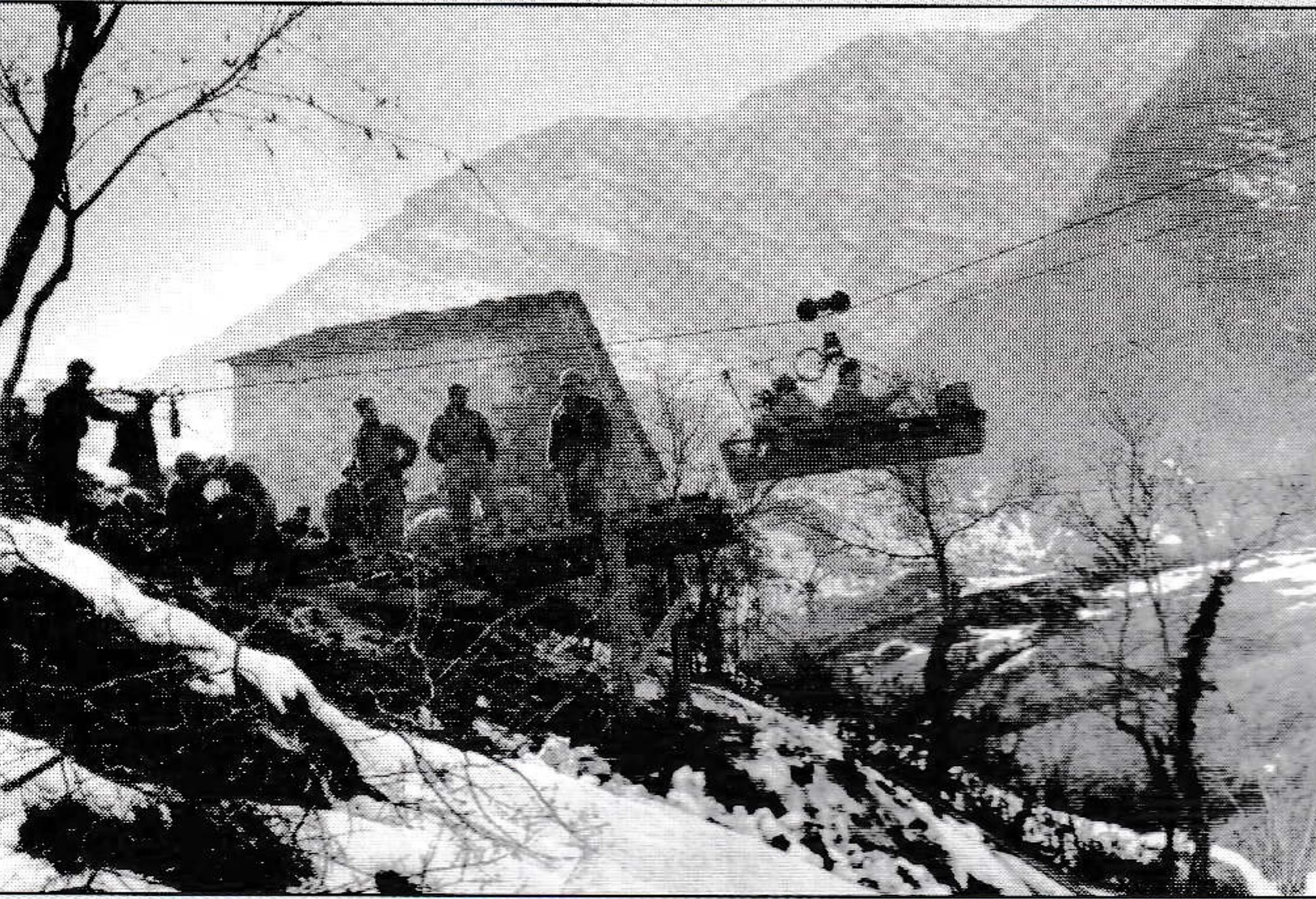
Photo courtesy of Bob Bishop
Any possibility of a successful offensive depended on capturing Riva first. The German artillery dug in on the far side of Riva had already defeated two previous attempts on Belvedere. [The rest of this sidebar continues on page 95, which is not included in the source PDF.]