


A lot has happened since then, including the death of Bousquet’s founder, the area’s sale to other owners and finally the return of the property late in 1968 to Paul Bousquet, the younger son of the pioneer ski operator. Paul, a varsity skier at University of Vermont, had put in some 15 years with Bell Telephone Co., at Killington ski area as mountain manager and with Pomalift, Inc., as head man for North American operations.
In his first season at the helm, Paul Bousquet noticed that the original lighting system had been only slightly improved and expanded, so this past Winter, he opened up with lights from top to bottom, as well as snowmaking and a 3500-ft. Savio double chairlift. After a lengthy study of other types of lighting, he decided on Sylvania metal arc lights, which produce the same amount of lamp lumens as quartz or incandescent lights, but use only a fraction of the current. Each metal arc lamp produces 32,000 lumens, but uses only 400 watts, compared to 1500 watts for the other systems. There is a hitch, of course, as each metal arc lamp costs $160, compared to $41 for an incandescent lamp.
However, there is a second strong point in favor of the use of metal arcs. They last 10,500 hours, compared to 1500 hours for incandescents. Finally, the metal arcs radiate a bright, clean, almost natural light—in marked contrast to the ghoulish shades produced by mercury vapor or the pale yellow of incandescent lighting.
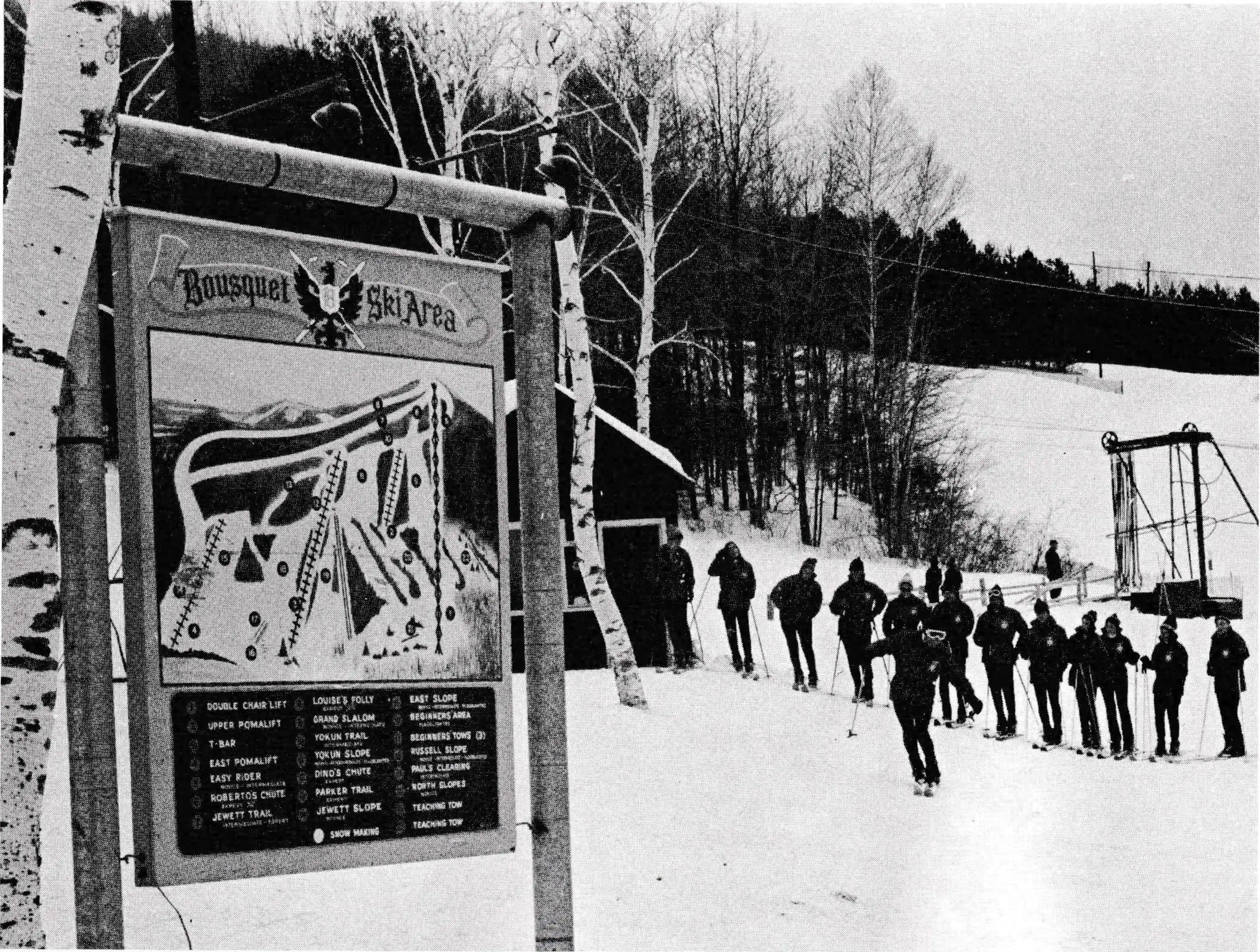
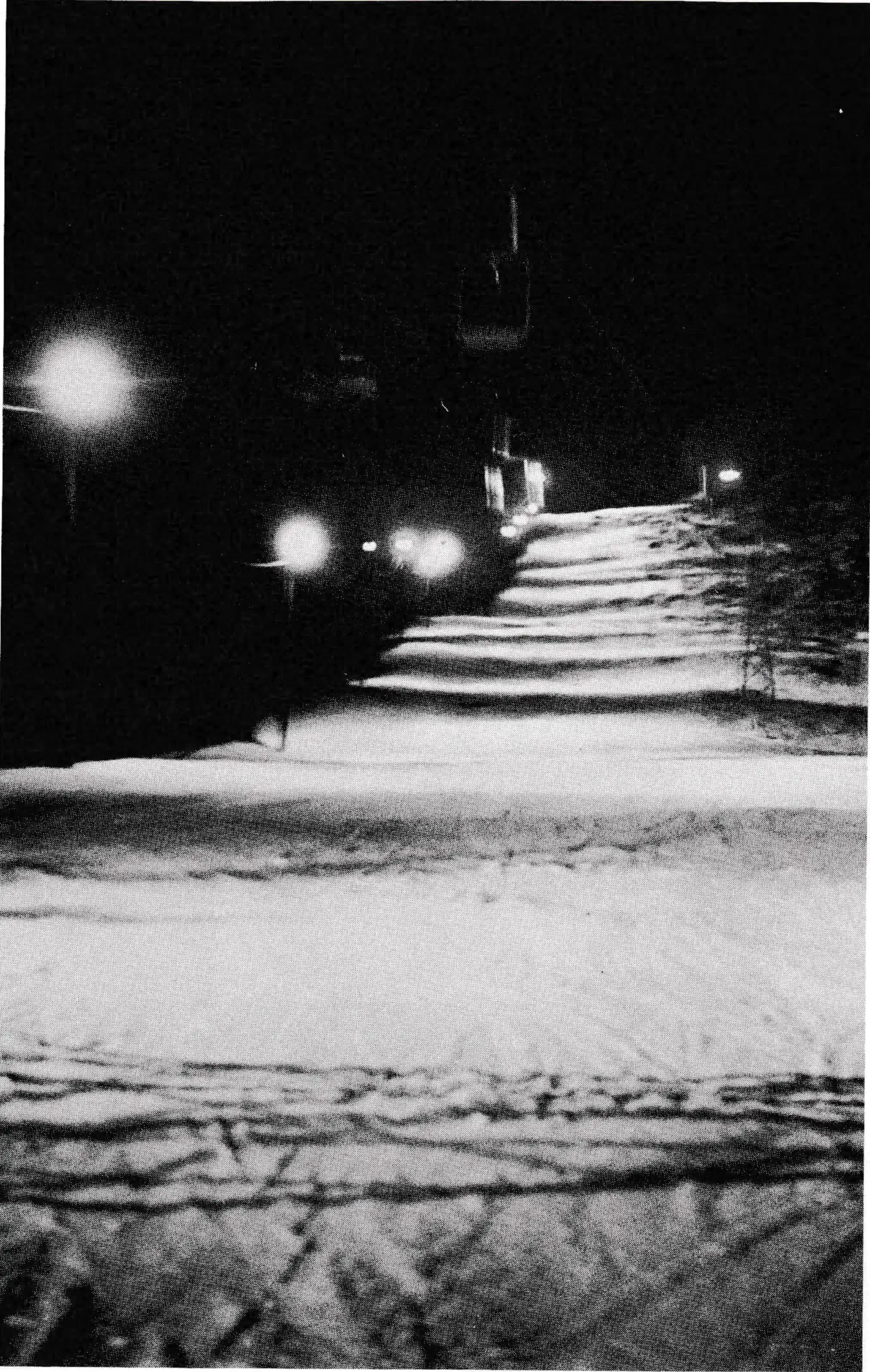
Using 40-ft. wooden class 5 telephone poles each 150 ft. along the east side of the lift line, Paul mounted two lamps on each pole and installed some other lights around the base lodge. The older, incandescent-lamp system was left intact to serve the T-bar, Pomalift and rope tow slopes. With all lifts in operation, Bousquet figures more than 40 acres of slopes are lighted, with a capacity of more than 4000 skiers per hour. The multi-lift system is necessary, since some nights see more than 1000 skiers on the slopes.
The area is open five nights a week, Tuesday through Saturday, from 6:30 to 10:30, with tickets selling for $3 per person, regardless of age. The two slowest nights, Tuesday and Saturday, are perked up with a Nite-Owl Special, skiing from 6:30 to 8:30 for $1. In addition, adult evening programs are sold in a series of eight weeks, one night per week, at $24. This is enough to keep ski school director Courtland McDermott and 35 pros busy throughout the week with night classes. No transient classes are taught nights.

As the area is only two miles from Pittsfield, Mass. (population 55,000), Bousquet figures that night skiing represents 27 per cent of his total income. It costs money to operate this system, and the electricity bill is substantial. A five-man crew can handle most night business. This means that the average Winter season of 100 days at Bousquet’s is stretched out by about 75 nights.
The food service and ski shop businesses are not that great on the night shift, but the rental business booms. In addition to making extra money, the night classes introduce some 500 new skiers to the sport each year. And they come back during the day, too.
While no season tickets are offered for night skiing, Bousquet says that this Winter there was a five-fold increase in the number of season ticket holders taking part in night skiing. Starting March 1, he instituted a good-neighbor program. Anyone holding a season ticket from any other area could ski for only $1. The response was good and none of the other areas complained.
Bousquet found that steady skiing did not hurt the quality of his snow, as he made new snow frequently anyway. He plans to increase his night skiing facilities next Winter and gradually to replace all the old lights with new metal arcs.