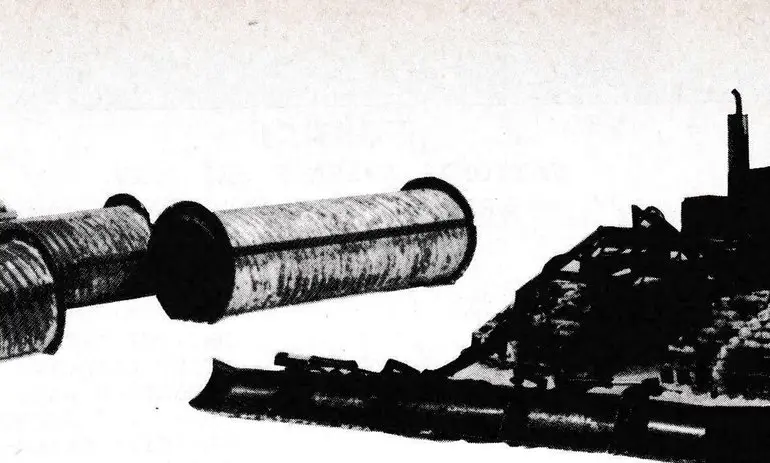
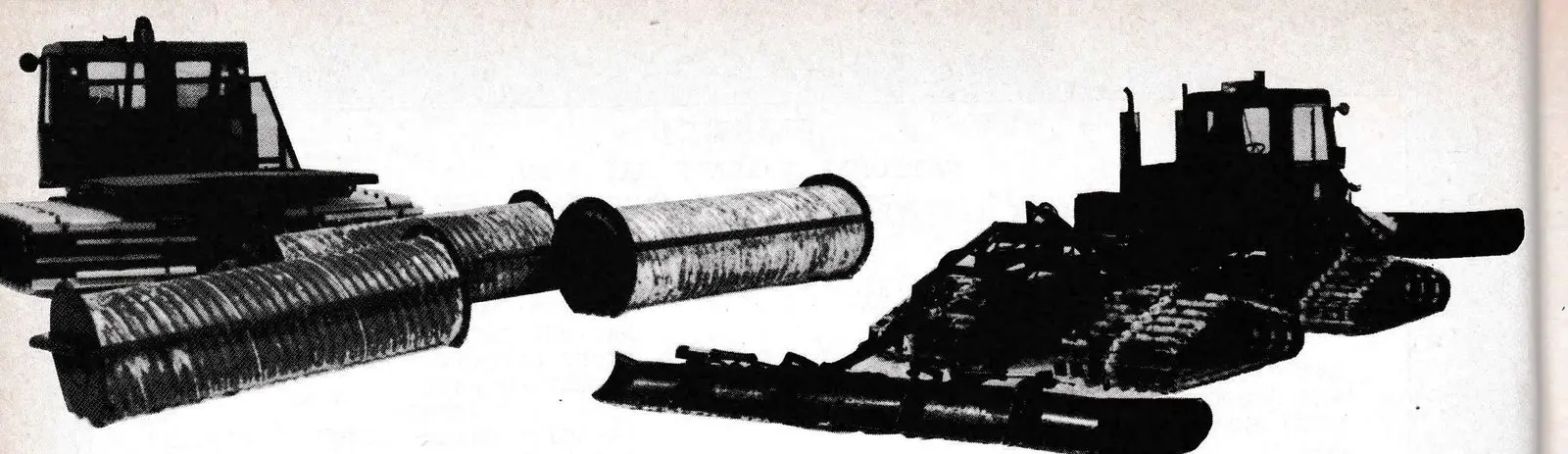
The main reason for the de-emphasis on rollers is that the compactor bars are much easier to use. They don’t have to be hitched and unhitched, and in tight spots the wings can be folded up or the whole bar lifted onto the cat. On the other hand, there are some advantages to rollers. Going downhill they pull less snow away from break-offs that always run short of snow. They are cheap to build and almost maintenance free, short of major driver error. On the other hand, compactor bars never try to get ahead of you coming down a steep hill and never try to climb up on your tracks, as rollers will sometimes do.
Often grooming decisions are made on the grooming supervisor’s intuition or what the driver thinks will be easiest for him, rather than on knowledge or real information. Which leads some people in the grooming business to wonder if there is any significant difference in the effect that the two implements have on snow.
Last winter at Lake Louise ski area in Alberta, we had an opportunity to get some reasonably hard data on the differences between these two implements. What we wanted to find out was which device produced snow most resistant to being moved by turning skis and thus is slower to be made into moguls and pushed down and off the hill.
Density measurements we knew would determine which implement produced the greatest amount of compaction and that would probably coincide with the resistance to ski action. However, a more direct measure is hardness. The instrument for measuring hardness, suitable for use in a ski area, is the Ram Penetrometer used in avalanche work. This is a tube one meter long and a few centimeters in diameter with a conical point at one end. The hardness of the snow is measured by the resistance to pushing the ram into the snow. Usually the weight of the ram itself will push it into the first few centimeters of soft snow. Then a calibrated rod is added to the tube. A hammer of known weight slides on this rod. By keeping track of the number of times the hammer is dropped, the height from which it is dropped and the amount of penetration, the hardness of the various layers of snow can be calculated. The formula is:
R = T + H + NFH/P
- R is the Ram number in Newtons (the hardness of snow)
- T is the weight of the tube
- H is the weight of the hammer
- N is the number of blows of the hammer
- F is the fall height of the hammer
- P is the penetration into the snow
An experiment was set up that would tell us the hardness that rollers and compactor bars produce, how the hardness changed over the first few hours after packing and the depth at which the implements were effective. The data was collected through the winter of 1984 by the Lake Louise Avalanche Patrol working under the direction of the Banff Park Warden Service.
In an area of undisturbed snow, free from wind action, a snow cat made side-by-side passes with rollers and with a compactor bar. Then, as quickly as possible, Ram tests were done on untracked snow, rollered snow and compactor-barred snow. (The tests were done on the strips that went between the tracks of the cat so their effect would not be a factor.) After 20 minutes, another set of tests was done and after two hours a third set. More tests at six, twelve and twenty-four hours would have been desirable, but unfortunately the necessary time was not available. These tests were done five times through the winter. Graphs were plotted with the Ram number against the depth of snow for each series of tests.

It is the nature of the Ram that even from tests done side by side in apparently uniform snow, the numbers are not exactly the same. However, repeated tests showed general trends which provided broad patterns, although not exact comparisons.
Tests revealed these highlights:
1) There is very little increase in the hardness of the snow immediately after packing, but it increases with time. That is, if snow is packed immediately before skiers use it they will rut and mogul much faster than if it “sets up” for a few hours.
2) With either rollers or compactor bars there is no change from uncompacted snow below 60 cm. from the surface. The tests were done on a light, dry Rocky Mountain snow pack with lots of sugar (temperature gradient) snow in the lower part of the pack. This is probably the snow most sensitive to packing machinery. In any other type of snow likely to be found in a ski area, the effect of packing would be much shallower.
3) There is a distinct difference between the hardness produced by rollers and compactor bars. In the snow conditions encountered in this series of tests, rollers made harder snow. Does this difference outweigh the convenience of the compactor bar? In most cases probably not. However, early in the season and at times when there is very little snowfall during the entire winter and it is important to get the most out of every snowflake, the extra hardness produced by the roller may be significant.