Some, especially in the media, find a tale of disaster to tell—a sort of shorthand arithmetic to show how the market is declining, which usually starts with something like this: “The number of ski areas has dropped 25 percent in the last 10 years, and once there were twice as many as the 535 we have today.” The problem is not with the arithmetic itself, but with the lack of understanding of what the numbers mean.
In the interests of accuracy, we present the best research available on the subject. Using 1955-56 as the base year—exactly 40 years ago—there were 66 ski areas in operation—23 in the East, 6 in the Midwest and 37 in the West.
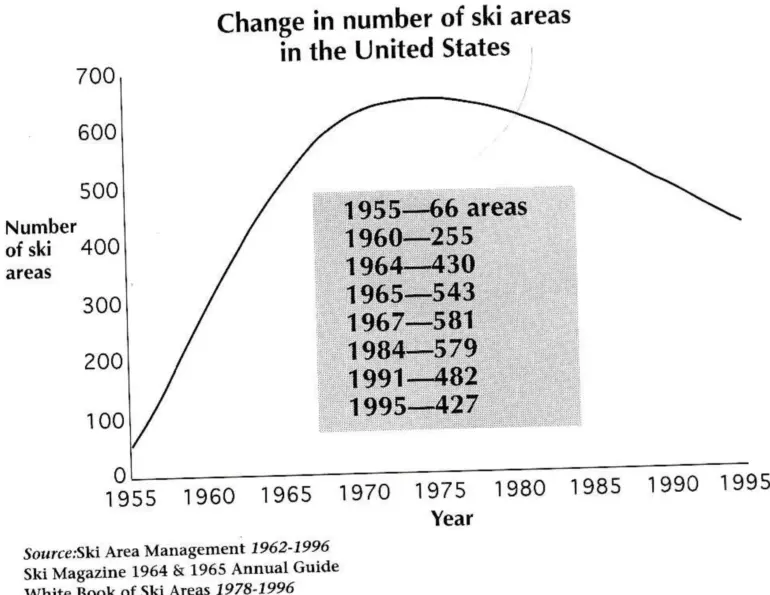
Then came the boom. Those 66 areas increased rapidly to 543 in ten years. That’s an average of 47.7 new areas a year. Whereas in 1956 there were about 89 lifts, there were 1,234 ten years later.
Of course, by today’s standards, many of the areas were very small, as were the lifts that served them. In 1956, there were only 1.3 lifts per area and 10 years later that had increased to 2.2—a substantial increase, but still very little compared to the average 6.6 lifts per area we have today. The average chairlift built in 1965 had a capacity of 800 per hour, compared to today’s average of over 2,000 per hour.
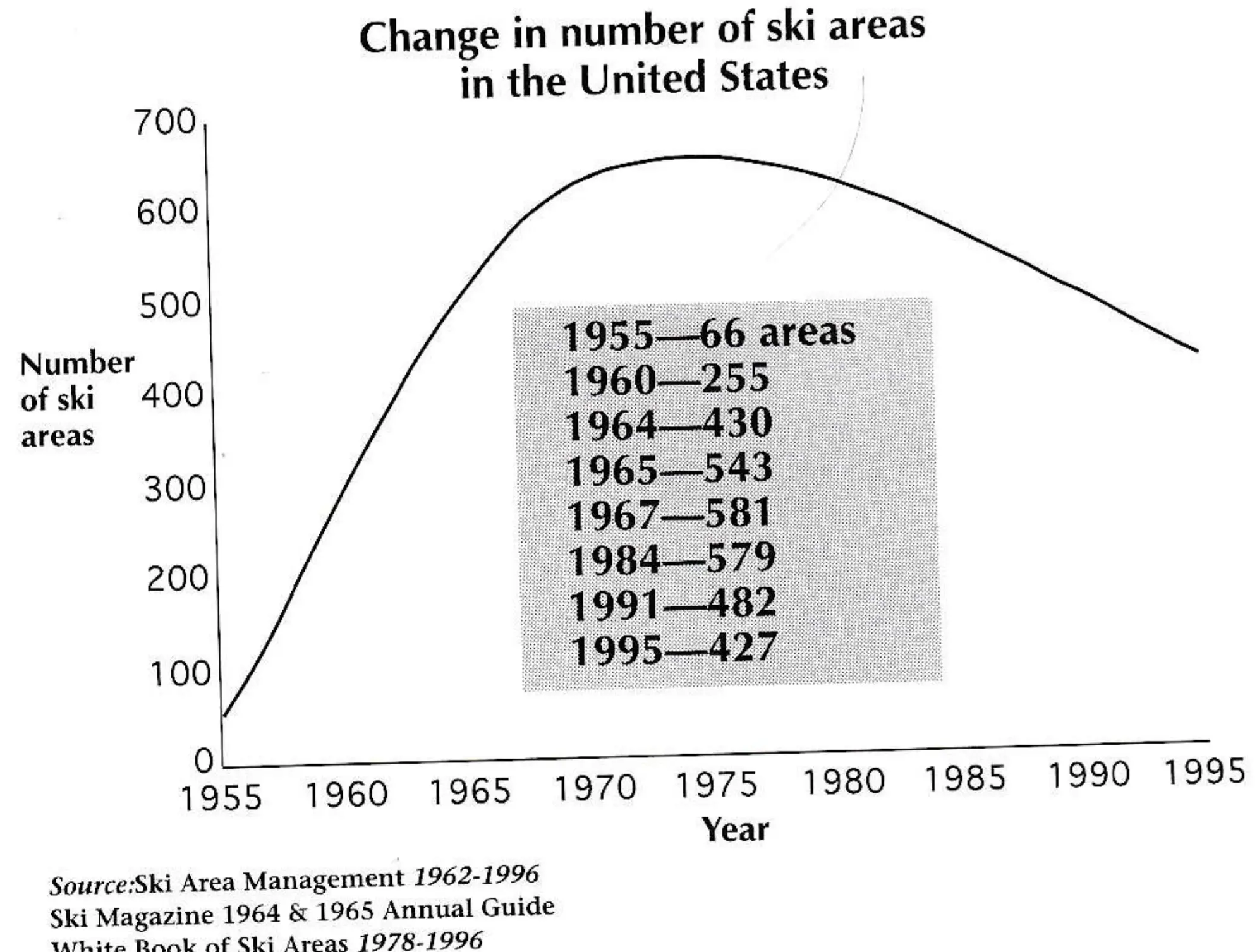
Chart data (Change in number of ski areas in the United States): 1955—66 areas; 1960—255; 1964—430; 1965—543; 1967—581; 1984—579; 1991—482; 1995—427.
Source: Ski Area Management 1962-1996 Ski Magazine 1964 & 1965 Annual Guide White Book of Ski Areas 1978-1996 The curve joins data points from eight years, identified on the chart, in which there are statistically reliable “snapshots” of the inventory of ski areas. The curve is reasonable, but given the gap between 1967 and 1984, cannot be considered definitive. To be counted, an area had to have at least one fixed cable lift or three or more rope tows.
The peak year for the total number of areas was probably around 1975 with a total of around 650 (see table). How could that be? “Official” figures from NSAA talk about when there were over 1,000 areas, and the conservative Bob Enzel, publisher of “The White Book of Ski Areas,” wrote, “There is reason to believe that during the late 1960s or early 1970s, there may have been as many as 1,400 ski areas in operation.” So how to explain the 650 shown in the chart?
It comes down to a question of what a ski area is. In the early days of the sport there was an incredible mushrooming of tiny ski hills, many on golf courses without any uphill transportation, countless others with one, or perhaps even two, rope tows. Some were connected with clubs, some with town recreation departments. Virtually none had serious commercial expectations. Those that did were the ones that ended up as the 650 shown above. To quantify this differentiation, our definition of a ski area is limited to facilities that have (or had) at least one fixed (that is, not portable) cable lift, surface or aerial. Only “major” rope tow areas are included, which means three or more rope tows.

Since 1975, the number of areas has been declining—slowly at first, and then in recent years somewhat faster. Just in the past 10 years there has been a decline of 25 percent in the number of ski areas in the US. It is essential to understand that the ski areas going out of business are the smaller ones (statistically in the smallest 10 percent), with average vertical of 673 feet and only 1.7 lifts per area.
In point of fact, we have quite a healthy industry in my opinion, and we have been steadily improving and increasing the skiing product we offer: we have steadily increased total lift capacity, total skiing terrain and total snowmaking.
In light of this, the push to consolidation is understandable, creating as it does, not only economies of scale but also dynamic new marketing and promotional opportunities, to say nothing of purchasing leverage. The capacity of these resort conglomerates to generate handsome cash flows is also catching the attention of the investment community and is powerful witness to our underlying strengths and potential.
There are now about 25 companies in the United States that own two or more resorts. Twenty-five years ago there were only two. Just in the last 10 years, 22 of the 50 largest ski resorts in the U.S. have changed hands, or are currently in the process of doing so. Indeed, 10 of them have changed hands more than once. Most of those being bought have ended up in one of these multi-resort ownership groups. In very few cases were these “distress sales.” Rather, they were purchases made in expectation of profit and/or capital appreciation.
The downside of the disappearance of small ski areas is the loss of local availability of the sport—the loss of exposure. Countless children once got their first taste of skiing on the small hills locally available to them. That has largely gone, and gone for good. It remains to be seen whether or not the marketing and promotional muscle of the big players will pick up the slack and restore growth. One sure bet is that the smaller surviving areas, especially those close to major markets, should be able to thrive on just the core business of the snow-sliding sports. There is a need for them and they will be courted. The nimble and flexible among them may well experience handsome profitability; the flat-footed and those that resist change may disappear.
The trend toward consolidation will continue. This is neither good nor bad; just a logical inevitability.