


Rental shops get a bad rap. And it’s no wonder. Traditionally, rental shops have been located in hard-to-find places, they’ve been dark and there haven’t been a lot of resources thrown at them. In short, the rental shop is the bane of most resort operators’ existence. But not for Intrawest. This often-neglected part of the business is a big money earner for the resort conglomerate. So much so, in fact, that the company also invests in rental shops at resorts Intrawest doesn’t own.
“We’re in excess of 50 million dollars a year in rental in North America,” says Sandy Black, vice president in charge of retail operations. And, he says, it’s profitable. “That’s one of the reasons why rentals is an area we’re paying attention to, it’s a high-margin business—it’s a high-labor business, too—but it’s a high-margin business with definite above-average returns.”
And, while Intrawest admits it does not have the perfect rental scenario at the moment, its goal is to have one within the next five years.
Picture this: a software system that can tell technicians when skis need tuning and automatically calculates DIN settings, employees who treat customers like they’re dining in a five-star restaurant and customers able to walk through the rental process from start to finish in five minutes.
“Our objective is to get to a consistent or average five-minute rental. That’s our goal as a company and that would be whether it’s during the slowest time or the busiest time, it’s just a five-minute rental,” says Black, who adds the resort company has already begun to lay the foundation for this dream.
“Four years ago we made a decision to treat rentals in the same manner as retail,” he explains. “We decided to provide better space, better dollars and a cleaner, brighter environment to make it more appealing to our guests.”
The New Vail Example
Intrawest has had a chance to put some of its rental vision into practice this season with its new Mountain Adventure Center at Vail. It’s a 10,000-square-foot facility with 4,000-square-feet of rental space near the Vista Bahn. More than $1 million went into the store, which has slate blue stone floors with cherry and maple hardwood paneling. It also houses Intrawest’s Pod system.
“When you walk into a store you’re directed to a pod that’s appropriate to the type of equipment you’re looking for,” Black explains. In the Vail store, for instance, there is a pod for snowboards, a pod for skis and a pod for tele-skis, snowshoes and skiboards. At these pods, or activity islands within the store, customers are seated and an employee brings the equipment to the guest. The guest can also shop around the retail displays and make all final purchases, including the rental, at their pod.
“As opposed to being in the traditional line up,” says Black, “where you line up for your boots, then line up for your bootfitting, then line up for your skis and then line up to pay, we’ve created this pod system.” There are 11 pods and 11 cash registers. “How many rental shops have 11 cash registers?” asks Black, who adds that these are all steps to speed up the rental process. In the meantime, such stores increase accessory sales to rental customers.
In the future, Intrawest’s goal is to have a Mountain Adventure Center at the base of every major resort in North America. These centers, or branded Intrawest rental stores are more than just rental or retail. They also take care of other guest needs. For example, at the Vail Mountain Adventure Center, there are day lockers, a robotic tuner, an Italian coffee bar and boot-fitting services. “It’s a one-stop shop,” Black says, adding that if it’s located at a mountain Intrawest owns, guests will also be able to purchase lift tickets, make ski school reservations and get resort information from a guest services representative. This summer, an adventure center will be built at Copper Mountain that will also serve as the resort’s day lodge.
The Pods Are Multiplying
Intrawest has been incorporating its pods and other new rental ideas into the 54 Breeze/Max rental outlets the company purchased last year, which are in the process of being renovated. So far, the company has redone about 15 of them and plans to tackle the remaining 39 over the next four years. And, at its resorts, Intrawest has taken steps to improve the rental procedure and its environment. These transformations have resulted in cleaner, brighter facilities that are more appealing for resort guests. In addition, employees are happier. And that, says Black, translates into employees doing a better job servicing guests. In fact, he says that the number of rental-shop employees who return for the following season has recently increased at least as much as 30 percent. But it takes more than happy employees and renovations to get to a five-minute rental, and Intrawest knows that. And, the company thinks it knows what it will take to get to its goal, including cooperation from suppliers and manufacturers. Black says Intrawest is in the top five of large-volume buyers of equipment and is evaluating rental technology to trim its use of time and design stores and computer systems to get to that five-minute rental. Right now, the Intrawest average is at 18 to 19 minutes and the company plans to whittle away a couple of minutes each year. All of the new stores that have been opened have better computer systems, but it’s a new custom software program—compatible with existing retail software—that ultimately promises to cut that time down. Intrawest plans to test the software this spring for some locations next season.
Better Rentals Through Software
“It’s the most advanced rental software in the world,” Black explains. The rental program is designed to automatically calculate DIN settings, keep track of inventories, flag equipment that needs to be tuned, keep a database of resort customers and keep track of what products those customers have been using. But that’s not all. It also has data warehousing modules and the capacity to conduct a retail analysis of merchandise activity. “We’ll be able to datamine our rental business,” Black says. “We’ll be able to drill down for different types of information.” This could range from such details as the average ski length rented between January 15 and February 15 or what percentage of skis went to beginner skiers or women versus men.
Even with “magic” software, employees will be more important than ever. Intrawest employee training includes pod training and animation training, contests and perks. Intrawest holds pod contests to identify those that have produced the most transactions. The winners get pizza and beer.
“It’s incredible,” says Black, “these guys go nuts. They have a lot of fun with it and the goal is to work just as quickly and as fast as they can. Those types of short-term motivations are key to our business.” The Intrawest formula places two shop employees at each pod. “We equate running a pod very much to being a good waiter. If you’re a good waiter, you’re attentive to all the different details and needs of the guests eating at your tables. And, it’s the same thing with the pod. Everyone who comes and sits down at your pod needs service. You have to fit their boots as quickly as you can, assess their needs, get their skis, get the boot in the ski, get them paid, get them out of there.”
Experts Get the Treatment, Too
As more and more advanced skiers and snowboarders look for demo gear, it’s especially important to provide them not only with quality equipment, but with a high level of service because they’re more sophisticated. Intrawest has answered on both fronts with knowledgeable staffs and annually increasing percentage of high-performance rental and demo gear in its fleets. At the Vail Mountain Adventure Center, for example, there are 100 pairs of Salomon XScreams and 50 pairs of Rossignol Bandit X skis to take care of high-performance equipment requests. Intrawest also encourages its advanced skiers and snowboarders to purchase a Mountain Adventure Center Pass (MAC pass) for $49.95. It allows the customer use of any equipment (including skiboards, snowshoes, telemark skis,and high-performance demo boards and skis) with no limits. “Advanced skiers and snowboarders love to try different types of equipment,” Black says. These centers are currently only at Vail and Whistler, where there are actually five locations on the mountain.
Of course, not every ski area has the resources Intrawest does. But, as Black points out, you don’t have to spend a million dollars on every rental shop to dress up a facility and improve customer satisfaction—some paint and nice carpeting does go a long way.

“It’s important to put a little bit of thought into the process,” he explains, “basic things like lighting, smell and signage—if everyone addressed these things, our entry-level rider or skier would have a better experience.”
Emergence from the Ashes
Mountain Creek’s Phoenix project went from a smoldering heap to base village in 68 days
What’s a resort to do when their base lodge goes up in smoke just a few months before the start of the season? And when the shop is in ashes and the fleet has been wiped out, how do you get a workable rental operation up and running where rental volumes have always been huge?
The management at Intrawest-owned Mountain Creek, N.J., faced these questions and more when the old, 40,000-square-foot wood-framed Vernon Lodge burned to the ground last October 10. The resort lost a fleet of 3,500 pairs of rental skis, a restaurant, a bar, kitchens and offices. Rather than bring in a bunch of trailers for the winter, management shifted into high gear to accommodate guests more comfortably in time for a December 18 opening, although a lack of snow delayed the opening to December 23.
To get to that point in a little over two months, Intrawest decided to bulldoze the wreckage, hire an architect and build six temporary structures totalling 33,000 square feet. “We designed and built the space with one driving principle in mind,” says General Manager Charles Blier. “To create memories and to provide a hassle-free experience from the time guests arrive until they leave.”
A large part of that experience involves the rental shop at the resort—a mere 45 miles from New York City. Rental’s impact on the resort and how it fits with the Intrawest philosophy played a big role in the decision to build the temporary base. Blier acknowledges that bringing in trailers would have been easier, but Intrawest wasn’t going to delay its plan to change the public’s perception of Mountain Creek (formerly Vernon Valley/Great Gorge) by transforming it into a premier resort. The plan was already underway and the company had spent an estimated $26 million on new lifts, snowmaking and the South Lodge before the fire. An insurance payment of between $15 and $20 million helped, making it possible to move ahead with the aptlynamed Phoenix Project, which is to be removed and replaced with a permanent lodge after the 2000-2001 season.
After the first season of operation, Mountain Creek managers will fine tune operations in the temporary 10,000-square-foot rental facility to get people in and out in 15 minutes every day. On a normal weekday this past season, that goal wasn’t a problem. And on weekends, says DeBerry, guests were entering and exiting in about 25 minutes, as long as the rental building was fully staffed.
“Just finding enough staff to work the shop was a huge challenge,” DeBerry says. The shop is designed to employ up to 50 people during busy times and this past season’s busiest days saw close to 2,500 rentals. When traffic was high and staffing was off, however, guests waited almost an hour.
Now the question is: Will the Intrawest pod system—using islands within the store where customers are seated and are brought gear—work at Mountain Creek once the permanent lodge is built? “We’re still thinking about it,” says Senior Rental Manager Frank DeBerry. “With the volume that we’re doing, bringing people to these little pods would mean a tremendous amount of staff.” As a result, Intrawest is looking into the possibility of designing a “super pod” system for Mountain Creek that might involve five employees servicing 20 guests at a time.
Amazing Turnaround
While management was pleased it even had a rental shop to operate last season, more impressive is the fact that the resort had an entire base area up and running as well. Blier calls the effort to erect the temporary base facilities amazing, explaining that “all the employees and the community pulled together after the fire.” He notes that neighbors even gave the local planning board the green light to temporarily lift a noise ordinance to allow construction to take place at night.
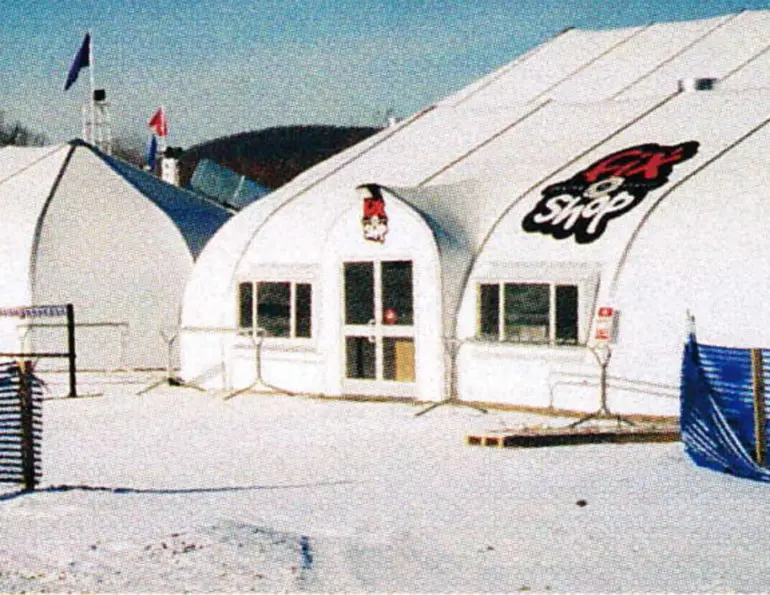
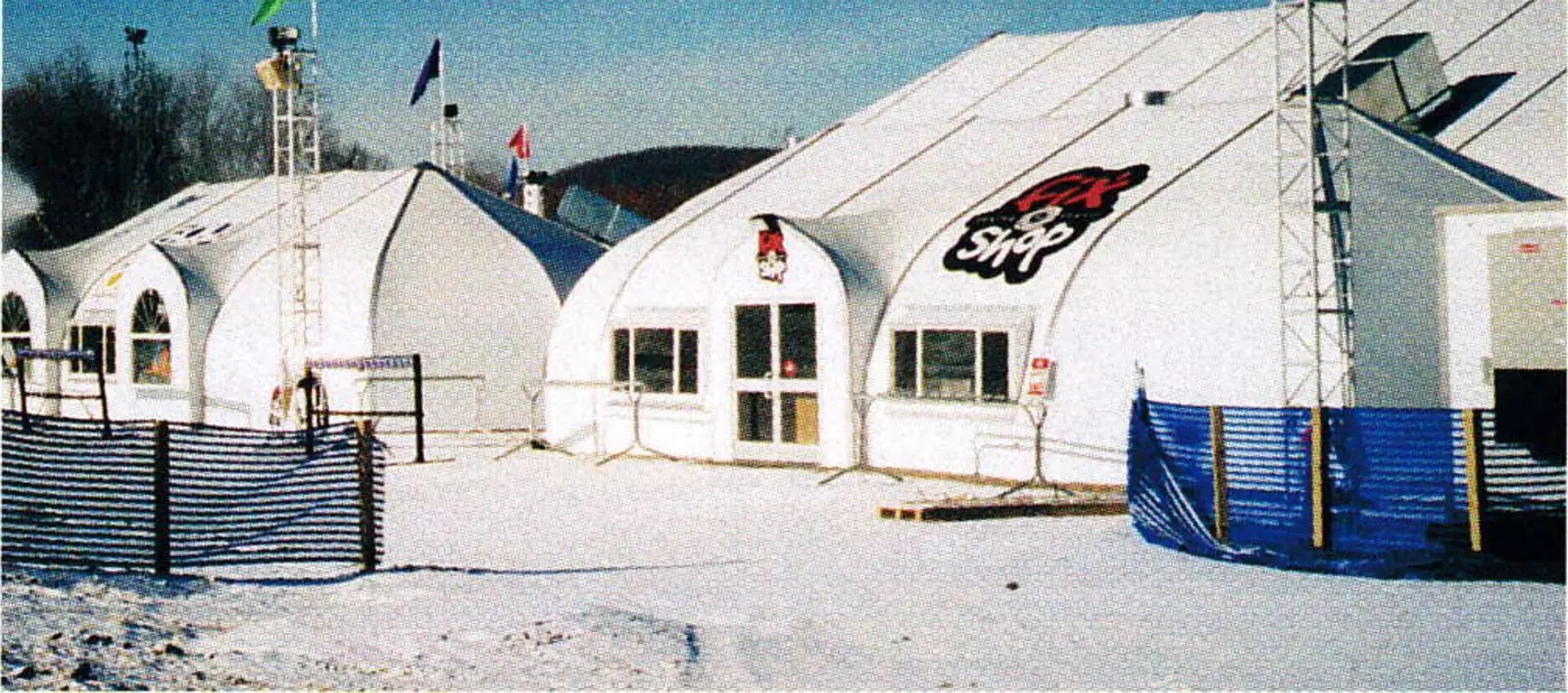
The project took about $8 million and 80 workers just shy of 10 weeks (shifts worked around the clock for the first six weeks) to raise and finish a small village of buildings comprised of polyester fabric stretched over heavy-gauge, aluminum frames. The project took 68 days from clearing the site to installing carpeting.
The leased buildings—built on top of 20,000 tons of fill—resemble tents. Designs, drawn by The Goldstein Partnership architectural firm of West Orange, N.J., were submitted and revised as construction began. Things moved so quickly, in fact, that two days after the shelters were unloaded from trucks, contractors were installing the ventilation and sprinkler systems.
—Jonathan Gourlay

