
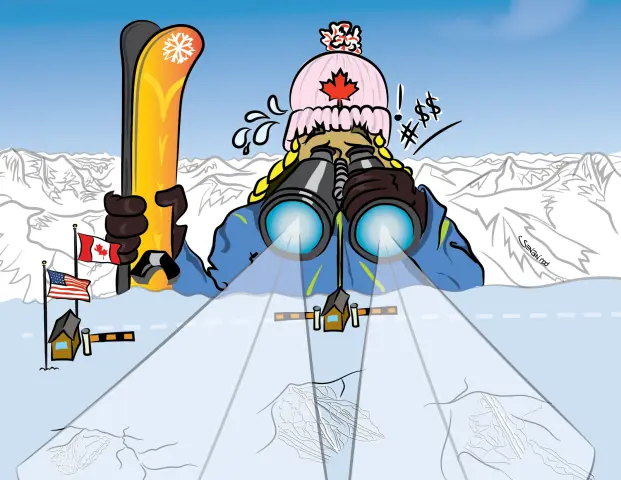

If you are not familiar with the Roadless Area Review and Evaluation (RARE) situation, please read the following report by T. Mark O’Reilly, chief spokesman for the U.S. Ski Association.
A Forest Service review of roadless areas in the National Forests may sound the death knell for ski area development in the United States. The purpose of the review, begun in July of 1977, is to determine which roadless areas have potential for classification as wilderness areas. Lands classified as wilderness will never again be available for future ski area development.
Roadless areas are portions of National Forests, usually 5,000 acres or larger, which are undeveloped. In its first Roadless Area Review and Evaluation (RARE I), made in 1973, the Forest Service identified 1,449 roadless areas totaling 56 million acres, or about one-third of the area of the National Forest System. Of this it selected 274 areas totaling 12 million acres for further wilderness study.
A new and accelerated review was ordered by Administration officials because of environmentalist accusations that the Forest Service was “too slow” and did not adequately consider “wilderness needs” in evaluating the 1973 wilderness selections. Under the new program, or RARE II as it is informally called, a second inventory and evaluation is in progress. RARE II has identified 65.7 million acres as roadless and undeveloped. Of the total, 63.7 million acres are in the West and 2.3 million acres in the East.
Some ski industry observers saw the handwriting on the wall more than a year ago. In January, 1977, D.R.C. Brown, president of the Aspen Skiing Corp., declared that ski area developers and the skiing public are “losing out because of the so-called environmentalists” as a result of the influence they exert on the U.S. Forest Service, which controls most of the potential ski area sites.
Bankers, too, have expressed concern that the ski industry is either over the hill or heading there. Tom Swanson, a vice president of the United Banks of Denver, is involved in the bank’s financing of ski areas. More than a year ago, at a seminar conducted by the U.S. Forest Service, Swanson commented, “We are confused . . . We feel very uncertain about the future of the ski industry and about the future of many companies that are in the ski industry . . . We don’t feel that growth will be as dramatic over the next several years as it has been over the last five or six years.”
The United States Ski Association, a volunteer organization of approximately 100,000 members representing an estimated 11 million alpine and nordic skiers, has officially expressed similar concern. Don Simpson, USSA’s Vice President for Public Affairs, has stated, “Under RARE II inadequate consideration is being given to the need for winter sports sites despite a projected increase in the demand for skiing of 92% by the year 2000. The combination of a growing interest in the sport and virtually no increase in facilities will seriously degrade the quality of the skiing experience.”
The intent of the RARE II program is to “round out” the National Wilderness Preservation System (NWPS) set up by the Wilderness Act of 1964. The Administration views the NWPS as a system which should display a variety of physical attributes.
At a series of public meetings held throughout the country last summer, people were asked to give their ideas as to what criteria should be used for evaluating potential wilderness areas. Although the public did not know it, the Administration already had decided on criteria before the meetings were completed, and they were announced even before all the public responses were analyzed. It had been decided, they said, that the National Wilderness Preservation System would be rounded out on the basis of land form representation, ecosystem representation, the presence of wilderness-associated wildlife, and accessibility and distribution.
Throughout the West, the people responding to the Forest Service workshops said that in managing National Forest Lands first considerations should be given to maintaining the availability of timber, mineral, and energy supplies, and access for recreation requiring development. At some hearings, one-third of those responding volunteered that there should be no more Wilderness classifications. The Administration now is trying to play down these results. All of this makes one suspicious that the RARE II program is being manipulated to produce the outcome desired by those who designed it.
Further, RARE II is not needed to meet the goals for wilderness established by the Forest and Rangeland Renewable Resources Planning Act of 1974 (RPA). RPA provided the mandate for the first long-range planning for National Forest lands for conservation, recreation and commercial purposes. The act required an assessment of our renewable resource needs and establishment of targets to provide a balance of resource outputs.
Prior to RARE II, there were already enough areas either classified as wilderness or in the classification process to meet established goals. It is important to note that the goal for wilderness cannot be arbitrarily increased without adverse effects on the other resource output targets of the program, such as recreation. Unfortunately, RARE II is now “the only game in town”—not just in Washington D.C., but across the nation.
Evaluation of identified roadless areas began in November, 1977. The evaluation will examine the wilderness, social and economic impact of wilderness classification. A draft environmental statement will be issued in late spring of 1978 on management alternatives under wilderness and non-wilderness designations. The public will again be given the opportunity to comment at hearings to be held during the summer of 1978.
The ski industry and the skiing public cannot expect that these lands will receive much consideration as potential skiing sites unless they become knowledgeable, vocal and involved in the RARE II program. Forest Service officials must be made aware that this is a growing sport, that room for expansion is necessary, and that plans must be made today to provide for the future.
A voice from the past
The following is excerpted from an article by J.E. Carpenter in the 1946 American Ski Annual. Jerry was then the Director of the Winter Sports Department of the California Chamber of Commerce. He had great hopes. We wonder how he would feel today with RARE on the scene.—The Editors

California is looking forward to the greatest winter sports season in its history, limited only by adequate areas, accessibility, and accommodations. Probably no area in the United States has greater potential possibilities, or a greater responsibility to provide recreation for a vastly increased population.
In California we are particularly dependent upon government for facilities for skiing and summer mountain recreation, in as much as a total of 25.08 per cent of the entire State, and nearly all of our best recreation areas, are in National Parks and Monuments, National Forests and State Parks and Monuments. Recreation facilities were totally inadequate before the war. The National Forests could care for but 35 per cent of the people who wanted to use the forests for various kinds of recreation. The National Parks were so crowded that it was a question as to whether or not limitations would have to be placed on length of stay.
Our greatest handicap has been the lack of recognition of recreation as such by Congress and having Congress furnish the necessary funds for adequate recreation developments on government owned properties.
We have succeeded in getting our legislature to pass the following resolution:
WHEREAS, Approximately 25 per cent of the area of the State of California in which is located our finest recreation areas, is owned by the Federal Government and administered by the United Forest Service and the National Park Service, and it is the responsibility of the Federal Government to develop and administer Federally owned lands; and
WHEREAS, Recreational facilities in these areas were entirely inadequate before the war to provide even proper sanitary facilities and, unless developed in the postwar period to take care of additional needs caused by the tremendous increase in population and the anticipated large influx of tourists, may cause serious loss to the economy of the State of California and the Nation; and
WHEREAS, The provision of adequate recreational facilities in National parks and forests is a matter of National responsibility; now, therefore, be it
RESOLVED by the Assembly, That the Congress of the United States be memorialized to recognize recreation as a proper and desirable function of Government in the National Forests and Parks . . .
Recommendations have been made to the United States Forest Service for both summer and winter recreation facilities.
Among these recommended winter improvements are 1000 miles of ski trails, 5000 acres of play area, 50 warming shelters, 75 units of parking areas, 40 organization shelters, 20 special water development and distribution projects, and 15 sanitation projects. In the summer development, recommendations are for a large number of hunting cabins which will be used for overnight touring in winter.
We are also hopeful that the best skiing area in southern California, San Gorgonio, will be reclassified from wilderness status to permit its development.
Altogether, prospects for skiing developments in California were never brighter.