Huge retail operations like Wal-Mart are gearing up to put radio frequency chips in every price tag and package on their shelves. The goal is to replace bar code readers. The advantage is that RF chips can be read automatically, from a couple of feet away, by a machine that doesn’t earn $8 an hour. For a retail operation, this means that merchandise can be inventoried as it comes through the loading dock, counted while on the shelves, reordered at the check-out counter—and stopped at the front door if pilfered. In many stores, customers with credit cards could simply swipe a card on their way out the door, eliminating the check-out clerk’s hourly pay.
An RF chip system has similar advantages for a winter resort. It serves as a highly efficient ticket-checker, and can be used to track skiers’ and riders’ usage of the mountain. Some systems can add credit-card capabilities and promote cashless transactions. Mostly, RF chips provide both control and information, two precious commodities in resort operations.
An RF chip is, in effect, a small piece of PROM—a programmable read-only memory. The program is just a unique number. In the retail environment, this number is the UPC (universal product code). The reader or scanner sends a radio frequency beam into the chip, which is tuned to resonate back at that frequency with its coded number. So the reader functions a bit like a radar set: It sends out the radio energy, then reads the data in the bounce-back response. The chip needs no on-board power source.
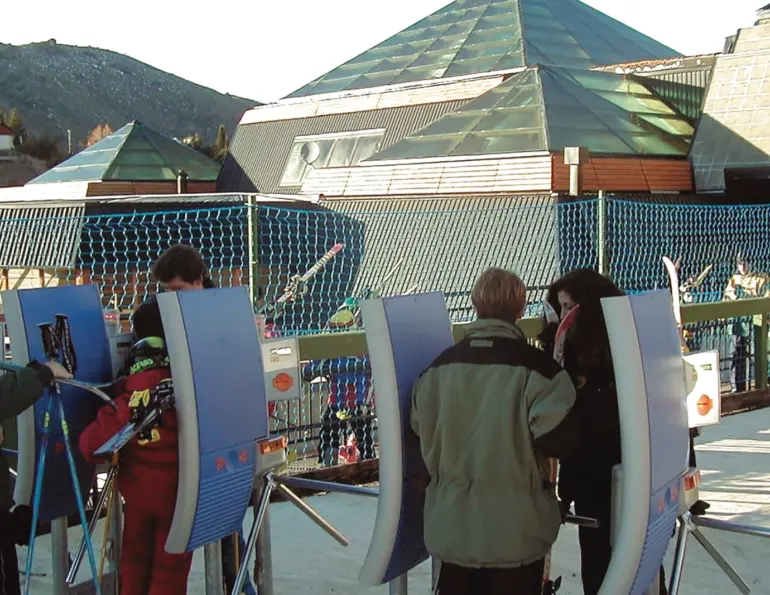
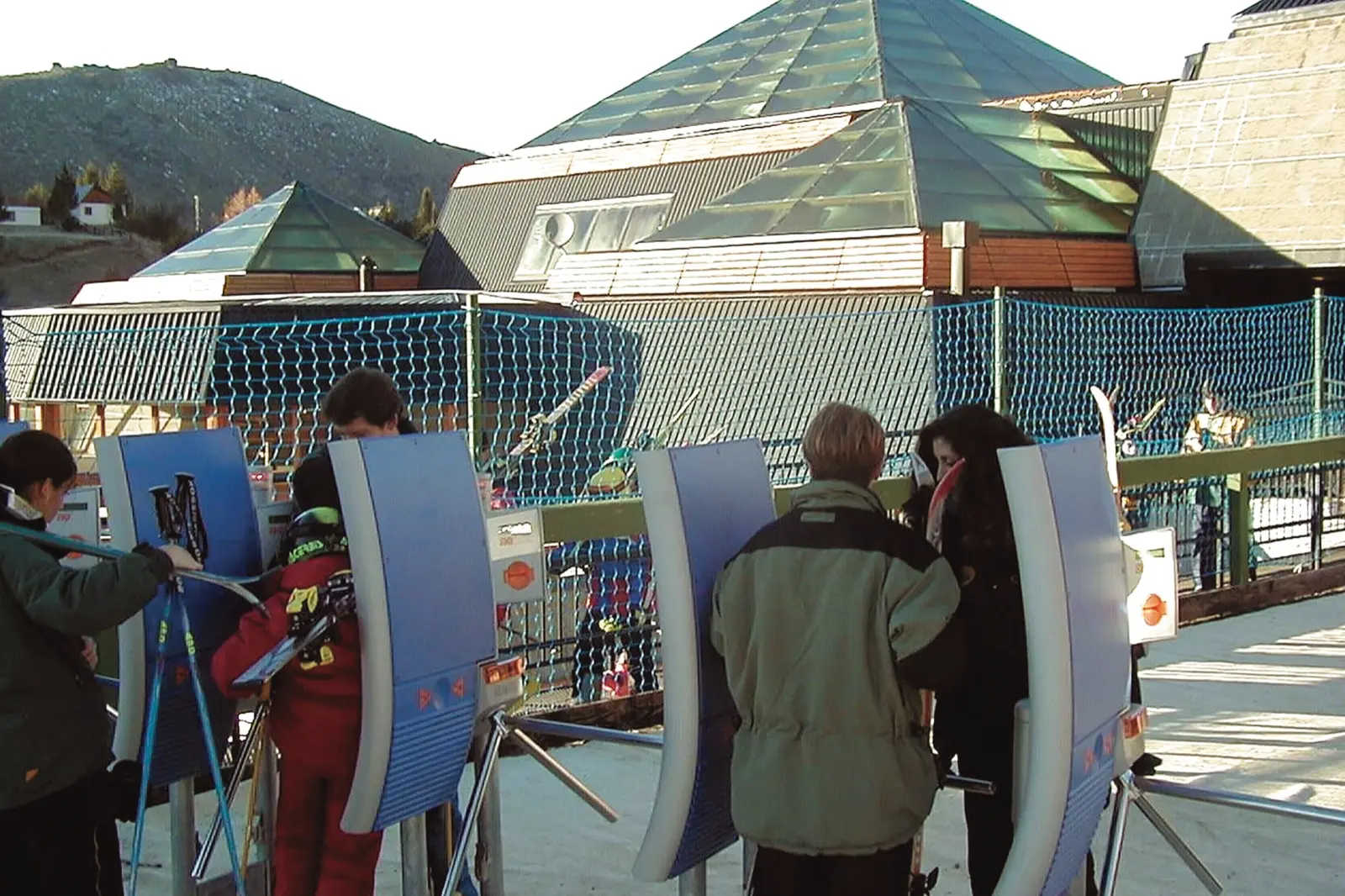
In the customer-access environment—a theme park, movie theater, parking garage or ski resort—the chip is programmed with a pass number. The customer walks, rides, skis or drives past the reader and is admitted or billed. For the customer, it’s a hands-free process. The ticket or pass stays tucked in a pocket or on a neck cord, inside the parka. There’s no ticket checker, just a friendly greeter who handles traffic snarls in the corral and customer service issues.
In large batches, RF chips currently cost about 50 cents each, which is too expensive to slap them onto every grocery package (but perhaps cheap enough for use with a lift ticket or pass). When the price falls to a nickel or less, expect to see bar code readers disappear from major chain stores. In the smaller quantities used for laminate ski passes, prices can run as high as $3 each.
Dozens of ski resorts have already adopted RF technology for lift passes. Whole regions in Europe use it; in North America, RF readers control lift access at Aspen Highlands, Bachelor, Big Sky, Solitude, Red Lodge, Mountain High, Copper, Mt. Tremblant, Catamount, and others.
Four companies now offer RF lift access systems. These range from ultra-simple (a reader that records the passage of a valid ticket and signals the passage of an invalid one) to sophisticated (smart-cards that can interface with every point-of-purchase in the resort, and eventually with the economy of the world). Here’s how the field looks.
Inexpensive Access Control
For small resorts, the entry-level system is a simple ski-through gate, without a flow-control turnstile. It looks a bit like the theft-prevention scanners at the exits of major retail stores. The first of these systems in North America was installed at Killington in 1998. The mountain had introduced a Mag 7 card with an RF chip, which was supposed to provide access to the Bear Mountain, Superstar and K1 quad lifts. Employees using hand-held scanners were supposed to scan the cards, which were to expire after seven days. But the scanners didn’t do their jobs, and hundreds of “paying” guests skied all season on their one-week cards. Locals began calling it the Mag 70 card.
Killington called in FCS Development, a custom enterprise software company in North Clarendon, Vt. According to Jackie Fenner at FCS, the company engineered a four-lane card reader for each lift. At that early date, the technology was still quite expensive—about $3,000 per lane, or $36,000 for the three lifts. At least the system worked; it caught 400 cheaters in its first week. The plan was to expand the program to the entire Killington lift network, but ASC found itself strapped for cash, and no more access readers were installed.
FCS went on to develop an inexpensive barcode ticket system based on a Videx handheld scanner, selling at $1,500 per unit. Implemented at three waterparks, plus Bolton Valley, Vt., and Eldora, Colo., the system required only a daily upload of the day’s barcode number to the handheld units. Each lift required one or two hand units. “The system is still only as reliable as the person using it,” Fenner notes. The company has now developed an RF reader that sells for $3,500, to replace the Videx units.
The laminated plastic passcards that replace the traditional ticket are a convenience for skiers and riders, since they don’t have to fish passes out of their parkas on each lift ride. The ticket-checker simply passes the reader near the skier’s pocket. On the other hand, it’s not an inexpensive convenience; the plastic passcards cost $3 apiece. This can be cost-effective if the cards are recycled. It can also provide an inexpensive way to give management and staff a year or two of experience with the technology if you’re considering the installation of a pass-through gate system at a later date.
The Entry-Level Access Gate
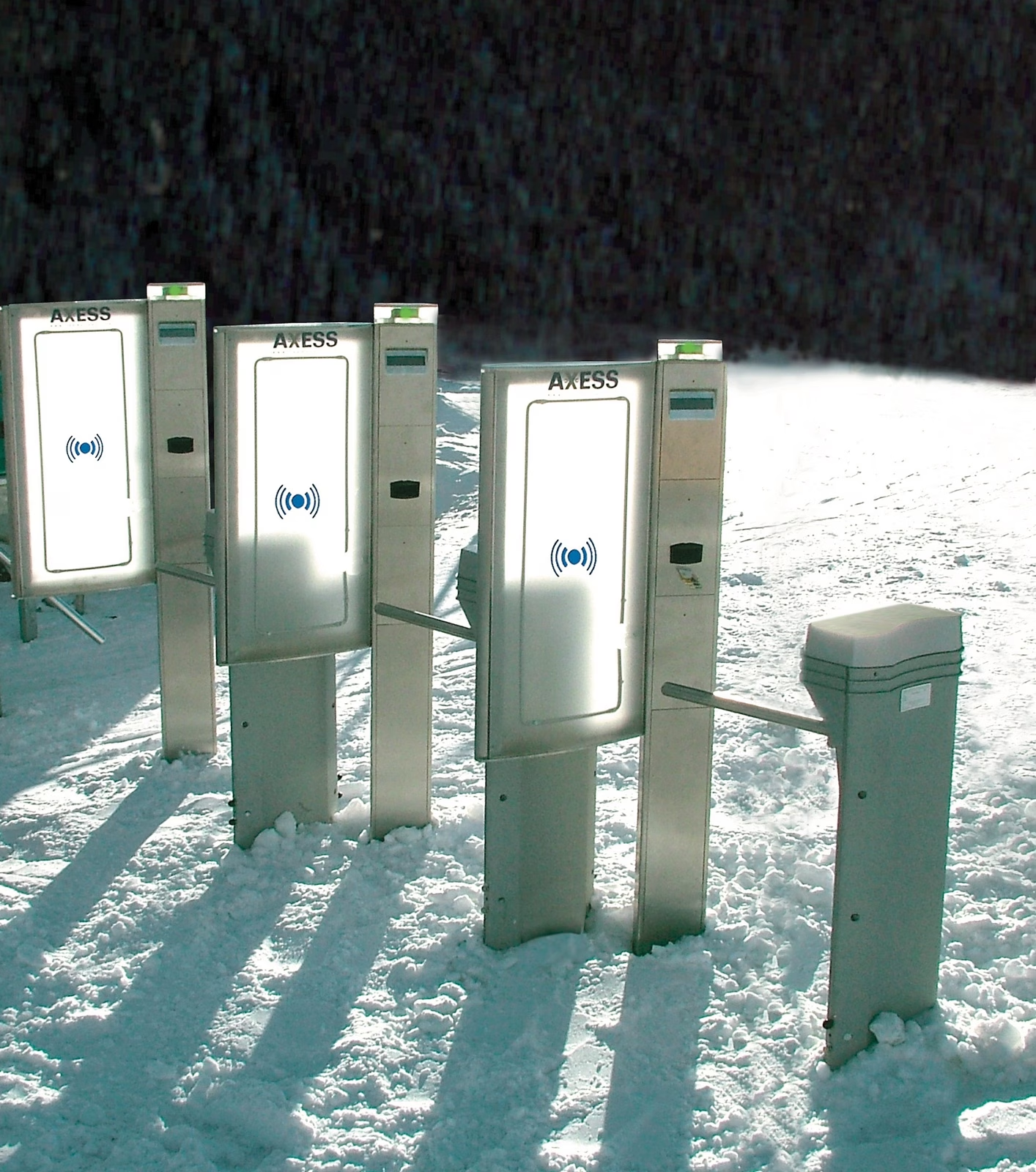
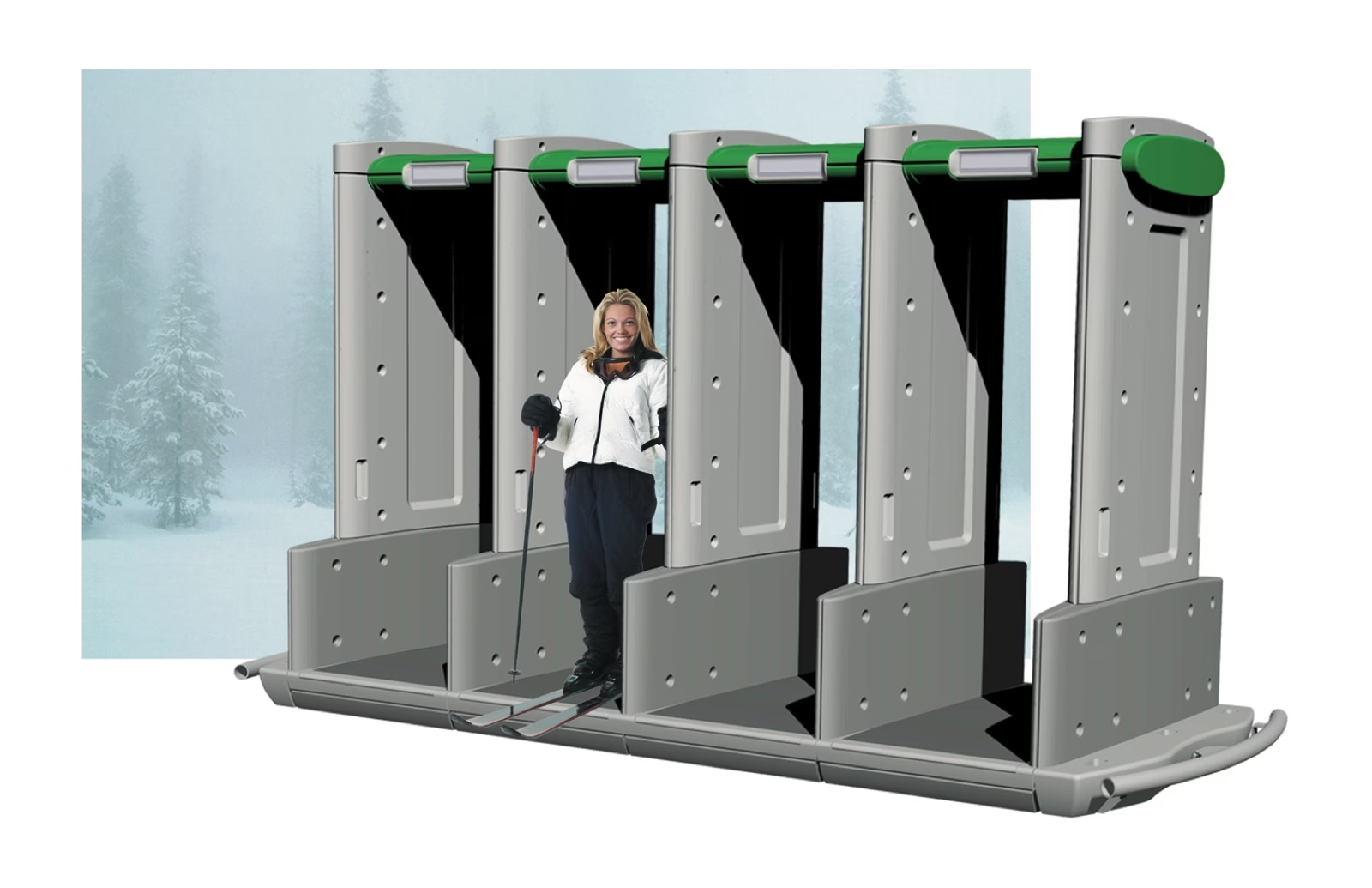
Next up the sophistication scale is the ski-through gate developed by Entrelogic in Marlborough, Mass., and scheduled for installation this winter at four smaller resorts. Romas Radis notes that beginners often have trouble negotiating a turnstile. “We wanted something like the metal detector at airport security,” he said. The skier or boarder shuffles through it unimpeded. An infrared beam notes the passage of a body through the gate, while the RF reader notes whether the card is valid for the day. “An operator stands on the other side and as long as the gate doesn’t beep, you’re okay,” Radis says.
It’s a bit more complex than that. The gate can signal the attendant whether the card is encoded with an adult, junior or senior pass, so an alert employee can stop a teenager, for instance, skiing on a child’s ticket. Entrelogic offers two types of tickets: an inlay in a normal paper ticket, for about 50 cents apiece, and a direct-to-lift laminated card. A four-lane gate costs about $12,000, and requires no wiring to the resort’s computer system. Just plug it into the AC connection at the lift shack. But traffic data can be downloaded in real time to track, for instance, where loyalty card customers have been skiing. The whole rig can be moved easily for snow grooming.
The Skier-Info Card
Skidata, an Austrian company with its U.S. headquarters in Los Angeles, has installed RF turnstiles at Mt. Bachelor, Big Sky, Red Lodge, Solitude, Mountain High, and Aspen Highlands, and expects to start putting up gates at the other Aspen resorts this fall. Dozens of installations are running Europe.
Says operations manager Peter Dauenhauer, “RF offers three major advantages: You don’t need labor to control ticketing. You have full time control, which means ticketing flexibility—you can charge by the ride or by the hour, for instance, and track vertical for loyalty programs. And there are risk management advantages to being able to track individual skiers. If a skier goes missing you can look up his ride history and find out where he last skied.”
Mountain High takes full advantage of the Skidata system. A rider who already holds a passcard can go to the resort’s website and buy a day’s access, which is instantly credited to the passcard. Then the customer goes straight to the lift, bypassing the ticket window.
The Skidata turnstile array costs about $30,000 for a typical high speed quad lift. About 3,000 of these units are already in use at ski resorts, theme parks, and parking garages across the U.S. Many more are in service in Europe. Dauenhauer suggests that adding access control to an existing Siriusware or RTF enterprise software system is a straightforward install, and will require a couple of days of training for department supervisors.
The All-in-One Resort Card
The most ambitious RF system comes from Rapidtron, of Costa Mesa, California. Rapidtron has about 3,500 turnstile units running in Europe, including the Dolomiti Superski complex in Italy. About 1,600 more gates are going up this fall, including the entire Arlberg complex in Austria, Val d’Aosta in Italy, and the Portes du Soleil region in France. In addition to ski areas, Rapidtron has been very successful with fitness centers.
In North America, Rapidtron has 160 fitness centers and a handful of ski areas using the system. Park City has a full set of gates, Copper Mountain has ten units in place, and Rapidtron plans to fold in Mt. Tremblant and Tamarack this season. The systems are fully integrated with the resort’s enterprise software, so managers can watch traffic in real time. This can improve planning and staffing for snowmaking and grooming, and it allows the marketing folks to create new ticketing or loyalty reward products on the fly.
Vice president Peter Dermutz figures the price to install the moveable gates—they can be lifted on a gantry for snow-grooming—starts around $100,000, including full software integration and staff training. But the gates also cut the number of ticket-checkers per high-speed lift from four or five down to one greeter. The system is fully modular, so malfunctions can be handled quickly, and simply, by unplugging the bad unit and plugging in a good one, with repair done in the shop.
Both Comptrol and Siriusware have developed modules to interface their software packages directly with the Rapidtron gate system. In addition, according to Mark Danneman at Sirius, it would be an easy matter to code an interface for SkiData. “About two weeks including training resort managers,” he estimates.
The involvement with Intrawest should be the giveaway that Rapidtron has plans beyond simple access control. President John Creel notes that the company is about to acquire a smartcard integrator. The smartcard will not only function for lift access, but can be “charged” with money for use at all the resort’s retail and food-and-beverage locations. A parent can give the kids a lift pass that’s also good for lunch only, or put other restrictions on the use of the funds. Rapidtron’s smartcard system was developed by JP Morgan Chase and the US Navy, for use on ships at sea. It means that naval personnel don’t need to process cash on board, saving thousands of hours per ship per year.
“In the private sector, when the customer loads cash into the card up-front, the resort profits from the float until the card is emptied out,” Creel points out. “People seem to spend more on impulse purchases.”
Resorts can also use the smartcard system to pay employees, who then access cash through an ATM. This eliminates paper checks; if the employee needs a full accounting of tax deductions, the ATM machine can print it. Someday soon, customers will be able to recharge the smartcard with the swipe of a credit card at a baselodge kiosk. A biometric system will take a hand-scan to verify that the non-transferable card is in its owner’s possession.
The smartcard system is already in use in Bally and other fitness clubs, and at the rec centers at UCLA and UC Berkeley. The universities plan to morph their smartcards into student ID cards for use at all campus facilities. Creel notes that the card can incorporate a magnetic stripe on the back—in which case it can function with all Chase-affiliated merchandisers and worldwide loyalty programs.
The plastic smartcard currently costs about $3, but it’s fully recyclable. A thermoprint coating permits the resort to put the customer’s photo and related copy on the card at the same time the chip is reprogrammed. Some businesses simply charge a deposit for the card, which encourages the customer to keep it for future use, or return it so it can be reprinted for another customer. But if you need a cheaper version, a paper smartcard is in the works.
Eventually, within an empire like Intrawest, the card could function as a credit card, lodging door key, lift access card, parking access card—and emergency ski wax scraper.

In fitness club applications, labor savings pays for the equipment in three to six weeks, Creel says. And labor savings will also help resorts. “The big problem for resorts today is labor,” he says. “The days of affordable ski bum labor are gone.” Another advantage is in customer relations. Instead of a “ticket checker who functions purely as a cop,” lift personnel can focus on providing information or assisting guests in whatever ways are warranted, Creel says. “With RF card access, employees no longer have to be cops.”
RF Access Suppliers
FCS Development, Inc.
Tel: (802) 747-9075; fax: (802) 775·2467
www.fcsdevelopment.com
Comptrol Systems Inc.
Tel.: (303) 972-9118
www.comptrolsystems.com
Innovative Data Systems
Tel.: (631) 244-0069
Rapidtron 1-866-817-0127
Tel.: 949-798-0652; fax: 949-474-4550
www.rapidtron.com
Skidata of California Inc.
Tel.: (310) 337-1028
www.skidata.com
Skier-trac
Tel.: (508) 229-1790; fax: (508) 229-1792
E-mail: Sales: [email protected]
Siriusware Inc.
Tel.: 1-800-352-0633; (505) 751-0633
www.siriusware.com