All successful ski areas, large and small, are involved in ongoing capital and operational planning. Whether we’re talking about a new marketing approach, construction of new lift facilities or determining the summer projects for the carpenter, most activities need a plan if they are going to be implemented in an efficient manner. One technique that is available to ski area managers, but used too infrequently, is critical path scheduling.
Critical path scheduling also known as network modeling has been around since the late 1950’s. PERT (Program Evaluation and Review Technique) was established by the Navy as a planning tool for the Polaris missile project. Much of the Polaris success was attributed to PERT and it became a significant planning tool for many large-scale government projects. CPM or Critical Path Method was developed by the DuPont Company to plan maintenance at their chemical plants located worldwide. Although named differently, the two techniques are almost identical in concept and methodology.
So what does refinishing your base area restaurant have in common with the Polaris missile project? And what can your lift maintenance people possibly learn from DuPont’s chemical plant program? In short why should a ski area even consider utilizing one of these funny-sounding planning tools?
The main reason for using a critical path scheduling program boils down to MONEY! Critical path scheduling can provide the area operator with several ways of saving time and money on any activity or project they undertake. These savings can be grouped as follows:
1) To compress time frames. Once you know all the activities that must take place and understand their interrelationships, you’re in a position to modify schedules to tighten up where “float” exists. An alternative is to add projects if more time is found.
2) To schedule activities so they compliment cashflow and still get all projects finished. Have you made expenditures and then realized you didn’t need to for another four months? Or, have you placed an order when you thought you had lots of time and the equipment/material showed up late?
3) To monitor work taking place. When you have a well-thought-out plan in place before the project starts, the plan can be used as a benchmark to evaluate the work as it takes place. Are you ahead or behind schedule? What steps can be taken to get back on schedule?
4) To augment staff communication. If all the employees are involved in the scheduling process they will understand the entire project. They will also know what the final goal is and also the need for timely action on their part in reaching that goal.
When these benefits are viewed collectively, it is easy to see why all ski area operators should employ some form of critical path scheduling. The biggest drawbacks in the past to using this tool was the need to have someone on staff who was very good at mathematics or to have access to a mainframe computer with one of the PERT or CPM programs on it. The advent of personal computers and numerous computer programs has now made this dynamic planning tool available to virtually every ski area.
Today an operator can set up a critical path schedule for any project to be undertaken. The basic components needed for a network to be generated can be summarized as follows:
Activities in the network represent actual operations or activities in the real project. Examples could include digging a foundation or printing a brochure.

Events in the network represent milestones in the project and occur at a point in time. For example, both the start and finish of an activity could be events.
Duration is the period of time assigned to each activity within the project. Generally past experience or contacting someone with similar experience in the best way to determine a duration for a particular activity.
Sequence and relationships are the logical sequence for all activities. What occurs first and what follows? Also, there are often inter-relationships between various activities. Often two or more activities can take place after one is completed.
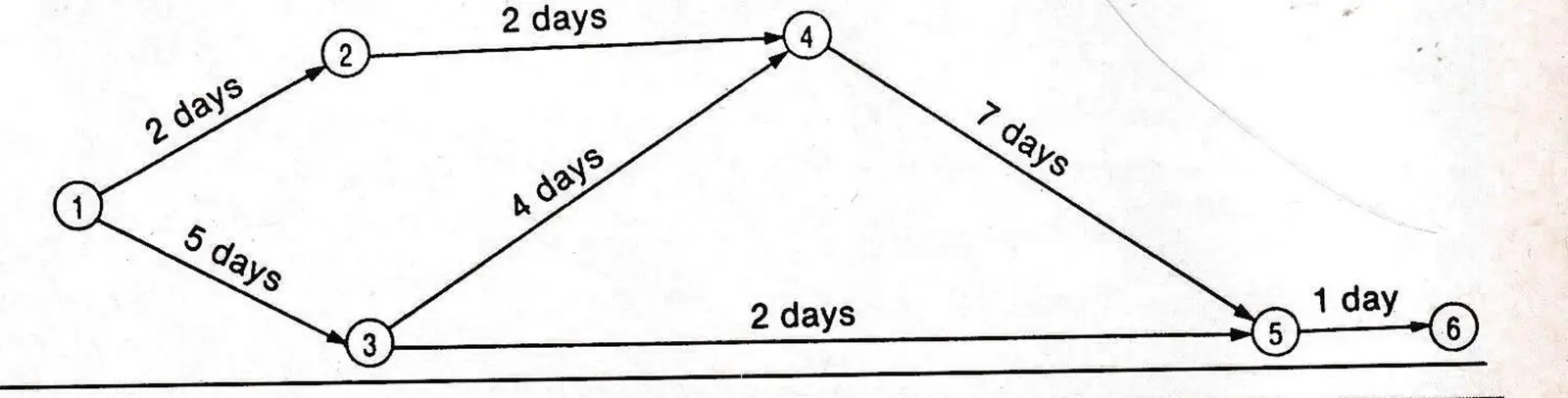
If the ski area operator can understand these basic components then he can layout a critical path schedule. Graphically we can illustrate these components and their relationships in the schedule. Below is a schedule for pouring a foundation.
| Activity | Description | Duration |
|---|---|---|
| 1-2 | Locate foundation site | 2 days |
| 1-3 | Hire contractor | 5 days |
| 2-4 | Survey foundations | 2 days |
| 3-4 | Contractor mobilization | 4 days |
| 4-5 | Dig and set forms | 7 days |
| 3-5 | Order concrete | 2 days |
| 5-6 | Pour concrete | 1 day |
Depending on the project size, the operator can develop either a detailed or broad-based schedule. Generally the larger the project, the more broad-based the schedule. As the project proceeds, modifications to the schedule will provide greater planning detail. Once a schedule has been roughed in graphically, such as in the example, then the computer can take over.
There are several good computer programs available today that are inexpensive ($500-1000) and run on many of the popular personal computers. Depending on the program and the computer used, as many as 1,500 activities can be incorporated into one plan. Some of the better known programs include: Pertmaster Harvard Project Manager and Qwiknet. Usually for $50-100 you can obtain demo disks for these programs and then evaluate them for your particular projects.
Once a program is selected and the information for a project is entered, the full management potential of the technique is realized through numerous report options. Depending on who needs the information, all of these critical path programs can generate a variety of reports and charts. By running weekly or monthly reports, it is easy for everyone involved in the project to see how it is progressing. Changes can be made early, where they will do the most good.
In today’s business world, where time and money are so important, critical path scheduling can significantly improve productivity and the ski area bottom line.