Lee Tillotson, who knew the mountain well enough to anticipate every bump, was foreman of a 15-man blasting crew that was removing troublesome spots from the trails, and creating the ditches to bury snowmaking pipe. The Vermont supervisor for Maine Drilling and Blasting Inc., Tillotson had been working at Stratton on and off for four years. The work last summer, however, had intensified to meet the demands of the Stratton Corp.’s three-year $60 million expansion program.
“Years ago,” Tillotson explained as he coaxed the vehicle up the mountain, “it was just assumed that if you were gonna blast, you were gonna do damage.”
“Not any more,” he declared.
As if to underscore the point, he braked the truck to a stop near a lift tower halfway up the trail. Beside the vehicle was a gaping cut into a rock ledge that went across the trail just a few feet uphill from the tower.
“See that cut,” he said, his voice reflecting the pride of an artist. “If we blasted carelessly, so that rock and other debris all flew around, then that could be the end of that particular lift . . .
“Vibrations from the explosions could crack the foundations of the tower for sure, making the lift dangerous and guaranteeing that it wouldn’t pass the state’s safety inspection . . . Or a flying rock could ruin the haul rope by cutting one of the wires . . . or could bash in a chair so it wouldn’t swing around the bullwheel right, raising hell with the machinery, possibly causing a de-ropement.
“That’s why control is important. Ski area managers should expect control when they undertake a blasting operation.”
“In fact,” he continued, “when people see one of our blasts, they ask, ‘Is that all there is to it? . . . I didn’t see anything.’ And that’s the way it should be.”
As the principal method of removing rock ledge, blasting really hasn’t departed much from its origin more than 100 years ago when nitro-glycerin 3/4 mile Hoosac Tunnel in western Massachusetts. Basically a hole, about three inches wide, is drilled into the rock, a stick or sticks of dynamite are slid down the hole, with one end of a wire attached to the explosive, the other end to a detonator. The detonator is activated, setting off an electric charge, which explodes the dynamite.
So much for the basics. What is not so certain is the technique of blasting. This involves knowing where to drill the holes, how much dynamite to put in them, how to time the blast so that all of the dynamite doesn’t go off simultaneously and how to make sure the blast doesn’t go in the wrong direction. No two blasts, no two situations are the same. But if the technique is right, only a muffled thump will be heard, indicating the charges have exploded. The ground will rise about four feet and then settle. Very little debris will fly around.
Tillotson explained that such control isn’t quite so critical in other kinds of blasting work. A lot of the blasting for the interstate highways, he said is right out in the open under conditions where blasters can fill a rock ledge full
of charge, take shelter and fire away. Either heavy steel mats contain the blast or it really doesn’t matter if rock does fly around because the surrounding space is open.
Ski area blasting, however, requires a much more precise technique, because of the proximity of buildings and lifts. A blast gone astray (or, in blaster’s jargon, “a shot lost”) can destroy a chairlift, or at least its haul rope, or badly damage an existing building such as a base lodge.
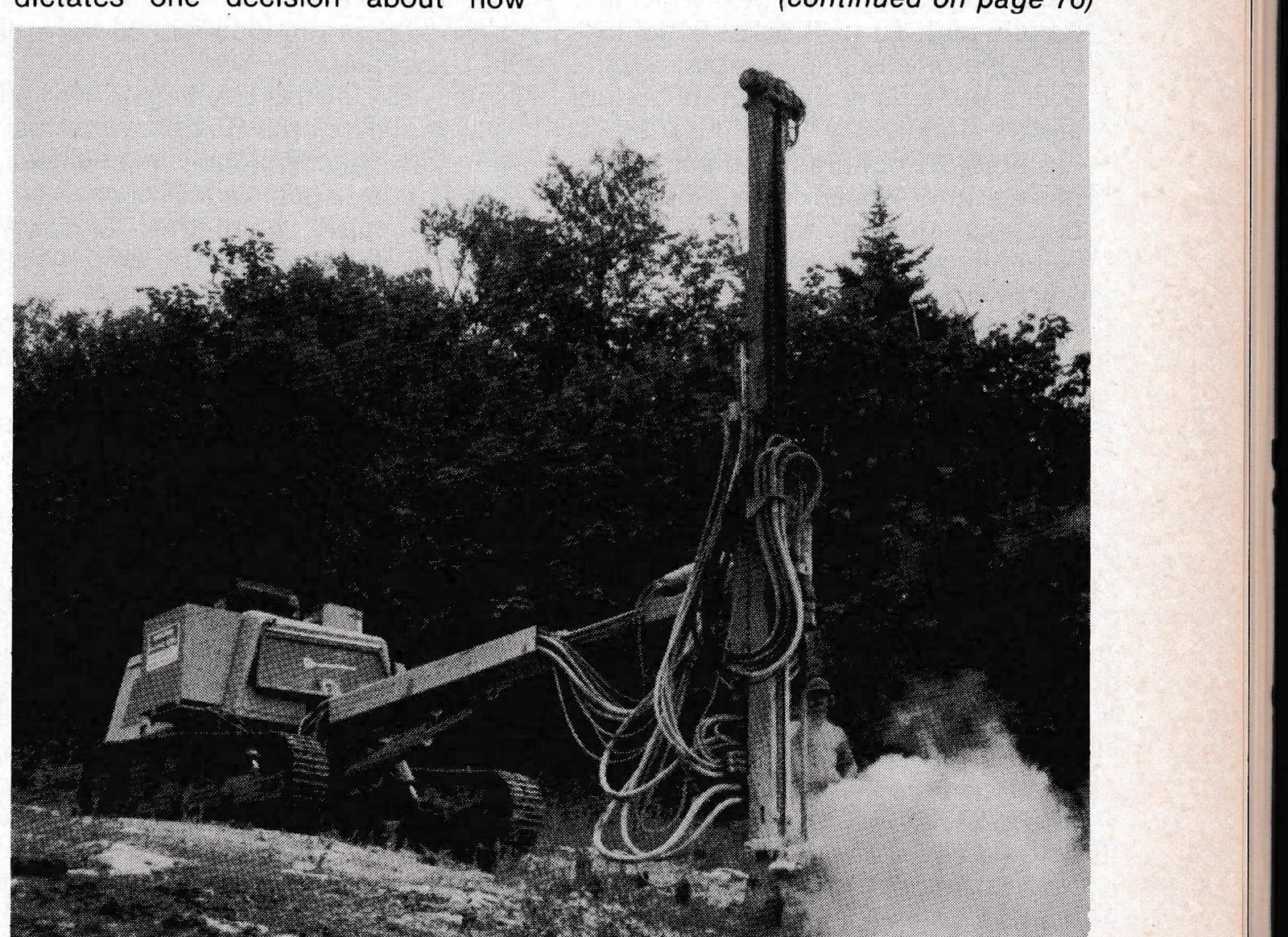
Ski areas also pose other problems for blasters. Dragging the top-heavy and somewhat awkwardly-shaped rock drills around mountains and locating them precisely on sharp pitches is much more of a problem than if the work were being performed on the fairly flat levels of most interstate highways.
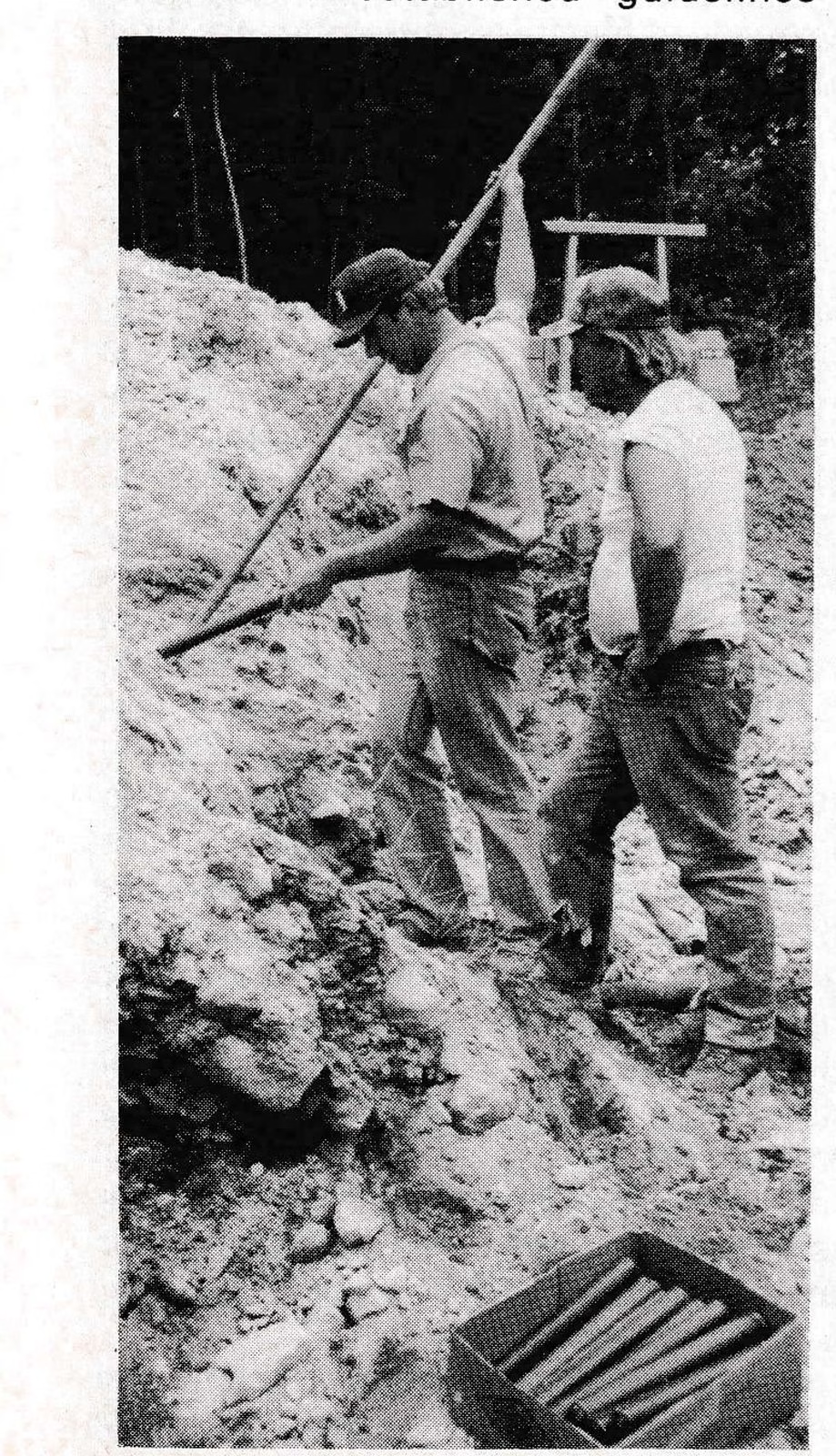
Secondly, the refuse from ski trail blasts cannot be carted away easily. Blasting jobs have to be figured carefully in advance so that the debris can be used for backf ill or for filling in a nearby section of trail. Thirdly, thunderstorms, so common on mountains during the summer, represent a tremendous hazard because the electricity can set off a blast prematurely. Finally, mountains, particularly those in New England, are composed of dozens of different kinds of rock, some hard, some soft, folding over each other in tortured, twisting and turning layers. Each kind of rock reacts differently to a dynamite blast.
Tillotson explained that while there are some established guidelines about how much dynamite to use and how many holes to drill, experience is what really counts when blasting trails at ski areas.
“If everything that needed to be done during a blasting operation could be reduced to a formula, then anyone who could work the formula could be a blaster,” he mused, quickly adding that in real life blasting doesn’t work that way.
“Like anything else, the theory runs out before you hit the field . . . and that’s the case here,” he said.

Elaborating, he said that one of the chief potential miscalculations is not putting enough charge into the holes. This means that the rock won’t fracture instantly.
“The explosion should go sideways,” he explained, “breaking the rock at the sides of the drill hole. But if there isn’t enough explosive, the rock won’t break, and the only place the explosion can go is up. When this happens, debris and rock are blown right out of the top of the hole. If the blast goes sideways, the way it should, then the loose rock is contained by the rock above . . . everything is loosened, but doesn’t fly all around.”
Part of knowing how much explosive to use is knowing the characteristics of the rock. Marble is hard, shale is soft. Obviously, hard rock takes more explosive.
Tillotson said that the hole drilling process provides important clues about the composition of the rock. If the drill pierces the rock easily, that dictates one decision about how much explosive to use; if the rock is hard, that dictates another. Other clues about the rock’s composition are provided by outcroppings on the trail itself or what has been found in previous blasts in the immediate area.
Seismographs, the instruments that measure vibrations, are tremendously important tools for blasters when they have to work close to lift towers or other foundations. The seismograph, placed at the foundation of a tower will measure vibrations from the initial blast. This measurement provides an important clue about how much explosive to use in subsequent blasts, particularly as they get nearer to the foundation.
Timing of the explosions is another critical part of blasting technique, Tillotson explained. In order to encourage the blast to go sideways, each hole of charges explodes a millesecond apart. A good overall blast is like lining up dominos and then knocking them down. The first hole is exploded, then the second, the third and so on. The principle behind the sequential explosions is that the blast will take the course of least resistance. Thus, if the first hole is blasted, and therefore soft, the blast from the second hole will travel towards the first hole, staying underground, rather than going up. If all charges in all the holes were exploded at the same time, the only place the blast could go would be up, thus spreading debris and rock all around.
Tillotson described the scope of the Stratton job as much larger than most ski area trail work. He observed that the job had been made immensely easier by the use of hydraulic, rather than compressed air, rock drills.
The difference, he explained, is that the more conventional compressed air drills require a compressor that must be hauled around the mountain with the drill, requiring two pieces of awkward equipment to be placed at each blasting location, rather than one. Secondly, compressors represent a second machine that needs fuel at each location. And often they require even more equipment, such as bulldozers or grooming machines to anchor them so they won’t slide down the mountain. He estimated that the Stratton job would have taken an additional month to month-and-one-half to accomplish, if the blasters had to rely on compressed air drills. The fuel consumed would be double, he estimated. Hydraulic rock drills are routinely used for highway construction, he said, but not for ski areas. Part of the reason is that they are relatively new on the market. The types being used on the Stratton job were manufactured by Ingersoll-Rand and Atlas Copco, both American companies, and by Tamrock, a Finnish manufacturer.
Tillotson said that he would advise ski area operators who are about to undertake blasting projects to expect that the blasting will be controlled.
“There are all kinds of blasters,” he said, “and they all have different kinds of experience. A company that specializes in blasting for interstate highways, may not be an appropriate choice for ski areas because interstate highway blasting does not have to be so precise.”
Secondly, he said, the reputations of blasters should be checked. The questions of what jobs they have done and how well they have performed should be asked, he advised.
However, he remarked, it can be difficult for a ski area operator to obtain answers to these questions because blasting companies are routinely hired as subcontractors, not as prime contractors. Since blasting companies are self-insured, prime contractors are apt to hire on the basis of price only, rather than reputation. If something goes wrong, the blasting company is insured, the prime contractor will reason. And that means the prime contractor is relieved of responsibility.
“The problem with all of this,” Tillotson observed, “is that if a blasting mistake is made, it can’t be covered up. There’s simply no way to repair a blast gone wrong.”