
By definition, good working relationships means this: (1) You have established reasonably good lines of communication with the local ski writers and broadcasters (2) You know who to call when you have information about routine area events and can expect a good reception (3) Unless some natural disaster is competing with you for media time and space, the chances are that whatever you’re offering will get some coverage.
From the area operator’s point of view, publicity that helps keep the area name in front of its local or regional customers is more valuable than advertising. Editorial coverage is more believable. This spirit of cooperation keeps the news people happy because you’re helping them do their jobs with a minimum of fuss and you’re communicating with your skiers. All well and good.
If you have a good press program, or at least you’ve held the number of snarling antagonists to a minimum, even a perfect press program will not protect you from the frustrating job of handing the unexpected visitor who claims to be working for an exotic magazine. He has arrived on your doorstep with wife, two children and a baby sitter. All they need in the way of cooperation, the visitor assures you, is five lift tickets. Didn’t my editor send you a letter?
This is basic freebie problem number one for most ski area operators. Do you send them packing, which is your first and most logical reaction, or do you buckle under on the theory that maybe the guy really is from the magazine he says he’s from, circulation 3,455,000?
First of all, every ski area should have a definite press pass policy, one that has been put in writing and distributed to employees that are likely to come into direct contact with the wandering press. This would include all ticket sellers and, obviously, all publicity and marketing personnel as well as anyone working in the area with management responsibility.
Second, there should be as little deviation from the policy as possible. If you have a good press program, you will have little to fear because you will be taking care of the majority of legitimate press requests in advance as part of your general working arrangement with local media. In the case of the writer from the national magazine with the big family and baby sitter, if the writer was visiting your area on assignment, he would have been identified in advance by his publication. In any case, no national publication would ever authorize an editorial employee or writer on assignment to ask for lift tickets for friends and relatives. Finally, any responsible publication with significant circulation would consider the cost of lift tickets a reasonable and proper item of expense to be added to the expense account.
As a specific example, should you ever be approached by an individual claiming to be writing a story for Sports Illustrated, Ski Magazine, Skiing Magazine or Ski Racing and looking for anything from a free lift ticket to meals and lodging, assume the character is a fraud—unless the individual carries a letter of introduction in advance by the publications’ editors or you have been contacted in advance by the publication explaining who was coming and for what purpose. You need never worry about offending a major publication by refusing to hand a comp lift ticket to an individual without proper identification. It’s the responsibility of the publication to make sure details of that sort are taken care of. It’s not the ski area’s responsibility. No legitimate publication would hold the area responsible for a failing of its own.
What exactly, then, is a reasonable and proper press pass policy? Obviously, there are great latitudes in policy from area to area. Vail, for example, would necessarily have different problems from Mt. Tom. Much of it depends on geography, facilities and even reputation.
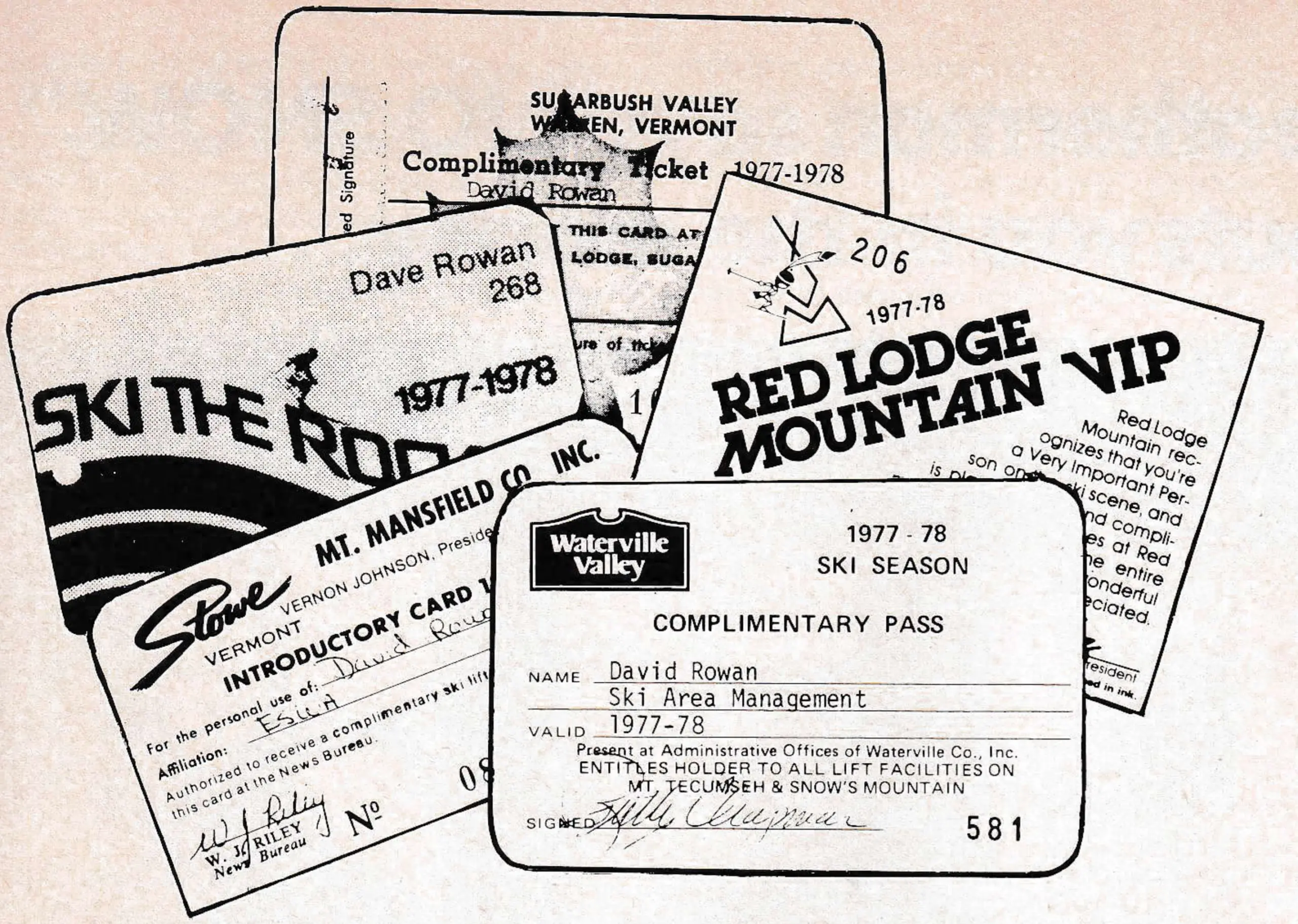
But a first ingredient of a pass policy would be to establish a program for your local press. Except for a few major resort areas, the bulk of ski areas in the U.S. draw the most significant number of skiers from its immediate geographical area. The day or even weekend skier is critical to the area’s business. Local working ski writers and working broadcasters should be supplied with season passes to your area. The justification is that the more they ski in your area, the better acquainted they will be with what you’re doing and what’s happening in your area. The more they know, the more they can tell others. These passes should be limited to working editorial personnel and should be, of course, non-transferable. The passes themselves should be of a type that are exchanged for a lift ticket each time it is used so you know who is using what passes and how often.
To take care of the non-working media people—ad departments, editorial staff not involved in day to day ski coverage—a press day can be extremely useful. This would simply be a day early in the season when all advertising, editorial and upper administrative department personnel would be invited for a day of skiing and a tour of your facilities. It would be Daily Funnel day at the ski area. Assuming we’re talking about a small daily or even a local weekly, work out the details with the publisher.
What do you do about the local ski writer, pass in hand, who shows up with wife and children for a day of skiing? As a matter of policy, no area should be obligated in any way to provide free skiing to a ski writer’s family, friends or dog. This particular rule should be included in your area’s basic written press pass policy. Now that that’s established, you might want to bend a bit under certain circumstances.
For example, as you probably know your local ski reporter on a personal basis, or should after a season or two, as a courtesy, you might want to offer his wife (or husband, should that be the case) a pass good for three days of skiing during the season—or even a full pass, should you think it to your advantage.
There are a couple of reasons for doing this. First, bluntly stated, most editorial jobs on small and medium sized daily newspapers are not well paying jobs. Second, you want to do whatever is reasonable to encourage your local press contact to visit your area as often as possible. In no case, should a ski writer’s children have to be offered lift tickets.
If you’re an average ski area with mostly regional customers, if you have a local media press policy that is working well, you will probably not have to spend too much time worrying about how to handle the travel editor of the New York Times. But you still should include instructions on handling out of the area press in your written press policy. Among the points to include would be that the individual be properly identified and that comp lift tickets be limited to the individual directly involved with the station or publication.
On those rare occasions when a writer appears with models, a truck load of camera equipment and requests for over-snow transportation, the details would undoubtedly have been taken care of well in advance. The basic area operator’s problem will remain the “walk in” with suspect credentials and a story too good to believe. The astute area operator will hang in there and not hesitate to bounce the pretender out into the snow—politely and with firmness. Trust your instincts and you’ll seldom be wrong.
If it turns out you have booted out a legitimate member of the press, the publication the poor fellow represents should offer you an apology for not making proper arrangements or providing proper identification.
If you do uncover a pretender, by all means, notify the publication the individual claims to represent. Just as you want to eliminate fakes, the publication whose name is being used fraudulently wants to discourage any improper use of its name as well.