

Every skier has probably imagined what would happen if a chair lift stopped in a minus 10 degree cold, with a blustery wind blowing, leaving him hanging 30 feet above ground. Fortunately few jump in such situations, but they certainly remember the experience and probably won’t return to that ski area.
On the other hand, every ski area manager has also imagined — possibly even experienced — such a chair lift stoppage with the attending legal tangles, costly settlements and personal anguish. They vow it will never happen again.
These kinds of problems are avoidable. They can be avoided by controlling the factors which cause them. In short, by preventing them.
Preventive maintenance insures that equipment is always safe, and in effective operating condition. But preventative maintenance cannot be haphazard, it must be a planned program. And, while some ski area maintenance problems are unique, many valuable maintenance experience from other industries can be applied to the ski industry in developing effective preventive maintenance (PM) programs.
PM Defined
Preventive maintenance embraces any action which serves to prolong the life of equipment or prevent premature failures. This includes lubrication, equipment inspection and adjustment as well as corrective maintenance. PM also embraces predictive techniques such as vibration analysis.
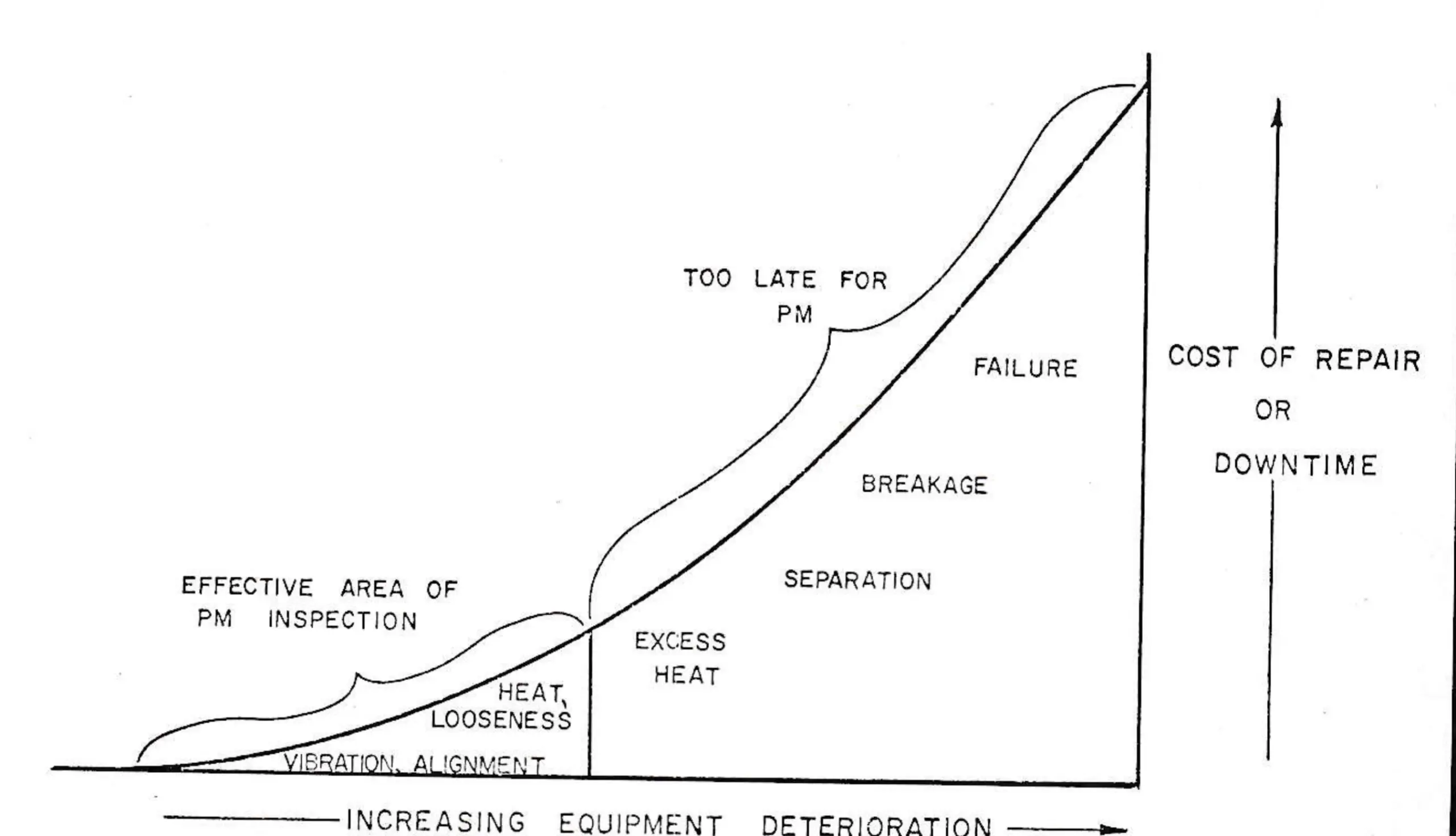
PM should be “detection oriented.” That is, the principal objective of a program should be to actively seek problems and correct them before they produce a crisis. This “detection orientation” is the principal means of converting a potentially costly emergency into a much less expensive scheduled reapir. (Figure 1).
Smaller ski areas usually have maintenance crews who serve in many capacities. The establishment and carrying out of a planned PM program allows them to make the best use of their limited labor resources.
Developing a Workable PM Program
The development of a PM program requires a close evaluation of maintenance needs. Typical questions that should be asked include:
- What kind of lubrication service is required for each ski lift? What are the lubrication needs of other equipment?
- How often should the lubrication service be performed?
- How many manhours does each service take to perform, including travel time especially to remote lifts?
- Can inspection, lubrication, adjustment and small repairs be combined to reduce service time?
- Can lift operators or vehicle drivers assist by performing simple checks and inspections then reporting the results?
- Can special testing devices be used to speed the inspection or warn of impending problems?
- What should be done with the results of the equipment inspection to ensure corrective actions occur?
- How many manhours are required to support the total PM program?
- Is there a record of past repairs, adjustments or equipment modifications kept to guide the inspectors?
- Does such history reveal chronic, dangerous problems?
- Who records such history? Who reads and analyzes it to find the problems? Is it being kept on file to ensure compliance with safety requirements?
As the program takes shape more specific details of items that are to be checked, serviced and adjusted must be listed. These are provided for by using a written check-list. Since there are stringent safety requirements, especially for ski lifts, the checklists should include specific corrective actions and signatures of personnel who perform the work.
PM inspections must not be sidetracked by allowing major repairs to be made where only inspection was intended. The great temptation of mechanics is to attempt to fix everything they can while they are “inspecting.”

The intent of an inspection job is to examine, service, adjust and then report major repair needs. Many jobs are beyond their capability to repair alone. Often a crew is needed.
There is the classic story in industrial maintenance of the inspector who attempted to repair everything he found as he went. Each week as his supervisor reviewed inspection results he noted that 90 per cent of the reported deficiencies occurred on the first 15 per cent of the equipment inspected. Few, if any deficiencies were reported on the remaining 85 per cent of the equipment. To test his worst suspicions, the inspector was instructed to run the inspection route backwards. As expected, the bulk of deficiencies were now reported on the last 15 per cent of the equipment. The inspector had inspected and repaired about 15 per cent of the assigned equipment and ran out of time — “overlooking” the remaining 85 per cent.
Winning Operators and Mangement Support
The best way to win the support of operators is to have them participate in the PM program. For instance:
- At the start of a PM inpsection or servicing tell operators what maintenance intends to do. Then, ask them to describe any special difficulties. Use their advice to help find specific problem areas.
- At the completion of the service or inspection, report what has been done or what has been found. If a problem was corrected tell them. If a repair is needed tell them about it also.
These simple actions can result in solid operations support for the PM program if done conscientiously.
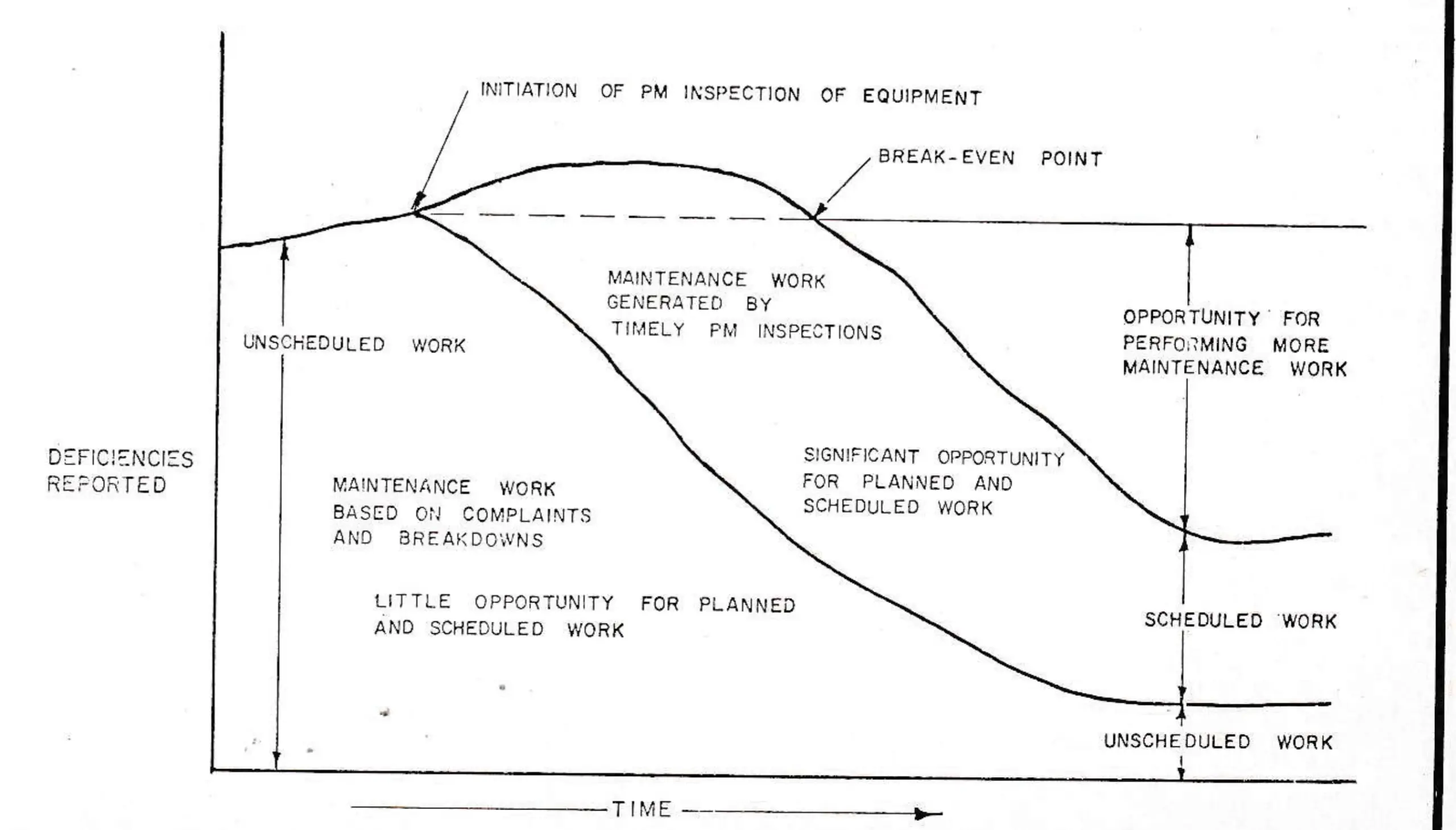
While management may see PM as a panacea for its equipment problems, they sometimes do not understand how it should be used. Yet, their education is necessary to gain proper support for the program. Management must be made aware that a PM program will initially require a greater effort and perhaps extensive maintenance manpower. They must also be aware of the ultimate benefits of the program. (Figure 2).
Before the program is launched the maintenance supervisor should seek and obtain the support of management. He must be able to clearly demonstrate real benefits of doing PM. Management must support PM actively.
Then, when the program is launched, the supervisor must obtain the support of operators, drivers and operations personnel. They are important, necessary supporters of the PM support.
Human lives depend on a quality effort made to ensure that ski areas operate safely. The PM program provides an organized approach to ensure that this happens.