


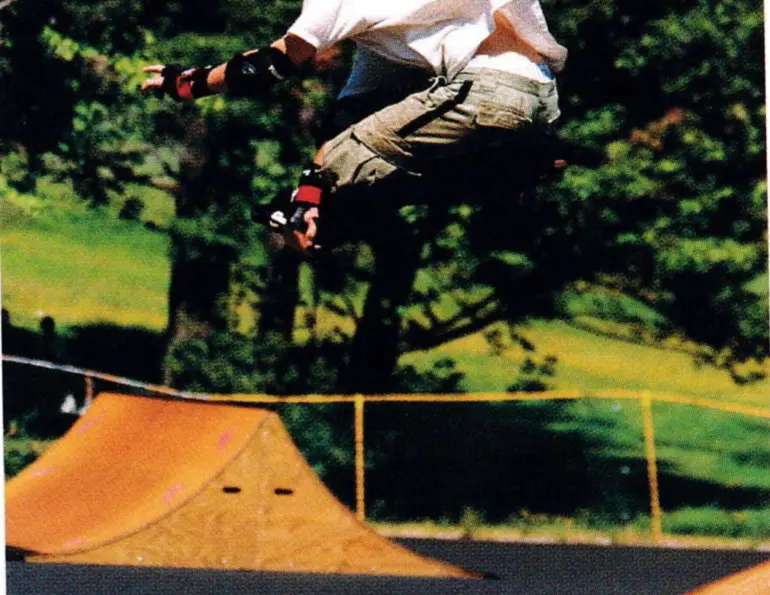
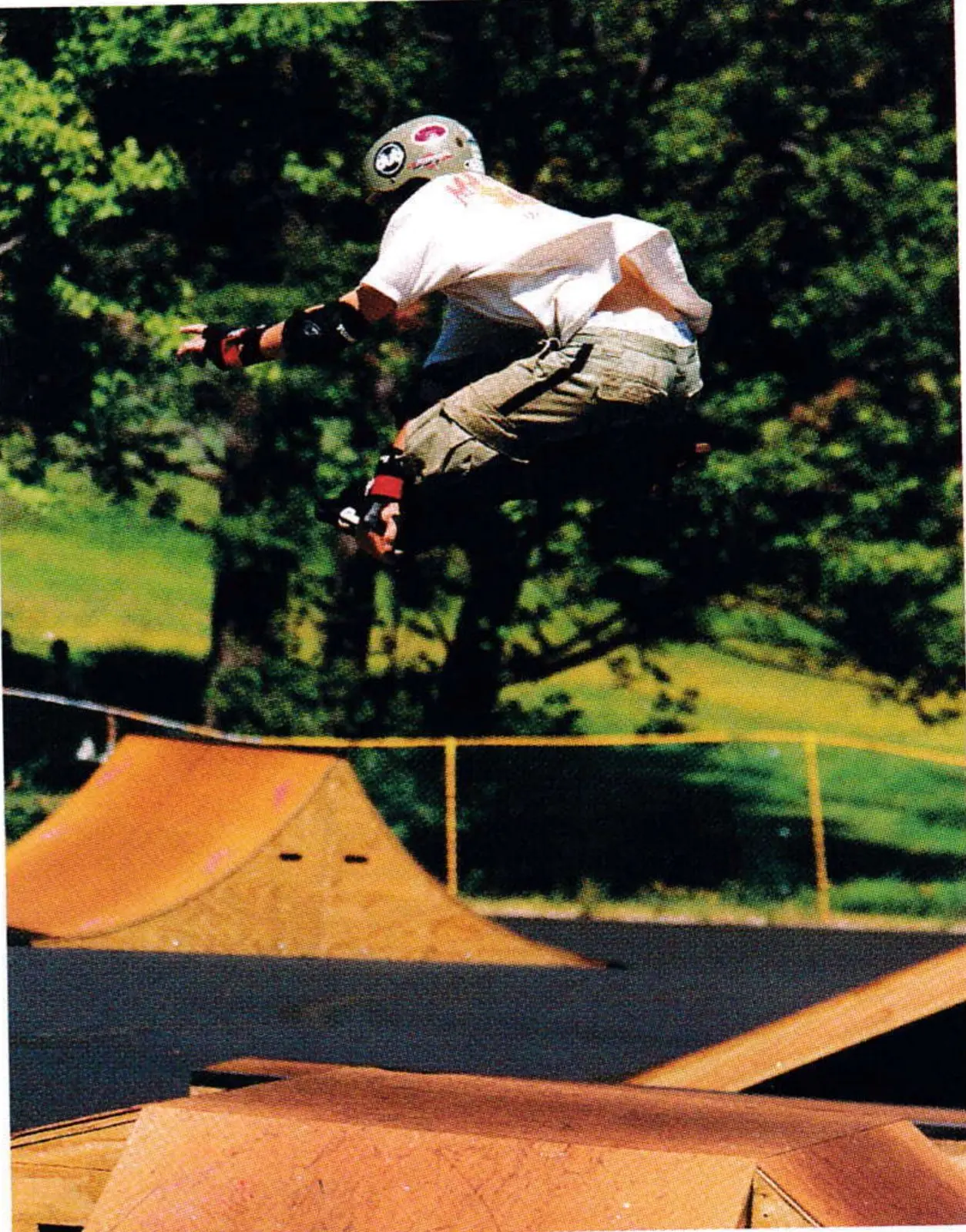
Photo by Sierra Photo, Mount Sunapee
Though the area doesn’t generate the number of summer visitors that frequent the White Mountain region or lower Vermont, nearby Lake Sunapee gets its share of summer-fun seekers and creating a skatepark was a project designed to increase summer traffic at the ski area.
Because we were starting with only a section of empty asphalt, the first question we asked was, what kinds of structures should we build and how many? Several trips to the local skateparks did more to show us what we didn’t want to build than what we did. Typically these parks turned out to be one-hit wonders, built of untreated lumber and plywood that was warping and creating more trouble than fun for skateboarders and inline skaters.
Some initial research on the Internet gave us an idea of what a hot skatepark looked like. But some looked too big, too expensive and didn’t answer the basic question: how much do you need to start out? After all, this was our initial foray and we weren’t competing to host the summer X-Games … yet.
Our questions led to ZeroGravity Designs in Rutland, Vt., and Frank Sparrow. Sparrow, who has been designing and building skateparks and their features for several years, initially met with us in March of 1999. He provided several design options to appeal to all skill levels and we contracted with him to build the original structures for the skatepark. Our directions were that there had to be enough variety in features to create a skatepark that would remain interesting and keep kids coming back for more. To do this, Sparrow decided to divide our park into two parts, placing hits for intermediates on one side and smaller ones for novices on the other, allowing skaters to cross back and forth.
The structures for the intermediate side of the park included:
- a quarterpipe (6’6″ high by 12′ long)
- a slant wall (7′ high by 8′ wide)
- a pyramid (3’6″ high, 24′ by 13′ base)
- a corner elbow (6′ high with 12′ by 12′ corner bases)
- a spine (3′ high by 8′ long with rail)
- two curbs
- two freestanding rails
The novice structures included:
- a quarterpipe (3′ high by 8′ long)
- a slant wall (3’6″ high by 6′ wide)
- a slant wall (2’6″ high by 4′ wide)
- a fun box (4′ by 4′ table top with 2-foot launches and flat walls)
The features were placed, according to Sparrow’s layout, on a relatively level area that measured 100 feet wide by 120 feet long in the corner of our asphalt parking lot in the summer of 1999. The new skatepark was fenced off from parking and striped to subdivide it into the novice and intermediate sections.
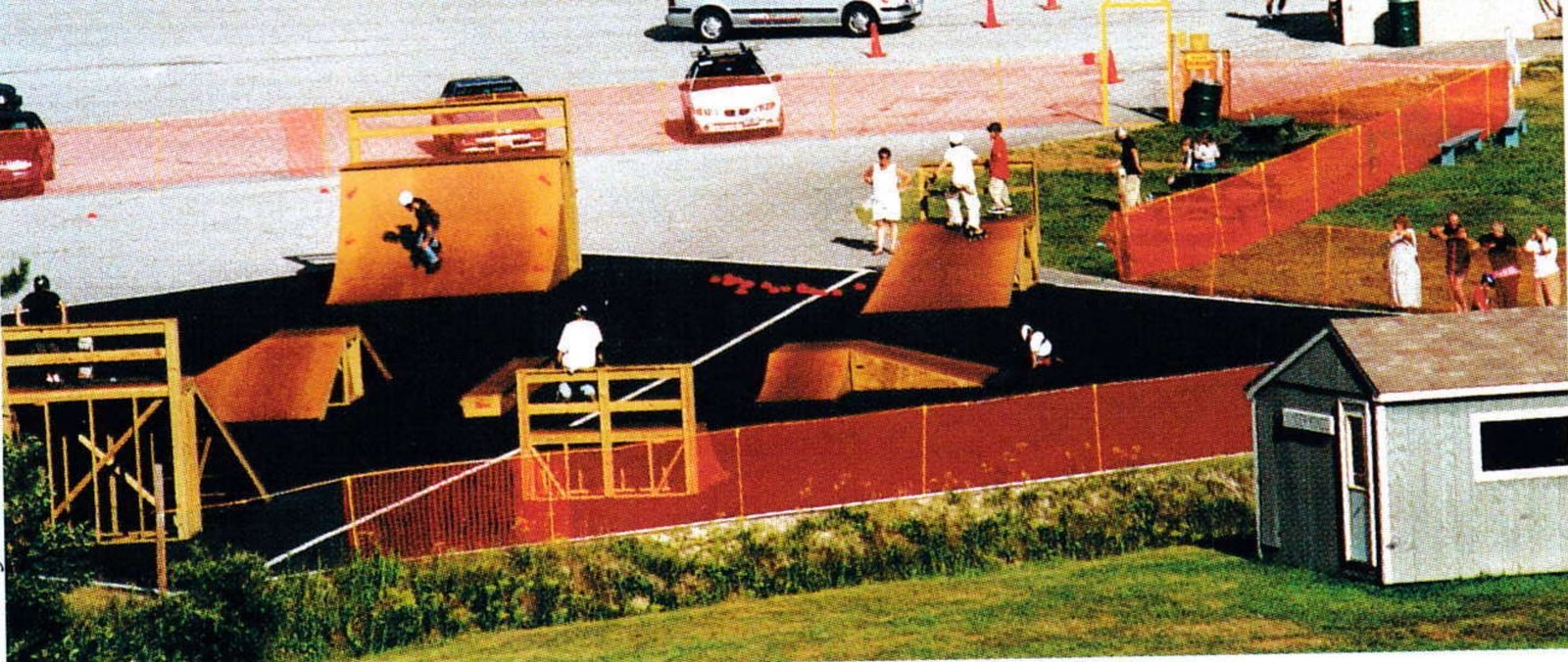
Photo by Sierra Photo, Mount Sunapee
All the structures were built from pressure-treated lumber and plywood for longevity. (All structures are stored on a flatbed trailer under tarps in the winter.) The decks and transition ramps are a plastic composite material similar to the facing on concrete forms. In skate-park speak, the material is called skate-lite and is smoother, faster and wears longer than pressure-treated plywood. It is also four to five times as expensive, selling for more than $100 for a four-by-eight sheet.
Keeping Customers Satisfied
The first year investment in the skatepark was roughly $25,000, covering materials, design work and labor. From opening day, it seemed the expense was worth every penny because the park was an immediate hit. In addition to season passes, we sell several ticket options such as one-hour, two-hour, half-day and whole-day passes. Both skateboards and inline skates are allowed, but bicycles and scooters are not. The comfortable carrying capacity is about 30 to 35 kids.
During that first season, we kept a running list of improvements to be made. Aside from small things, the overwhelming request from local skaters was the addition of a big halfpipe.

Mount Sunapee staff built the halfpipe on-site for about $6,000, with designs gathered from the Internet. It measures 32 feet long with a radius of nine feet from center to the decks. It has two deck heights of nine and six feet to serve both intermediate and advanced skaters. Due to the significant cost of the skate-lite material, the halfpipe decks were covered with 3/8-inch AC plywood treated with linseed oil. After one season, the skaters have accepted the halfpipe with minimal complaint about the decking material. More important than the surface appears to be the quality of the design of the halfpipe and the fact that such a large one exists in the area.
We built the halfpipe outside the existing skatepark, effectively increasing the facility’s capacity by more than just the number of pipe skaters. Now, a significant number of spectators gather to watch the kids perform. A picnic table was placed next to the halfpipe for spectators and kids waiting their turn. The capacity of the park is now 45 to 50 kids.
The big pipe also provides the skatepark a completeness that was lacking in the first year. Now there is clearly a novice area, an intermediate area and an advanced area.
Another significant improvement over the first season was the re-surfacing of the asphalt pavement with a green acrylic material similar to the surfaces of many asphalt-based tennis courts. The acrylic material is harder and faster than asphalt, smooths out irregularities and also reflects much more sunlight, keeping the surface cooler. Two coats of the acrylic surface were applied by our staff at a cost of about $1,500.
Season passes for the second summer of operation were offered at $79, sales of which increased dramatically from the previous season, probably because of the addition of the halfpipe and the acrylic coating. Tickets for one hour were $5, a two-hour ticket was $7 and half-days were $10. The one-hour and two-hour tickets are the biggest sellers. In the first season we sold a total 1,162 tickets and saw that increase to 1,602 in the second summer.
We also offer rentals, pads and helmets at the skatepark through a leading local ski shop, Bob Skinner’s Ski & Sports. We require skaters to wear helmets and strongly recommend they wear pads, in addition to collecting liability releases. Mount Sunapee and Bob Skinner’s are now partners in the daily operation, with Skinner supplying teenagers who supervise park activities in exchange for rental earnings. Most of the casual skaters require rentals in addition to admission tickets, while most of the skateboarders own their equipment.
Admission earnings are not significant, but are viewed as one of many revenue components in our summer operation. We do know, however, that earnings from the skatepark will pay for its accumulated capital costs in three years, including improvements we foresee this spring.
The skatepark has quickly become a fixture in the community as a safe location for local youth to have fun and expend energy. We are not sure who likes the park the most: the kids who can’t wait to be dropped off or the moms who get a couple hours of freedom.

