


Vail Associates, Inc. announced recently that future design limitations at Vail would set “design day operating capacity” at 11,000 skiers. In their shareholders’ report they define “design day” as the average number of skiers on 30 peak operating days. They go on to say that this “design day capacity is based not only on lift and trail capacity, but also is a measure of the quality of the skiing experience including such subjective criteria as snow coverage and length of ski lift lines.”
A ski area’s “comfortable” capacity or “design day” capacity or “skiers-at-one-time” capacity is a critical judgement factor in the physical and economic evaluation process. We, in the ski industry, know well the fallacy of believing our area capacity is the sum of each lift’s uphill capacity, a concept over publicized by well-meaning promotion departments. However, we are just now beginning to educate the politicians, bankers, regulatory authorities and investors to the true significance of “capacity.”
I prefer to look at capacity in terms that will isolate the critical design parameter. Therefore, since we can build more lifts or larger day lodges, the finite limit at a site is generally the extent of ski terrain and the constraints to access.
Let us review a typical situation to illustrate the various numbers currently accepted and the logical planning procedure. Two examples should demonstrate the various critical judgements required. First is a site in the remote regions of the Rockies where nature has provided vast reaches of mountains, a super abundance of snow and long winters. Second is a site in mid-America where population densities are at a peak, hills at a premium, and winter an ambivalent season.
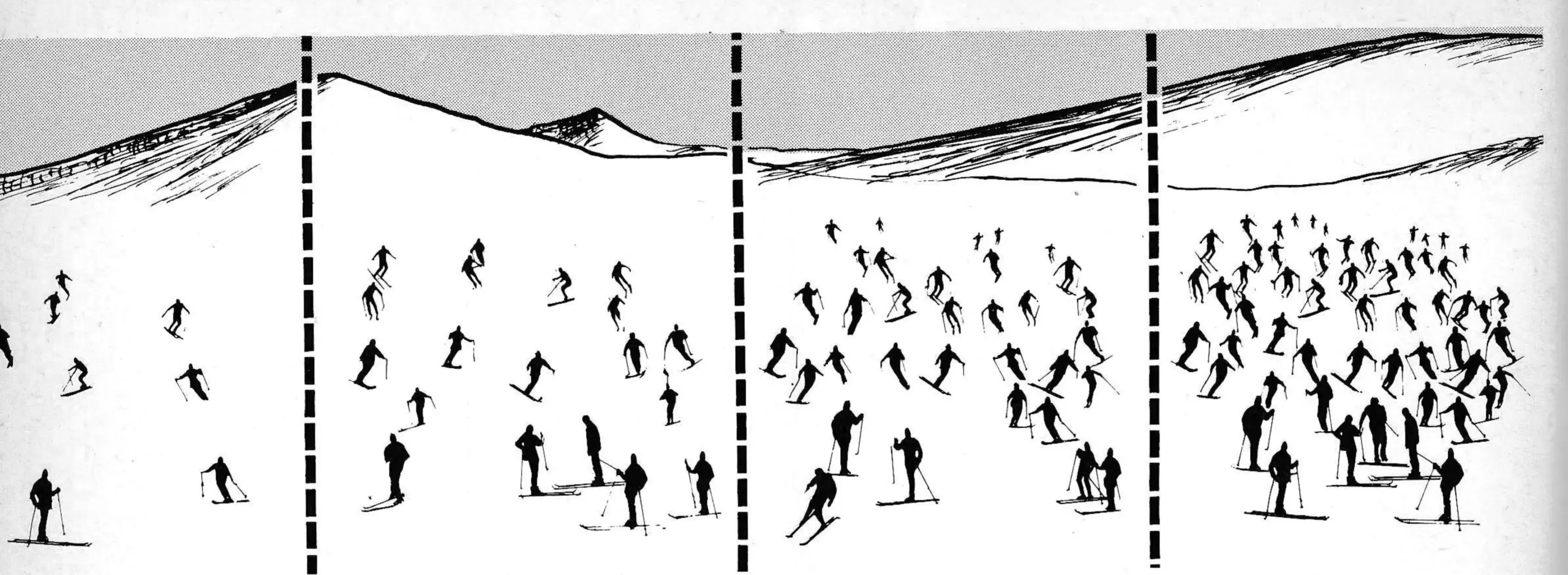
The key parameter in establishing a ski site’s capacity is determined by measuring the appropriate skier density per acre of ski slope or trail. This judgement is some function of the steepness or grade of the terrain, slope and trail design, quality and quantity of the snow cover, extent of snow farming, and the skill level and expectations of the skier market. Acceptable densities vary from 100 skiers per acre on flat, mid-America novice terrain to 5 skiers per acre on steep, powder, expert slopes at destination ski resorts in the West.
A technical note here will have us all viewing this density in a similar manner. Average density means only one half or thereabouts are actually on the slopes at one time as the other half will be in line, in the day lodges or riding up on the lifts. Here is a typical situation.
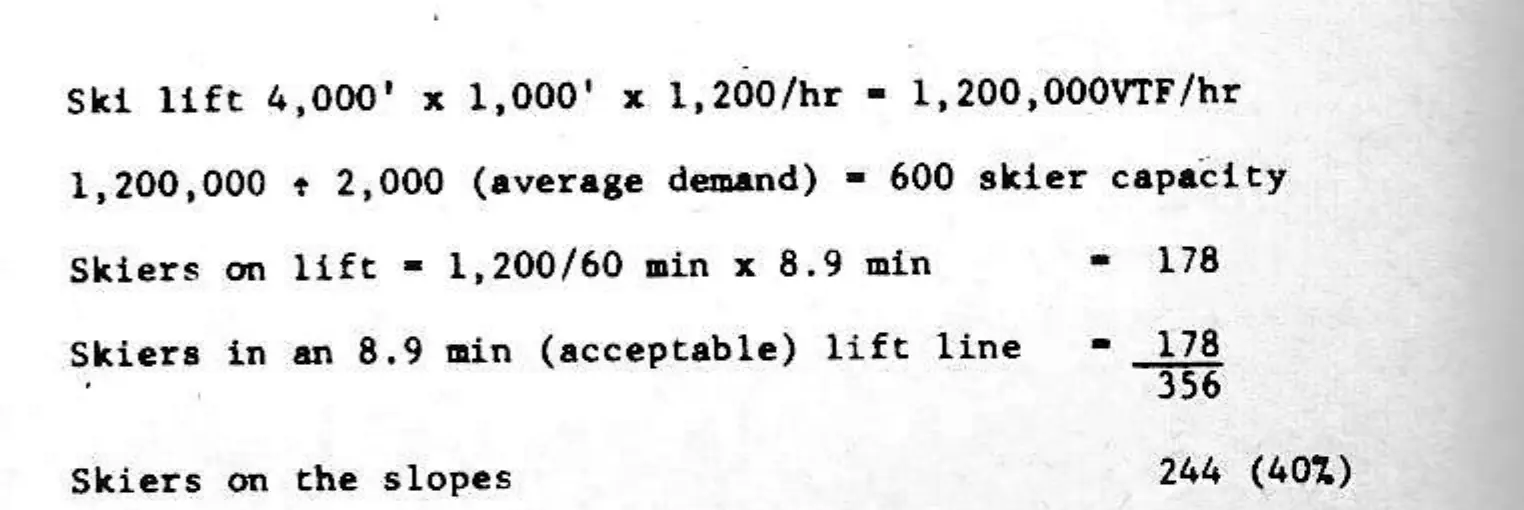
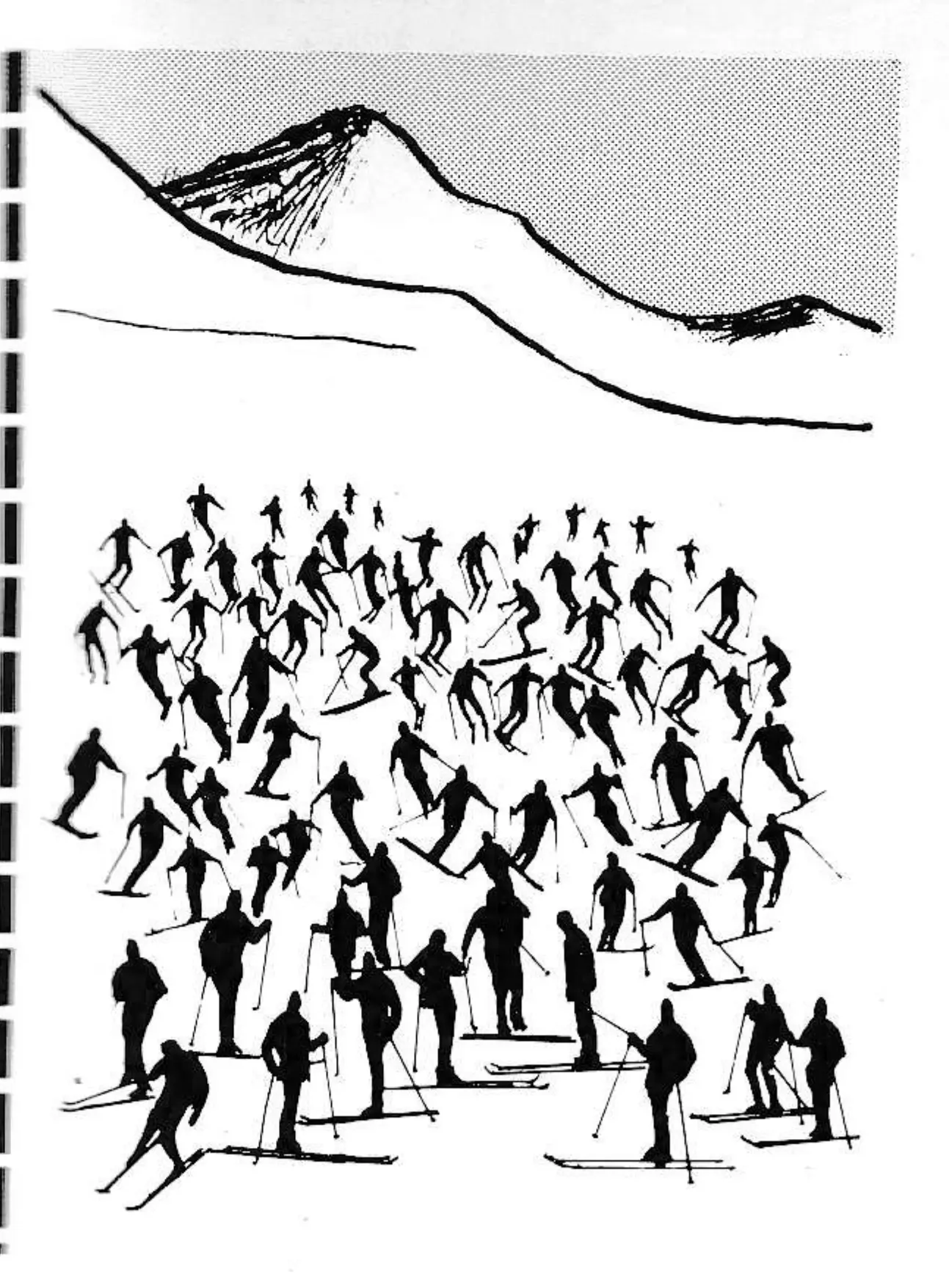
When facilities are designed for expert skiers and operated at capacity, even fewer are on the slopes at one time while beginner areas see greater proportions.
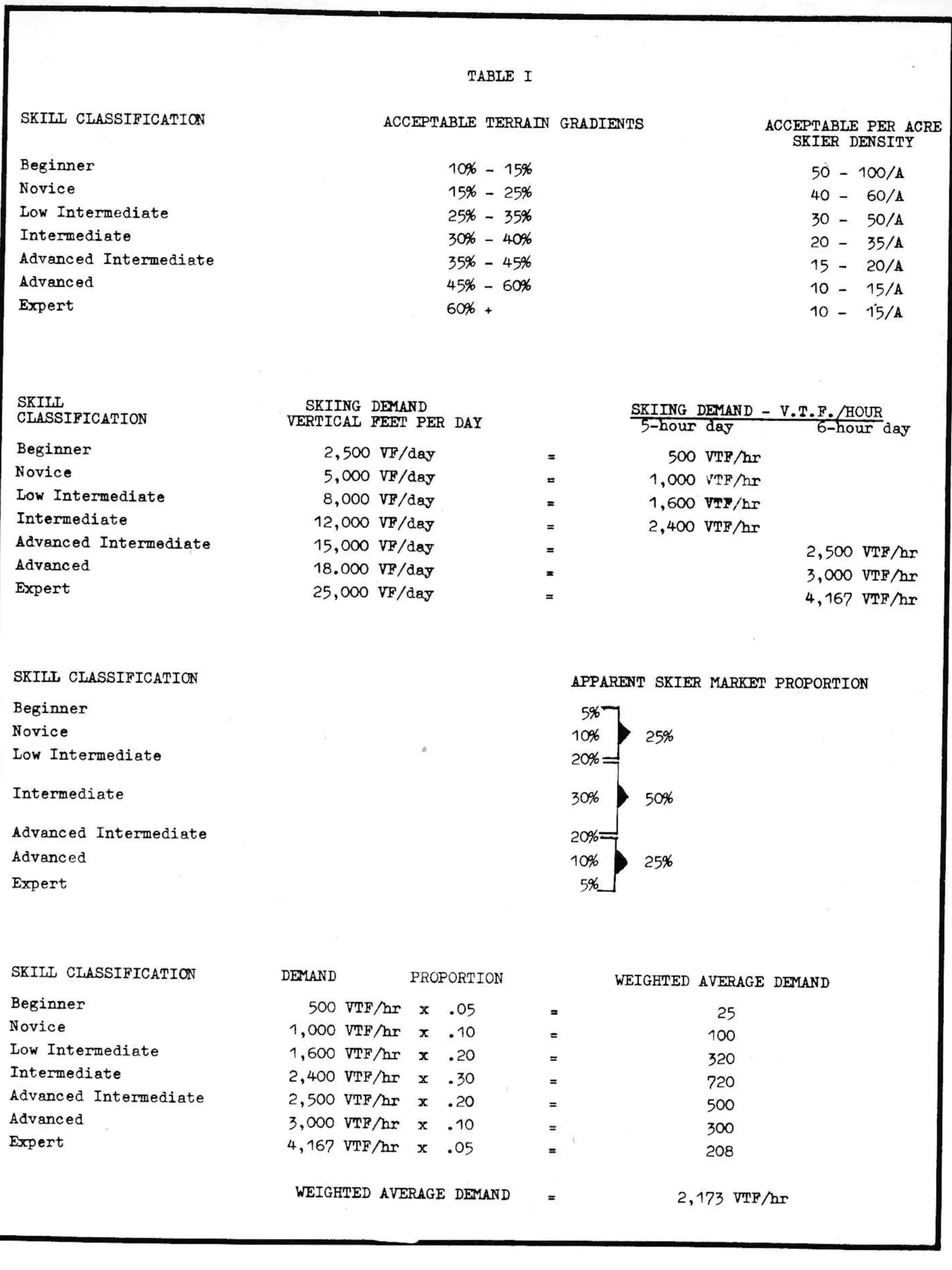
Table I summarizes design standards to then be applied to each situation as determined appropriate. We may now apply these tools to the two situations described earlier.
First, the remote site in the Rockies. Here the problem is not so much determining how many skiers the site will hold as it is to set capacity criteria based upon other factors and to evaluate the site’s ability to meet these requirements. This remote site will probably succeed only as a major vacation destination resort because by definition it is a large mountain at great distance from population centers. Skiers seeking vacation destinations are searching for a variety of skiing experiences and dependable snow cover and surface conditions. They also want a place where there is some night life and where they may meet and socialize as well as ski. These skier market expectations set the basic planning parameters. The site must have at least 200 acres of potential ski slopes and trails and preferably double this. This terrain must contain a variety of grades grouped to allow the development of ski lift and trail systems designed to serve the expected skier vacation market in proportion to their skill levels. A final limiting parameter is access, meaning access to the skiing from the village, restaurants and accommodations, and vice versa. Experience has shown that to expect more than 3,500 to 4,500 skiers to pass thru one staging-base area is to invite severe congestion and create a mob atmosphere.
To adequately develop 200-plus acres (at $1,000 to $2,000 per acre to construct) and provide the required night life and social atmosphere, this vacation ski resort must be designed to accommodate at least 3,000 and preferably 4,000 skiers. To be an economically feasible destination resort, capacity must be some 4,000. In developing the area design and laying out slopes, trails, lifts and warming centers, the developer now uses the capacity criteria and adapts it to meet his perceptions. Density may be pegged at the low end of the scale since there is probably some excess of terrain that can be opened without too much added cost and since vacationers are seeking less crowded conditions. Most current western resorts have very low densities in the range of 10 per acre. Lifts now can be located to serve the designed slope and trail systems by sizing each lift to provide the density desired on each lift-trail system. For instance, to serve three 10-acre trails of lower intermediate skill classification where the vertical drop is 800 feet will require a triple chair at 1,800 per hour to meet skier expectations and reach terrain design capacity.
Step 1 – 30 acres at 30 skiers per acre — 900 skiers (design capacity)

Step 2 – 900 skiers of lower intermediate ability demand 1,600 vertical feet of skiing per hour. 900 x 1,600 —1,440,000 divided by 800 available vertical feet, sets the required 1,800 per hr. uphill capacity.
Now lets look at the mid-America situation. Here demand is beyond the physical ability of the land to provide attractive skiing opportunities. The limiting factor is terrain, coupled with unreliable winter weather and a relatively short season. The developer must maximize available terrain since he will probably need to provide snow making as well as the typical lifts, parking, day lodges and trails. Here acceptable density will probably be set at the high end of the scale to create an economically feasible operation. Developments with as little as 30 acres of terrain support 1,100 skiers without detrimental congestion. Here the average skier will be satisfied with less vertical skiing per hour or day.
Table II summarizes specific site capacity and design parameters for the two diverse sites.
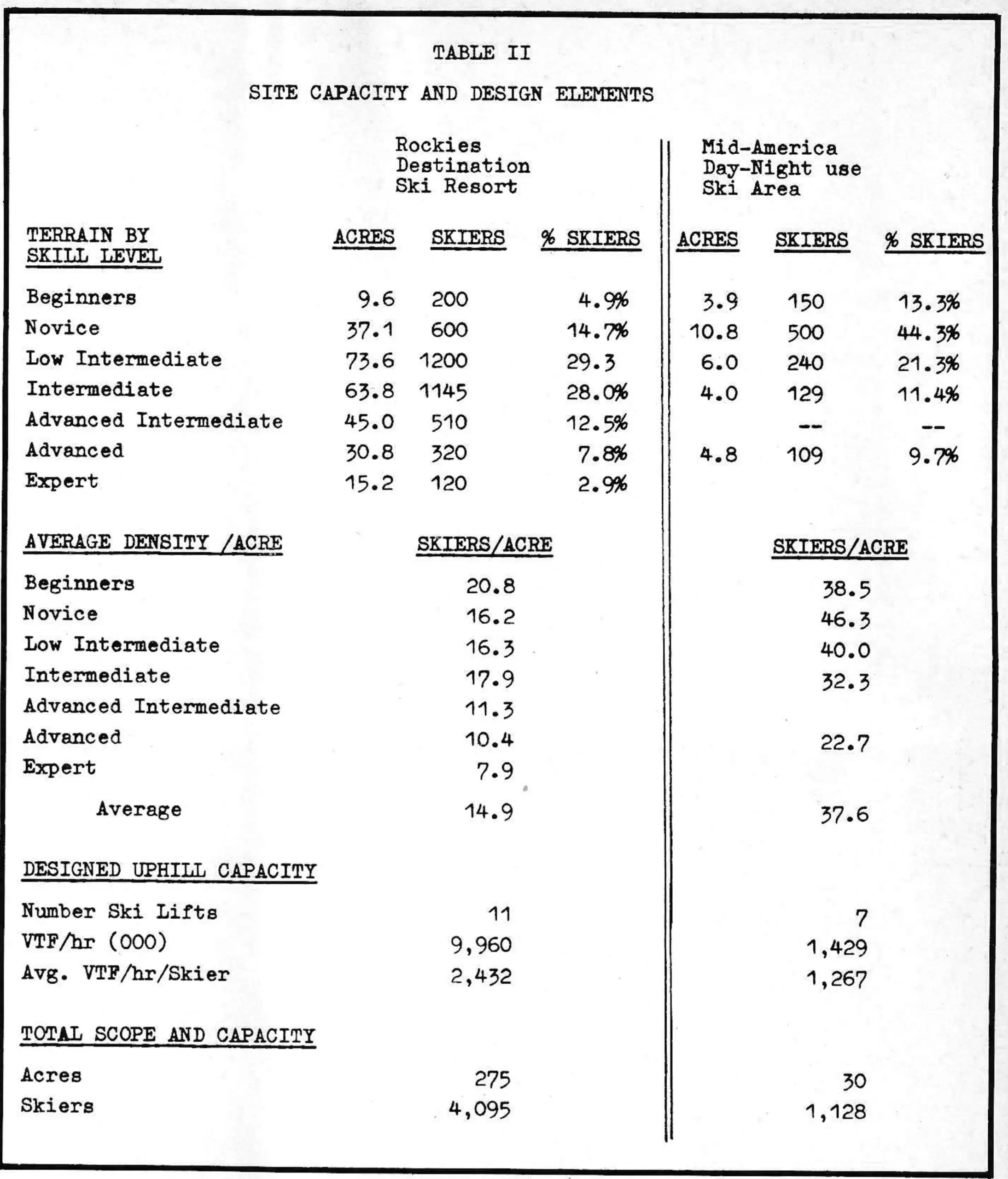
The second key parameter in the capacity formula is the anticipated skiing demand of the skiers attracted. The design standards illustrated on Table II show demand varying from 2,500 vertical feet per 5 hour day to 25,000 vertical feet per 6 hour day. While these measures of skier satisfaction are based upon observation, and work well when applied, they still are judgement factors and could change with the advent of better slope grooming, better ski equipment, and better physical conditioning. The latter is definitely a limiting factor. Even the expert skier will be satisfied with less vertical per day once he spends most of his working day behind a desk.
The apparent market proportion of skiers by skill level is the third key capacity parameter. Again, observation and market research support the bell curve distribution described on Table II. More research is needed to either support these standards or to revise them to more closely match the actual behavior of today’s skiers.
This exercise in juggling numbers is more than a parlor game. It is critical to the planners as they search for a balanced ski facility and one that will be economically feasible. Capacity is also of paramount importance in evaluating the probable environmental impact of a proposed ski area. Each ski area or potential site has one critical limiting capacity parameter and should be designed in a balanced manner to maximize the identified limiting element.
Polution, either air, water, noise, or people, has become an important parameter in some of the popular ski resort valleys in the Rockies. Where terrain, snow, and demand seem limitless this finite parameter has become an off-of-the-ski-hill criterion and must be fully as limiting as those here discussed.
A ski area’s capacity is a judgment figure based upon the elements discussed here. Whether the number is eyeballed or calculated, the key parameters are acceptable density per acre of ski slopes and trails, anticipated demand for miles or vertical feet of skiing, and the probable makeup of the skill levels of the skier market. The objective is to create a ski area where all facilities are utilized in a balanced way, the skiers are happy and the ski area is profitable.