

SKI INDUSTRY BOUNCES OFF BOTTOM
What’s the deepest recession experienced by the ski industry in the last 20 years? You might be inclined to say 1990-91. But it has been neither as severe nor as protracted as the three-year recession of 1980-82. And the good news is the industry now appears to have bounced off the bottom of the recent slump.
Despite lower attendance at the USIA Trade Show in Las Vegas, retailers who came did serious buying of skiwear and equipment. The same happened at the WWSRA buying show a month later in Denver. Suppliers were pleasantly surprised and upbeat.
Shops are lean on inventories, forcing them to restock. . . but not overstock. If consumers buy heavily next fall, retailers will have to rely on re-ordering to meet demand, or buy and trade in the secondary market to find product, or lose sales.
Even the longstanding market bane of world-wide over-production and over-supply may have eased: European factories are reportedly producing more conservatively and, following two excellent snow seasons in the Alps, there was strong buying demand by European retailers at the big ISPO show in Munich. The major flaw in the picture? Big unsold stocks of ski equipment are reported in Japan.
THE NUMBERS GIVE PERSPECTIVE
The recession of 1980-82 lasted for three entire seasons and was characterized not just by weak consumer demand, but also by huge unsold stocks of equipment, double-digit interest rates and falling skier-visits. The average annual value of ski imports for the three years was $29.8 million, which I calculate to be 20 percent worse than 1991, after dollars are adjusted for inflation.
In 1991, alpine ski shipments, according to Ski Business, fell to an estimated 763,000 pairs. But it was only one year and it was still above the average shipment level that prevailed over three years in the period 1980-82.
Even the slump in skier-days in the 1990-91 season — down to 46.7 million — did not match the three-year average of 45.9 million skier-days that I calculated for 1980-82. Poor natural snow conditions 10 years ago could not be overcome by the relatively small amount of snowmaking capacity at the time. And more areas were vulnerable: The business volume of 45.9 million skier-days, then, was apportioned among 150 more ski areas than operated in 1990-91.
Marvin Kottke is slated to present the 1991-92 numbers at the Orlando USIA convention. My guess is national skier-days will top 49 million. Late-season skiing conditions were excellent in many parts of the country. Meanwhile, if you think things could be better, remember how much worse they were.
DOES B.C. STAND FOR “BETTER CONCEPTS?”
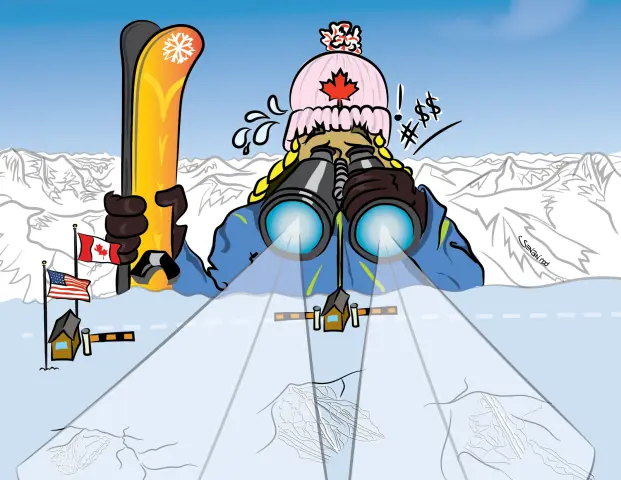
I recently spent two weeks skiing and traveling in Canada’s westernmost province, British Columbia. At Whistler, I saw a resort base as well conceived as Colorado’s Beaver Creek. (Aside from these two, no one else in North America is close.) Whistler’s plans will enable it to surpass Vail in beds within walking distance of the lifts and it has spectacular scenery and skiing (a mile of vertical drop).
Critics say Whistler enjoys a “socialist” advantage over U.S. resorts in getting government help and in compelling local businesses and property owners to contribute to the resort association. True. But part of Vail’s number-one status was achieved at the expense of unrewarded bondholders, and why shouldn’t everyone at a resort contribute to marketing? Take your pick of medicines.
Al Raine, an important figure in the development of Whistler, and husband of Nancy Greene (the first woman to win the World Cup), helicoptered me to a vast cirque, about 40 miles northeast of Whistler. Here, Raine hopes to build a new resort, Cayoosh. Lifted by the chopper, we made four 2,000-foot descents above treeline and through natural glades, skiing on creamy corn snow atop a hard base. (Eat thy hearts out!)
While Raine may not break ground on Cayoosh until the year 2000, the approval processes he faces at least are known and, once agreed, less subject to casual litigation than in the U.S. The B.C. government leases mountains for lifts and trails and allows the developer to purchase increments of base land at a pre-agreed price, as long as a pre-agreed resort master plan is followed.
FAT SKIS REVOLUTIONIZE DEEP SNOW SKIING
We drove inland to meet Hans Gmoser, founder of Canadian Mountain Holidays, world’s largest heli-skiing operator. Gmoser says he’s retired and been replaced by President Mark Kingsbury, but it didn’t appear to me he has slowed down. When I met Gmoser, he’d just come from Vancouver where he’s attempting to persuade the B.C. government to let CMH thin-cut timber and create heli-skiing glades, rather than uglify mountainsides by the customary clear-cutting.

I’ve said before that CMH, with only 30,000 skier-days annually, ranks among the top 15 ski areas in North America in revenues, and Gmoser never once worries that “the high cost of skiing” will limit growth. Proving that skiers will pay for quality, CMH is able to charge the equivalent of about $500 a day for a lift ticket.
Anyone planning to build a new ski inn or hotel soon would be willfully irresponsible not to take a week (cost $3,500 to $4,500) to heli-ski out of CMH’s new lodge in the Adamant Mountains. It is state-of-art accommodation, designed with virtually every skier-comfort and detailed wish in mind. There is nothing else like it in North America.
In April, I skied mid-winter powder in the Adamants on Atomic’s new wide Powder Plus ski, in a 180-centimeter length (equivalent in surface to a 215-cm. conventional ski). It makes deep snow skiing so easy I felt I was cheating. CMH and Mike Wiegele, another big heli-ski operator in B.C., believe the fat, short ski will open their market to thousands of lower-level advanced skiers who’ve found deep snow too formidable to handle. Both heli-ski operators expect to furnish two-thirds or more of their clients next year with Atomic or Miller “fats” or “modified fats.”
Not a bad idea, too, for performance rental shops at areas where deep or difficult snow prevails. Atomic is negotiating with Snowbird and others. (Purchase price in wholesale quantities is $254 a pair.)
FOLLOW-UP NEWS . . .
In the last issue of SAM, I reported a split over a Colorado program — separate from Bernie Weichsel’s SKI USA — to market skiing to foreign countries. Well, Colorado Ski Country USA has hired Carol Luther, formerly PR for the new Denver Airport, to be Director of International Marketing. The Colorado program will parallel SKI USA in selling to Europeans and Mexicans, but it will also take aim at Canada, which SKI USA does not do.
CSCUSA head John Lay is vague about how the two organizations will mesh, but says his new $150,000-plus international sales effort was inevitable because, without it, Colorado areas would not have been able to tap promotional dollars from the state’s Tourism Board and the Denver Airport for international marketing.
Seven of the ten major resorts in the new CSCUSA program belonged to Weichsel’s SKI USA last season, and four have said they’ll support him again. “One thing they couldn’t do was to force an either/or choice on Colorado areas,” says Weichsel.
Meanwhile, Colorado areas needn’t worry about losing rentable beds as a result of legislation that would have taxed casual owners of second-homes and condos as if they were hotel-owners. A bill to reclassify condos, rented more than 30 days a year, as commercial property was defeated in the Colorado Senate.
IS MT. ASHLAND A LESSON?
A couple of months ago, Mt. Ashland, Ore., looked like it would join the scores of small to medium-sized ski areas that have gone under in recent years. But the town of Ashland rallied to raise $1.6 million to keep it open. Without the area, school children and families would lack convenient daily skiing and many would likely have quit the sport. The ski industry should study the volunteer effort that halted the dismantling of Mt. Ashland’s lifts and the closing of the area.
SHORT SWINGS. . .
Does Steamboat’s former owner, Martin Hart, have a competitor? Kamori Kanko, which bought Steamboat from Hart, plans major investments, including two new high-speed quads, to increase volume. Hart, meanwhile, is attempting to develop nearby Lake Catamount, and recently allowed to the Rocky Mountain News that the Japanese are not interested in financing his project. . . Copper Mountain part-owner Peter Munk was recently ranked by the Financial Post as Canada’s highest paid executive in 1991. . . For a model of how to present your case to legislators and other influentials, write Joe Parkinson at Vermont Ski Areas Association (26 State St., Montpelier, VT 05601) and ask for a copy of his Winter 1992 Reports. . . Look for this filmed seqence to be shown over and over next season: Extreme skier Garret Bartelt fell 250 vertical feet down a chute and over cliffs, smashing into rocks, gashing his head and breaking his right leg in two places, during the recent, 2nd annual World Extreme Skiing Championships in Alaska.