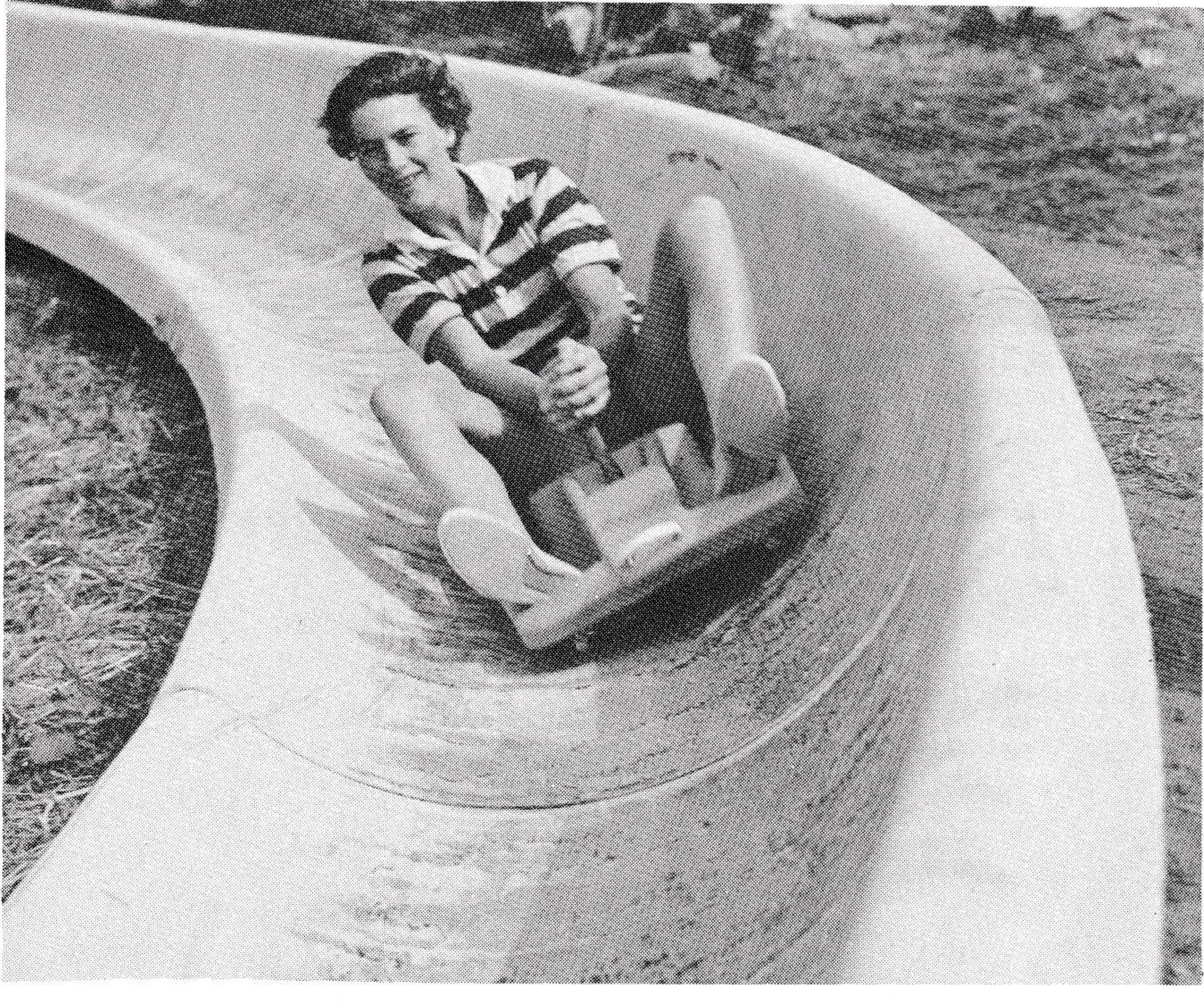
Thorne, president of the Mt. Attitash Lift Corporation which operates Attitash Ski Area in Bartlett, N.H., has good reason to be merry. His resort along with Bromley, Vt., Mt. Cascade, Quebec, Great Gorge, N.J. and Gatlinburg, Tenn., has installed the Alpine Slide. Its success was, according to Thorne, ” . . . fantastic. We didn’t pay for the whole thing in one year, but we did much better than we had antipciated.”
This phenomenan originated with Demag, a multi-million dollar West German firm. Thorne had traveled to Germany searching for a summer activity which would work for his area and which would pump the necessary cash flow into the business during the slack season. He had previously considered running chairlift rides or using the grounds for camping, but found fault with both. Neither brought in enough revenue, and the scenic ride already had competition from two other attractions in his own Mt. Washington Valley region.
When Thorne and his board of directors decided to proceed with the purchase of the franchise, he dealt with the American distributor, The Alpine Slide Corporation of Manchester Center, Vt. Total installation costs ran to $400,000, which included the site preparation and purchase price of the franchise, slide parts and sleds.
Attitash has dual slides, each 4,000 feet in length. The concrete-asbestos sections are purported to be extremely durable once in place. Thorne estimates a 10-year life span with an occasional section needing replacement. German winters, which are almost as severe as those of New Hampshire, haven’t caused frost cracking. The heavy duty plastic sleds are durable, and while the runners wear, they are meant to be replaced. The 250 Attitash sleds had new runners installed midway through the season at a cost of $5 per sled.
Financing for the slide was not easily arranged. Banks were extremely leery of this new idea, not wanting to lend half a million to an area that had had a difficult time staying solvent with its winter trade. Now, Thorne believes, “It’s definitely a bankable situation due to the experience factor.”
Attitash had to take out additional accident and liability insurance coverage, but the independent agent who handles insurance for the mountain charged a smaller premium for the slide than for skiing. The safety factor was good with no serious accidents. The few cuts and bruises were handled at a first aid room.
Support facilities include indoor and outdoor restaurants and a craft fair, which also boomed last summer. Thorne constructed 12 buildings to house a variety of craftsmen at work. The space was donated by the area, and payment was a percentage of the profits from sales.
Sanitary considerations created some initial problems. On a normal day 2,500 to 3,000 people were in and out. Thorne found he had to “do a little work” on existing units and open up additional facilities at the ski base area.

In contrast to winter business, which peaks on weekends and is slow during the week, the slide business is consistent. Located in a summer resort area, Attitash drew from a wider geographical area than the winter Massachusetts-Rhode Island crowd. Lift lines as long as two and a half hours were not uncommon, and the average at midday was one hour. Little was spent on promotion. Advertising was mostly word of mouth.
Taking the average summer week’s profits against those of a winter week, the slide came out ahead. From July 1 to October 24, 200,000 rides were sold at $2.25 for adults and $1.75 for juniors. Discount books of 5 and 10-ride tickets for both juniors and adults were available, and the tickets were transferable. Senior citizens over 70 rode free, and there were many geriatric dragsters. “We didn’t have an empty chair go up the mountain all season,” Thorne claims.
Is the Alpine Slide the answer to all areas’ summer doldrums? “Definitely not,” states Thorne. The proper location is a prime consideration. Either an area should be in a population center or in the heart of an established summer resort. Attitash has the added advantage of being on a major highway, and its slide is highly visible from the road.
The correct slope is another consideration. The ideal grade is from 15 to 18 per cent with a maximum of 20 per cent and a minimum of 12 per cent.
Proximity to another slide must be taken into account. The Alpine Slide Corporation determines eligibility of franchise based on population drawing capacity. A slide near a population concentration would have a smaller franchise area than a slide out in the country.
The factors have all come together at Attitash, and everyone has benefitted: the public through an enjoyable experience, the economy of the surrounding towns by year-round resident employment, and the area by a two-season income.