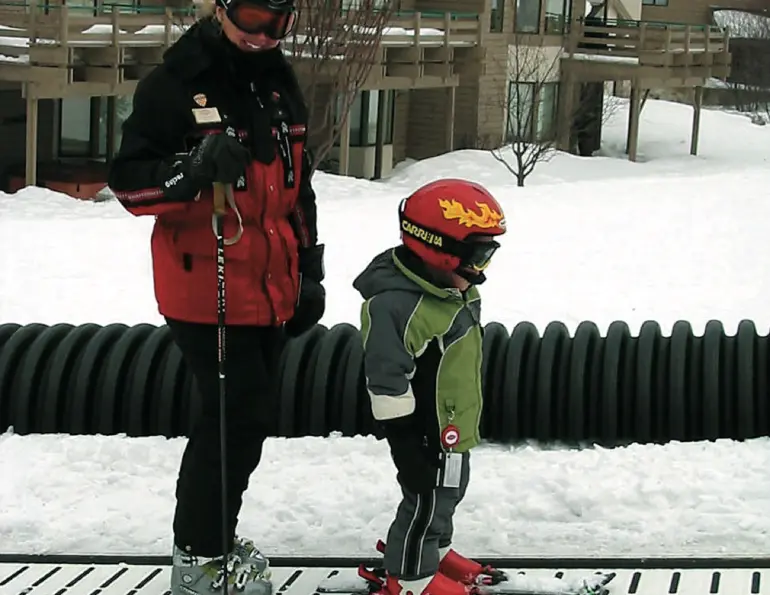
Last summer Mount Sunapee, New Hampshire, wanted to make its beginner terrain more user-friendly. It shaved five feet off the top of the slope, added it to the bottom, and replaced a handle tow with a conveyor lift. The handle tow was moved to a gentle grade for use primarily by adults, off to one side of the main learn-to area.
“It was a huge success,” said general manager Jay Gamble. “Learning skiers and instructors were very excited over how much better the complex functioned. The intimidation factor is greatly decreased due to the gradient reductions plus dramatically improved traffic flow.” Instructors, he said, experienced an “increased level of satisfaction” with the overall effect.
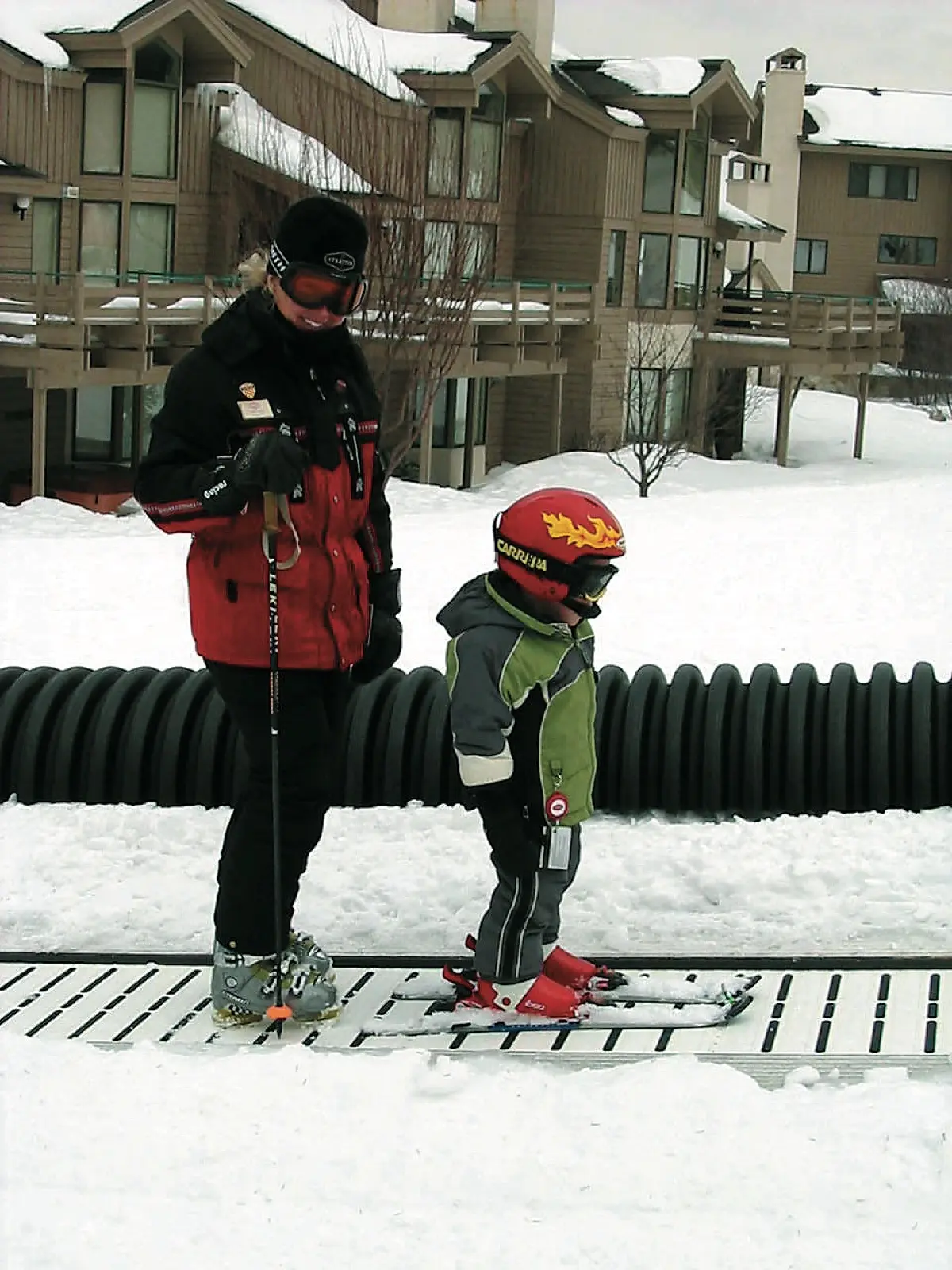
The conveyor lift and the reduced slope angle both had an impact on improving the first-time experience. The lift is a snap for everyone to ride; “the wire rope tow just couldn’t handle all the different heights and ability levels, especially at that grade [18 percent],” Gamble said. And adults appreciated the secluded handle tow slope, which reduced their anxiety levels.
Sculpting terrain specifically to suit the needs of beginners is catching on. Both Stratton and Killington are currently planning major renovations aimed at easing the beginner’s introduction to sliding. At Stratton, the plan calls for a complete makeover of the teaching terrain. The area plans to convert an open slope into three distinct trails, which will insulate beginners from cross traffic and other beginners. The trail designs refocus the students’ view to a portion of the trail and avoid the distractions of a wide-open area, keeping the experience within their comfort zone. Alois Lechner, the area’s 30-year veteran ski school director, predicts the changes “will produce happier guests who will learn faster, with less effort.”
At Killington, Jeff Temple, VP of mountain operations, said the area will quadruple its beginner teaching terrain and add another kid-friendly carpet parallel to an existing one. The area plans to double the width of an 8-percent slope and extend it uphill, eliminating an unused 14 percent grade. In addition, a handle tow is being relocated from a 14 percent grade to a new 8-9 percent slope. “This expansion should handle our expected growth for the near future and also provide our customers with a more enjoyable experience,” said Temple.
A Simple Equation
Often, areas don’t do enough to provide skill-appropriate terrain, and instead rely on whatever flattish terrain is available. Frequently, this terrain has too much pitch for beginners. The best ski instructors in the world can’t deliver the product if the anxiety level of their students is so high, that their students—our future—simply can’t progress from “never-evers” to repeat skiers.
So what do first-timers need? Security first and foremost. Somewhere between a 5- and 7-percent grade is a “no-push” incline where a skier pushes off and keeps moving, albeit very slowly. And that’s just about perfect: as the gradient increases, so does acceleration, speed, and yes, anxiety. A 10 percent gradient, in most cases, is too steep to conduct the first session. Just a few percentage points in grade can make an incredible difference in student comfort and anxiety level.
Second, it is extremely difficult to conduct classes in areas that aren’t insulated from other skiing traffic, even if that traffic is comprised of other students. Insulating students is not the same as isolating them. Never-evers want to be out of the traffic flow, but close enough to feel part of the action. Security and convenience also means knowing that restrooms, food and family are not far away. Proximity keeps anxiety levels reasonable and enhances the teaching atmosphere.
Third. What type of transport device is best for beginners: handle tow, platter-pull, J-bar, T-bar, aerial lift, conveyor or even the well-established fiber rope tow? Learning skiers and riders need something that is low, slow, easy to load and unload and provides some level of stability and security.
Physical Progression
Those, then, are the basic elements of learn-to terrain. Next, consider the physical progression offered to your learning skiers. Let’s assume that the learning skier has happily arrived at the ski school meeting place and been placed into the correct class of less than 10 people. Maintaining a secure and cozy feeling, the instructor guides his charges through a progression of gradients and on-snow experiences which allow the student to gain confidence while learning how to control speed and make simple turns.
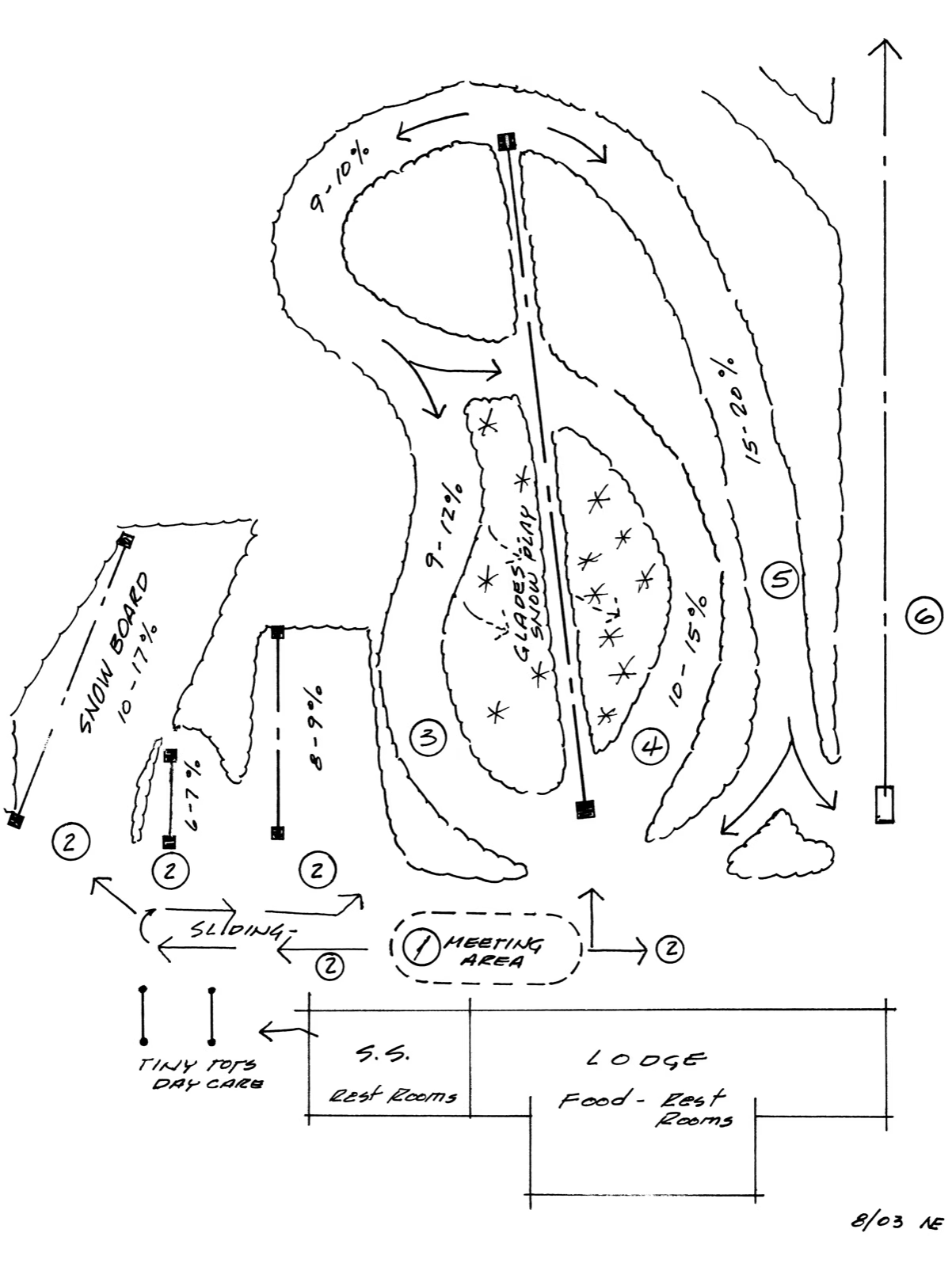
Assuming the students have all been checked for proper equipment and their boots are on the correct feet, their first experience is, logically, on a nearly flat surface for sliding and gliding. Adjacent to this insulated area is a slope where the gradients gradually approach 7 to 8 percent with a near-level runout that will slow our students to a gradual stop. This combination of grade and runout is critical; otherwise anxiety levels go up, skiers sit on the back of their skis, and learning stops. (Why do our students sit back on their skis? Because they are trying to control their speed—which, by the way, is your job). If, after a few runs, the newly inducted skier is wearing a smile and is actually poling in an effort to go faster (imagine that) the most important portion of the on-snow experience has been achieved: acceptance of the gliding feeling. Congratulations!
During these first moments, our beginner is probably checking out all of the more advanced skiers enjoying a ride up that conveyor thing. It looks really cool (no one is falling, the lift hasn’t stopped and the instructors are all smiling). This first lift should be at a gradient of between 7 and 9 percent and service a slope of 8 to 9 percent. The slope should be wide enough (50 feet or more is preferable) for practicing turns and long enough (125 feet or more, 250 to 300 feet is even better) to benefit from this new downhill experience. Again, a near-level runout space provides reassurance. Look for smiles and weight forward.
Progression to subsequent downhill skiing experience should be gradual. Ideally, the next slope or trail should offer an expanded experience on grades between 8 and 15 percent. This terrain should be insulated with no cross traffic or other interference and still be within a reasonable distance to the bathrooms and food. Properly designed trails and slopes up to 1,500 feet long can provide adequate time for an instructor to teach while not intimidating the learning student. A logical choice for uphill transport for this terrain is a low (no ski-under) and slow (275 fpm) aerial lift with a loading interval of 7.5 to 9 seconds. Please note, if an existing lift is stopping too often for misloads or unloads, that is not the skiers’ fault.
If you run a really classy operation, then the next progression will be to a trail or slope of up to 18 or 20 percent gradient with plenty of lower gradients in between. Also, there is a real benefit if this downhill experience is serviced by the same lift, as this reduces the stress and anxiety of negotiating another new lift.

Uplifting Thoughts
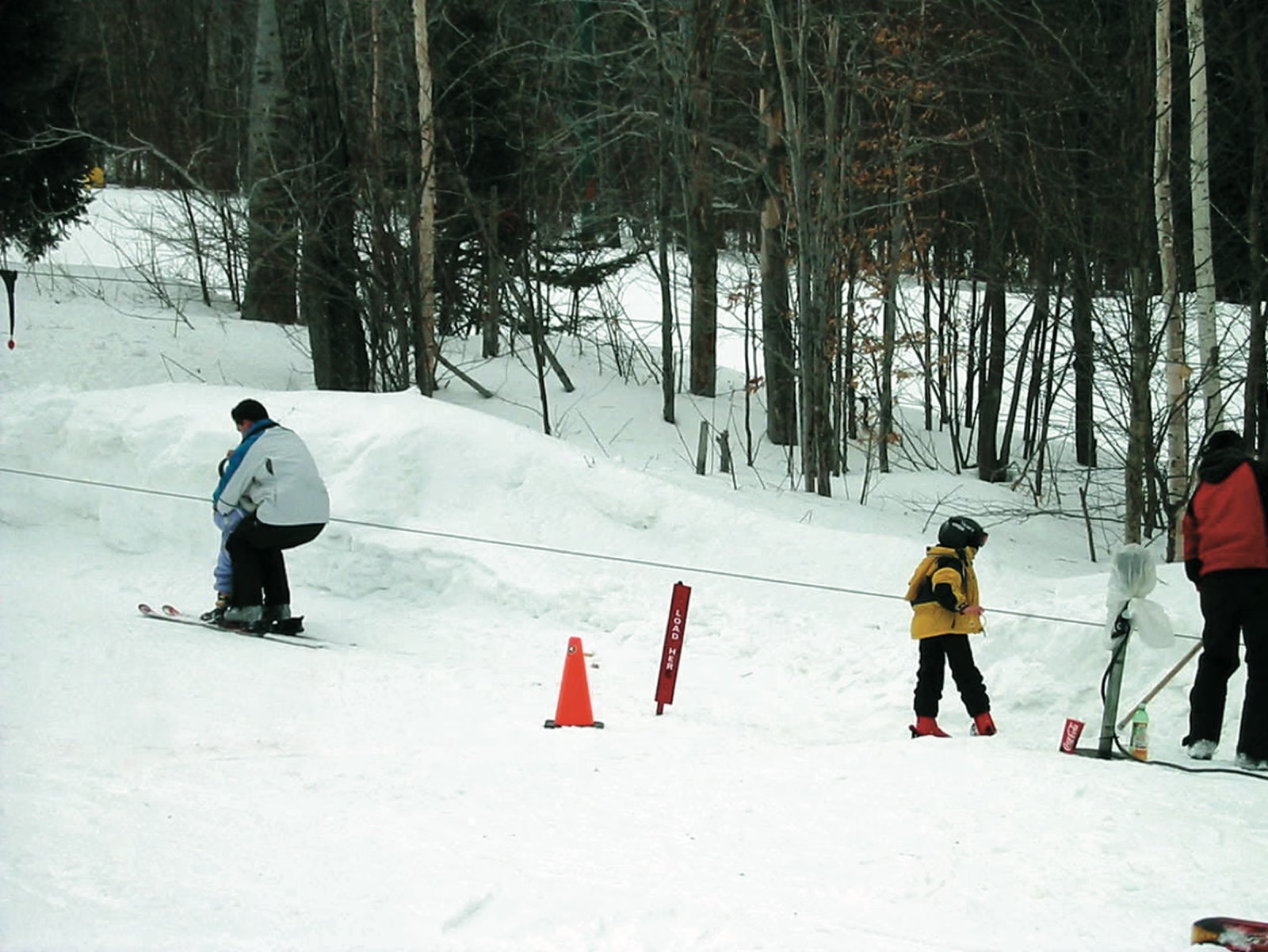
Which brings us back to the question, which lift is best for those first few rides? For many, many years, the fiber rope tow filled this need, and in many cases still does. In the early 70’s, the wire rope handle tow became the lift of choice for never-evers. Within the past 7 to 8 years, conveyors have gained favor for transporting beginning skiers.
Certainly, conveyors have their advantages. They maximize capacity and minimize anxiety. They are fun for beginners to ride.
Are conveyors the only answer for new skiers? No, the more common surface lifts will also work—if they are installed on an appropriate grade and the snow surface is reasonably maintained. No surface lift should be installed on a gradient steeper than the rider has proven she or he can manage. For the first timers, that means a gradient of no more than 8 or 9 percent. Plus, rope speeds ideally should be under 250 feet per minute (a slow walk).
But for high capacities, surface lifts just can’t compare to conveyors. The maximum design capacity for a lift with single riders is, practically speaking, 600 folks per hour (one every 6 seconds). But a more typically realized number is about 400 skiers per hour, or about an 8 second interval.
Conveyors, on the other hand, can easily accommodate 1,200 riders per hour. Skiers and riders always try to occupy the belt space available which, on the average, tends to be about a 5 or 6 feet spacing (for tiny tots it can be less). With a belt speed of, say, 180 fpm, a 6-foot spacing translates into 30 people per minute or 1,800 people per hour.
Of course, that capacity costs money. Wire rope tows (with variable speed) can be installed for about $30,000 if grading is minimal. A relocated platter or J-bar (T-bars are not beginner friendly) could easily cost $50,000 to $75,000. Fiber rope tows can provide a ride for less than $10,000 including equipment and shelter. Conveyors, for comparison, can cost $25,000 for 50 or 60 feet, and $90,000 for 300 feet.
All ski school operations can benefit dramatically from having the correct progression of slopes and lifts at their disposal. In addition, many times more learning skiers can be taught in the same space when the above guidelines are followed. More skiers equals a better bottom line. More happy skiers means more beginners will come back.
How Steep is the Slope?
Considering a beginner makeover? Factual data on widths and gradients is mandatory. Your design team should determine what gradients currently work best for the learning skier and then measure the width, length and gradient. Tape measures can handle the distances easily enough, and a clinometer is best for gradients. Find out what gradients your students are actually being exposed to. You may be surprised.
By far, the most popular and easy-to-use clinometer is manufactured by Suunto. Ideal for reading any vertical angle in degrees or percent, this small $100 instrument (www. forestry-suppliers.com) can be used summer and winter.
If you don’t find any 7% to 9% grades within your current teaching complex, either move to a place where they exist, or build them. How? Using another person as your target, have your assistant walk up the slope 100 feet or so. Align the reference line inside the instrument with the equivalent height from the ground on your target. Read the scale for percent. Let’s assume it is 13% and you want to build an 8% teaching slope. Subtract 8 from 13 and get 5% excess grade. Multiply .05 times the 100 foot slope length to get the number of feet (5) that must be cut from the slope at the 100 foot mark. It is that simple. If you’re feeling clever, you can remove 2 and 1/2 feet from the top of the slope and fill in 2 and 1/2 feet at the bottom to achieve the same slope angle. —NE