

- It is a flexible structural member capable of transmitting force in a straight line or around sheaves.
- It can be wound on a shipping reel to make delivery and installation possible.
- It possesses great strength and a long life when properly maintained.
- It can be spliced to produce an endless loop.
- It can be repaired in place to correct accidental damage suffered on the job.
- It is made up of many individual, cold-drawn, high carbon steel wires that are arranged in a precise geometric pattern that permits each continuous length of wire to assume its proportionate share of an imposed load at all times.
Like any other machine, wire rope must be lubricated on a regular schedule during its useful service life to insure that individual wires move freely against adjacent wires, and individual strands against adjacent strands. Lubrication also provides protection against corrosion. Considering the environment in which wire rope is used, the amount and cost of maintenance required is relatively small.
However, like any machine, wire rope will eventually wear to the point where the condition of the rope is no longer sufficient for safe, dependable operation. Normally, degradation that results from the accumulation of a great amount of work (ton-mile revolutions) is discoverable by a trained wire rope inspector following a well-planned program of periodic inspections and strict adherence to the requirements stated in applicable codes. The end point in the service life of a haul rope must never be assumed to be rope failure. Instead, it should be when degradation of the rope results in a loss of strength sufficient to reduce the designed factor of safety to an unacceptable level.
The importance of wire rope to the skiing industry is a fact. However, most users are unaware of how wire rope is made—knowledge that might be useful in making proper decisions concerning repair and replacement.
From Rods to Wire
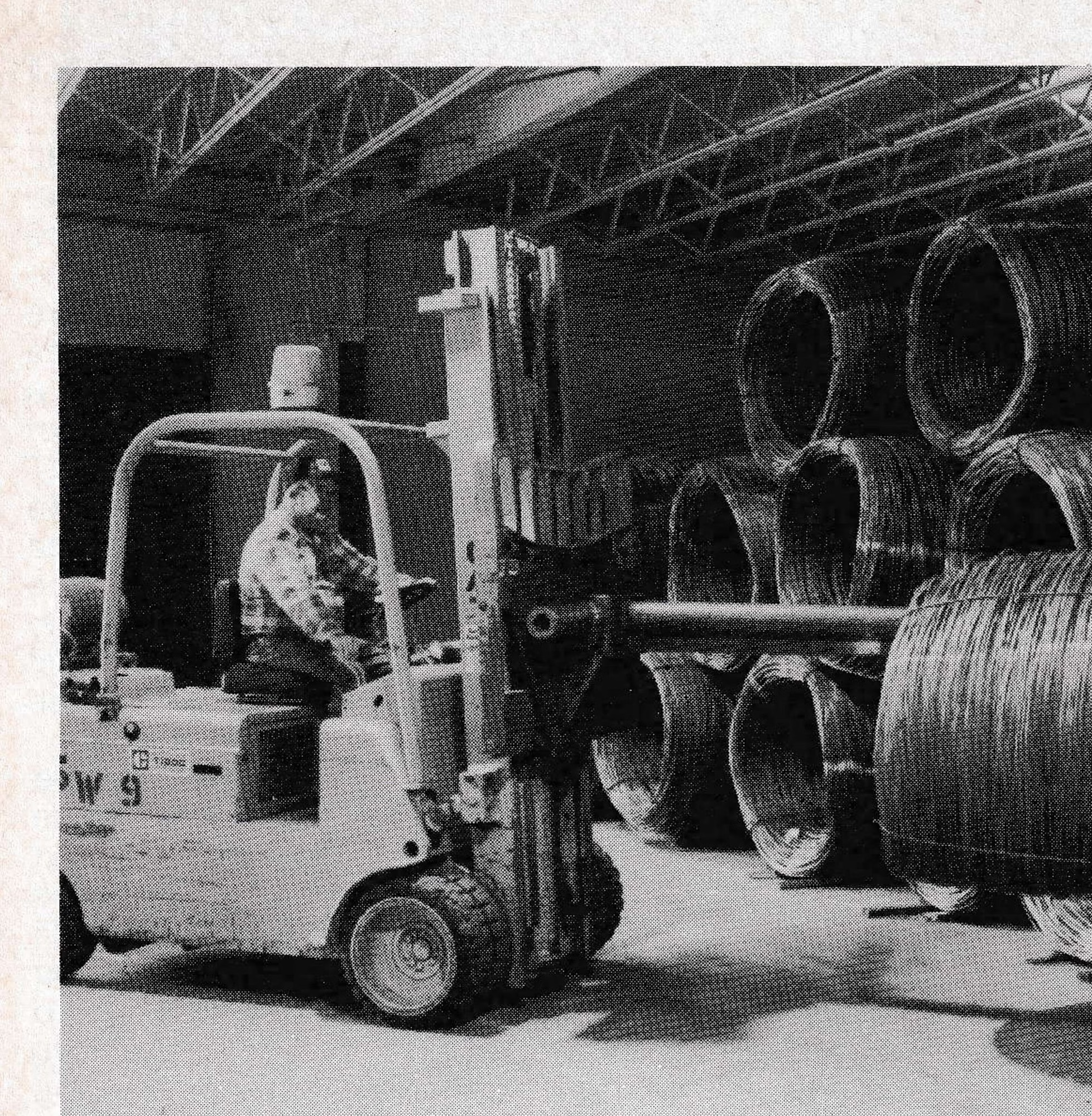
Wire production begins with large coils of high carbon, hot rolled, control-cooled steel rods. The rods, which are exacting in chemical and physical properties, are pulled through a set of mechanical descaling rollers that actually flake off any iron oxide scale on the rod’s surface. Following this operation, the rod is drawn through a series of tungsten carbide dies on a high speed “ripping” or “break-down” machine. This is the first cold drawing operation and is the start of the process of transforming the rod into rope wire.
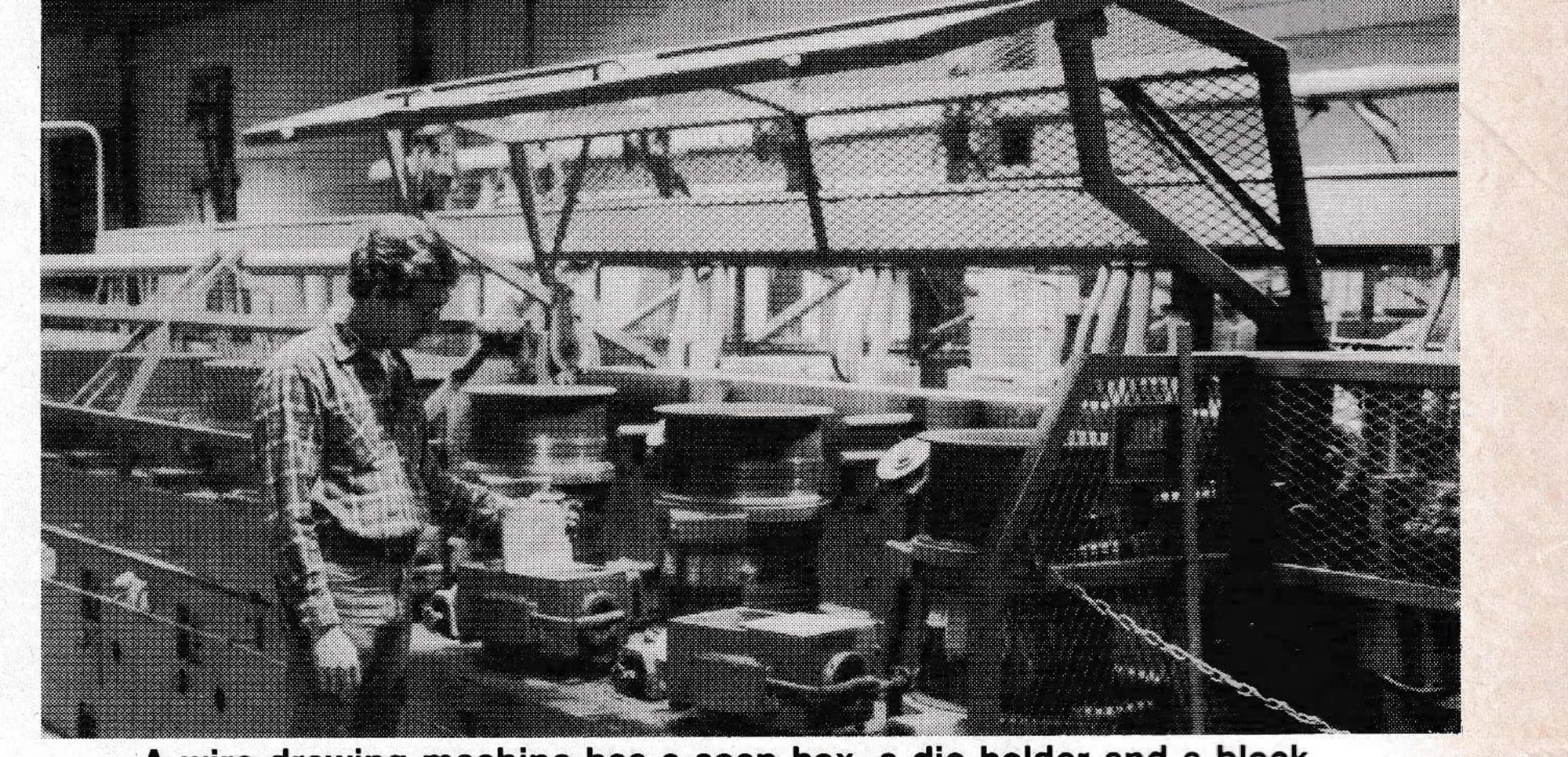
A break-down machine usually consists of a series of one to nine sets of dies and capstans or blocks. The blocks pull the wire through each successively smaller diameter die. Each block and die combination has a soap box in front of the die through which the wire passes as it enters the die. The box holds a specially formulated soap which acts as a lubricant to reduce the friction that is inherent to the drawing process. In addition to the soap lubricant, the dies are contained in a chemically treated cooling water solution which is continuously circulated to dissipate the heat caused by the friction of high-speed drawing. The same cooling water is sprayed on the inside of the hollow drawing blocks to cool the wire further as it is accumulated on the blocks before going on to the next successive die. Air is blown on the accumulated wire from the outside to help achieve the same result. The secret to drawing high-strength, carbon steel wire, and yet retain good ductile properties, lies in preventing the wire from heating up to a temperature that will cause embrittlement.
The semi-finished wire, now called process wire, has been reduced in size to a point where it is approximately 85 percent larger in cross sectional area than the desired final wire size. Samples of the process wire are tested in the wire mill’s quality control laboratory for tensile strength and uniformity in size to be certain that the wire is of the proper grade and suitable for use in producing the final finished wire. Every inch of the rod has had to withstand extreme bending while passing through the mechanical descaling rollers, so it already has been 100 percent tested for brittleness.
Before drawing the process wire down to the final size desired, it must be heat treated to obtain the necessary internal microstructure throughout. This heat treating of the process wire is called patenting and it is accomplished by running the wire through a controlled atmosphere furnace which heats the wire above its recrystallization temperature (approximately 1800°F) for a short period of time. Following this, the wire is quenched in a lead bath at about 1000°F before it is exposed to the ambient room temperature. All work-hardening resulting from previous drawing is removed by this process and the wire now has the physical properties required for final drawing. Every grade of steel has a specific strength requirement. For example, a typical 1078 grade has a tensile strength in the range of 170,000 to 190,000 PSI after patenting.
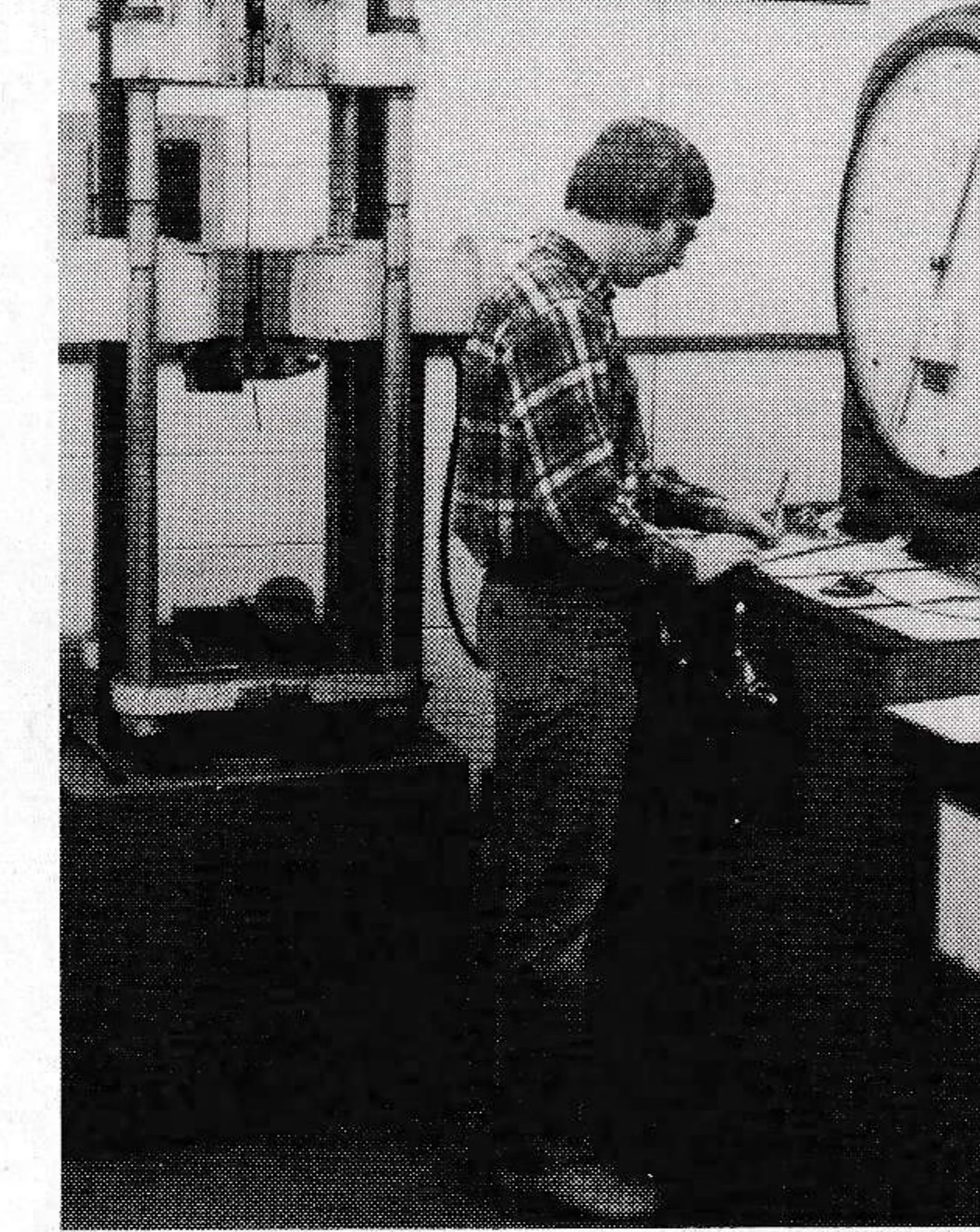
After the wire exits from the lead quench, it runs through an acid cleaning bath, fresh water rinse, neutralizing bath, borax coating tank and finally a drying oven before it is accumulated on carriers. Once again a sample of the wire is taken from every carrier for testing in the laboratory to measure tensile strength and ductility. These tests are made to insure that the patenting operation has been complete and proper.
The wire is now ready for final drawing. High-speed machines running at 2,000 to 4,000 feet per minute, depending on the size of the wire being drawn, are used for this operation. These machines, which have seven to 10 dies each in a series, are similar in design to the break down machines used earlier only they are faster. The wire coming off the finishing machines is wound on “bobbins” that hold the wire until it is used to make wire rope. Wire samples are taken from each bobbin and one last quality control check is performed in the laboratory. These test results as well as those from earlier tests are permanently recorded so that at any time, if necessary, each wire in a given completed wire rope can be traced back to the original rod manufacturer, and even back to the actual lot of steel used to produce the rod.

The finished wire, properly identified according to its grade, diameter, and manufacturing lot, is then stored in a heated indoor warehouse until it is required by the wire rope mill.
Making Rope
The types of wire rope constructions made vary in the number, size and geometric pattern in which the wires in each strand are arranged. For example, a 6X25 filler wire construction has 6 strands, each containing 25 wires. Each strand has a centerwire of one diameter and 6 wires of a second diameter around it. Six small filler wires lay in the valleys between these 6 wires. The outside layer of 12 wires are of a fourth diameter. The result is a very precisely fitted group of wires that form a round strand that is relatively flexible and yet very strong.
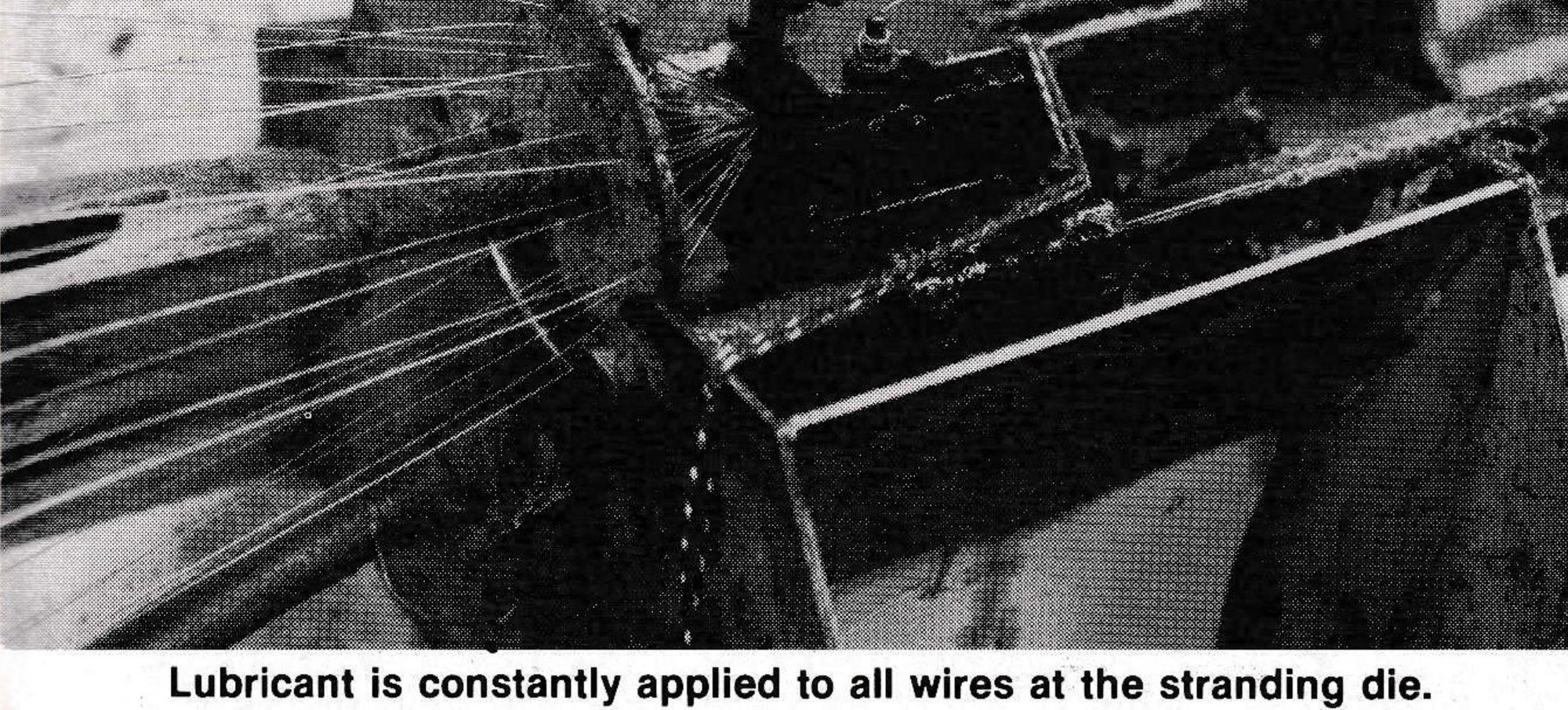
Strands are made on either a tubular or a planetary stranding machine, but the majority are tubular in design. Basically, a tubular strander is a long tube with bobbins of wire suspended in cradles along the tube’s longitudinal center at regularly spaced intervals. Tubular stranders range from small ones that hold only 7 bobbins of wire to large ones that hold up to 41 bobbins of wire. The wire from each bobbin is laced through eyes along the length of the tube to the front end of the machine where the wires come together at a forming die. As the tube rotates, the wires are laid together in the desired geometrical pattern and, at the same time, they are pulled through the die by a haul-off drum driven at a speed geared to, and in synchronization with, the rotation of the tube. Lubricant is applied to the strand wires just prior to the forming die and any excess lubricant is wiped off after the strand exits from the die.
Bobbins of finished strand are then mounted in a tubular or a planetary closing machine in the same manner as the bobbins of wire were loaded in a stranding machine. Because of the helical shape that the strands must take when they are closed into a rope, six equal lengths approximately 1,070 feet each are required to produce a 1,000 foot length of finished wire rope.
In closing a wire rope, the strands are laid around a core or center. The center may be a natural fiber (sisal) or a synthetic fiber (polyproplene) rope or it may be metallic core in the form of an independent wire rope center (IWRC). As the closing machine rotates, the strands are helically laid around the core and are pulled through a closing die by a haul-off drum that is synchronized with the rotation of the machine.
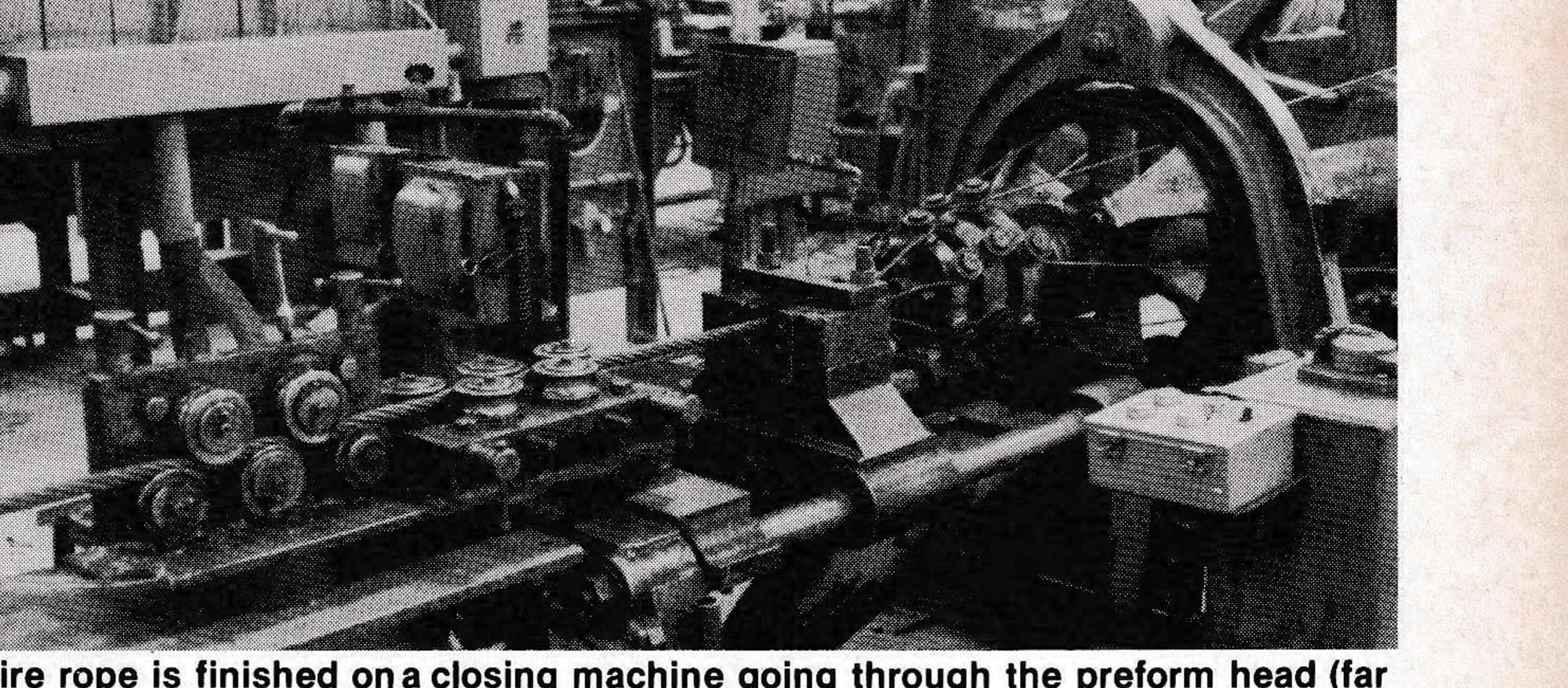
As the strands are closed around the core, a permanent helical deformation is introduced by a procedure called preforming. Pre-forming equalizes the tensions between the individual strands and prevents the rope from flying apart when cut. Fatigue life and ease of handling are greatly increased by this operation. Pre-forming is accomplished by passing the strands over a set of rollers which cause them to take the shape they will assume when they are positioned in the finished rope. Preforming must be very exact to assure a high quality rope. In most cases, the preformed rope is also postformed by running it between two sets of rollers positioned in opposite planes to further equalize stresses and minimize any tendency for the rope to twist.
Quality control inspections are conducted at each stage of the strand and wire rope manufacturing operations. This includes the recording of various measurements of individual strands and finished rope. Also, samples of finished ropes are cut from each mill run for the purpose of detailed testing including a full-section breaking strength test. One untested sample from each mill run is properly tagged and kept for future reference or reinspection, if necessary. Inspection data and the records of tests conducted on the rope’s components, such as wire, core and lubrication during the manufacturing process provide a complete manufacturing history and insure a quality product.