

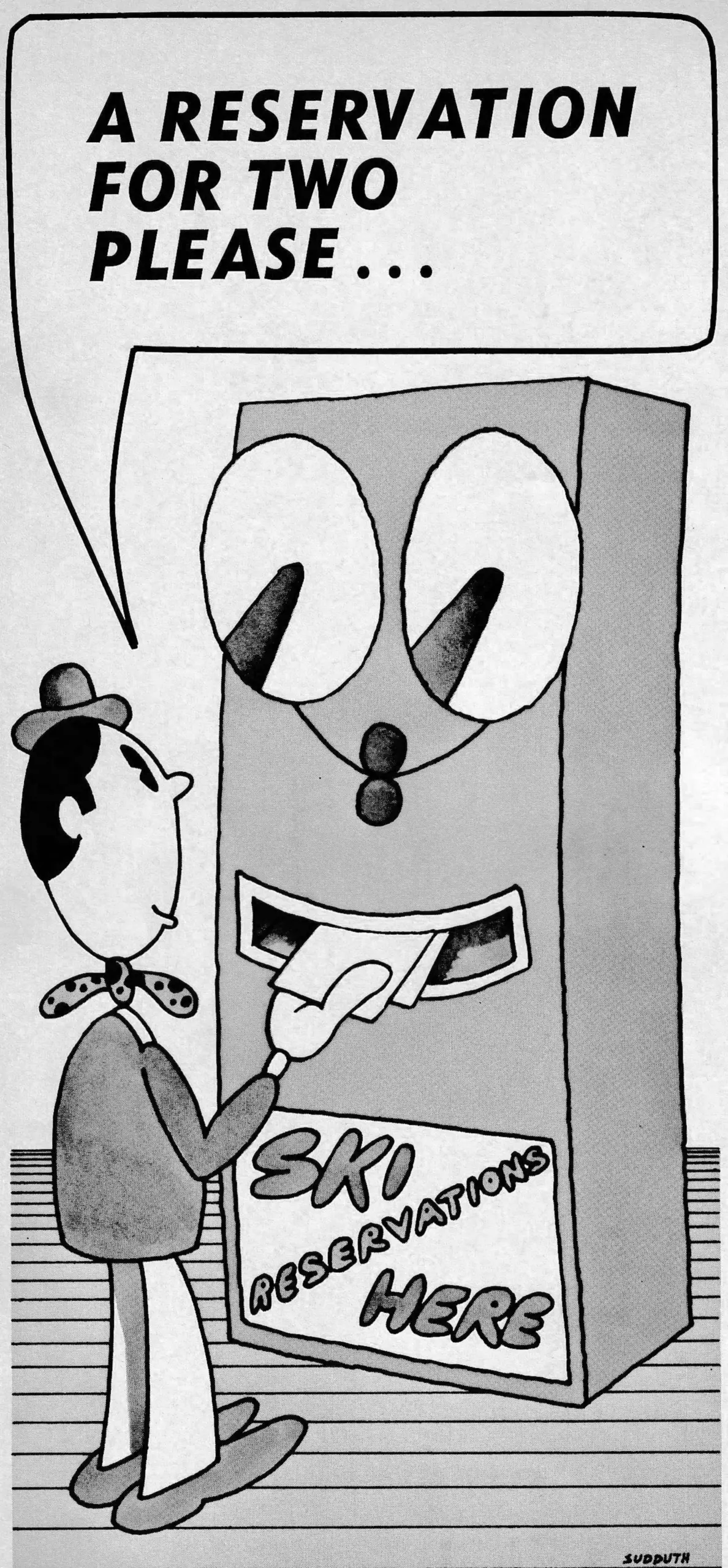
The techniques now being used range all the way from Camelback’s (Pa.) deliberate non-expansion of its parking lot to Windham’s (N.Y.) transformation into a private membership club. The most widely used approach is to limit the number of day tickets that will be sold and to enable the public to reserve those tickets in advance, before they leave home. (Magic Mountain, Vt., is an exception; for six seasons, Art Thorner says, they have had limited tickets, first-come-first-served, without reservations.) Four areas are using the new Ticketron system of reservations-by-computer, but others seem pleased with homemade systems.
Whatever the system, the problems and blessings are similar. The management has had to budget staff time, if only in small amounts for handling reservations, and has had to learn how to turn latecomers away gracefully. Another tough decision is picking the magic number.
A major blessing, gleefully noted by management at Bromley, Vt., is that once a skier has prepaid for his ticket, he is not likely to be lured away to a competitor’s mountain. If midweek conditions are promising but then deteriorate, buyers won’t conk out. The reservation is money in the till.
Since the limited-ticket trend is too new for a formal decimal-studded survey, here is SAM’s nutshelling of current approaches:
New Hampshire’s Attitash is one of limited-skiing’s pioneers. Area manager Phil Robertson, when he was at Cranmore, instituted a preferential loading line at $2 extra for the Skimobile. When his own area debuted in 1964, reserved skiing was part of the set-up and remains so today. Each season, the general public is invited to register, revealing the ages and ski abilities of the family members, the number of days usually skied, the occupation of the family head, credit information plus three personal references.
Robertson himself then chooses the first 2,400 acceptable entries. These are the skiers who will then be permitted to pay to be on the reservation list—$5 if their application is received by October, $7.50 if by November, $10 if received by December or later.
Only 950 tickets are sold each day, so that possession of the right to reserve does not in itself give the buyer the right to ski Attitash. A card only gives the holder the right to telephone and ask that tickets be saved. He can reserve as many as he likes. Once he has phoned, the caller is responsible for the tickets—unless he cancels by 9:30 a.m. of the chosen day.
Robertson says that the membership costs more than defray the cost of bookkeeping but points out that two women (“We should have three”) are needed to service the phones. The advantages, in the eyes of this veteran of 37 years of ski management, are that “lines are kept to 10 minutes, and the clientele is dependable and responsible.” Vandalism, ski theft and abuse of facilities are minimal.
No-shows are not a problem either. “People just have not pulled tricks like tieing up holiday reservations they won’t use,” Robertson says, “Some of our original cardholders are still with us”—and this despite the fact that current cardholders get no priority in renewing but must send their money as promptly as total newcomers.
Not far away in New Hampshire’s Ski 93 kingdom, Governor Sherman Adams’ Loon Mountain represents another pioneering attempt to avoid overcrowding. Since it opened in 1966, it has limited the line on its gondola and placed a separate, looser limitation on the number of chairlift-only tickets to be sold. The object is to keep the gondola wait to 25 minutes. The number of tickets, however, varies according to the weather, snow and point in season. Early in the season, when skiers are slowed by cold weather and their own lack of conditioning, more tickets can be sold than in spring. Until this year, there was no way to pre-reserve. First come were first served and sometimes all the tickets were gone before 9 a.m., which seldom delighted those who had been delayed by balky children or heavy traffic.
Ticketron at Loon
This past season Loon tried Ticketron, and by the time the season was past New Year’s weekend, the management was pleased. Now, neither Junior nor other slow-starters can keep Poppa from getting his ticket, if he has gone to one of the two dozen Ticketron “terminals” in the Boston area (or for that matter, any of the Ticketron counters in North America.)
Ticketron is the electronic box office for theaters, sporting events, part of New York’s Off-Track Betting and part of New Jersey’s lottery ticket sales. It tickets the Northeast’s Metroliner trains, reserves tee-off times at certain golf courses and represents California campsites. Their New England man, Don Reiland, happens to be a skier and it was he who recognized the application to ticket sales.
Each Ticketron counter is the terminal of a computer network. The skier asks for his reservation, the computer sends data over telephone lines, finding a ticket if one is available and prints up an instant ticket. The skier pays the normal lift price plus 65 cents for the service and goes away married to that mountain for that day. The mountain pays nothing. If he risks waiting until he gets to Loon, he can buy a reserved ticket free, but if the line is sold out, he’s out of luck.

Stratton: standing room only
Unlike Loon, Stratton in Vermont is off the highway and so Frank Snyder and his staff were particularly concerned about the ire of people who made it to the parking lot only to be told the hill was sold out. The solution: SRO signs and special attendants at the beginning of the access road. The surprise: skiers often come up the road anyway to buy a ticket for the following day.
Originally, Stratton announced its limit would be 4,500 day tickets, but this produced a flood of skiers buying season tickets and 20-day booklets—in effect, exemptions from day ticket restrictions. Stratton felt it had to lower the day limit to 3,500. During the first few days of operation, the management was satisfied that 3,500 plus season ticket skiers made for uncrowded trails and liftlines no longer than 15 minutes. (SAM found some skiers who said they waited longer.) Dick Lechthaler, Stratton’s marketing man, is looking forward to the traffic data that Ticketron sales will yield.
Neighboring Bromley, like Stratton, emphasizes the importance of the presold customer. In fact, at this point in the area’s effort to rebuild its once formidable popularity, the area considers Ticketron more as bait than as a crowd-control device. For 1971-72 Bromley limited its season passes to 300 and eliminated pre-season discounts and special prices for homeowners. The purpose was to generate revenue without raising prices. Next season, however, Bromley plans to encourage more season tickets but will probably keep its day ticket limit around the current 2,700.
Even nearby Magic Mountain, which has resisted reservation systems, in the words of Art Horner, is “keeping an open mind” but continuing to close the door after 1,800 people have checked in.
Out in Colorado, reserved-ticket skiing began at Arapahoe Basin. In 1970-71, it set a limit of 1,600 day tickets, available to the first people who phoned in or stopped in Denver stores. They never hit that number on the hill. Arapahoe’s Larry Jump discovered that day skiers who got a late start never went to the area because they were sure it would be sold out. Others phoned in, then changed their minds. This year, things are expected to go smoother because phone-ins have been eliminated. Arapahoe has been pre-selling vouchers in the Denver area, at the seven branches of the May D&F department stores and the branches of Gart Brothers sports shops. They are exchanged for a ticket on the hill at no extra cost. One Arapahoe staffer describes the system as “a convenience for the public and a traffic builder for the store.”
Thomas I. Sheridan, Jr., president of the 800-family Windham Mountain Club, regards limited-ticket fever with the happy calm of a prophet seeing his predictions come true. In 1963, the Sheridan family took over Cave Mountain, then formed the club, renamed the mountain and sold it to the membership. Midweek, anybody can buy a day ticket, but on weekends the lifts, clubhouse and neighboring home development are geared to the demands of the affluent, diligent—and vocal—skiers who pay annual dues, occasional extra assessments and initiation fees that have more than doubled since the initial $1,500.
To become a Windham member now costs $12,500 and carries several privileges ranging from reserved parking to the right to sell the membership on the market.
Beginnings at Windham
The Sheridans were Stratton skiers who wanted to set up a club there entitled to preferential loading or even to build a special clubhouse lift that members could use when the main mountain got crowded. Stratton demurred, so the Sheridans bought the Catskill area and tried preferential loading. The privilege was sold for $1,500 a year. It didn’t work; the public and the members resented each other. Some of those members got together to raise the cash to go private.
“Some day,” says Sheridan, “every area will either be Windham or a Vail, either a club or a big destination resort. Even then, there might be private clubhouse areas adjacent to the public slopes. The Strattons and Bromleys that are limiting tickets now, are really moving in the direction of clubs.”
At this point in ski history, clubs and public areas are two very different kettles of fish. James Branch, president of Sno Engineering, says his company made a study of clubs and found that some made a nice profit. Many small areas are thinking about going private, and regard limited-skiing as a possible transition.