


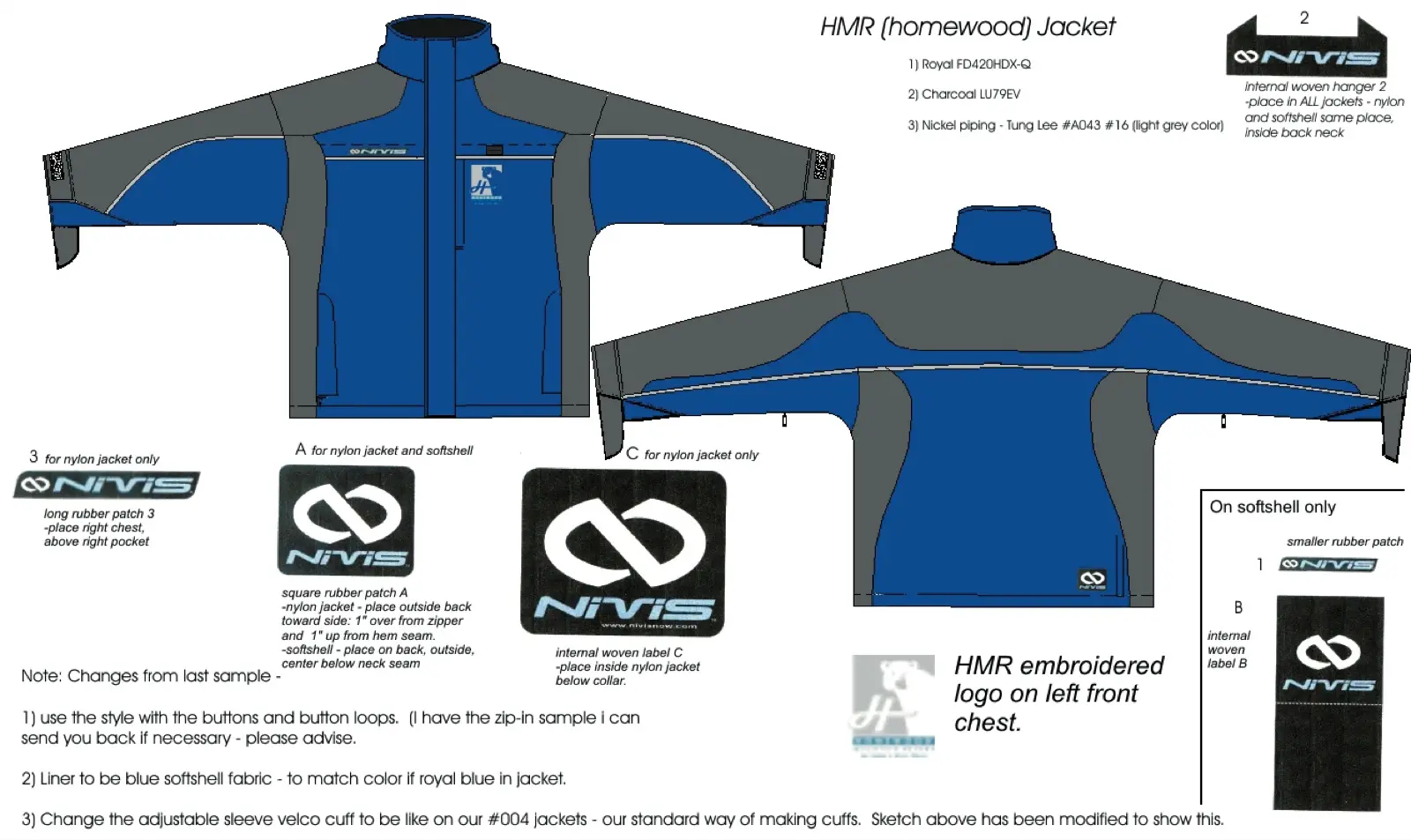
When the Homewood, Calif., lift department uniforms were at the end of their life cycle, management did the usual thing: the general manager, human resources, resort services, marketing, and other executives sat down with a couple of designers to discuss their needs and wants for new uniforms. But they ended up doing something very unusual: launching Nivis, the resort’s own activewear brand, potentially opening the door to a four-season side business that no other resort has yet pursued.
The Homewood staff started out in the usual collaborative way, discussing the look for their new uniforms (“less trendy and more longevity, but friendly to guests,” says Collier Cook, the resort’s marketing and communications director). They chose a classy color scheme (deep blue like nearby Lake Tahoe, plus silver and dark gray) that could be phased in as other departments’ uniforms also needed replacing in subsequent years. Each department director contributed thoughts on what features the garments ought to have.
Then, recalls Cook, “[Homewood president] Jeremy Yurosek piped up, ‘I’d like to start a company to do this clothing.’ We are taking the opportunity to start a line with attributes that work on the mountain every day. It stems from our desire to look outside the norm. We don’t know where we’ll eventually go with it, but our intention is to sell it [the clothing] elsewhere at retail.”
Homewood has contracted with Mountain Uniforms to produce the Nivis jackets that lift operators, mountain hosts and management team are wearing this season. With 150 uniforms on the hill as a proving ground, this could launch a brand with items for the kind of four-seasons recreation that the Tahoe region enjoys.
Even if you don’t take the uniform business as seriously as Homewood, uniform decisions loom large nonetheless. The array of choices in ready-designed styles, colors, materials and features is magnified by the options available in custom uniform programs, whether offered by a uniform specialist or as a uniform program available from a retail supplier.
Part of the decision is purely economic. Few areas can afford to outfit their entire staff in new duds in a single year, so a crucial decision comes down to how long a supplier will commit to keeping those garments available for reorders—and whether reorders will be at the same prices as the initial order.
Suppliers generally caution against penny wisdom and pound folly. “You get what you pay for,” says Brian Brooks, director of business development for Avalanche Skiwear. “If you get a real deal on a jacket, there’s usually a reason for it.” Sometimes the reason is that the garments have a brief useful life or have design, materials or manufacturing flaws that are problematic when used day-in, day-out for three winters or longer.
Sometimes, however, the reason is one that can benefit ski areas. For example, W.L. Gore is ratcheting up a program that discounts its Gore-Tex laminate for end use in uniforms that carry prominent external identification. “This isn’t like a NASCAR logo,” says Gore’s Doug Graham. “We put stipulations on size and placement and require use on some of our more rugged fabrics, to make sure that they hold up well.” Manufacturers who pass along this discount, which Graham describes as “pretty significant,” can help areas achieve bottom-line savings.
Dedicated uniform suppliers say that their prime advantages are a short and flexible lead time between ordering and delivery, guaranteed reorders and true customization. Companies that also have retail programs counter that on-slope brand visibility drives retail sales in area-owned outlets. In fact, some manufacturers provide uniforms to high-profile areas as part of a marketing program, while others offer discounts to resorts that both buy staff uniforms and order for their retail outlets.
Anyone watching the bottom line also needs to think about a uniform supplier’s viability. “If there’s a problem with your uniforms, you want a company that will be around to respond,” says Spyder’s Andy Templin.
Performance First
Before areas get to price, though, most start with an idea of what they need. When people are working outside, usually in the cold, performance is critical for maintaining a healthy, happy workforce. Waterproof breathable fabrics and layering systems are de rigueur for area uniforms, but few trends are so strong that they can be considered industry-wide. Some areas supply employees only with jackets, requiring them to buy their own base and mid-layers, hats, gloves, gaiters and the like.
Durability is another consideration. Mardee Kayser, president of Ski Area Supplies, which specializes in rugged clothing for snowmakers, patrollers and others who require extremely durable items, has mixed emotions when she hears, “I’ve had this jacket for eight years.” On the one hand, she’s proud of the quality; on the other, she says it dampens orders for the company’s 1000-denier Cordura jackets.
Other factors, while secondary, are very important to many areas, particularly in the areas of guest relations, host programs and, perhaps most of all, ski and snowboard school. That lands us in the netherworld of fashion. Not only do guests respond well to a natty and identifiable ski school uniform, says Avalanche Skiwear’s director of business development Brian Brooks, but “when the ski school director looks up the hill, he wants to be able to spot his people.”
Fashion and Function
Crested Butte is a good case in point. It came under new ownership just as the resort needed new uniforms anyway. “After five years, our Hard Corps jackets were finally wearing out,” says marketing vice president Gina Kroft. “That company doesn’t exist anymore, so we had to look elsewhere. We had various companies give us samples to test. We chose Spyder’s ProGear because of its functionality.”

One new twist is the way the Butte is branding itself. Instead of screaming “Crested Butte,” there’s only the mountain icon on the back. Sharp colors and distinctive vest embroidery identify each department: C.B. Mountain Schools for instructors, for example, and a generic model with C.B. Mountain Resort. The new look will be phased in as the old Hard Corps gear wears out.
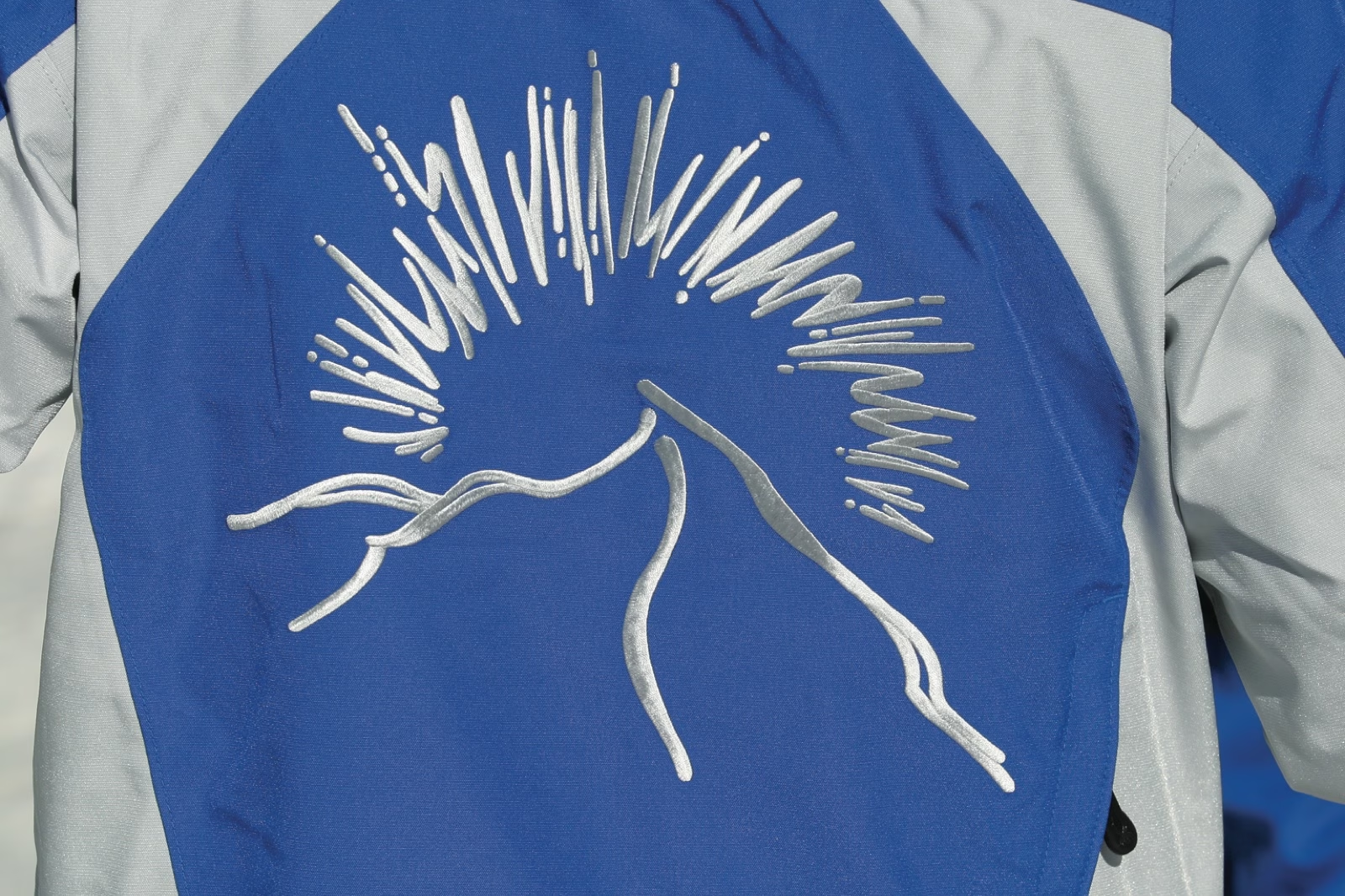
Crested Butte is typical of larger resorts that order different uniforms for the ski and snowboard instructors, and other departments too. Smaller areas are more likely to order one style of uniform for all, in the interest of economy, and also because qualified instructors may be asked to teach both skiing and riding.
Because it is a brand-new resort, Tamarack, Idaho, started from square one when it came to uniforms. Tamarack’s vice president of operations Jim Spenst says, “The person assigned to do this before I got here ordered Avalanche because he had them at Deer Valley. They delivered when we were under the eight ball. We ordered in May and had them in time for the season. They have guaranteed reorders for at last three years.”
Styles are similar throughout, but colors vary by department. Instructor uniforms indicate whether they are on the ski or snowboard side, and the patrol wears mango yellow. “I had it at Copper Mountain for a decade,” says Spenst. “Eighty percent of the people on the mountain are wearing blue or red, so [with that uniform, patrol] visibility went way up. Guests really liked that.”
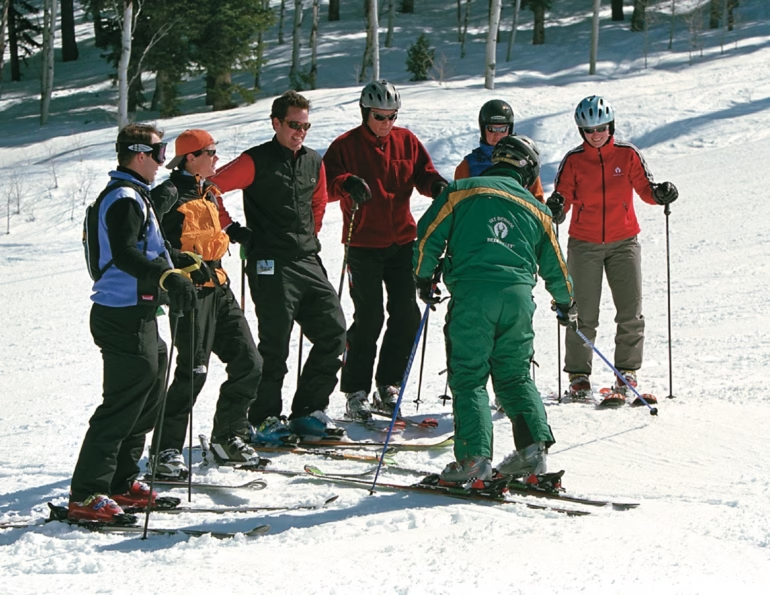
Color consistency is the theme at Deer Valley, where forest green is “a focal point,” according to director of merchandising Georgia Anderson. She adds, “We try to keep ‘Deer Valley green’ on the forefront of our designs. We look for companies that can handle custom uniforms. We look for appearance, but we also need durability, warmth, and waterproofness, as well as reorder capability.”
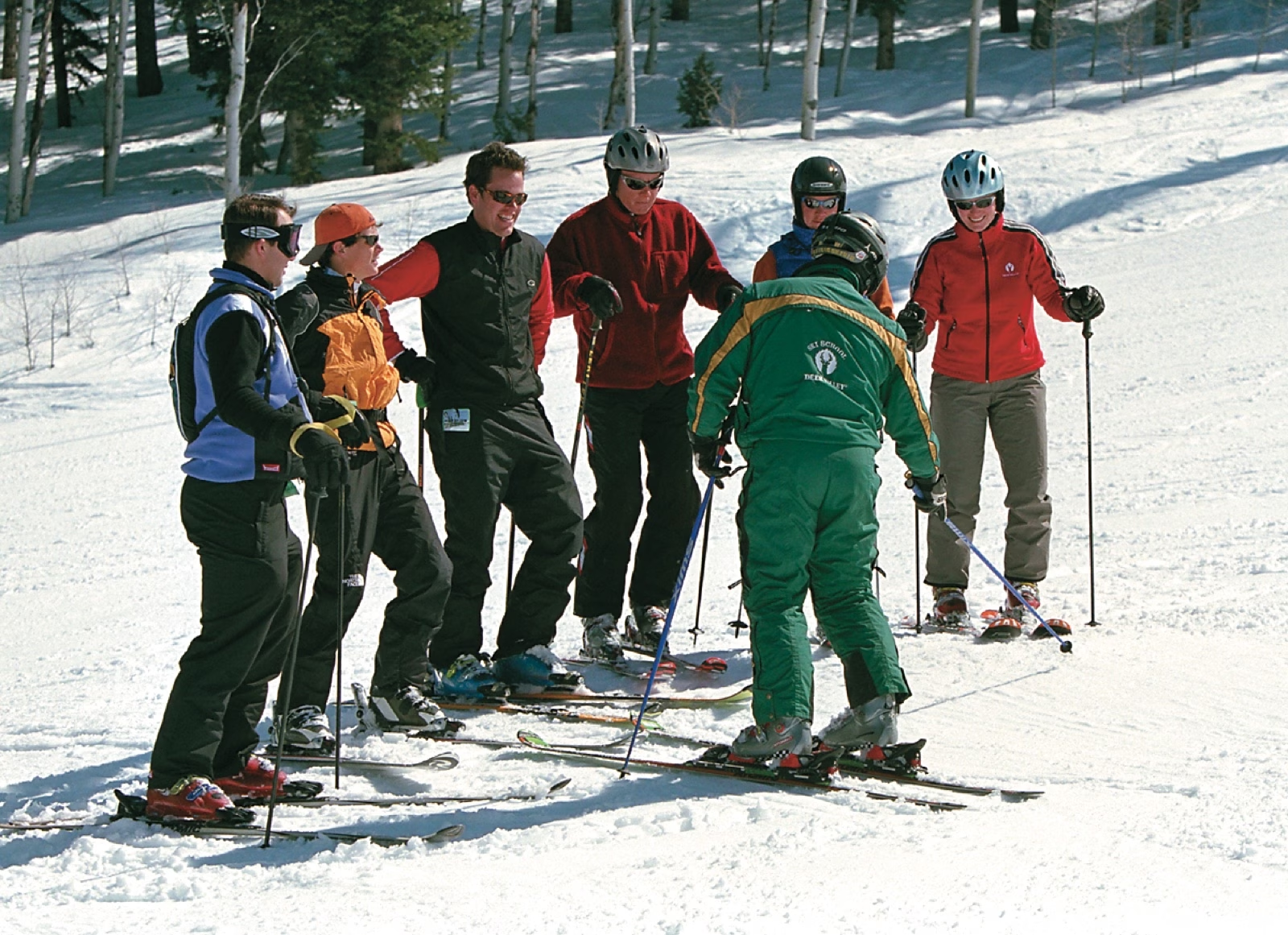
Photo courtesy of Deer Valley Resort
Color aside, Deer Valley does different orders according to each department’s needs. The ski school and ski patrol wear Avalanche. “The company’s strength lies in their ability to make exactly what you want and have it available for reorder,” Anderson notes. Mountain operations people such as lift attendants, mountain hosts and race hill crew are outfitted with Spyder, whose customization of colors and features on particular body styles and great reorder program appeal to Anderson, too.
Attention to Details
Customization is an important feature for companies that make nothing but uniforms. Mountain Uniforms creates basic styles that resorts are free to modify, sometimes by combining features from two styles. “We see everything,” says Kim Stearns. “Sometimes resorts have an idea of their own. Sometimes they want a cross between two jackets. We’ll send them a form to fill out or do a phone interview. We can help as much or as little as they want. The back of our catalogue has a copy-and-color feature, and customers can go on-line and click colors into styles.”
For practical reasons, being able to select specific features for different departments appeals to many ski areas. Mountain hosts and ambassadors might need large, easily accessible pockets for trail maps. Some people need radio pockets. Areas with night-skiing operations might want reflective panels on some uniforms. Patrollers may wish to accommodate their fanny packs in a particular way. Other jacket options from most suppliers include nametag windows, pass windows, and a range of pocket styles.
The entire ordering process is also important to consider. While most retail skiwear suppliers like to have orders in by April for delivery the following season, uniform makers can often work within a tighter timeframe. Beyond-X, with roots in the World Cup scene, a base in Sweden and a company-owned factory in Poland, offers six order periods throughout the year. The last one for the current season closed in late November, for February delivery. In addition, vice president of sales and marketing Ed Chappee boasts that the company offers “repeatability in color, style and fabrics for five years.” This is significant for such Beyond-X customers as tiny Campgaw, N.J., which has had the same uniform for six years and orders 50 to 100 fill-in pieces each year. For small areas, especially, checking on minimum reorder requirements is wise before signing the order sheet.
The only sure thing is that attention to uniform programs is growing. Whether it’s image or morale, the consensus is that functional, weatherproof garments make for happy, welcoming employees—and that results in happy customers who feel welcomed.
Uniform Suppliers
The best way to check out the latest styles, fabrics, and features is to visit the Uniform Center sponsored by SAM at the SIA Trade Show in Las Vegas, Jan. 24-27. In case you can’t make it to the show, we’ve listed suppliers here:
| Supplier | Phone | Website |
|---|---|---|
| Apogee Sportswear | 1-877-770-9090 | www.apogee.com |
| Avalanche Skiwear | (418) 877-5584 | www.avalancheskiwear.com |
| Beyond-X | 1-800-639-3166 | www.beyondx-usa.com |
| Bonfire Snowboarding | 1-800-225-6850 | www.salomon-sports.com |
| Descente North America | 1-800-999-0475 | www.descente.net |
| Helly Hansen | 1-800-435-5901 | www.hellyhansen.com |
| Leba Designs | (510) 649-7850 | www.lebadesign.com |
| Mountain Hardware | 1-800-953-8375 | www.mountainhardware.com |
| Mountain Uniforms | (775) 831-7670 | www.mountainuniforms.com |
| The North Face | 1-800-447-2333 | www.thenorthface.com |
| Predatorwear | (530) 581-5905 | www.predatorwear.com |
| Schure Sports (Karbon) | 1-800-656-8359 | www.karbon.net |
| Seabreeze Trading | 1-877-644-1744 | www.seabreezetrading.com |
| Ski Area Supplies | 1-800-727-1980 | www.skiareasupplies.com |
| Skea | 1-800-338-6303 | www.skealimited.com |
| Sorel (Columbia) | 1-877-508-6050 | www.sorel.com |
| SportHill | 1-888-622-8444 | www.sporthill.com |
| Sport Obermeyer | 1-800-525-4203 | www.obermeyer.com |
| Spyder Active Sports | 1-800-333-0302 | www.spyder.com |

