


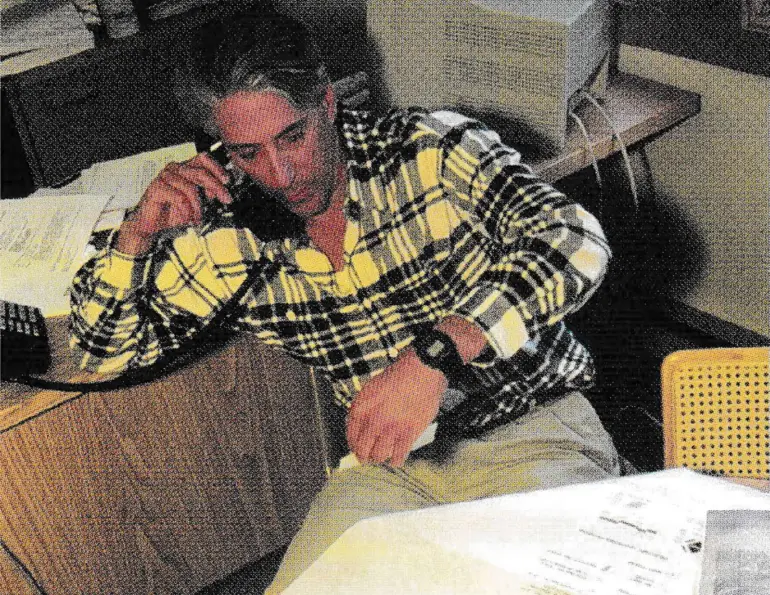
Les Otten’s dream to own Killington, he remembers, started on Thanksgiving Day 1967 when he was skiing there. He was 19. Driving home for the family dinner, he couldn’t stop thinking about what he’d do differently if he owned the place. “Of course, at that age you don’t have to confuse dream with reality.”
Reality came when he bought Sunday River, Me., from the owners of Killington, and then proceeded to build it to the point where it started to pose a marketing threat to Killington. By the early 1990s a fierce rivalry began between the two resorts. When did the rivalry really begin? “Sometime around 1971,” answers Otten, slyly giving the date he started working for Killington founder, Preston Smith. Then, with a smile, he corrects himself. “I mean 1993.”
The high-profile sparring was universally perceived at the time as an ego-driven rivalry between Otten and Smith—the Les ‘n Pres show.
While acknowledging this was part of it, Otten sees the rivalry somewhat differently, feeling he was almost dragged into it because of the headline-making insults that flew back and forth between the marketing departments for a while.
Otten confesses that one barb really got to him. “It was when one of Killington’s top staffers commented on the Summit Hotel we were building,” he recalls, “and bragged openly, ‘Now Otten’s really done it; he’s thrown $15 million down the tubes. He’ll be broke by springtime and we’ll buy it back.’”
Otten says the success of the quarter-share hotel and convention center project was already assured, so when a couple of Killington senior executives pooh-poohed it, he found it “extremely offensive.” It was then, he says, that the passions really started to build. “I mean, don’t wake the gorilla up! If you wanted to really tick me off, this was the way to do it, and suddenly I found some of the people In the industry I respected the most were fueling me, saying I had made a big mistake.”
He recalls that at the time Sunday River was starting to do a good job in the Boston market, building on a reputation for good snow and good grooming. “I think [Killington] wanted to stop us—stop us dead in our tracks so that we wouldn’t invade Connecticut and New York and the rest of their markets.”
Then it became a popular thing to take a swing and, as Otten recalls, “Killington was in Vermont taking a swing at us and Sugarloaf was in Maine taking a swing at us. Meanwhile our numbers kept going up and both these guys were taking swats at us and every once in a while we would swat back. We stooped down and swatted back.”
“It was the biggest mistake we ever made, and my advice to anyone who finds himself in this sort of situation is to never swat back.”
However, by then the rivalry had developed a life of its own. What might have been friendly at the beginning became more and more intense—and personalized. Despite the fact that Otten and Smith had enjoyed a long and good relationship, “we kinda got alienated because of what the marketing guys were doing. They were creating a justification for their existence and for the money they were spending for ads. As president of the company you can’t help being sucked into that. I know I was. You’d have to ask Pres, but I think he got sucked into it. But in all that time I never lost my respect and fascination, my admiration for what Pres had built.”
While this rivalry was making its very public way, maneuverings of even greater competitive intensity were taking place behind the scenes. As far back as 1990, Otten had cast a longing eye at Sugarbush. He had wanted to buy it then, but had realized neither he nor his company were ready for it. “Things weren’t in place; couldn’t plug things in.”
In the meantime, in 1994 Otten bought Attitash, N.H., just an hour from Sunday River, which he felt very good about. “We needed to gain strength as a regional company and Attitash was a good place to grow from.” It was also the start of a learning curve for Otten in how to gear up for expansion, especially with regard to staff.
“I started to learn some stuff about how I had to have people working for me who were like me, which meant I had to treat them the way I treated myself, which was I gave myself permission to fail and gave myself a lot of room to work. I think I gave a bunch of our people the freedom to do their jobs and things began to gel.”
It was that that gave Otten the confidence to take another look at Sugarbush in 1994. As luck would have it, that was also when the banks forced Waterville Valley onto the market, and Otten took a look at it.
“We just couldn’t do both,” says Otten. “We were stretched to the limit.” But Killington was waiting in the wings, and moved in on Waterville as soon as Otten walked away. And Killington had acted with similar speed in picking up Sugarloaf.
Otten recalls that it actually felt at the time as though it was a tit-for-tat battle. “It felt like every time we did something they were reacting and doing something else. We did Attitash, they did Sugarloaf. . .We did Sugarbush, they did Waterville. Boom, boom, boom, boom! Whoa!”
What the public didn’t realize was that S-K-I, which was cultivating an image of aggressive growth, had, as early as 1990, retained financial advisers to find a buyer for the whole empire—first Kidder Peabody and then, in 1993, Schroder Wertheim. S-K-I’s acquisitions made the company look more attractive to a buyer, while the sale of their California area, Bear Mountain, enhanced their balance sheet and positioned them as a strong regional force.
So now there were two companies that were developing regional strength, with neither able to do everything it wanted. “We kinda cut each other off,” says Otten. Stratton went to Intrawest, Okemo and Loon were going to stay as independents.
Among those interested in buying S-K-I was George Gillett who, by 1994, was not at all the powerless, ex-bankrupt, figurehead chairman of Vail that the industry saw, but rather was an experienced, savvy entrepreneur on the comeback trail, with capital of his own and access to more. More importantly, he was energized by a family dream and determination to again become a major player in the industry he loves. [See also Gillett interview on page 57.]
Otten remembers a phone call in the fall of 1994 from Gillett to the effect that, “In case you hear any rumors about it, I am taking a look at Killington.” One of several scenarios envisaged by Gillett was a grand consolidation in which he would bring everything together—the S-K-I properties and Otten’s—with Otten and Gillett sharing ownership and direction. These ideas ultimately collapsed because, while each expresses admiration for the skills and visions of the other, each also recognized there were different personal agendas that would never be compatible.
By the summer of 1995, a disappointed and frustrated Gillett told Otten he was giving up on S-K-I. But in the meantime, knowing that company was in play had lighted fires in Otten and he began thinking, dreaming, planning, calculating, “sticking my nose in a lot of places,” talking to investment bankers— all at the same time that he was digesting the huge Sugarbush purchase, getting permits, figuring out how best to spend $15 million on it.
As Otten recalls it, “By the summer of ’95 I had convinced myself that I would be able to take my company, lever it in the open market by raising bank financing or bond debt financing and come up with a price that would buy these guys out.” And this is exactly what he eventually did. But first he had to become credible as a buyer.
“You have to see it from their perspective,” Otten explains, “and project yourself into the mentality. ‘Here’s this Otten guy who was once our friend, then our rival. He’s making noises about buying our company, but we don’t know anything about his company, whether he’s making any money.’ I was still this 22-year-old kid they sent to Maine. It was hard for them to take me seriously.”

Otten says it was the third-party investment banker who was able to authenticate Otten’s company as a credible buyer, and with that done, he put together a bank deal. “Then,” says Otten, “we threw it away.”
Actually, Otten’s was a deliberate choice of opting for high-yield bond financing. “You pay dearly to get the bank deal in place so that the guy who puts it together walks away with a million dollars, but you shop the deal—you make it better. It wasn’t about getting a better rate, it was about giving the company more flexibility. I’m very glad we made that choice.”
Unlike the bank financing he might have had, Otten pays no principle on his $140 million of bond debt financing for 10 years, so he will be paying that back in 2006 dollars which, given normal inflation, compounds to a sizeable saving.
Otten ended up offering $16 per share, which reflected maximum leverage possible. It took $18 to close the deal and Otten had to “temporarily give up four percent of the company.” Essentially, one of the debt instruments carries this “kicker”—a form of extra payout. As Otten puts it, “You not only get your bond money back with interest but you get a chunk of the company. It’s not public stock, it’s not registered, it’s shelf stock. Like warrants. It’s a pre-set deal where we can buy it back.”
For those who do them, putting deals together is virtually an art form, to be engaged in with passion, sometimes with obsession. And as soon as one deal is done, it’s off to the next one. In all this, Otten is no exception. But he is also fascinated by realization of the potential of a completed deal.
In the S-K-I purchase, Otten’s team was able to give effect to its marketing potential with stunning speed, so that for the coming season he has over $14 million in partnership dollars going to work for his company and—the point he likes to hammer home—working for the whole ski industry.
“Directly or indirectly, ASC has got about a $30 million marketing program and half of that is beneficial to the industry as a whole,” he says. Significantly, at least 80 percent of the partnership dollars represent new money—money that was not previously at work for skiing. (At presstime, partnership dollars were in the $15 million range.) ASC’s principal partners are currently Jeep, Anheuser-Busch, McDonald’s, Visa, Pepsi and Mobil. A significant portion of this effort is going to television advertising where exciting visual images will convey what Otten calls “the upper-end energy of what the sport’s all about.”
Otten contrasts the message he wants with the industry’s $6 million television effort in 1990 which was essentially created by committee. The net result was that an inherently exciting, colorful sport—the original extreme game,” as Otten puts it—was reduced by the constraints of political correctness to bland tones of khaki.
ASC and their promotional partners plan to convey a very different picture. “You’re going to see a snowboarder upside down, skiers in the air, wild-eyed faces with smiles on them,” Otten enthuses, and the message will be “If you want to have a high-energy, fun time, Do winter! Do it with us!”
Otten foresees the main promotional thrust for industry marketing coming from the five or six largest players in the country turning on their own programs, doing the sort of things that can’t, he insists, be done by committee.
He sees NSAA pursuing the mandate it received at the Charleston summit. “We sent Mike Berry off in a great direction to do the PR. and promotional end of skiing, make it cool and pick the target groups that need to be marketed and build a national program.” But he remains skeptical about NSAA’s capacity to actually launch a program. “It’s an association and nobody can say, ‘This is what we’re going to do.”
Asked about the future, Otten demurs: “I’m not in the business of prediction.” But clearly, he thinks he is in a growth business. He believes strongly in the upside potential of the echo boom, and wants to get the sport’s promotional rocket boosters firing even if he has to do it all by himself. After all, growing the sport will create new opportunities for the expansion of ASC.
“We’ll have some surprises, I’m sure, before the year’s over,” Otten said offhandedly. Obviously, and by choice, there’s no rest for the deal-maker.
Trainee Otten at Killington
Once out of college, Les Otten went to Killington in 1971 as a management trainee, reporting directly to President Pres Smith and VP/Controller Marty Wilson. “It seemed like a dream come true: a job at a great ski area at $150 a week. In those days that wasn’t half bad. But what I didn’t realize was it was for a 70-hour week. The guys making $2.25 an hour with overtime after 45 hours were making out much better than we were.
“Trainees did everything; make snow, run lifts, learn how to change the oil for the french fries. I worked in every department.
“What I didn’t expect after leaving college, though, was to ever have to write another paper, but part of a trainee’s responsibility was to turn in a management paper every two weeks. Pres and Marty might ask for one on what I thought about the lift department or the maintenance department. I remember writing one about Ramshead, saying I didn’t like the way the mountain was designed, facilities at the bottom were inadequate, there was no bridge underneath the road, that they ought to take the top of the lift and blow it up and give the top back to nature—I don’t think we used the word ‘environment’ back then.
“Wow! I almost got myself eliminated from the program. Now, 24 years later, guess what: We’re shortening Ramshead, replacing it with a detachable; we’ve given the Appalachian Trail access back to the summit, we’re building facilities and building a bridge under the road. I sort of wish people who accuse me of being a johnny-come-lately to environmental sensitivity could read that old paper. I always had environmental priorities.”
