
When I joined Park City in October 1999, information technology (IT) at ski areas was a lot like the weather: everyone talked about it, but nobody did much about it. Also like the weather, information technology can have a big impact on the bottom line. But unlike the weather, you can actually do something about IT.
My arrival coincided with Park City’s IT preparations for the 2002 Olympics. The area was seeking staff for the IT department, and this seemed like a great opportunity. I had earned a Bachelor of Science in Management Information Systems from the University of North Carolina at Wilmington and I had my own technology consulting business. I applied and was hired (mainly, my boss later told me, because I was the only candidate who would work for $8.50 an hour).
This proved more challenging than I expected. Change does not come easily anywhere, and the ski industry is no exception. I found that most people at the management level have risen through the ranks, making an outsider’s vision hard to accept. In many departments, the way it has always been done is the way it is still being done.
Part of this is because ski resorts are geographically challenged. This creates a hurdle with respect to the quality of the basic infrastructure needs, like telecom services, and reduces exposure to new technologies that are out there. As a result, investments in technology aren’t high on the priority list.
But I also knew that resorts had to change for the industry to grow and be competitive with other recreation industries in a flat or declining market.
The State of PCMR, 1999
My first few weeks/months of work were eye opening. I was surprised by the lack of technology employed to run and monitor the day-to-day revenue operations of a company of this size. The area was using Comptrol, a DOS-based ticketing system, as its point-of-sale (POS) system. This had some advantages: Comptrol is stable, inexpensive and needs minimal infrastructure investment to operate. But the reporting functionality was cumbersome, and it was difficult to get data out of the system for any kind of analysis. There was minimal customer and/or transaction information available within the system.
Other departments had even less IT capability. The new food and beverage operation used a Sierra Nevada Cash Register System; other locations relied on regular cash registers (Z-tapes). We were still using a manual punch card system for timekeeping, which made labor tracking and/or controlling it nearly impossible. There was no interoperability between these disparate business systems, which made it extremely difficult to make effective and timely business decisions.
The process of auditing and reporting revenues was very difficult and cumbersome as well. This required entering data by hand from frontline systems (Comptrol, Sierra Nevada and Z-Tapes) into an in-house custom-developed Access-based mountain reporting system, and from that system entering data by hand into the general ledger. This process left plenty of room for mistakes, and it took an inordinate amount of time to get the financial data into the hands of the people who needed it.
The IT department had also grown haphazardly. It included a multitude of different types of servers, computer workstations, network hardware and a DeskJet printer directly connected to most workstations. There was no formal inventory for the equipment on hand, and no documentation, such as cabling diagrams, for the infrastructure in place. This made for a very inefficient and expensive IT operation.
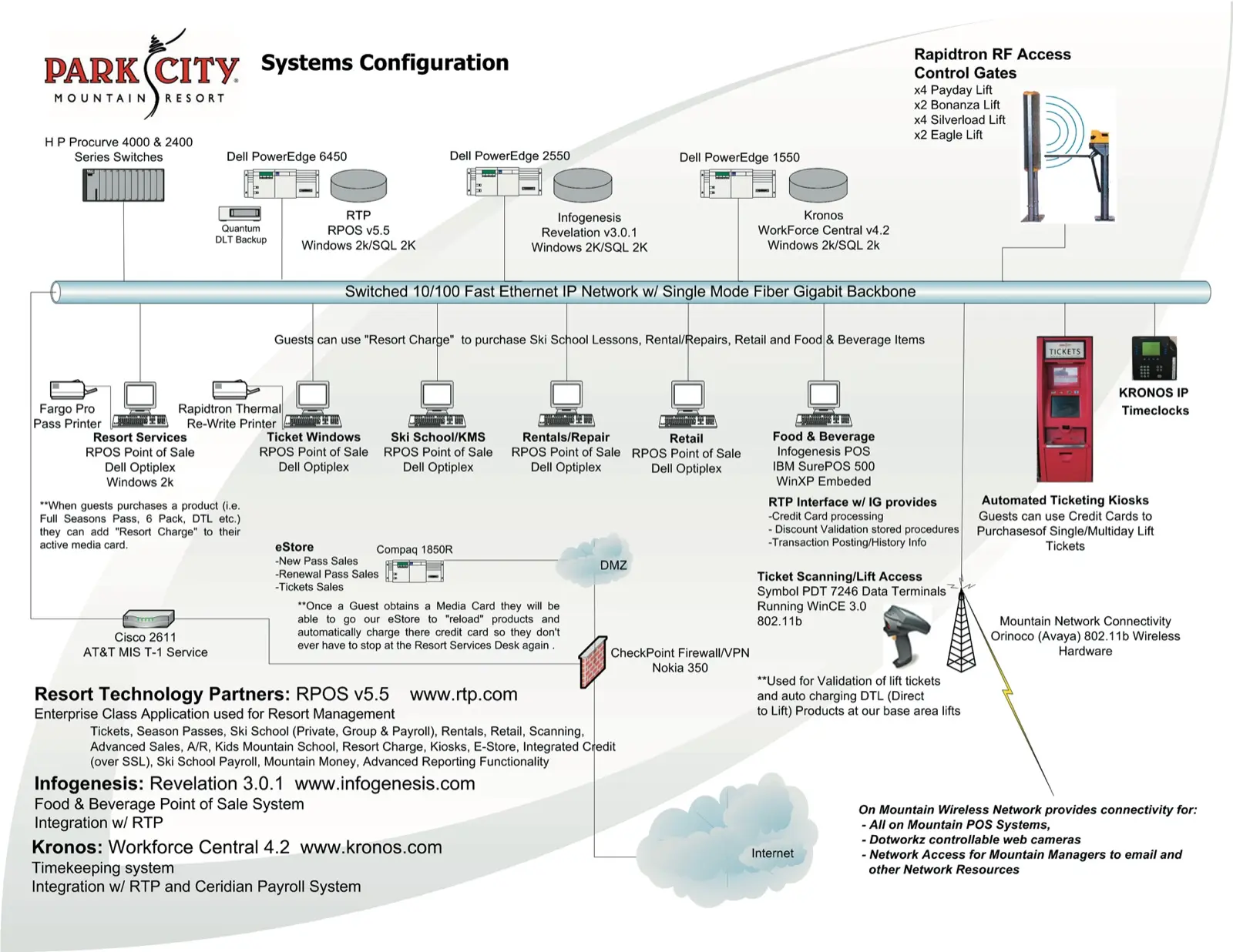
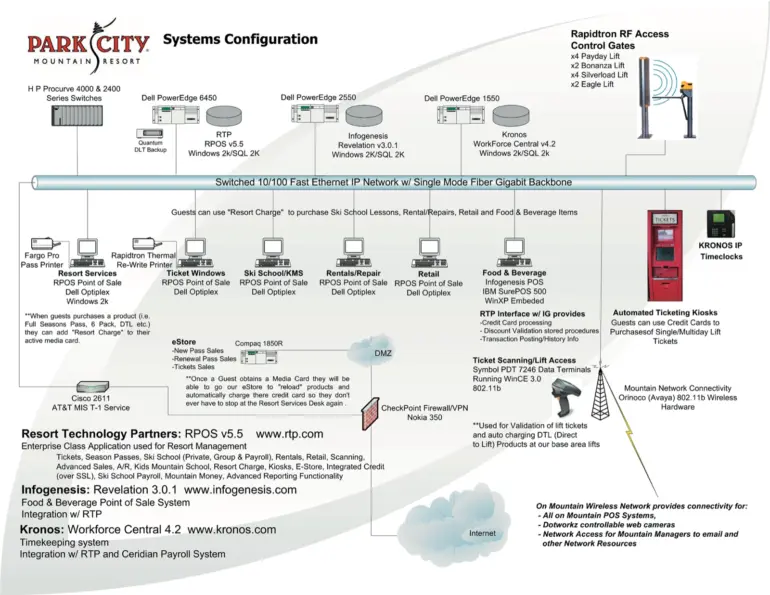
The State of PCMR, 2004
Today, not one revenue center operates the same way it did in 1999. We have implemented a resort-wide IT system that allows for almost instant access to information from almost every operations department. And many of these departments have experienced dramatic increases in efficiencies as a result.
Some of the benefits of our technology investments are:
- Revenue and Sales Reporting: Timely and accurate enabling of real-time business decisions. The audit process has also been streamlined and automated to reduce errors.
- Integrated Systems: Our resort-wide RTP management system maintains data in one tightly integrated system that’s easy to manage and administer. We have built our systems on an open architecture so that information can be easily shared between systems, making for transparent interoperability. RTP handles all revenue centers except for F&B, which is handled by Infogenesis, and Kronos is used for timekeeping. These systems all share information to more effectively run our business.
- Analysis: the ability to analyze just about any aspect or line of the business with up-to-the-minute data.
- Labor Control: The ability to effectively manage one of the industry’s biggest expenses.
- Customer Service: The ability to provide a higher level of customer service. This includes “perpetual media,” so that we don’t have to “touch” each customer every year to renew a pass, and the use of Resort Charge, with the capacity to link a credit card to a season’s pass for cashless transactions at any resort POS.
- Customer Information: Extensive customer data and transaction history captured. Now, any desktop can access customer information and find out what a guest has purchased, how many days they have skied, if they rented equipment and much more.
- Sales Dept: Enabling the sales team to better service their customers, track accounts receivable, and even to print and distribute their own tickets.
- Integrated Credit Card Processing: No more Hyper COM terminals and costs associated with supporting that platform. Credit card information is stored with the transaction in the database, which streamlines the chargeback process.
Getting There
In order to be ready for the Winter Olympic Games in February of 2002, the IT staff had to accomplish several tasks. First, to understand the existing state of IT at the resort. Second, to recommend capital investments in technology, based on return on investment (ROI) analysis. Third, to implement our plan. And finally, to maintain these systems.
From my previous experiences I knew that implementing systems that were built on standardized platforms, and in an open architecture, would enable us to easily share information and would future-proof our investment.
This plan would require a serious investment in hardware (servers, PCs and peripherals), software (for POS and office productivity) and infrastructure (network hardware and data and voice cabling/connectivity) in a phased implementation plan, in which each new phase builds on the existing systems.
Would this investment in technology pay for itself in an acceptable amount of time? There are both hard and soft return on investment components of IT spending. Hard returns include (but are not limited to) decreases in head count and training time for front line employees, credit card processing efficiencies, reduced telecom charges and accurate tracking of rental discrepancies, along with the control and management of employee and passholder discounts.
Soft returns can’t be quantified so directly but nonetheless have value. For example, if you know a customer spent $10,000 in ski school with you last year, who the instructor was and what product/lesson they chose, you can provide a higher level of customer service and perhaps up-sell this customer.
We showed that this investment in technology would pay for itself in two to three years, depending on the values given to the soft ROI opportunities.
Year 1: 1999/2000
We began by evaluating the different software options that that could run a resort of our size (in terms of skier days and total revenue) and provide the level of service our customers want.

Our list of potential vendors included Comptrol, Sirius, RTP, Ski Data and InTouch. After a thorough investigation we chose RTP as our primary POS provider, and Infogenesis as our F&B POS vendor. This was a group decision that involved all the affected department managers; their support was important.
The first department that would be directly impacted was the ticket/pass office, our major revenue source. Fortunately, the manager at that time was fully behind this change and helped move it forward.
Most of the other departments followed suit, but of course there was some pushback—change is difficult to manifest. The ski school guys were the most skeptical. They knew exactly how they wanted to run their shop and were skeptical that any software could function just the way they wanted it. But after they looked at the application and talked to people using it, they came on board. If you talk to them now, I don’t think that they would go back to the old way of doing things again.
Year 2: 2000-01
With technology projects you want to be careful not to over overextend yourself. We began our IT upgrade by migrating the back-end reporting functionality from a custom-developed in-house system to RTP’s Central Audit System. This set the stage for the full implementation the following summer. It allowed us to set up and configure the ‘back end’ without the burden of a full-scale hardware role out. It also allowed management to become acquainted with the new mountain reporting system.
We also added four Retail RTP POS systems in the just-completed Legacy Lodge. RTP wrote an interface to pass sales information between the front-end POS and Dataworks, our back-end inventory management software. Similarly, we implemented four Infogenesis F&B POS systems at the newly-remodeled Summit House restaurant. We also upgraded infrastructure, specifically network hardware and voice and data cabling.
Year 3: 2001-02
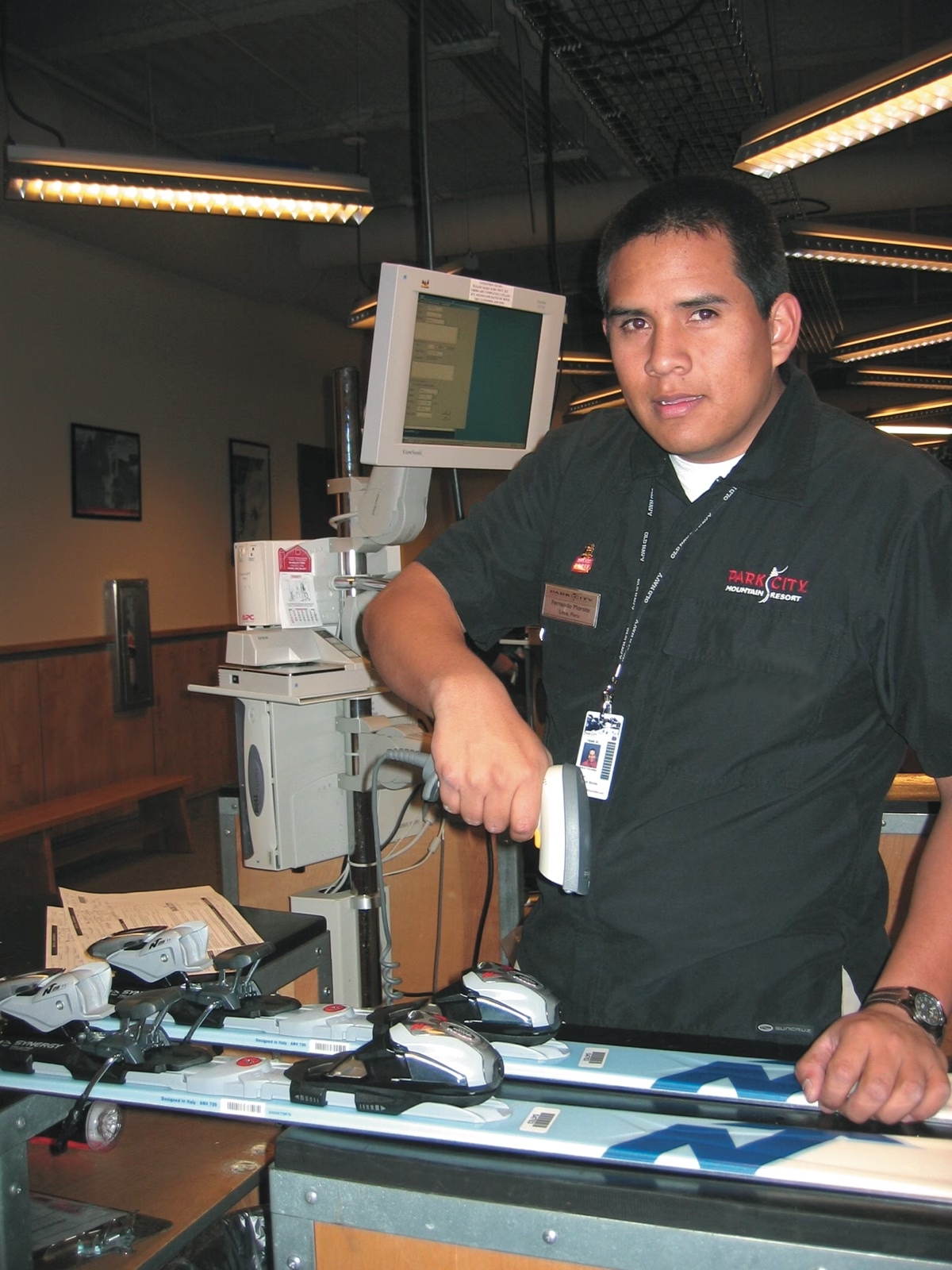
With a year of mostly back-end experience behind us, we rolled out a full-scale resort-wide RTP implementation: Tickets, Passes, Ski School (Privates, Groups & Payroll), Rentals, Rental Inventory, Repair, eStore, Mtn Money Voucher System, Advanced Sales, A/R Billing Module, Resort Charge (Credit Card linked to pass for cashless transactions at any resort POS), Integrated Credit Card Processing over IP (the Internet), and Ticket Scanning. We also added three automated ticketing kiosks. All in all, we had a total of 45 RTP POS systems.
To complement the RTP POS systems we added 15 Infogenesis F&B POS systems to the remainder of the restaurant locations. We went this route in large part because RTP had written an interface to Infogenesis that posted transaction data for the Mountain Report, handled discount validation for season passholders and employees, and processed credit cards and resort charges.
To provide instant access to data from on-mountain POS locations, we also implemented a 2.4 GHz wireless network connected to the base area servers. This also gave on-mountain mangers access to email and other network services.
This was all completed on time and under budget before the 2002 Winter Olympic Games, February 8th-24th in 2002. Capital expenditures for this year were in the mid six figures.
Year 4: 2002-03
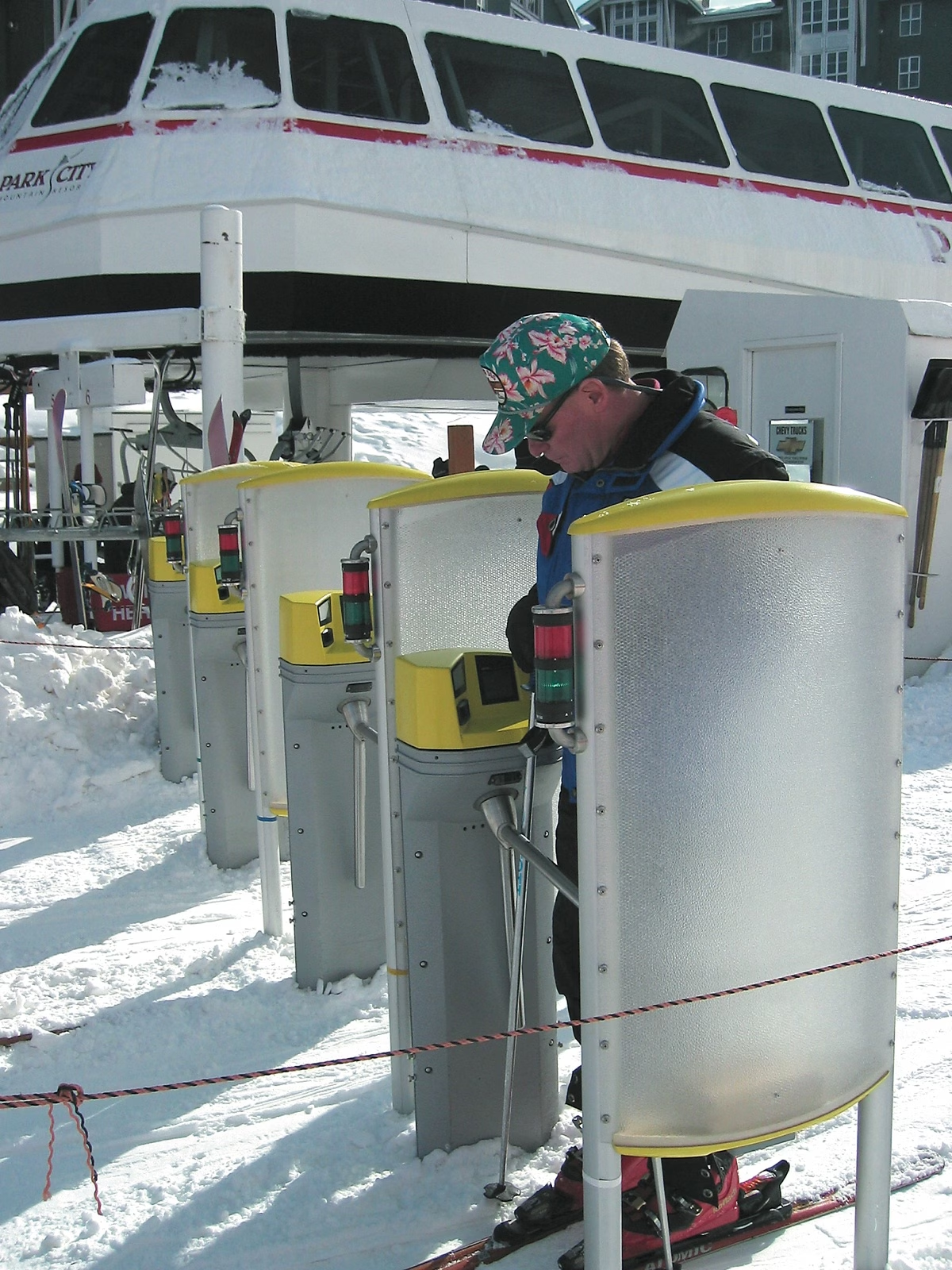
We worked with RTP and Rapidtron in late spring 2002 to test some new turnstiles that allowed automated lift access. The Rapidtron turnstiles read an RF (radio frequency) chip embedded in the card; if the card is valid, the turnstile opens and the guest slides through. The interface between the software (RTP) and the hardware (Rapidtron) worked seamlessly, so we installed eight single-lane turnstiles, two each at four of our most popular lifts, and introduced our Fast Tracks program. This allowed many of our season passholders and anyone purchasing a 4+-day ticket access to these lanes.
We also added six more automated ticketing kiosks, including a mobile unit. We added 10 RTP POS’s for a new Call Center project, as well as two Infogenesis F&B POS systems and two Symbol wireless handheld order devices for one of our restaurants. We also migrated from a home-grown time keeping system to Kronos, a leading single-source provider of employee-centric human resources (HR), payroll, scheduling, and time and labor solutions. And we again upgraded our server room.
Year 5: 2003-04
The success of the Fast Tracks program led us to add five more Rapidtron turnstiles. We now offer a single-day upgrade product printed on recyclable, reusable, thermal media cards. This technology can revolutionize the way ticketing is done at North American resorts. We also added six more Resort Services POS systems to assist in capturing more customer information and provide a better level of customer service and two more Infogenesis F&B POS systems.
The Future
Technology can open up the industry to new opportunities. It can make it easier (and less expensive) for our customers to visit and enjoy this sport. We will soon see resorts operating in an all-RF environment—no more paper tickets. Other existing technologies will become common: RF tags in rental equipment, GPS tracking and mapping of our guests’ day, the use of real time electronic signage for crowd control and information access, as well as wireless hotspots and/or internet kiosks around the mountain and base area. If you don’t have an e-commerce strategy now, you might want to develop one to better serve your customers.
Not every resort needs to offer all the innovations we have here at Park City. But on some level, technology should and will play a role at every resort—if not now, then soon. Investigate what technology can do for your business and for your customer. The industry needs to find more and better ways to utilize it—not only to manage existing business, but to drive new business.