
Every time a non-skier arrives at your ski area he represents a potential (1) student, (2) food and beverage purchaser, (3) equipment renter/purchaser and (4) lift ticket buyer. All too often he is a one-timer for steps 1-3 but he never reaches step 4—he never becomes a confirmed skier, or he takes too long getting there. The question is why.
Look at your ski school hill. Is it guilty of providing a non-learning environment? Does it have fences across the bottom? Is it hemmed in by trees or buildings? Is it an out-run area for advanced skiers with traffic darting in and out around the classes? Is it too steep without any out-run? Quite frankly, is it an afterthought?
Designing the hill
A “teaching-learning hill” must be physically and psychologically designed to present close to perfect conditions for aggressive learning, and aggressive learning means total involvement on the part of both student and teacher on the student’s progress rather than the teacher on progress and the student on pure self-preservation.
The physical attributes of a teaching-learning hill are many. The setting should be away from the noise and activity of the loading areas of other lifts. It should be a slope unto itself rather than the out-run for a trail used by the general skiing public. The bottom must be a long, flat out-run that will allow for easy, natural stopping. There should be no fences, ski racks, grooming machines or other obstructions. In addition to the obvious hazard any obstructions present, they also produce psychological barriers to learning and, therefore, a defensive student.
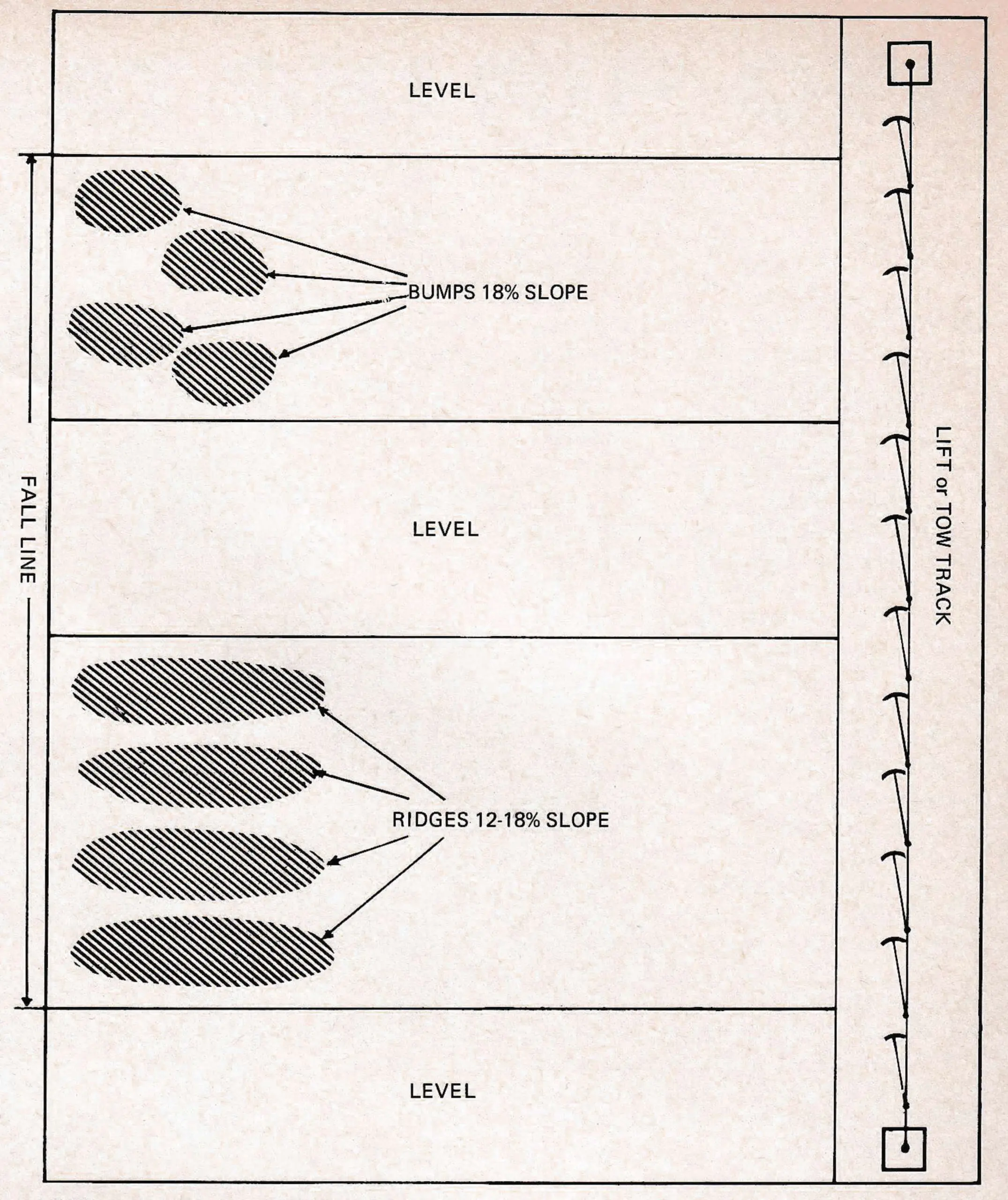
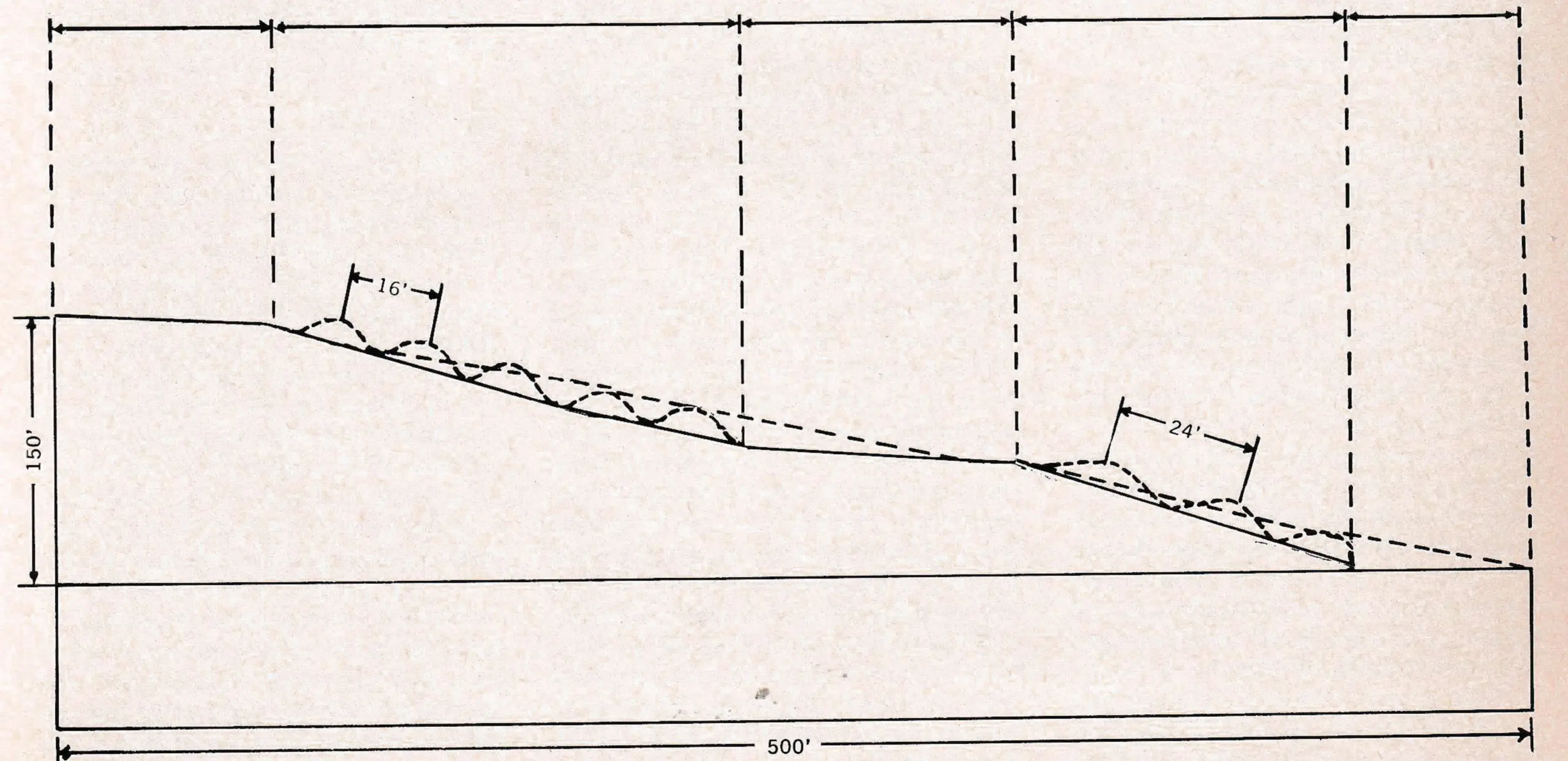
There should be a logical progression from gentle to steeper terrain with bumps and ridges on some sections of the hill. The progress should lead from skiing on a gentle slope which the student can climb up to a ride up the lift where the student can ski from a level area halfway up a slope down a hill of the same steepness as the first hill used. Then he can progress to a run down from the top of the hill over a steeper descent to the halfway level.
The snow surface should be as well-manicured as possible to allow for fast learning. In areas where snowmaking is available it should be used on this terrain to allow both for early-season skiing and to provide for continually good conditions.
Aggressive learning
Both the American Teaching Method (ATM), where students work from a wedge (small snowplow), and GLM, where the student starts with his skis parallel, require a terrain situation where the teacher’s method of teaching and the student’s method of learning can be aggressive.
Once past the initial stages of ski control, bumps and ridges in the slope surface teach the student to cope with the natural slope conditions that exist on the rest of the mountain. The bumps and ridges should be large enough to make the skier adjust his body in order to absorb them while skiing, a straight run down or across the slope. However, they should not be abrupt, sharp or large enough to throw the skier into the air under normal skiing conditions. It is best to construct the bumps and ridges solely out of snow. Artificially created mounds made with hay bales, tires, boxes, etc. provide the necessary ingredients for a lawsuit over foreign obstacles on the slope.
Bumps and ridges also provide aids in producing turns by promoting and continuing the turning of the skis once the turn has been initiated. This helps the new skier to see moguls as a positive part of skiing rather than insurmountable monsters all over the mountain.
Selecting a lift
The area operator has three alternatives in choosing a lift—rope, cable/bar or chairlift. But whichever lift or tow is used, the fact that real beginners will be using it should be the guideline in determining type, placement, operational personnel and methods. The loading, unloading and track areas must be well maintained, the personnel must understand the intended use of the lift and slope (for learning) and area management must be prepared to provide this care if the lift is to be a positive part of the teaching-learning sequence.
The ropetow is inexpensive, easy to install and hard as hell on the skier. Not only is the rope tow hard to hang on to; it sometimes raises havoc with clothing. Although they are high capacity and many of us learned to ski on slopes served by ropes, they don’t fulfill the purpose of a teaching-learning hill, which is to provide comfort, ease of learning and the atmosphere of an up-to-date area. In short, the ropetow is functional but not the best answer.
A chairlift is fine if it is: (1) low profile (many new skiers are afraid of being off the ground); (2) has a slow and variable rope speed; (3) has a very easy loading area; and (4), especially important, a very simple, safe, shallow exit. This almost demands bull wheel unloading. A chairlift is definitely more comfortable, permanent, but also more costly.
The cable/bar lifts in the form of cable/handles, T-bars, J-bars, and platterpulls offer the best solution. They are less expensive than aerial lifts, some are portable and some require only one operator. (Check your state aerial tramway safety code.)
To date the slow J-bar and cable/handle type lifts have shown the most promise. They are easy to ride, maintain and, by comparison, less expensive than most.
T-bars are relatively difficult for the beginning skier. Because the bar is designed for two, the single rider is forced to adjust for the absent rider, putting him off-center. This is especially true in the case of a tube-type T. In the spring loaded box/cable T-bar the T usually slants off to one side with one rider and tends to be quite unstable. Put two beginners on the same T-bar and the chances for problems are doubled.
Basically, however, all these considerations add up to the same thing—the skier’s total attention should be on moving his skis and enjoying himself. Then, after he has used all the areas of the teaching-learning hill successfully, he will be ready to progress to and enjoy other slopes and trails on the mountain.
Jon Putnam, a member of the executive committee of Professional Ski Instructors of America, is president of Recreation Specialists, Inc., a recreation management consulting firm in Franconia, N.H.