
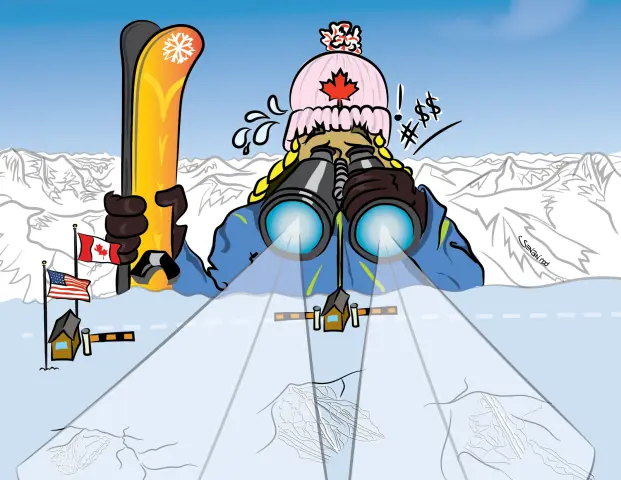

In an age where giant airliners are pirated with breathless ease it is hardly surprising that skis have become a target for the less enterprising thief. Figures from CNA Financial Corporation, underwriters of the USSA insurance program, show thefts of skis rose 22 per cent from 1969-70 to 1970-71 with the average value per pair up 15 per cent. And these figures are low. One Western police officer estimates ski theft has grown 50 to 75 per cent for each of the last 10 years. Add to this the fact that 61 per cent of the thefts occur at ski areas and you have substantial reason for growing area operator alarm.
How does it happen?
- A young woman broke her leg and was taken by the ski patrol to the local hospital. When she returned to the scene of the accident with her leg in a cast, her skis were gone.
- An instructor at an Eastern area carefully separated his skis before going in for lunch. Once he had disappeared, a thief who had watched the operation deftly collected the skis.
- A tour leader discovered his skis missing after he had stopped for coffee. And he found them again, too—they had been stolen by another leader on the same tour.
- At a large Eastern area an alert parking lot attendant noticed an unusually large number of skis being shuffled into a van. When the police investigated they discovered a complete workshop where bindings and serial numbers were removed before the skis even left the parking lot.
- A young man neglected to use his lock when he ran into the lodge at the end of the day to pick up his boots. Unfortunately that was time enough for someone to make off with his skis.
The list could go on indefinitely, but it would serve to make only one point—that there is no typical ski theft. The thief may be acting alone or as part of a ring; he will take one ski of a pair that has been separated, or carry off a pair—lock and all—from in front of the lodge; he may be selling them at a profit or just looking for a new pair for himself.
Method, however, is only incidental to the biggest problem: Who is responsible for the thefts and how can they be stopped?
Most often it is the skier himself who has been lax. The large majority of ski areas provide locking racks, but as all too many area operators woefully report, “Skiers just don’t use them. Even during the lunch hour the racks are half empty.” So, as it goes without saying that most thieves will steal the pair of skis that require the least amount of effort, skis are stolen despite the area’s precautions.
Unfortunately this has not served to mitigate the area’s responsibility. A skier who returns from lunch to find his skis missing is angry, and since he can’t find the thief he vents his anger on the area operator. Even if he is forced to admit his own negligence, the skier will think twice about coming back to the area where his skis were stolen, and he’s sure to tell his friends about it, too.
So by default the responsibility belongs to the areas. Unfortunately their efforts to prevent thefts to date have been largely ineffective. Typically, the area operator installs a few lockers wherever space is available, prays to God that the skier will use them and then calls the police after the horse is out of the barn. It just isn’t enough.
To begin with, calling the police is usually more of a symbolic action than a pragmatic one. The police will fill out an accident report and put the skis on a nationwide list of stolen property, and there’s a slight chance they can be recovered if—and it’s a big if—the skier has the serial numbers or has his name engraved on them. Occasionally, when it appears that there has been a ring at work, the police can set up a roadblock. But they can’t spot the thief who stuffed his old wooden skis in a snowbank and walked off with somebody else’s new fiberglass models.
Installing lockers and locked ski racks is a good beginning. But all too often it is just that—a beginning. The most obvious mistake is to install too few lockers. The rule of thumb suggested by the manufacturers is 5 to 10 per cent of the daily traffic. One sure sign that there are too few is when skiers take the key overnight to ensure their having a locker when they arrive in the morning. And the lockers must be maintained so that they are all in working order. Finally, and perhaps most important, the lockers must be put in the right place. According to Bill Cancilla, whose firm Ski Safe Inc. pioneered in the ski lock field in 1955, skiers want convenience, and areas that find their lockers aren’t being used probably have them in the wrong place. “Lockers for extra clothing and equipment should be where the skiers change,” he counsels. “Lockers to check skis during the lunch hour should be near the restaurant.”
Once adequate facilities have been installed, the public must be encouraged to use them. And it is here that most areas have fallen down in their efforts to prevent theft. They print a disclaimer on the back of the lift ticket and from there on in the skier is on his own. Unless the skiing public is made aware of its responsibility to discourage theft, the area’s effort will go unrewarded. It’s really a matter of consumer education.
Start by admitting that the problem exists and encourage the public to use some kind of lock or, at the very least, to split their skis. While the latter doesn’t guarantee that the skis won’t be stolen, it is a good deterrent. Remind the skier to keep the serial number—should the skis be recovered he’s going to need it to prove ownership. Tell him about the USSA insurance program which provides $250 coverage for an $8.25 premium.
There’s still no guarantee that there won’t be thefts at your area, but they can be drastically reduced. At Jay Peak, Vt., a determined management cut thefts by 75 per cent. Their program was simple. First maintenance on the lockers was increased—broken locks were repaired promptly and skis left in the day lockers for more than a few days were removed and taken to the Lost and Found. The police were notified when there seemed to be an undue number of thefts and roadblocks were set up. Often the stolen skis would be found stashed in a snowbank. Finally, announcements were made reminding skiers to protect their equipment.
At Great Gorge, N.J., after closed-circuit TV proved ineffective, the management rethought the problem and proceeded to fence in the base area. With every skier coming and going through the same entrance, aspiring ski thieves could no longer sneak away quite so easily.

At Alpine Meadows, Calif, frequent loudspeaker announcements were made reminding skiers to see that their equipment was safe. Next winter a sign is being posted by the ticket booth as well. As a further deterrent, off-duty police officers patrol the base area. Result: thefts are down.
If more areas had programs like these chances are ski theft wouldn’t be the problem it is. The big step is in admitting that the problem exists and communicating that awareness to the public. Skiers know enough not to leave the keys in their car when they park it, to keep their wallet in a zippered pocket, so it wouldn’t come as a shock to them that they must take similar care with their skis. After all, what’s the difference between leaving $200 in cash lying on the snow or a pair of $200-skis? Put it to the skier like that, give him a sufficient number of well-maintained locking facilities and chances are thefts will plummet.
Listed here are firms that sell, lease or concession ski-locking devices.
H & B Leasing, 2031 Bryant St., Denver, Colo. Standing or wall-mounted racks in units of 20; key and coin operated; supplied to area on a leasing basis; locking unit made in Switzerland, so keys cannot be duplicated.
Lockup Ski Security Systems, 15600 Industrial Pkwy, Cleveland, Ohio, 44135. Wood rack with metal locking bar or locking bar attached to wall; skier owns locking mechanism, an aluminum bracket to fit the locking pin and a padlock with five-pin cylinder; cost to area is $100 for a 36-position rack and 15 lock assemblies; individual locks retail for $6.
Price, Delivery and Quality Corp., 415 Belden Ave., Unit 15-0, Addison, Ill. 60101. Steel clip holds both skis and poles locked together in one unit, with either a key or combination lock; cable allows skier to attach unit to a fixed object; $5.95 retail.
Sentinel Automatic Lockers, Div. of Flexible Co., Loudonville, Ohio 44842. Coin operated lockers that accept from 1¢ to 75¢; holds up to two pairs of skis and poles; lockers come in baked enamel, partial or total stainless steel and range in price from $75-$140 each, wide range of sizes.
Ski-Safe, Inc., P.O. Box 2447, San Francisco, Calif. 94104. 10-unit coin and key operated rack, also made for wall or railing mount, $260 a unit; 16-unit circular, adjustable pole rack, coin and key operated, $395 a unit; kep operated rack in units of two; $18.50 per unit (good for use by area personnel or for private homes); coin and key-operated parcel lockers (made by American Locker, distributed solely by Ski Safe), best sizes are 14x15x21 inches at $44.50 and 12x18x12 inches at $36.50.
Ski Safe also leases racks and lockers and runs concessions.
Ski Valet, 2860 Spring Street, Redwood City, Calif. 94063. Each circular coin or key operated ski rack holds 10 pairs of skis and poles with a bar locking mechanism. The weatherproof racks are made of lightweight fiberglass and come in a variety of colors. Height is adjustable. Also available in a wall or pole mounted straight rack. All models available only on concession.