
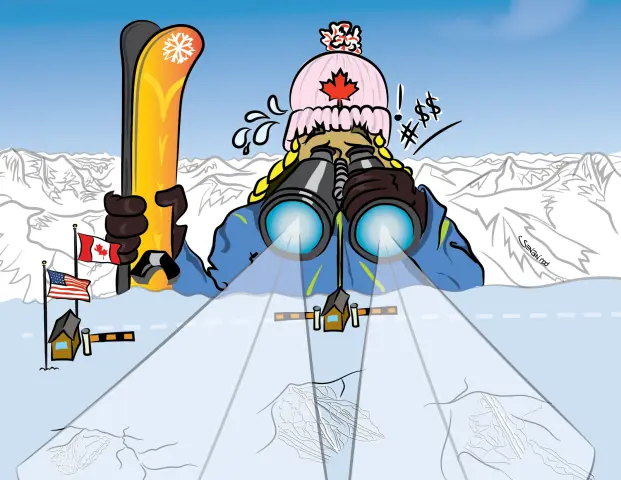

Recreation or Sport?
Occasionally, of course, figures produced by a study simply confirm conclusions already reached by less scientific means, most often by instinct. For example, most ski area operators had already suspected that the skier of today is considerably different than the skier of the 1950’s and drastically different than the skier of the 1940’s.
Just how different was pointed out in Farwell’s report on the ski market in the Northeast conducted for the ARA. Almost 20,000 individual interviews showed that approximately three of every five skiers questioned had been skiing less than five seasons. One in five was on skis for the first time during the year of the interview.
It is true that the interviews also showed that there remains a hard core group of skiers who have skied for at least 15 years, but this particular group appeared as less than 20 per cent of the total number interviewed.
This set of figures should have an unsettling effect on most ski area operators. What it indicates is that the average ski area or resort is depending for growth and profit on a huge proportion of newcomers . . . a market whose stability may be held in question. The millions of dollars spent on expansion and new areas was invested not in satisfying the so-called hard core, but in accommodating a mass of skiers whose habits indicate they may be largely only casually interested in skiing.
What this should also reveal to the ski area operator is that he is gradually swinging from the ski business to the business of recreation. The fine distinction here is that his competition is no longer confined to other ski areas and resorts, but to many other forms of recreation. The family of skiers he entertained last year may be not only weighing the merits of a return trip against the possibilities of a swing through Colorado or Vermont, but against a week in Palm Springs or a trip to the Bahamas.
The hard core of fanatics who were responsible for the early development of this modern era of skiing and were satisfied to find sleeping bag space and rope tow service have been engulfed, for better or for worse, by the newer skiers who actually are products of our own imaginations. These are the skiers who were wooed into the sport by fashion, glamor and resort-oriented advertising and promotion and, logically enough, demand the services and facilities they were led to believe were norms for the industry.
Drought, But Not Disaster
Accepting the fact that the Farwell report substantiated conclusions that most ski area operators had reached, there is a more recent example of the dangers of reaching conclusions based on little or no factual information.
The ski season in New England received nation-wide publicity as a disaster. Heading into the New York trade shows, manufacturers and importers were prepared for the worst.
Yet the buying was strong, registrations at both the SIA and Snow Shows were up. And hard on the heels of reports of the “disaster of the century,” more total ski business was written during the April 10-15 week in New York than any other week in history.
Basically, lack of reliable reports from New England during the season had produced a largely false picture of what actually took place. F. D. (Skip) Voorhees, in completing a report on the 1964-65 season in the East for Ski Business, reached three conclusions after post-season interviews with area operators and industry figures:
- A great deal of the negative thinking developed as a result of poor press and of statements from operators with a negative or defeatist approach.
- Operators who maintained flexible organizations, who were well financed and who had imaginative and affirmative approaches, largely overcame the “mid-season disaster.”
- Geographic location and ease of access were major controlling factors.
The failure of the industry to produce more accurate records of its day-to-day activity doesn’t mean, then, that the desire to do so doesn’t exist. Rather it indicates we still have a long way to go toward establishing a strong industry-wide structure capable of producing data vital to logical and strong growth.
Self-Help
One of the more encouraging examples of self-help in the ski industry was the organization of the National Ski Areas Association, now preparing for its third annual meeting June 11-12 at Mt. Snow, Vermont.
Like all similar organizations, the fact that it has a name, address and phone number tends to give the NSAA an identity of its own as a separate and living thing. Programs and accomplishments of NSAA are regarded as activities of NSAA when, realistically, they are accomplishments of the individuals working together under the single name, NSAA.
The happy fact here is that while there is no limit to the accomplishments of individuals with common goals working together, there is also no limit to the number of individuals who can pitch in and help.
Staff Changes
This is the point at which we would like to acknowledge internal changes at Ski Area Management. Primarily, this is to note the recent appointment of David Rowan as senior vice president of Universal Publishing and Distributing Corporation, publishers of Ski Magazine and Ski Business as well as Ski Area Management.
As the originator of Ski Area Management, the founder of the Clinics and Equipment Trade Shows and the first executive secretary of NSAA, we hope the ski area and resort operator will be encouraged by the fact that their point of view will be ably represented near the top in this country’s most ski-oriented publishing company.
As for Ski Area Management, the records show the addition of a new editor who is pleased to be working in a growing and increasingly more sophisticated ski area and resort field.