


Generally speaking, November means lean times for the ski area. The Fall foliage crowd has become satiated, the lifts are down for final pre-season maintenance and expensive crews and equipment are putting the area in shape for the coming winter. Revenue dollars can be counted on the fingers of one mitten.
Last November, however, 1,500 people were merrily skiing down the slope at Mt. Tom, Massachusetts. The ski school was going like crazy. The cafeteria was selling hamburgers as fast as the counter-man could turn them out. Miraculous? No. Freak weather? No. The secret was a mat made of polyvinyl chloride bristles that closely approximates the surface of snow.
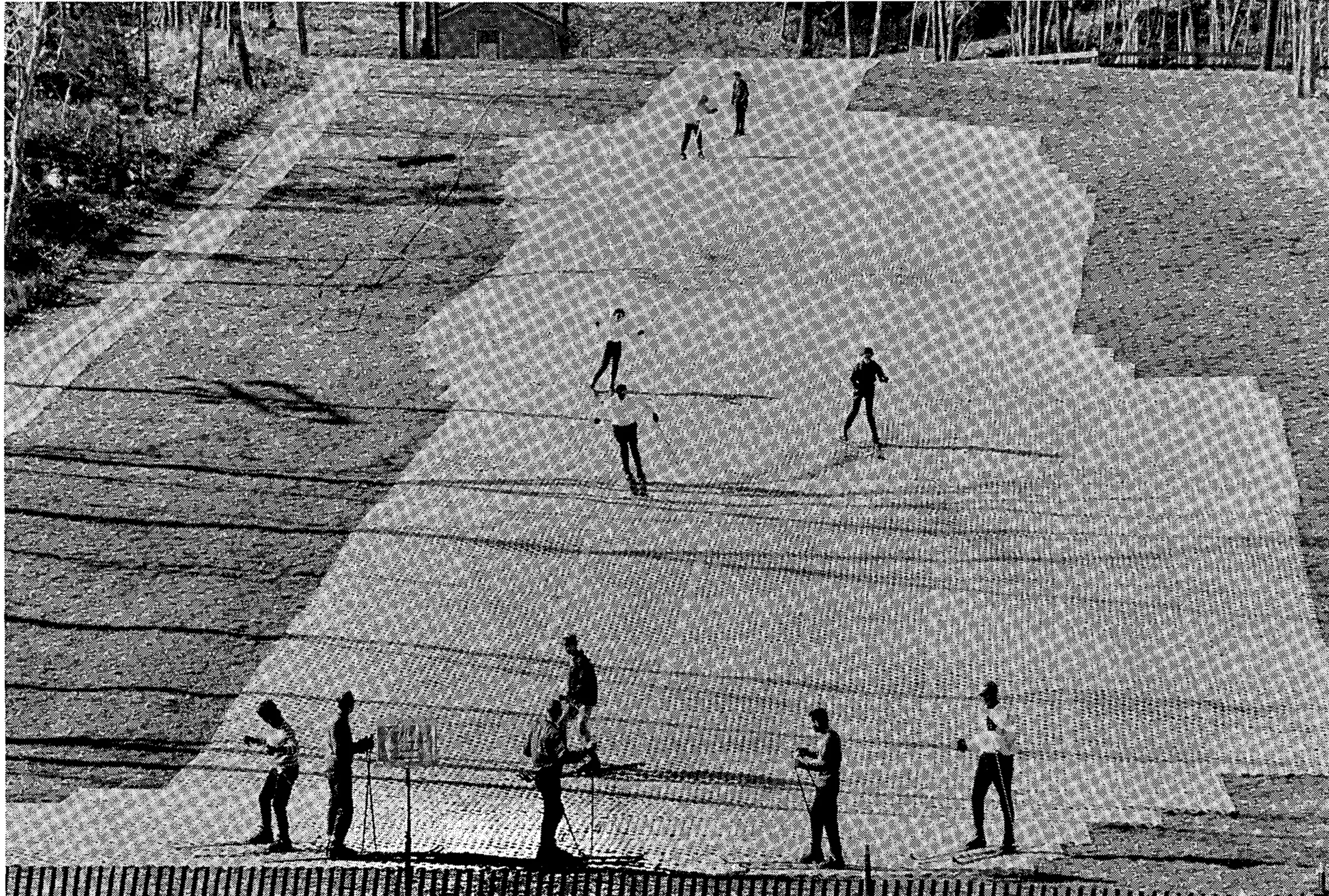
The story starts with the S. A. Felton Co., Manchester, New Hampshire, an affiliate of United Shoe Machinery Corporation. Felton had been appointed exclusive United States licensee by the Italian company that developed the mats and wanted to test its market potential in the U. S. They selected Mt. Tom because it is near a good sized city (Holyoke) and draws on a million-and-a-half population distribution in central Massachusetts. Cal Conniff, Mt. Tom’s manager, who is as promotion-minded as they come, agreed to try the stuff out and Mt. Tom became the first ski area in the U. S. to install the mats. In Europe they are commonly used for ski demonstrations, and there is a big recreational ski area in Japan that offers skiing on this surface.
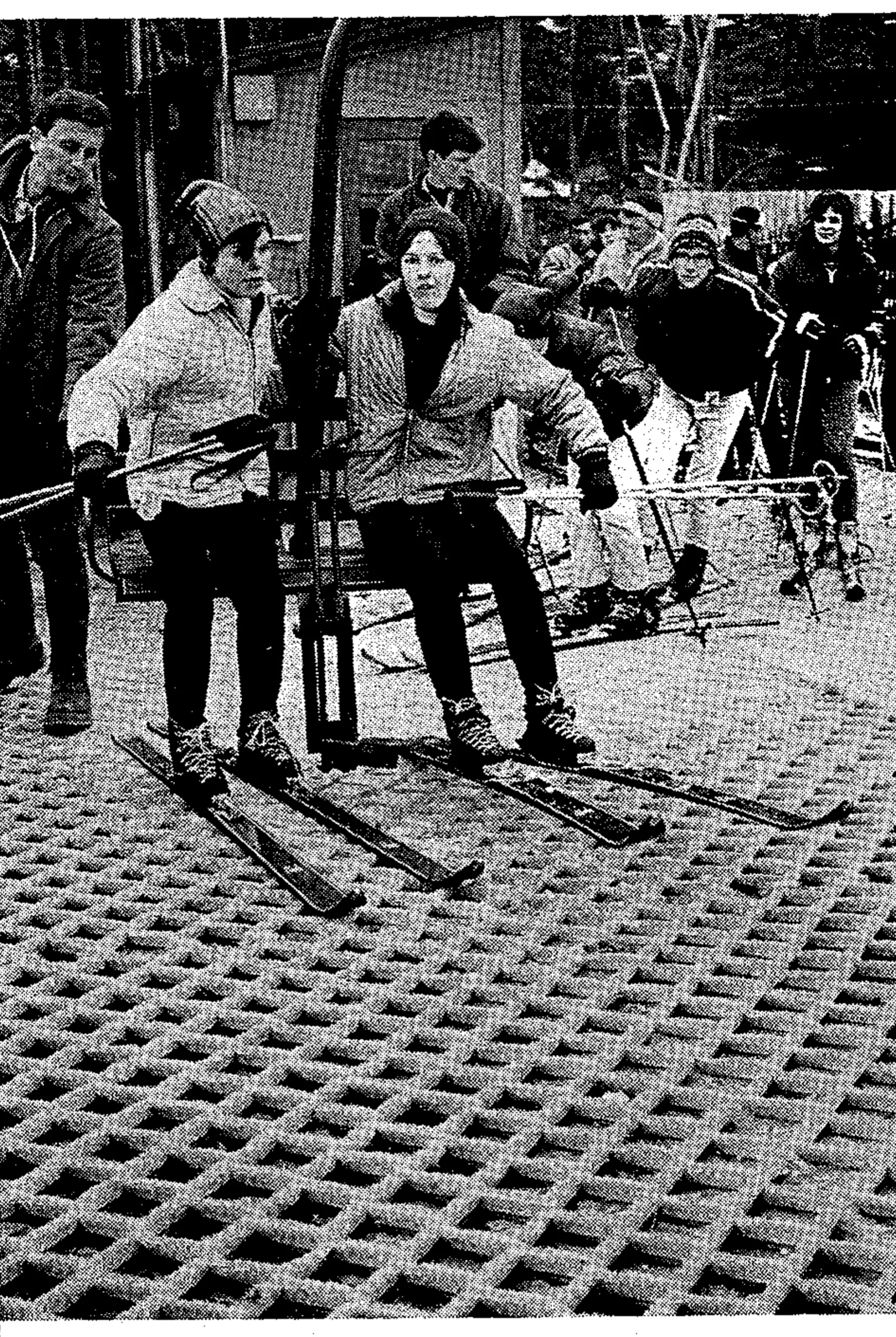
The mats, each measuring four-by-six feet and weighing 43 pounds, were installed to provide a ski slope 285 feet long, 75 to 100 feet wide, and with a 17 degree pitch. Additional sections were laid to provide a track for a T-bar. Penny Pitou and Egon Zimmermann were enlisted to launch the new slope. By the time the eastern press had exhausted the story possibilities, word had spread and the slope became a Mecca for the early-bird skier. Enthusiasts came from as far as New Hampshire and New York City to shake out their ski-legs and get the jump on the season.
The enthusiasm of the skiers was matched by the enthusiasm of Cal Conniff whose previous November gross was zero. Special lift tickets good for an hour-and-a-half of skiing on the mats were pegged at $3.50, with an extra $2.00 for a rented equipment package. Ski school director Stan Czernecki supervised the skiing and kept track of the tickets which were issued in different colors to differentiate between the hour-and-a-half sessions. Czernecki also did a land-office business in group lessons at $3.50 per hour-and-a-half and privates at $8.

By the third weekend in November, word of mouth had enticed 3,000 spectators to Mt. Tom, and the chairlift had been started up at $1.25 per ride. In addition, the crowds had put a bundle in the cafeteria’s till and forced the ski shop to hire extra help.
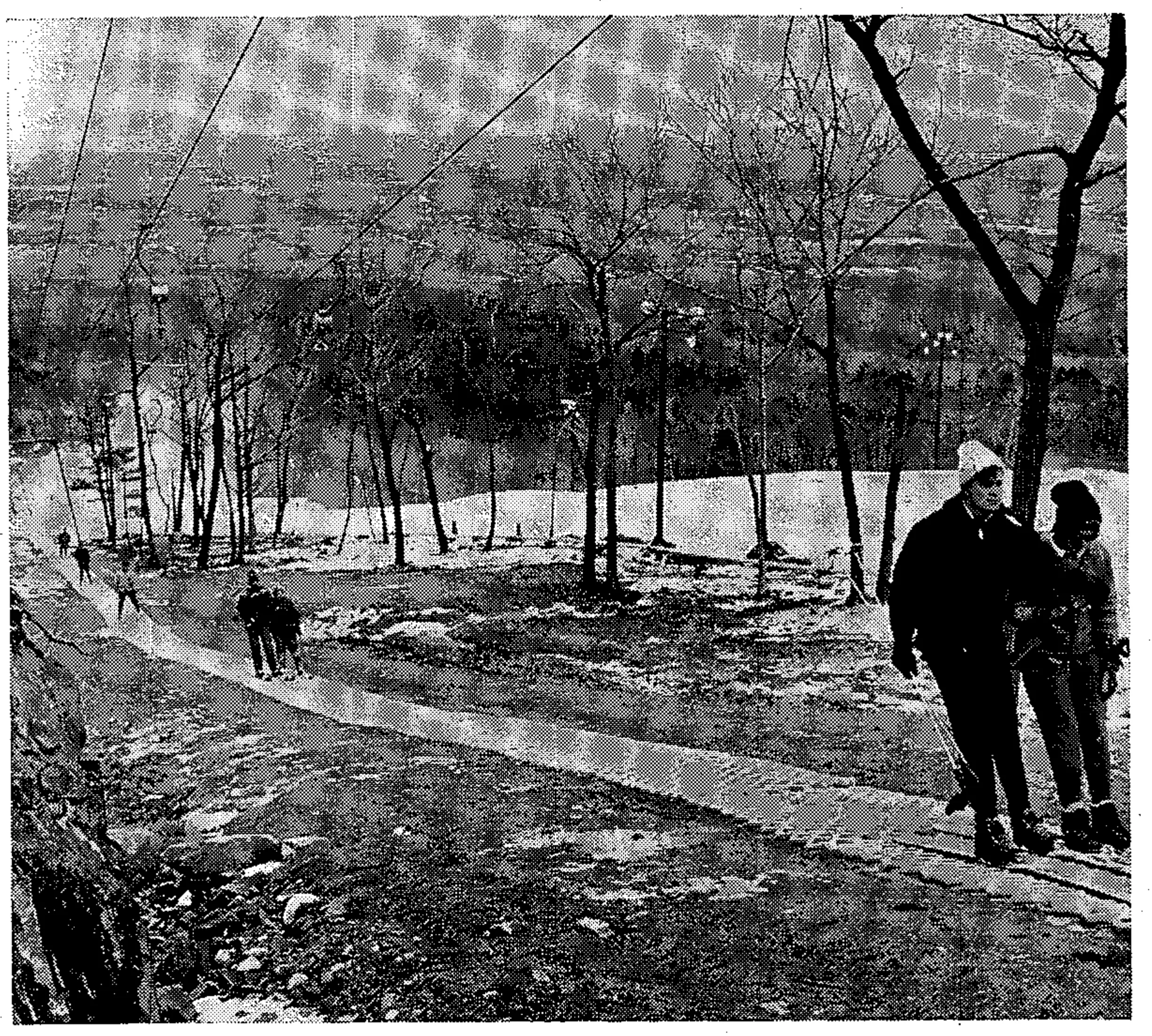
Ironically, it was during the actual ski season that the plastic mats proved even more valuable. As snowless day succeeded snowless day in the East, Mt. Tom used the mats around the terminal areas of the lifts and along surface drag lines, obviating the need for snowmaking in these areas. This enabled Conniff to concentrate his man-made snow system exclusively on trails—where it counted most.
Conniff figures that he was able to offer 12 days of skiing that might not have been available without the mats. He also reported that wherever the mats were in use, no labor was needed as in the past to shovel in snow and repair tracks scraped thin by the ascending skiers. (This was a maintenance procedure which previously had cost Mt. Tom up to $200 per week.) “Furthermore,” Conniff added, “in periods during a lack of natural snow, it costs about $250 a week to make enough snow to keep the lift lines in good shape. The man-hours and costs that can be saved by an area using mats in this way add up to real dollars.”
The mats themselves are constructed of inch-and-a-half long polyvinyl chloride bristles set in a non-oxidizing galvanized metal and arranged in a diamond pattern. The four-by-six foot sections are usually held in place by metal pins driven into the ground in much the same way as a railroad rail is held by a spike. However, since Mt. Tom has very little soil covering its bare rock slopes, Conniff was forced to wire his sections together to make the slope. Cost is $90 for each section in lots of 1 to 99; $72 each in lots of 100 to 499; and $65 each in lots of 500 or more. A Felton spokesman said that the price could be reduced as manufacturing reaches the mass-produced level. As of now, the mats are produced only on order.