

In one giant step, the ski industry in North America will have more than doubled the number of aerial tramways serving skiers on this continent before the 1965-66 ski season. By European standards, the number of new installations, three, would be considerably less than a giant stride. But considering there are only two skier-hauling jig-backs functioning today, one at Franconia, N. H., and the other at Heavenly Valley, Calif., the advance by our standards is monumental.
It is true that there are other jig-backs in service in North America. But of the total of eight, six are strictly tourist conveyors—Palm Springs, California; El Paso, Texas; Bridle Vail Falls, Utah; Estes Park, Colorado; Stone Mountain, Georgia, and Jasper National Park, Alberta.
The three new installations to be completed during the next six months, while counting heavily on tourist traffic in the summer, are basically ski resort installations. The first expected to be ready is at Jackson Hole, Wyoming. The second is at Sandia Peak near Albuquerque, N. M., and the third has a Dec. 1 completion date at Grouse Mountain, B. C.
Witnessing the installation of three major jig-backs in one summer after years of relative calm doesn’t necessarily mean that the resort business is in for a tramway stampede. But what it does mean is that few major resort developments will be making lift plans in the future without giving considerable consideration to a jig-back.
There are a number of obvious appeals to a jig-back and the first would have to be its tourist potential. The enclosed cabin and cabin size provides a greater feeling of security to the tourist. Although the average passenger may not realize it, the jig-back has a remarkably high safety record.
Another consideration is the basic appeal of a tramway as a promotional asset. As time marches on, the chairlift as the standard has become commonplace; it is a lesser form of uphill transportation which most skiers have come to accept.
But aside from tourist appeal and promotional values, there are more practical decisions to be made. First of all, to be economically feasible, the jig-back has to be built on suitable terrain. This would mean the longest possible spans and a minimum of towers, particularly break-over towers.
Where a gondola by safety standards is limited to the height above ground at any one point on the line, the jig-back has no such limitations. Evacuation is not as complicated as on a multi-cabin gondola lift. The cost of any jig-back is influenced largely by the number of towers necessary.
The Sandia Peak installation, a Bell, will have the longest unsupported span in the U. S. and the third longest in the world, 7,750 feet. There will be only two towers in the incline line length of 14,185 feet.
Both the Jackson Hole installation and the tram at Sandia have similar lengths, capacities and vertical rises, yet each is using a basically different construction approach. At Jackson, the backbone of the construction work is a work tram, which in itself is the largest tramway at any U. S. ski area. Sandia is relying primarily on helicopters.
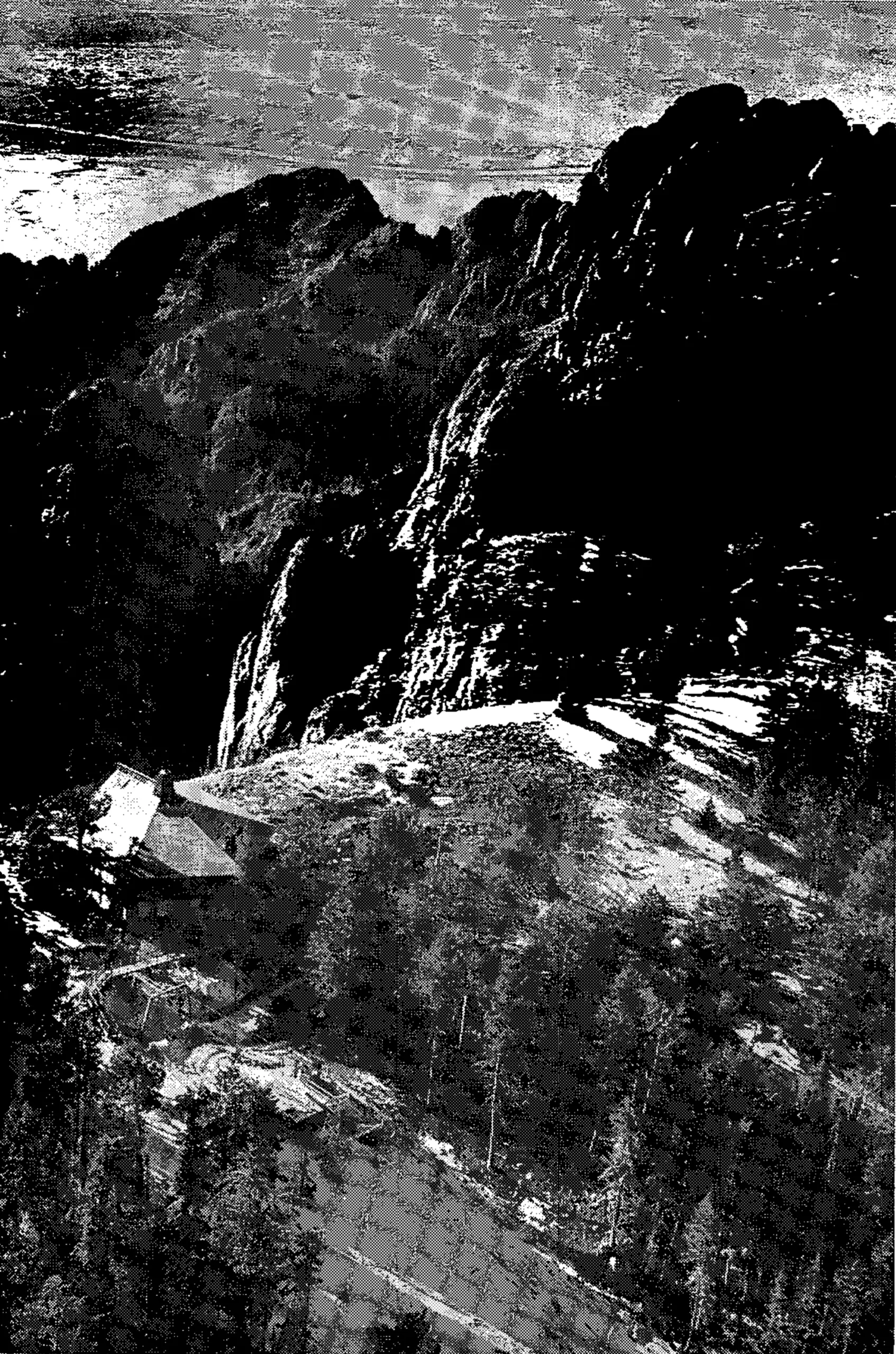
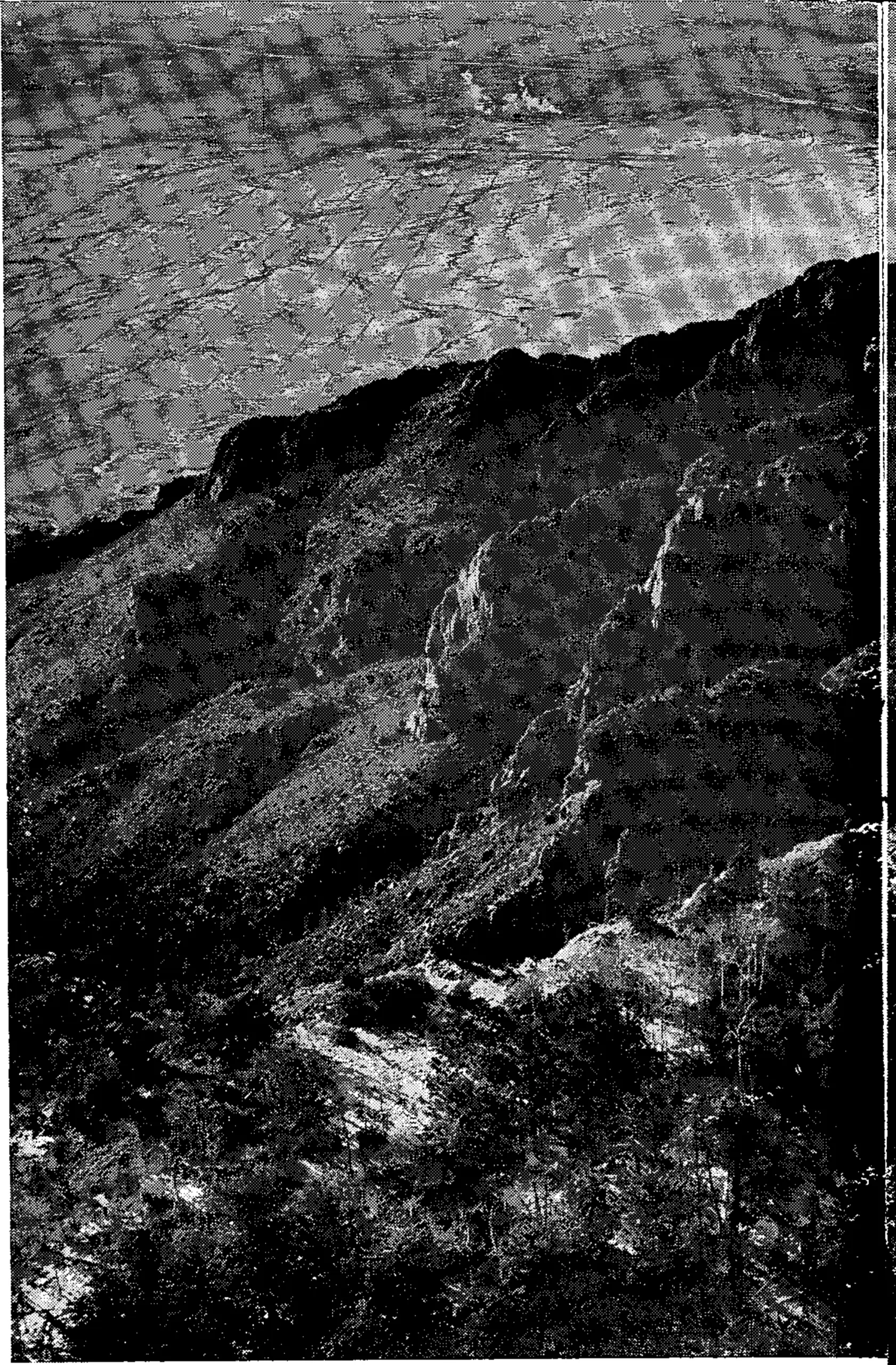
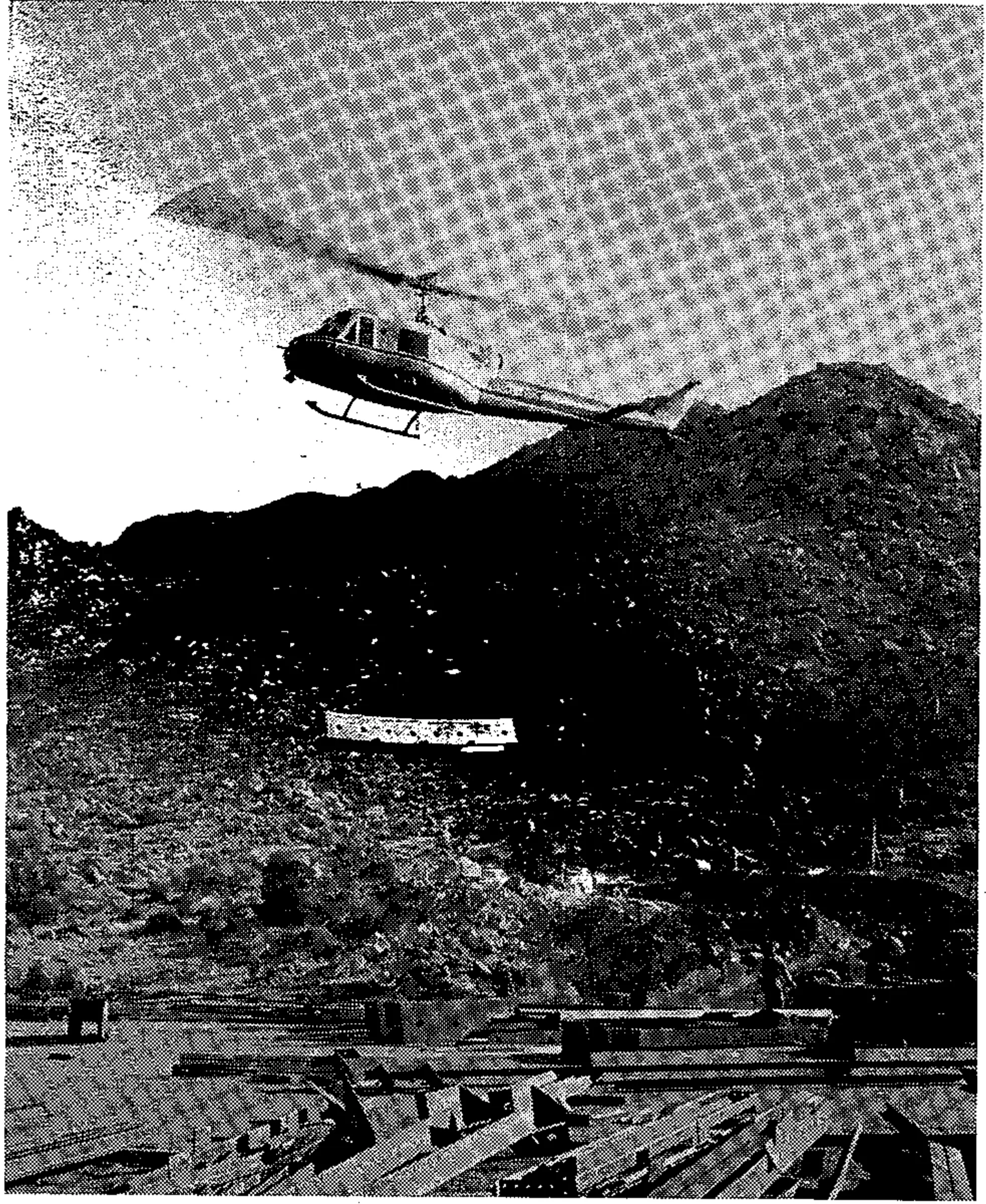 Jagged escarpment terrain over which Sandia Peak tram passes was a major factor in New Mexico resort’s decision to employ this type of lift. In distant background is Albuquerque suburb. Sandia is using helicopters as transportation workhorses in tower construction phase.
Dick Kent
There are a number of reasons why each is following the particular construction system that has been adopted. At Jackson, Willamette already owned a construction tram useable at the site, an obvious asset. But in addition, the Jackson Hole tramway will have at least five towers to pour while the helicopters need only lift concrete and steel for two towers in New Mexico. Also, the altitude at Jackson is greater, which means any helicopter would have greater weight and load restrictions in the thinner air.
Another basic consideration is the fact that the work tram can operate in all kinds of weather, which, in fact, the Jackson tram has done during the winter construction period just completed. Meanwhile, the weather in the Albuquerque area is generally milder and a higher percentage of flying days could be anticipated.
By installing a work tram at Jackson Hole, use of helicopters wasn’t necessarily precluded. Actually, the work tram itself was installed with helicopters. Steel and concrete work at individual towers will be handled by helicopter when practical.
The terrain itself was another influencing factor. Jackson Hole has no easy construction road to reach the top of the area. In fact, hauling materials in any quantity to the top of Jackson Hole by truck or snow vehicle would have been almost impossible. On the other hand, the upper terminal at Sandia Peak can be reached by road from the La Madera ski area. The upper terminal of La Madera’s chairlift and the tramway terminal are within a few yards of each other.
Once the installations have been completed, they have to be financially successful as well as technically perfect. All three tramways have a strong summer potential that has already been proven.
Grouse Mountain habitually does as much business during July and August as it does during the balance of the year, thanks to what is almost an in-town location and an appealing view of the harbor and the city of Vancouver. Jackson Hole regularly is flooded with about a million-and-a-half summer visitors and the local Snow King ski area chairlift has done a booming summer tourist ride business for a number of years. At Sandia Peak, the estimates on traffic stand at 334,000 customers per year for the first five years, then a jump is expected in 1971 to 554,000 per year.
The Grouse Mountain expansion plan, costing an estimated $1.5 million, also includes beefing up an existing chairlift from 750 to 1,200 per hour capacity. Two more chairs and additional T-bars are under consideration.
Just how much of an impact this Continent’s sudden plunge into the jig-back business will have on the future development plans at other major resorts remains to be seen, but it is certain that the curious will be given ample opportunity to draw their own conclusions.
| Jackson Hole | Sandia Peak | Grouse Mtn. | |
|---|---|---|---|
| Length (Incline)* | 12,556 | 14,185 | 5,200 |
| Vertical Rise | 4,135 | 3,819 | 2,750 |
| Cabin Capacity | 63 | 57 | 50 |
| Capacity per Hour (Each Direction) | 375 | 300 | 600 |
| Maximum Speed (Designed Maximum) | 2000 ft./min. | 1600 ft./min. | 2000 ft./min. |
| Manufacturer | Willamette Renton, Wash. | Bell Switzerland | Voest Ropeways Linz, Austria |
Why Snowmass Chose Chairs
By John Henry Auran
In the competition among ski areas for recognition and prestige, there has been a constant and costly escalation in the quality of uphill transportation. Less than a decade ago, the installation of any sizeable overhead cable lift was a major event. Today, it takes a gondola or an aerial tramway to achieve similar impact on an increasingly blasé ski population.

At least, so a great deal of current management thinking goes.
A strong dissenting voice to this concept in uphill transportation is that of the Aspen Skiing Corporation (Aspen Mountain, Buttermilk), which recently decided to speed up the timetable for its 10,000-acre Snowmass area so that it would be in “limited operation” by the 1966-67 season instead of a year later as originally planned.
If ever there was a case for a luxury lift, Snowmass would appear to be it. Not only will it be serving a luxury-oriented clientele, but from a technical point of view, there’s much that could be said for some sort of cabin lift for the three-mile ride to the top.
Yet, at least in the initial phases, Snowmass will be serviced by five double chairlifts—four of them scheduled for the “limited operation” opening in late fall of 1966.
A gondola or a tramway was not ruled out arbitrarily. To the contrary, the possibility of using one or the other was weighed carefully for two years before it was decided to stay with chairlifts.
A variety of factors went into the decision, but basically the very reasons for accelerating the program in the first place also swung the decision in favor of chairlifts—namely a rapidly growing need for additional capacity. In less than two years, Aspen has increased its business by 75 per cent (probably something of a record for an established area) and there appears to be no immediate end in sight to the spectacular boom. About 800 commercial beds were built in Aspen last summer and an additional 1000 beds are to be built this summer. Since in Aspen’s case there is a very direct relationship between lodging capacity and crowds on the mountains it became clear that present facilities on Aspen Mountain and Buttermilk may soon be inadequate.
The need for additional lift and trail capacity (the latter is probably the most underrated factor in area design) and the nature of the Snowmass terrain ruled out the one-big-lift approach.
“The only real justification for either a gondola or a tramway at this point would be for prestige,” Snowmass manager Jim Snobble said. “And that’s an expensive way to buy prestige.”
If both trail and lift capacity are the objectives, simple arithmetic favors the chairlift since no other uphill device surpasses it in hourly capacity. A gondola adequate to serve Snowmass would cost at least $400,000 and probably more, an aerial tramway from $800,000 to $1 million. In contrast, a 7000-foot chairlift costs about $150,000.
Based on these rough figures, the Aspen Skiing Corporation currently estimates that it can get Snowmass into operation with a beginners’ chairlift and three major chairs, snow vehicles, trails and a mountain-top restaurant for something over $1 million. Half of this amount will be spent for the installation and fabrication of the lifts.
If a gondola were substituted for two of the lifts in tandem to Sam’s Knob, not only would lift costs rise from something over $500,000 to about $700,000, but the hourly capacity of the lift/trail system would also be reduced (see “What is your Capacity—Lift Capacity, That Is” in the Winter 1964 issue of S.A.M.) by a substantial margin. If an aerial tramway were used, lift costs would rise to more than $1 million and many of the same problems with capacity would be encountered.
But beyond capital costs, there were other considerations, not all of which apply equally to gondolas and aerial tramways.
High labor and maintenance costs weighed heavily in deciding against a gondola. Aspen runs its chairlifts with an average of three operators, the actual number running from two to five, depending on the type and location of the lift. A gondola requires a minimum of six, more during peak operation. Equally important, compared with a chairlift and its fixed cable grips, the gondola’s derailing mechanism and its cable grips are relatively complex, requiring intensive maintenance and high level supervision. Yet actual per-hour capacity is lower than that of a chairlift, despite higher cable speeds.
Because the most modern aerial jig-back tramways are highly efficient in terms of operating and maintenance costs, such an installation was seriously considered. However, in running the lift to the Sam’s Knob location, it would have required about five massive towers, which not only add substantially to the capital costs, but would have negated many of the maintenance advantages of this kind of lift.
While a number of area experts have been critical of the Aspen Skiing Corporation’s conservative approach to lift building, they nevertheless find it difficult to dispute the popularity of the corporation’s existing areas (Aspen Mountain and Buttermilk) or the consistent financial success arising out of it.
The corporation has not ruled out a cabin lift either in the later phases of the Snowmass development (the East Alpine area is more suitable for aerial tramway application) or as a replacement for its No. 1 single chair on Aspen Mountain. But when it is installed, it will have passed successfully through the kind of hard-headed pencil work outlined above.