
“Robert Wilkinson” visited a number of ski areas in the Pocono Mountains of Pennsylvania last season. As a “staff editor of Ski magazine, he charged equipment and clothing purchases, lodging and lift tickets as well as cashed personal checks. As the bills were denied by Ski’s accountants and the checks bounced, the ski areas checked “Wilkinson’s status and found that they had been had. Ski has no editor named Wilkinson.
Meantime, flushed with success, “Wilkinson” moved into Vermont, but was stopped by stiffer credit policies as well as a tougher attitude toward the ski press. Eventually “Wilkinson” disappeared leaving behind some wiser, but poorer, small-size areas in the Poconos, and several smug, but justifiably cautious, larger areas in Vermont.
The Wilkinson case points up the fact that there are no hard and fast rules about ski area press policies. A ski area handles its press relations depending largely on how many requests and how much attention it normally receives, coupled with what “courtesies” management feels it ought to offer the press. It is your mountain, and obviously, you are entitled to give as many tickets, lunches, cocktails and beds in a lodge or condominium as you feel will be productive in terms of publicity return.
Obviously too, it is not good business to roll out the red carpet for any casual passerby who claims some relationship with the print or broadcast media. That doesn’t mean you shouldn’t extend any courtesies to anyone. It just means that you ought to be selective “comping” rooms, giving tickets to a writer or broadcaster who comes with an entourage in tow and so on.
The first distinction a ski area has to make is between press people on assignment, legitimate press people just coming through and marginal press people in terms of ski coverage. If there’s any area where it makes sense to pull out all stops, it is for representatives of an important medium who are on assignment to cover your area. That’s the time to break a management staffer or knowledgeable ski instructor loose to ski with the reporter, or photographer, to spend some time over lunch and perhaps to spring for a room. I’m not suggesting that freebies are “bribes” which will “guarantee” a good review. It’s just that showing hospitality and answering a reporter’s questions means that your area will be presented in the most favorable light.
Identifying press on assignment is usually quite easy, for if a major story is involved, you will get a call in advance to set up a mutually convenient time. Writers who ski certainly want to get out on your mountain, but they also want questions answered about policies, plans and personalities at your ski area.
On the other hand, as soon as the snow is on the ground, many areas find a stream of writers, broadcasters and photographers appearing at the doorstep. And, they often don’t have an assignment; just would like to get on the hill and look around. They usually don’t ask for much: a lift ticket or two and an offer “to get out of your way so you can do some work.”
Here’s where you have to do some serious sorting out of people from the local or regional media who might be useful as opposed to those who will never do anything for you — writers and photographers who are published regularly as opposed to those whose credit lines never appear anywhere. Clearly, you don’t want to antagonize someone legitimate, nor do you want to parcel out tickets to people who will never cover your area.
You have to be your own judge when it comes to non-ski, non-travel, non-sports staffers from nearby newspapers and radio stations, but for people from farther afield, there is some pre-screening which should prove useful. There is a nationwide band of ski press organizations, under the umbrella of the U.S. Ski Writers’ Association, to which most people who regularly write about skiing belong.
The biggest of the six regional organizations — the Eastern Ski Writers’ Association — has more than 100 Active Press members, nearly a hundred Associate Press members and dozens of Commercial members, who are mainly ski area public relations people.
A journalist who produces an ESWA Active Press card is the individual at his or her newspaper or radio station with primary responsibility for ski coverage, full-time ski publication staffers, selected TV staffers and freelancers who devote comparable attention to skiing. An Associate Press card means the individuals are frequent contributors on skiing but do not qualify for Active membership.
ESWA’s outgoing president Janet Nelson says that, “One of the primary functions of ESWA is as a licensing organization. We go through elaborate qualification reviews where we ask applicants to prove that they are already writing or broadcasting, not just planning to. In addition, we annually review about 30 members to make sure that they are still fulfilling ESWA requirements. We bump down in category or out of the organization those who no longer qualify.”
As a result of ESWA’s controls, most eastern ski areas honor an ESWA Active or Associate Press card for a comp lift ticket. Many areas also give a day ticket to the member and his or her spouse or traveling companion. Some areas give tickets to accompanying children, but as Eastern’s Phillip C. Camp says, “skiing is not a tribal privilege. The press should not expect free tickets for the whole family.”
Paul Pepe, the outside p.r. counsel who has functioned for years as Hunter Mountain’s publicity director, is a pragmatist about the hangers-on. “If a legitimate writer wants to bring relatives, I’m open. If a story sounds plausible, or if it’s an important editor who can control what is printed, we’re pretty open. The most glaring abuses are those who show up with fake credentials. People from obscure radio stations and newspapers were once a problem too, and we used to get ripped off. About three years ago, we instituted a new policy that cleaned up 90 per cent of the problem. The only people who get lift tickets at the desk are members of ESWA, holders of New York City press passes and holders of Season Press Passes issued by me. Anyone else who wants them has to contact me first. No exceptions. I know it’s a judgmental decision, and I make if. I don’t leave it to ticket sellers. We’re a big popular area, and we assume that there are still a few people who put one over on us. But we figure there may be a hundred rip-offs during a season, not a thousand.”
Season passes for special media people are a solution for ski valleys ranging from Waterville in New Hampshire to Heavenly in California. These passes can be turned in for day tickets anytime a holder visits the area, can be redeemed for a regular season pass with picture or are redeemable for a ski-week ticket any time during the season. Some Colorado ski areas honor only Colorado/Ski Country U.S.A. identification.
Beyond the relatively simple matter of lift tickets is that matter of other goodies like lodging. For many ski areas, especially small ones, it’s no problem because there is no lodging to be considered. Some ski areas which have the space and are actively promoting condo developments specifically invite the press to come and stay as well as ski. When Gene McMasters took over as general manager of Windham Mountain, N.Y., at the beginning of last season, he specifically set aside one unit for visiting firemen and urged the press to come for a weekend.
Copper Mountain, which is building its image as a destination resort, invited selected writers to stay at the area for a few days if they were coming Colorado way. And nearby Keystone, which wanted to communicate the fact that it is a multi-sport resort, comped numerous press people and VIPs when it hosted the 1977 Ladies’ World Speed Skating Championship last February.
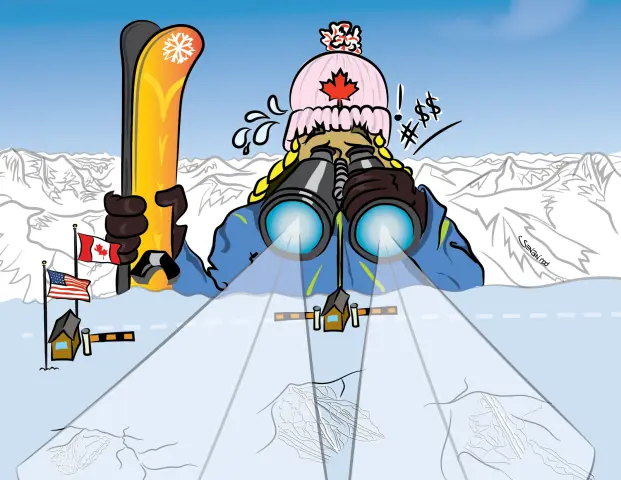
With increasing prices for ski weeks, the risk and challenge of press impersonation has gained. Last season, be side the case of “Wilkinson” described above, several western resorts were approached by photographers and broadcasters applying for anything they could get.
In another incident, an imposter posed as ski writer L. Dana Gatlin and called Wildcat, N.H., and Glen Ellen, Vt., asking for a complimentary room and lift tickets for his “nephew.” Stan Judge at Wildcat listened to the tale, as told by a voice with a New York accent rather than Dana’s New England tones, and said, “You’re not Dana.”
The impersonator got a little closer at Glen Ellen. President Harvey Clifford was “surprised” that ethical Dana Gatlin would make such a request and agreed on lift tickets, but not accommodations. When the area called Gatlin to check on the story, the writer suggested playing along to try to catch the imposter. If that happened, Gatlin offered to come up and testify, but the “nephew” never showed up.
All these impersonators melted away with the spring thaw, but if this is a trend, it can be guaranteed to surface in seasons to come.
No one will argue about a ski area’s right to set whatever guidelines it chooses to provide for ski press, but there are some definite comments that can be made about the way an area goes about communicating them — even to legitimate press.
Ski Magazine’s travel editor and ski-guide author Abby Rand visited a northwestern area famous for its late-season skiing. “We walked in and the manager came up to me and the photographer and said, ‘We have no rooms.’ Not even, ‘Hello,we have no rooms.’ All we wanted to do was to take pictures of the mountain!”
Diana Hunt, a freelance ski and travel writer, had a similar experience earlier last season. She introduced herself to the manager of a Colorado ski area and was greeted with a lecture about how unfairly the eastern press had been treating the western snow drought. “You do nothing but write about the fact that we have no skiing,” he said, “and you come here for lift tickets.”
Most large ski areas, however, have pretty decent day-to-day relationships with the press, and the best of the smaller mountains take equal pains to cultivate press in the markets from which their business comes.
Major ski competitions sometimes strain an area’s ability to do everything for everyone. Besides cordoning off the run where a race or freestyle event will take place, the ski area has to equip a press room with phones, typewriters and other paraphernalia, produce start sheets and results sheets, set up photo facilities and sometimes even accommodate the demands of TV and film crews.
“When we had the World Cup in 1971,” says Scott McCrea of Copper Mountain, “our own press was fine. The only ones who gave us trouble were the foreign press people. We couldn’t do enough to satisfy them. One big shot even demanded his own press room to work in.”
In short, in normal activities, a ski area should create and stick to policies about what to do for the press. Carrying press identification does not automatically entitle an individual to anything for nothing at a ski area, and professionals do not expect that it does. By the same token, giving a complimentary ticket or accommodations is no guarantee of press coverage, favorable or otherwise, and professional ski area publicists do not expect that it should be.
. . .And now for the bad news!
Trade-offs are soon forgotten when a hard news story strikes, such as a lift accident or other calamity. This past season, following a lift roll-back, one eastern area had “no comment” for everyone. A few years ago when a lift fell, killing one passenger, the area’s telephone was removed from the hook.
This can be quickly contrasted to the manner in which Vail Associates handled the tragic 1976 gondola accident which made national headlines. Publicity Manager Pam Conklin was cooperative and candid about the accident, the rescue operations, the casualty count and all the other sad reports from the fatal accident.
If anyone stepped out of line at Vail, it was the press which in some cases even interfered with the rescue operations. At one point, a press helicopter flew so close to the gondola cable, which still held cars full of people awaiting evacuation, that more lives were needlessly endangered.
John Christie relates another hard lesson in handling bad news which occurred when he was manager of Mount Snow, Vt. The resort had hired stunt skier Ruedi Wyrsch, who had also signed on to promote a revolutionary binding called the Inertia-B. It was on Mount Snow’s slopes, before a churning film camera, that Ruedi broke his leg on the binding.
The Inertia-B people asked Mount Snow to bury the cause of Ruedi’s cast, which management agreed to do. They issued a release indicating that Wyrsch had been injured falling on a patch of ice.
As Christie stated in his apologia at an ESWA meeting before an angry ski press group, “Ruedi’s accident didn’t happen in a closet. People saw it, and of course, our bad judgment was found out.” He explained, but did not seek to excuse, the decision to cover up the accident by saying that “we did not want to be responsible for the premature end to a binding concept which, once the bugs that caused Ruedi to break his leg were ironed out, might be a very good product.” Like John F. Kennedy after the Bay of Pigs, Christie took the blame for a crucial error and thus vindicated himself in the eyes of the media with whom he had previously enjoyed a good relationship.
Claire Walter is a former managing editor of both SAM and Ski magazines. She currently is a freelance writer and also handles ski and travel public relations.